
How I’d Use the Matrice 400 to Monitor Remote Fields When th
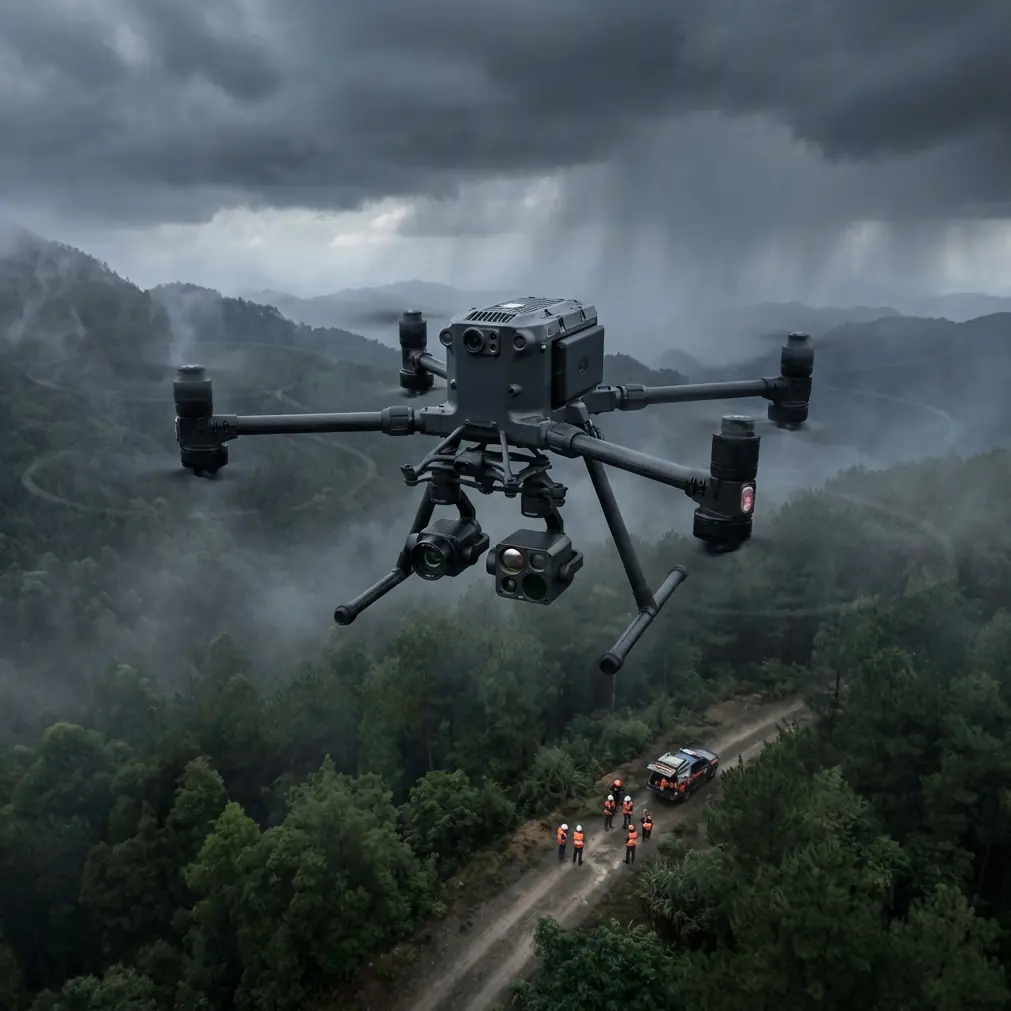
How I’d Use the Matrice 400 to Monitor Remote Fields When the Weather Turns Mid-Flight
META: A field-tested look at using Matrice 400 for remote agricultural monitoring, with practical insight on thermal control, fault isolation, O3 transmission, AES-256, hot-swap batteries, and reliable data capture in changing weather.
Remote field monitoring sounds simple until the job gets real. You launch at sunrise for crop health checks, drainage review, and thermal anomaly detection. By the second battery cycle, the wind shifts, the light hardens, and a line of unstable weather starts moving across the far boundary. That is where aircraft choice stops being a spec-sheet exercise.
For operators looking at the Matrice 400 for agricultural and land monitoring work, the most useful conversation is not “how far can it go” or “what payload can it lift” in isolation. The better question is this: how does the platform behave when several things go wrong at once, yet the mission still needs usable data?
That is the lens I use for remote field operations.
I’m drawing here not from marketing claims, but from two reference themes in civil aircraft design: fire-safe system design under fault conditions, and aerodynamic drag behavior around underside geometry. At first glance, those sound distant from daily drone work. They are not. They go directly to whether a large UAV remains dependable over isolated farmland when weather changes mid-flight, power systems heat up, and payload performance must stay stable enough for mapping and thermal interpretation.
Start with the mission, not the drone
A remote-field monitoring sortie usually combines several objectives in one window:
- photogrammetry for plant-count or drainage models
- thermal signature analysis for irrigation leaks, stressed crop zones, or livestock water-point checks
- visual inspection of fence lines, access roads, and erosion points
- repeatable data collection against prior GCP-based survey baselines
The Matrice 400 fits this kind of work best when treated as a systems platform. Its value is not only in flight endurance or payload flexibility. It is in how the aircraft supports continuity: long transmission links via O3, protected data handling with AES-256, and operational flow features such as hot-swap batteries that reduce downtime between flight blocks.
On a remote property, those details matter more than they do near a paved launch site. If the field team has driven two hours to reach the edge of a large growing area, every re-launch delay costs daylight, labor, and often weather margin.
The hidden issue in remote agriculture: heat, faults, and fire prevention
One of the most overlooked truths in UAV operations is that agricultural flight is often conducted around conditions that stress onboard systems: high ambient temperatures, dust, extended power draw, and repeated payload use. Add a long-range transmission workload and a heavy imaging stack, and thermal management stops being background engineering.
The reference material on civil aircraft design is unusually clear on this point. In flammable fluid zones, equipment surface temperatures must be tightly controlled. The source gives hard limits such as 200°C in fuel zones, 370°C in polyester oil zones, and 400°C in phosphate ester hydraulic oil zones. It also states that even under serious fault conditions, installed equipment must not become an ignition source, and that fault spread should be contained through proper isolation.
Now, a Matrice 400 flying over crops is not a crewed aircraft with the same internal zoning. But the operational lesson transfers cleanly: robust aircraft are designed so that a single fault does not cascade into a broader safety event. For a field operator, that translates into confidence when flying extended monitoring legs far from the takeoff point.
Why does this matter in practice?
Because remote monitoring often means you cannot immediately recover the aircraft if a subsystem degrades. If a drone encounters elevated internal temperatures, electrical instability, or weather-driven power fluctuations over the far side of a property, the design philosophy behind heat dissipation and fault isolation becomes the difference between a recoverable event and a mission-ending one.
That same source also stresses that systems, assemblies, and components should be appropriately isolated to prevent a fault from spreading. For large UAV operations, that principle is more than engineering trivia. It affects real-world trust. When I evaluate whether a platform belongs in routine remote-field work, I want evidence of disciplined system separation, controlled heat behavior, and protection against fault escalation. Without that, all the transmission range and sensor quality in the world are secondary.
What changed mid-flight: a realistic field scenario
Let’s put the Matrice 400 into a realistic agricultural mission.
The task is to monitor remote fields after uneven irrigation. You are collecting RGB imagery for photogrammetry and thermal data to identify temperature irregularities that may signal blocked emitters or saturated ground. Ground control points are already placed from a previous survey, so the objective is clean repeatability rather than exploratory flying.
The first part of the mission goes smoothly. O3 transmission gives you a stable live link from a launch site set well back from the target area. AES-256 matters here too, especially for large commercial farms that treat operational data as sensitive. Field boundaries, water usage patterns, and seasonal crop health maps are business intelligence. Protecting downlink and stored transmission data is not a luxury.
Then the weather shifts.
Cloud cover rolls in faster than expected. Surface wind changes direction, and the thermal contrast you were relying on starts to flatten in some rows while intensifying around water-retaining zones. This is exactly where the Matrice 400 becomes useful not because it prevents weather from changing, but because it lets the pilot adapt without collapsing the workflow.
A robust link matters first. When conditions degrade, stable transmission is no longer about convenience. It is about maintaining situational awareness while deciding whether to tighten the grid, switch altitude, prioritize thermal passes, or return early with partial but still valuable data.
Battery workflow matters next. With hot-swap batteries, the aircraft can be turned around quickly for a revised second sortie while preserving mission tempo. In agriculture, that can mean the difference between capturing the cooler post-front window and missing it entirely. A lot of crop diagnostics depend on timing. Weather does not wait for slow ground procedures.
Aerodynamics are not abstract when the underside carries the job
The second reference source is rough and partially corrupted, but it points to a very specific aerodynamic topic: drag characteristics and bottom pressure behavior around underside shapes, including a mention tied to a “shell-like” or contoured bottom form and a “bottom pressure coefficient” diagram.
That sounds academic. In field UAV work, it is not.
Large multirotor monitoring platforms often carry payloads, mounts, and structural features below the main body. The aerodynamics around the underside affect more than efficiency. They influence stability in gusts, flow disturbance around sensors, and the aircraft’s ability to hold a clean path during mapping.
For photogrammetry, stable geometry is everything. If your platform gets knocked around by shifting wind or underside flow disturbances, image overlap, angle consistency, and model quality can degrade. The problem gets worse when you are trying to compare this week’s dataset against prior GCP-referenced outputs. Small inconsistencies in flight behavior can ripple into larger interpretation errors.
The aerodynamic reference matters because it reminds us that underside design changes pressure distribution and drag behavior. Operationally, that means a well-managed underbody is not only about reducing resistance. It supports cleaner sensor performance and more predictable aircraft response when conditions become uneven.
In a remote agricultural mission, especially one involving thermal signature work, this has a direct payoff. Thermal analysis is sensitive to angle, altitude, atmospheric change, and timing. If the aircraft remains composed through light gust transitions, the data is simply easier to trust.
How I would structure a Matrice 400 field workflow
For teams planning remote monitoring with the Matrice 400, I would use a process like this.
1. Build the mission around two data priorities
Do not try to collect everything at maximum resolution in one pass. Decide whether the day’s primary output is photogrammetry or thermal interpretation.
If thermal is the priority, fly the most time-sensitive thermal blocks first, because changing cloud conditions can alter contrast quickly. If photogrammetry is primary, protect overlap and route consistency before chasing edge-case anomalies.
2. Use GCPs where comparison over time matters
For remote fields, GCP-supported repeatability still earns its place. If the goal is to compare drainage change, crop stand density, or erosion progression across multiple flights, grounded reference beats guesswork. The Matrice 400 is most effective when its aircraft stability and payload capability are paired with disciplined survey control.
3. Treat transmission reliability as part of data quality
Operators often separate link performance from mapping quality. That is a mistake. With O3 transmission, the benefit is not merely reach. It is decision continuity. When weather shifts, a stable control and viewing link lets the pilot preserve the best sections of the mission rather than aborting blindly.
4. Plan battery turnover as a weather strategy
Hot-swap batteries are especially useful in field monitoring because weather windows often open and close in short bursts. Fast turnaround lets you split a mission intelligently: one sortie for baseline RGB, a second for thermal follow-up once the atmosphere changes.
5. Keep thermal behavior in mind during long operations
The civil aircraft reference’s temperature thresholds—200°C, 232°C, 370°C, and 400°C in different fluid-related zones—serve as a reminder that heat management under fault conditions is a foundational safety discipline. In drone terms, long-duration remote operations should be planned with the same seriousness: monitor system health, avoid stacking unnecessary thermal load, and respect environmental stress before it becomes operational instability.
6. Assume fault containment matters
The source’s guidance on isolating systems to prevent fault spread is operationally significant for any large UAV deployed far from immediate recovery access. In plain terms: if one thing goes wrong, the aircraft should give the crew a manageable problem, not a chain reaction. That is exactly the standard remote agriculture operators should expect from a serious platform.
Why this matters more for remote fields than for easier jobs
A short inspection near home base can hide weaknesses. Remote agriculture exposes them.
You notice them when the aircraft must stay productive across multiple launches. You notice them when weather shifts midway through a grid. You notice them when thermal interpretation depends on preserving a narrow timing window. And you definitely notice them when a transmission link, battery workflow, or onboard stability issue forces you to come home with half a dataset.
That is why my assessment of the Matrice 400 for remote field monitoring comes down to one word: resilience.
Not resilience in a vague sense. Specific resilience.
- Resilience in communication, through O3 link stability
- Resilience in data handling, through AES-256 for sensitive farm intelligence
- Resilience in sortie pacing, through hot-swap battery workflow
- Resilience in data capture, through stable support for photogrammetry and thermal signature missions
- Resilience in aircraft philosophy, where heat control and fault isolation are treated as real design priorities rather than afterthoughts
If you are planning a remote-field operation and want to talk through payload pairing, GCP workflow, or BVLOS-ready mission structure, you can message our flight planning desk here.
My final take on the Matrice 400 for this use case
The Matrice 400 makes sense for remote monitoring when the mission cannot depend on perfect conditions. That is the real threshold. Plenty of aircraft look capable on a calm day over a simple block. Fewer hold their value when the wind shifts, the light changes, and the pilot has to rescue the mission without compromising safety or data integrity.
The best reading of the reference material is that dependable aircraft are built around disciplined containment: control heat, prevent ignition, isolate failures, and respect how aerodynamic surfaces affect behavior under load. Applied to the Matrice 400, those principles help explain why a serious operator would choose a robust platform for remote agriculture rather than a lighter aircraft pushed beyond its comfort zone.
For monitoring fields in remote areas, that is the standard that matters. Not hype. Not headline specs. The ability to come back with usable, trustworthy data when the day does not go according to plan.
Ready for your own Matrice 400? Contact our team for expert consultation.