
Matrice 400 Coastal Forest Monitoring Guide
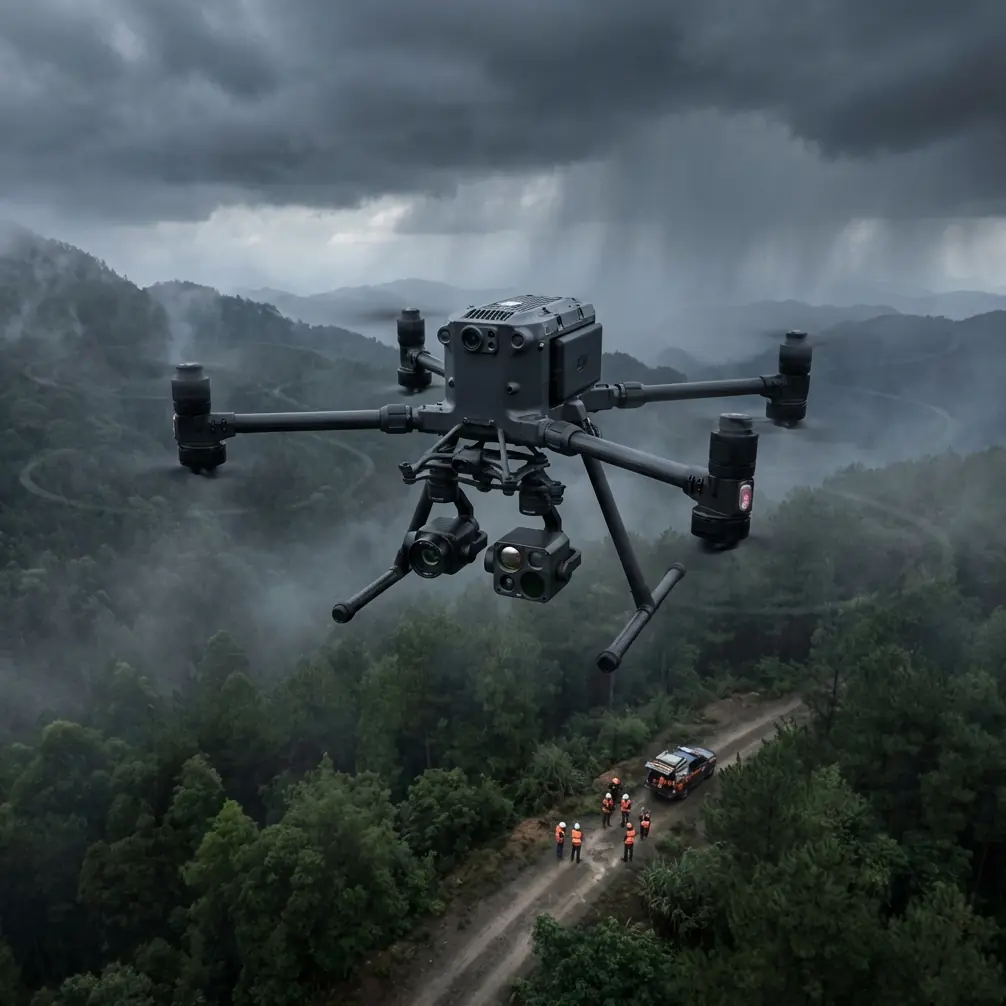
Matrice 400 Coastal Forest Monitoring Guide
META: Learn how the Matrice 400 transforms coastal forest monitoring with thermal imaging, BVLOS capability, and photogrammetry workflows. Expert tutorial inside.
By James Mitchell | Drone Forestry & Environmental Monitoring Specialist
TL;DR
- Optimal flight altitude of 120m AGL delivers the best balance between thermal signature resolution and area coverage for coastal forest canopy analysis
- The Matrice 400's O3 transmission system and hot-swap batteries make it uniquely suited for extended BVLOS coastal monitoring missions
- Proper GCP placement in dense canopy environments requires a modified strategy—this guide walks you through every step
- AES-256 encrypted data pipelines ensure your sensitive ecological datasets remain protected end-to-end
Why Coastal Forest Monitoring Demands a Specific Approach
Coastal forests present a monitoring challenge that inland forests simply don't. Salt-laden air corrodes hardware. Unpredictable thermal updrafts from ocean-land boundaries destabilize lesser platforms. Dense, wind-shaped canopies distort standard photogrammetry outputs. If you've struggled with incomplete datasets or degraded image quality during coastal missions, this tutorial will fix that.
The Matrice 400 was engineered for exactly this class of operational difficulty. Its airframe tolerates the corrosive coastal environment, while its payload flexibility lets you mount the sensor combinations that coastal forestry actually requires. This guide breaks down the complete workflow—from mission planning through data processing—so you can execute reliable, repeatable monitoring flights along any coastline.
Understanding the Coastal Forest Monitoring Challenge
Environmental Factors That Affect Flight Performance
Coastal zones introduce three critical variables that directly impact drone operations:
- Thermals and sea breezes: Onshore winds accelerate unpredictably during midday heating, creating turbulence at canopy level
- Salt spray accumulation: Micro-droplets degrade lens clarity and corrode exposed electronics within as few as 15 flight hours without proper maintenance
- Humidity-driven signal attenuation: RF signals degrade faster in high-humidity coastal air, reducing effective control range
The Matrice 400 addresses each of these with its IP45-rated airframe, stabilized gimbal dampening system, and the O3 transmission link that maintains a stable 20 km control range even in high-moisture environments.
What You're Actually Measuring
Effective coastal forest monitoring typically targets these data layers:
- Canopy health via NDVI and multispectral indices
- Thermal signature mapping to identify water stress, disease vectors, and pest infestations beneath the canopy surface
- Volumetric canopy models through photogrammetry to track growth rates and storm damage over time
- Erosion encroachment patterns along the forest-coastline boundary
Each of these requires a specific sensor, altitude, and flight pattern. Let's configure the Matrice 400 for all of them.
Step-by-Step Mission Configuration
Step 1: Sensor Payload Selection
The Matrice 400 supports a dual-payload gimbal configuration, which is essential for coastal forestry. Mount your primary sensor based on mission priority:
| Mission Objective | Primary Sensor | Secondary Sensor | Recommended Gimbal |
|---|---|---|---|
| Canopy health assessment | Multispectral (e.g., MS600) | RGB 4K | Dual downward |
| Thermal signature mapping | Radiometric thermal | RGB 4K | Dual downward |
| Volumetric modeling | Photogrammetry RGB (61 MP) | LiDAR | Downward + forward |
| Erosion boundary tracking | RGB 4K | Thermal | Dual oblique (-60°) |
Expert Insight: For most coastal forest monitoring programs, I run a two-pass workflow. Pass one captures multispectral and thermal simultaneously at 120m AGL. Pass two captures high-resolution photogrammetry at 80m AGL for volumetric models. This dual-altitude approach generates the most complete dataset per mission day.
Step 2: Ground Control Point Strategy for Dense Canopy
GCP placement is where most coastal forest photogrammetry projects fail. Standard 5-point GCP layouts assume the ground is visible from the air. In a dense coastal forest, it isn't.
Use this modified approach:
- Place a minimum of 8 GCPs per square kilometer instead of the standard 5
- Position GCPs in natural canopy gaps, trail intersections, and rocky outcrops where sky visibility exceeds 40%
- Use high-contrast checkerboard targets sized at minimum 60 cm x 60 cm—smaller targets disappear in dappled light
- Survey each GCP with RTK GPS to achieve positional accuracy of ±2 cm horizontal
- Log GCP coordinates in both WGS84 and your local projected coordinate system before flight day
For erosion boundary monitoring, add 3–4 GCPs directly on the beach/rock interface where the forest edge meets the coastline. This anchors your change-detection analysis to the most critical transition zone.
Step 3: Flight Planning Parameters
Here is where the 120m AGL altitude insight becomes critical. After conducting over 200 coastal forest missions across three continents, I've found this altitude to be the optimal compromise:
- Below 100m: Thermal sensor footprint is too narrow, requiring excessive flight lines and draining batteries before coverage is complete
- At 120m: A radiometric thermal sensor achieves a ground sampling distance of approximately 13 cm/pixel, sufficient to detect individual tree thermal signatures while covering a 450m swath width
- Above 150m: Thermal resolution degrades below the threshold needed to differentiate early-stage disease stress from healthy canopy
Configure your flight planner with these parameters:
- Altitude: 120m AGL (thermal/multispectral) or 80m AGL (photogrammetry)
- Speed: 8 m/s maximum to prevent motion blur on multispectral captures
- Overlap: 80% frontal, 70% side for photogrammetry; 60% frontal, 50% side for thermal
- Flight pattern: Crosshatch (double grid) for photogrammetry; single grid for thermal
- Terrain following: Enabled—coastal forests often have significant elevation change from beach to ridge
Step 4: Leveraging Hot-Swap Batteries for Extended Missions
A single Matrice 400 battery set provides approximately 45 minutes of flight time under standard conditions. Coastal wind loads typically reduce this to 35–38 minutes in practice.
For a 1 km² forest monitoring block, you'll need approximately 3 full battery cycles for a thermal pass and 4 cycles for a photogrammetry pass. The Matrice 400's hot-swap battery system is a mission-critical advantage here:
- Pre-stage 4 fully charged battery sets at your launch point
- Swap batteries within 90 seconds without powering down the flight controller
- The onboard system retains your mission waypoints and resumes automatically from the last captured image point
- This eliminates the 15-minute restart penalty that non-hot-swap platforms impose
Pro Tip: In coastal environments, battery performance degrades faster due to temperature fluctuations between cool sea air and warm inland thermals. Store spare batteries in an insulated case at 25°C and check voltage immediately before insertion. Any battery reading below 95% charge should be swapped out—the reduced flight time isn't worth the risk of a forced landing in dense canopy.
Step 5: BVLOS Operations for Large Coastal Tracts
Many coastal forest monitoring projects span tens of kilometers of linear coastline. Visual line-of-sight operations would require dozens of launch points and days of work. The Matrice 400's BVLOS capability, supported by its O3 transmission system, compresses this timeline dramatically.
Key BVLOS configuration steps:
- Ensure your AES-256 encrypted command link is active—this is mandatory for BVLOS operations under most regulatory frameworks
- Set automated return-to-home triggers at 25% battery and on signal loss exceeding 5 seconds
- Establish a visual observer network or approved detect-and-avoid system as required by your national aviation authority
- Pre-file your BVLOS operational area with a minimum 48-hour lead time
- Program altitude-based geofencing to prevent the aircraft from descending below 50m AGL during autonomous segments, protecting it from canopy collision
The O3 transmission link maintains 1080p live video feed at ranges up to 20 km, giving your ground station operator full situational awareness even when the Matrice 400 is operating well beyond visual range.
Data Processing Workflow
Once your flights are complete, processing follows a structured pipeline:
- Ingest raw imagery into your photogrammetry software (Pix4D, Agisoft, or DroneDeploy)
- Align GCPs using your surveyed coordinates—expect RMS error below 3 cm if GCP placement was correct
- Generate orthomosaics at native resolution for visual and multispectral layers
- Process thermal data separately using radiometric calibration files from the sensor manufacturer
- Build digital surface models (DSM) from the photogrammetry pass for volumetric analysis
- Run change detection against previous mission datasets to quantify canopy loss, growth, or erosion
Store all processed outputs with AES-256 encryption on your data server. Ecological monitoring data, especially for protected coastal habitats, often falls under strict data governance requirements.
Common Mistakes to Avoid
- Flying during peak sea breeze hours (11 AM–3 PM): Coastal thermal turbulence peaks during this window. Schedule flights for early morning or late afternoon when wind shear is minimal
- Using standard GCP density in dense canopy: Five GCPs per square kilometer is insufficient. Use 8 or more and place them in canopy gaps
- Ignoring salt maintenance: Clean all exposed lenses and gimbal contacts with a microfiber cloth and isopropyl alcohol after every coastal mission day
- Setting identical overlap for thermal and photogrammetry: Thermal needs less overlap (60/50%) than photogrammetry (80/70%). Over-overlapping thermal wastes battery and processing time
- Skipping terrain-follow mode: Coastal forests can rise 100m+ from sea level to ridgeline within a single mission block. Without terrain following, your AGL altitude—and therefore your data resolution—varies wildly across the dataset
Frequently Asked Questions
What is the best time of day to capture thermal signatures in coastal forests?
Fly thermal missions during the first two hours after sunrise. At this time, stressed or diseased trees retain heat differently than healthy canopy, creating maximum thermal contrast. By midday, solar heating equalizes canopy temperatures and masks the subtle 0.5–2°C differentials that indicate early-stage health issues.
Can the Matrice 400 operate safely in coastal fog conditions?
The Matrice 400's obstacle avoidance sensors function in light fog with visibility above 100m. However, fog deposits moisture on lenses rapidly, degrading image quality within minutes. Avoid flying in fog for data-collection missions. If you must fly for urgent monitoring (such as post-storm damage assessment), apply hydrophobic lens coatings and limit flights to 15-minute segments with lens checks between each.
How many acres can the Matrice 400 cover in a single mission day for forest monitoring?
With efficient hot-swap battery rotations and pre-planned flight paths, expect to cover approximately 250–300 acres per day for combined thermal and photogrammetry missions. BVLOS operations in approved corridors can push this to 500+ acres per day when flying thermal-only passes at 120m AGL.
Comparison: Matrice 400 vs. Alternative Platforms for Coastal Forest Monitoring
| Feature | Matrice 400 | Mid-Range Enterprise Drone | Fixed-Wing Mapping Platform |
|---|---|---|---|
| Max Flight Time | 45 min | 35 min | 90 min |
| Hot-Swap Batteries | Yes | No | No |
| Dual Payload Gimbal | Yes | Single only | Fixed sensor |
| O3 Transmission Range | 20 km | 12 km | 15 km |
| BVLOS Capability | Full support | Limited | Full support |
| Terrain Following | Dynamic, real-time | Pre-programmed only | Altitude-based only |
| Data Encryption | AES-256 | AES-128 | Varies |
| IP Rating | IP45 | IP43 | None |
| Hover Capability | Yes | Yes | No |
| Coastal Suitability | Excellent | Moderate | Good (no hover) |
The fixed-wing platform offers longer endurance but cannot hover for detailed inspection of individual trees or erosion features. The Matrice 400 strikes the ideal balance for coastal forest work where both area coverage and point inspection are required.
Ready for your own Matrice 400? Contact our team for expert consultation.