
Matrice 400 Best Practices for Forest Monitoring in Extreme
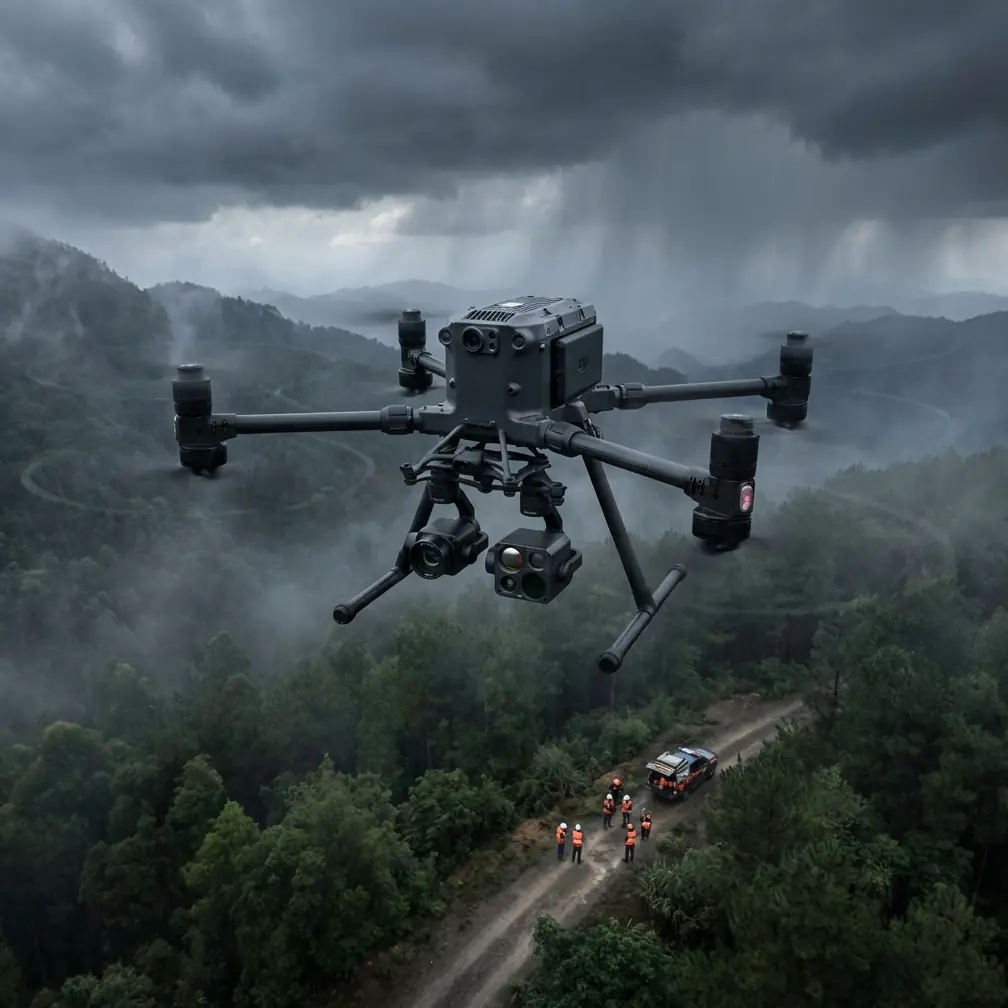
Matrice 400 Best Practices for Forest Monitoring in Extreme Temperatures
META: Expert tutorial on using the Matrice 400 for forest monitoring in extreme heat and cold, covering thermal workflows, EMI mitigation, O3 transmission, hot-swap batteries, BVLOS planning, and photogrammetry accuracy.
Forest monitoring gets difficult fast when the weather stops cooperating. Dense canopy, shifting light, long flight corridors, weak visual contrast, cold-soaked batteries, and summer heat buildup all stack risk into what looks simple on paper. The Matrice 400 enters that environment as a serious working aircraft, but the airframe alone does not solve the mission. What matters is how you configure it, how you manage thermal and mapping payload logic, and how you adapt when the forest itself starts interfering with the link.
This tutorial is built around one specific operating scenario: monitoring forests in extreme temperatures with a Matrice 400. Not generic drone flying. Not broad platform marketing. A field-ready workflow shaped by the realities of thermal signature interpretation, photogrammetry quality control, battery continuity, and signal discipline when electromagnetic interference starts degrading confidence.
I approach this as a practical sequence. If your job involves forest health surveys, wildfire recovery assessment, wildlife habitat observation, drainage corridor review, or timber stand documentation, the same core principles apply.
Start with the mission, not the aircraft
Forest operations usually split into two very different data problems.
The first is thermal detection. You may be looking for stressed vegetation, hotspots after a burn event, water movement under canopy gaps, or temperature anomalies around infrastructure crossing forest land. In these cases, the thermal signature matters more than visual beauty. You care about repeatability, contrast, and whether environmental conditions are masking what you need to see.
The second is spatial reconstruction. That means orthomosaics, canopy edge models, access road documentation, slope change review, and broader photogrammetry outputs. Here, image overlap, flight consistency, and ground control discipline become the deciding factors.
The Matrice 400 is most useful when you stop treating those as interchangeable jobs. A thermal sortie and a photogrammetry sortie may happen on the same day, but they should not be flown as if they have the same tolerances.
Extreme temperature changes everything
Cold and heat alter more than endurance. They change sensor behavior, power management, pilot judgment, and even how useful the collected data becomes.
In hot conditions, thermal imagery can flatten out because the forest floor, deadwood, exposed rock, and man-made objects all absorb and release heat differently. A hotspot that is obvious at dawn may disappear into the background by mid-afternoon. If you are using the Matrice 400 to isolate thermal anomalies, the best operational decision is often to shift the mission window rather than force the sensor to work against the environment.
In severe cold, the opposite problem appears. Batteries lose effective performance, warm-up periods matter more, and abrupt power drops become a planning issue rather than a rare exception. This is where hot-swap batteries become operationally significant. They are not just convenient on paper. In a forest mission far from a paved launch site, hot-swapping reduces downtime between flights, helps preserve workflow continuity, and keeps your mission cadence stable when daylight or weather windows are narrow. For repeated corridor passes or staged thermal checks, that continuity protects data consistency.
The practical lesson is simple: build your sortie plan around temperature behavior, not just around battery percentages or estimated route length.
Use thermal deliberately, not passively
A lot of crews carry thermal payloads but never really develop a thermal workflow. That wastes one of the most valuable capabilities in forest operations.
Thermal data is strongest when you define what anomaly you expect before takeoff. Are you searching for retained heat in smoldering debris? Moisture differences near drainage lines? Heat stress patterns in vegetation? Animal disturbance near forest edges? Each target creates a different threshold for altitude, speed, and timing.
The phrase thermal signature is often used too loosely. In practice, it means the recognizable temperature pattern of a feature relative to its surroundings. In forests, that relative context is unstable. Wind shifts, shadows move, tree density changes, and mixed terrain creates false positives. On the Matrice 400, the smart move is to run thermal passes with enough route discipline that you can compare sections consistently instead of reacting live to every bright spot on screen.
If your objective is hotspot verification after a fire event or during forestry recovery work, fly slower than you think you need to. Give the sensor time to stabilize on the area of interest. In cold environments, also allow equipment acclimatization before trusting the first thermal readings. A rushed launch can produce imagery that is technically captured but operationally misleading.
Photogrammetry still wins the long-term documentation job
Thermal helps you identify where to investigate. Photogrammetry helps you prove what changed.
For forest monitoring, this matters whenever you need repeatable baselines over time. Erosion around service roads, storm damage progression, canopy loss, invasive spread along edges, and replanting success all benefit from structured visual mapping. The Matrice 400 becomes especially useful here when paired with disciplined overlap planning and GCP strategy.
Ground control points are not glamorous, but they are often the difference between a map that is visually impressive and one that is defensible. Under forest conditions, edge zones, clearings, access tracks, and logging decks are usually the most practical areas for GCP placement. Inside dense canopy, expecting clean visual reference acquisition is often unrealistic. The right approach is to tie the accessible open sections well, then let your flight design support the rest.
Operationally, GCPs matter because forest projects often become comparison projects. A map generated today may be used against another dataset months later after heat stress, flood damage, pest spread, or selective clearing. If geospatial consistency drifts, your trend analysis becomes shaky. The Matrice 400 can carry the mission load, but your accuracy still depends on disciplined field setup.
BVLOS planning is about structure, not bravado
Large forest blocks tempt operators into loose planning. The area is wide, the site is remote, and the route looks straightforward. That is exactly when teams get casual.
If your operation is conducted under a lawful BVLOS framework, the Matrice 400 should be treated as a platform that rewards planning depth. Remote forestry routes bring terrain shielding, changing vegetation height, sparse landing options, and limited visual references. You do not solve those constraints by trusting the aircraft blindly. You solve them by segmenting routes, identifying communication risk zones, and pre-defining decision points for return, reroute, or alternate recovery.
This is where O3 transmission becomes operationally relevant. A robust transmission system supports long-range situational awareness, but forest operations rarely fail in open-sky conditions. They fail near ridgelines, under canopy adjacency, or around industrial edge zones where interference and obstruction combine. In other words, link quality is not a headline feature. It is a mission variable you actively manage.
If your team is moving into complex forest corridors and wants to compare route setups or payload combinations before deployment, a quick field discussion can save a lot of trial and error; you can reach out directly here via mission planning chat.
Handling electromagnetic interference with antenna adjustment
This is the part many operators discover only after a bad day in the field.
Forests are not usually the first environment people associate with electromagnetic interference, yet interference appears regularly at forest margins and working sites. Utility corridors, remote communications equipment, research stations, nearby industrial infrastructure, and even certain vehicle clusters can degrade link quality. Add uneven terrain and vegetation blockage, and the pilot may blame the aircraft when the issue is really signal geometry.
Antenna adjustment is not a cosmetic action. It is part of active link management.
Here is the field logic I recommend:
1. Read the environment before launch
Look beyond the trees. Identify towers, overhead lines, repeater sites, weather stations, solar installations, or heavy equipment staging areas. EMI risk is often visible if you stop and scan the perimeter.
2. Maintain antenna orientation discipline
Do not treat the controller antennas as fixed once takeoff is complete. As the aircraft transitions across a valley, moves laterally along a forest edge, or drops behind a ridgeline, the best antenna angle changes. Small adjustments can recover a deteriorating link before it becomes a real interruption.
3. Avoid body shielding
Pilots often rotate their torso to track the aircraft visually or to talk with spotters, unintentionally placing their own body between the controller and the aircraft. In weak-signal environments, that matters. Keep a clean front-facing stance when possible.
4. Use elevation intelligently
Sometimes the best response to EMI is not changing the route but changing your own position. A few meters of launch-site elevation or a move to a clearer line of sight can significantly improve transmission performance.
5. Distinguish obstruction from interference
If the signal drops predictably when the aircraft passes behind terrain or dense canopy edge, you may be dealing with blockage rather than true EMI. If degradation appears near built infrastructure or electrical assets despite good visibility, interference is more likely. The remedy is different, so diagnose before improvising.
The Matrice 400 is capable, but transmission resilience is not magic. Good crews treat antenna positioning as a live control input, especially in mixed forest-industrial environments.
Security matters more when the mission data matters
Forest monitoring is not always sensitive in the public sense, but it is often operationally sensitive. Land stewardship plans, replanting strategies, utility vegetation management records, insurance-related assessments, and environmental compliance datasets all have real value.
That is why AES-256 matters in practical terms. Encryption is not just a specification line. It reduces exposure when you are transmitting imagery and telemetry from remote areas where crews may rely on multiple mobile devices, temporary field networks, or distributed project teams. If your operation includes contracted analysts, landowners, or infrastructure stakeholders, secure transmission supports cleaner data governance from collection to review.
For expert operators, cybersecurity should sit alongside battery handling and airspace review as part of normal pre-mission discipline.
Build a repeatable forest workflow
A strong Matrice 400 forest mission usually follows a pattern like this:
- Conduct a site and signal survey before payload activation.
- Match the flight objective to either thermal detection or photogrammetry documentation.
- Schedule around temperature behavior, especially for early thermal contrast or cold-weather battery protection.
- Place GCPs where visibility and retrieval are realistic.
- Use O3 transmission awareness as part of route design, not as an afterthought.
- Adjust antennas actively when interference or terrain shielding appears.
- Rotate hot-swap batteries in a controlled sequence to preserve mission continuity.
- Secure the data path if the outputs support regulated, contractual, or commercial decisions.
None of that is complicated in isolation. The challenge is doing all of it consistently, in bad weather, in rough terrain, with enough discipline that the data remains useful six months later.
What separates average results from expert results
It is rarely the aircraft alone.
The crews getting the best outcomes from a Matrice 400 in forests tend to do three things differently. First, they define the output before they fly. Second, they respect environmental conditions instead of trying to overpower them. Third, they treat signal management, battery handling, and geospatial control as core mission tasks rather than support tasks.
That approach is what turns a capable UAV into a dependable monitoring system.
For extreme-temperature forestry work, the Matrice 400 makes the most sense when used as a stable platform for disciplined data capture: thermal when timing and contrast are right, photogrammetry when positional consistency matters, and secure long-range operations when route planning and transmission management are handled with care.
That is the real best practice. Not flying farther for the sake of it. Not chasing specs. Building sorties that keep the aircraft, the sensor, and the mission objective aligned from launch to archive.
Ready for your own Matrice 400? Contact our team for expert consultation.