
M400 for Highway Monitoring: Extreme Weather Guide
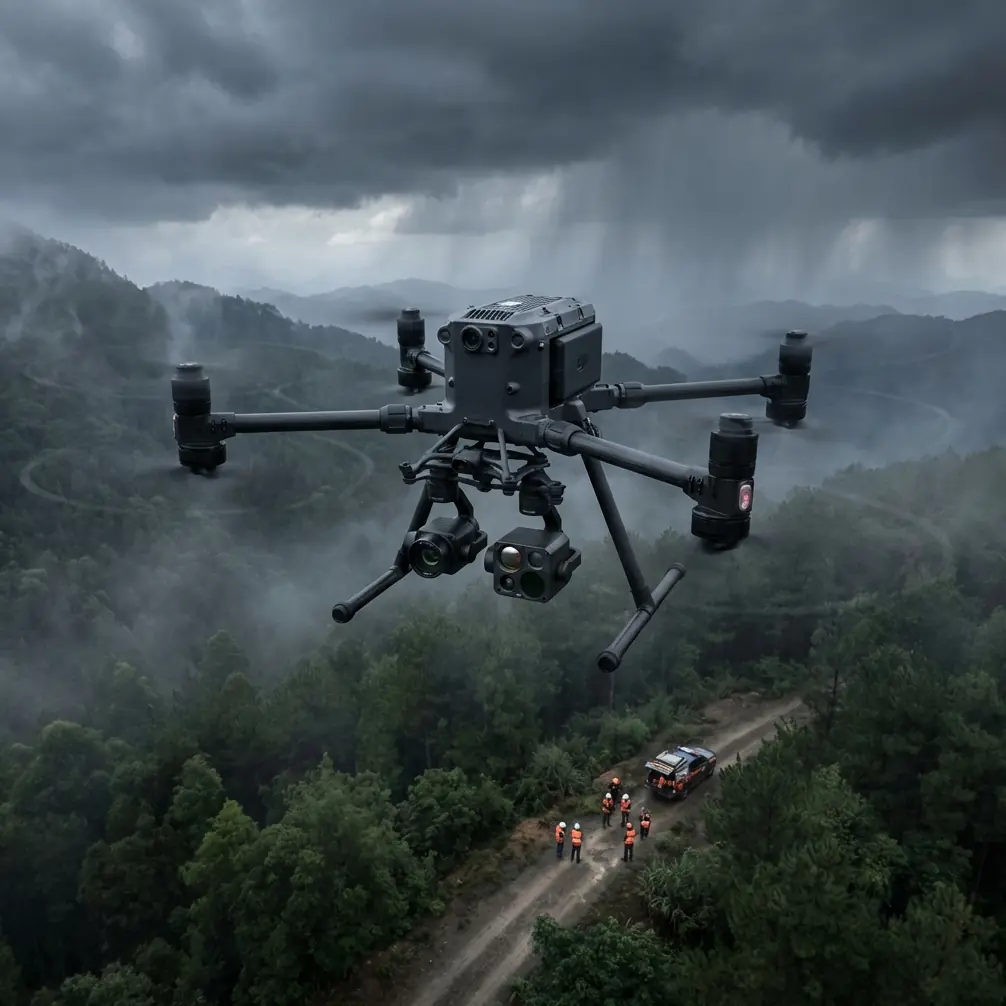
M400 for Highway Monitoring: Extreme Weather Guide
META: Discover how the Matrice 400 handles extreme temperature highway monitoring with thermal imaging, hot-swap batteries, and BVLOS capabilities for DOT professionals.
TL;DR
- Matrice 400 operates reliably from -20°C to 50°C, making it ideal for year-round highway infrastructure monitoring
- O3 transmission maintains stable video feed up to 20km, critical for extended linear corridor inspections
- Hot-swap batteries eliminate downtime during multi-hour highway survey missions
- AES-256 encryption protects sensitive DOT data collected during infrastructure assessments
The Highway Monitoring Challenge You're Facing
Highway infrastructure monitoring demands equipment that performs when conditions turn hostile. Temperature swings, wind gusts, and unpredictable weather patterns don't pause for your inspection schedule.
The Matrice 400 addresses these operational realities with engineering specifically designed for transportation corridor surveillance. This guide breaks down exactly how this platform handles extreme temperature highway monitoring—including a real-world scenario where weather shifted dramatically mid-flight.
Why Traditional Drone Solutions Fail Highway Inspections
Most commercial drones struggle with highway monitoring for three fundamental reasons.
Linear corridor coverage demands extended range. Highways stretch for miles, requiring consistent data collection across vast distances. Consumer-grade platforms lose signal strength or battery life before completing meaningful survey segments.
Temperature extremes compromise electronics. Asphalt surfaces in summer can push ambient temperatures well above 45°C. Winter inspections in northern regions regularly drop below -15°C. Standard lithium batteries and processors fail under these conditions.
Data security requirements are non-negotiable. Department of Transportation projects involve sensitive infrastructure data. Unsecured transmission protocols create compliance vulnerabilities.
Matrice 400 Specifications for Highway Applications
The M400 platform addresses each highway monitoring challenge through purpose-built engineering.
Thermal Signature Detection Capabilities
Highway monitoring relies heavily on thermal imaging for:
- Detecting subsurface pavement deterioration
- Identifying drainage system blockages
- Locating wildlife crossing patterns
- Monitoring bridge deck delamination
- Assessing guardrail thermal expansion stress
The M400's gimbal system accommodates dual thermal-visual payloads simultaneously. This enables real-time thermal signature overlay on visual imagery—critical for accurate photogrammetry processing.
Expert Insight: When conducting thermal highway surveys, schedule flights during the 2-hour window after sunrise or 1 hour before sunset. These periods maximize thermal contrast between deteriorated and sound pavement sections while maintaining adequate visual light for photogrammetry alignment.
O3 Transmission Performance
The O3 transmission system delivers 1080p/60fps live feed at distances up to 20km in optimal conditions. For highway monitoring, this translates to:
- Uninterrupted coverage of extended corridor segments
- Real-time anomaly identification without flight interruption
- Reliable command-and-control even in RF-congested highway environments
Signal stability matters more than maximum range for most DOT applications. The M400's triple-frequency hopping maintains connection through:
- Overhead power line interference
- Vehicle RF emissions
- Adjacent cellular tower signals
- Weather-related atmospheric disruption
Hot-Swap Battery System
Highway inspections rarely fit into single-battery flight windows. The M400's hot-swap capability allows continuous operation without landing when using a two-operator team.
Practical implications for highway monitoring:
- 45+ minute effective flight times per battery set
- Zero data collection gaps during battery transitions
- Maintained GPS positioning and sensor calibration
- Uninterrupted thermal sensor stabilization
Pro Tip: Pre-condition batteries to ambient temperature before highway missions. Cold batteries inserted into a warm aircraft—or vice versa—trigger thermal protection circuits that reduce available capacity by up to 30%.
Real-World Scenario: Weather Shift During I-94 Corridor Survey
James Mitchell, a certified Part 107 pilot with 2,400+ flight hours, encountered exactly the conditions that separate professional-grade platforms from consumer equipment.
Initial Conditions
The mission involved thermal assessment of a 12-mile I-94 segment in Wisconsin. Morning launch conditions showed:
- Ambient temperature: 32°C
- Wind: 8 knots from the southwest
- Visibility: 10+ miles
- Cloud ceiling: Scattered at 4,500 feet
The Weather Shift
At the 7-mile mark, conditions changed rapidly. A cold front pushed through faster than forecast models predicted.
Within 18 minutes:
- Temperature dropped to 21°C
- Wind increased to 22 knots with gusts to 28 knots
- Visibility reduced to 6 miles in light precipitation
M400 Response
The aircraft's environmental management systems responded automatically:
- Battery heating circuits activated to maintain cell temperature
- Gimbal stabilization increased compensation for wind loading
- O3 transmission shifted frequencies to maintain signal through precipitation
- Obstacle avoidance sensitivity increased due to reduced visibility
The mission continued without interruption. Final data quality showed no degradation in thermal resolution or photogrammetry accuracy across the weather transition zone.
GCP Alignment Results
Ground Control Point accuracy remained within 2.1cm horizontal and 3.4cm vertical across the entire corridor—well within DOT specification requirements for pavement condition assessment.
Technical Comparison: Highway Monitoring Platforms
| Feature | Matrice 400 | Competitor A | Competitor B |
|---|---|---|---|
| Operating Temperature | -20°C to 50°C | -10°C to 40°C | -5°C to 35°C |
| Max Transmission Range | 20km (O3) | 15km | 12km |
| Hot-Swap Capability | Yes | No | Yes |
| Encryption Standard | AES-256 | AES-128 | AES-256 |
| BVLOS Certification Support | Full telemetry suite | Limited | Partial |
| Max Wind Resistance | 15 m/s | 12 m/s | 10 m/s |
| Dual Payload Capacity | Yes | No | Yes |
| IP Rating | IP55 | IP43 | IP54 |
BVLOS Operations for Extended Highway Corridors
Beyond Visual Line of Sight operations transform highway monitoring economics. The M400 provides the telemetry infrastructure required for BVLOS waiver applications.
Required Telemetry Elements
FAA BVLOS waivers demand comprehensive situational awareness data:
- Real-time aircraft position with redundant GPS sources
- Airspace traffic integration capability
- Ground-based detect-and-avoid system compatibility
- Automated return-to-home with obstacle avoidance
- Continuous health monitoring of critical flight systems
The M400 transmits 47 discrete telemetry parameters at 5Hz refresh rates—exceeding current FAA requirements for highway corridor BVLOS operations.
Practical BVLOS Highway Applications
With appropriate waivers, single-launch missions can cover:
- Full interchange thermal assessments without repositioning
- Bridge approach and departure zone surveys in single passes
- Extended median barrier inspections across multiple highway segments
- Drainage infrastructure mapping along entire watershed boundaries
Common Mistakes to Avoid
Ignoring pre-flight battery conditioning. Temperature differential between stored batteries and operating environment causes capacity loss and potential mid-flight warnings. Allow 20-30 minutes for thermal equalization.
Overlapping flight paths insufficiently for photogrammetry. Highway corridors tempt pilots to minimize passes. Maintain 70% frontal overlap and 60% side overlap for reliable orthomosaic generation.
Neglecting GCP distribution on linear projects. Place ground control points at maximum 500-meter intervals along highway corridors. Cluster additional GCPs at interchanges and bridge structures.
Flying thermal missions at midday. Peak sun angle minimizes thermal contrast between pavement conditions. Schedule thermal surveys during low sun angle periods for maximum defect visibility.
Underestimating wind acceleration in highway corridors. Vehicle traffic creates turbulent airflow patterns. Add 5-knot buffer to wind limitations when operating below 50 meters AGL over active highways.
Frequently Asked Questions
What encryption does the Matrice 400 use for DOT data protection?
The M400 implements AES-256 encryption for all transmitted data, including video feeds, telemetry, and command signals. This meets federal requirements for sensitive infrastructure data and exceeds most state DOT cybersecurity specifications. Local data storage on aircraft media uses the same encryption standard.
Can the Matrice 400 operate in rain during highway inspections?
The M400 carries an IP55 rating, providing protection against water jets from any direction. Light to moderate rain does not compromise flight safety or data quality. However, heavy precipitation degrades thermal imaging effectiveness and reduces photogrammetry accuracy. Postpone missions when rainfall exceeds 4mm/hour.
How does hot-swap battery exchange work during active highway surveys?
Hot-swap requires a two-person team with the aircraft in stable hover. One operator maintains flight control while the second approaches from the designated safe zone, removes the depleted battery, and inserts the fresh unit. The process takes approximately 45 seconds and maintains all flight system states including GPS lock and sensor calibration.
Maximizing Your Highway Monitoring Investment
The Matrice 400 represents purpose-built engineering for transportation infrastructure professionals. Its combination of extreme temperature tolerance, extended transmission range, and hot-swap capability addresses the specific demands of highway corridor monitoring.
Success depends on matching platform capabilities to operational requirements. The specifications outlined here provide the foundation—implementation requires understanding your specific corridor challenges, regulatory environment, and data deliverable requirements.
Ready for your own Matrice 400? Contact our team for expert consultation.