
How to Monitor Mountain Highways with Matrice 400
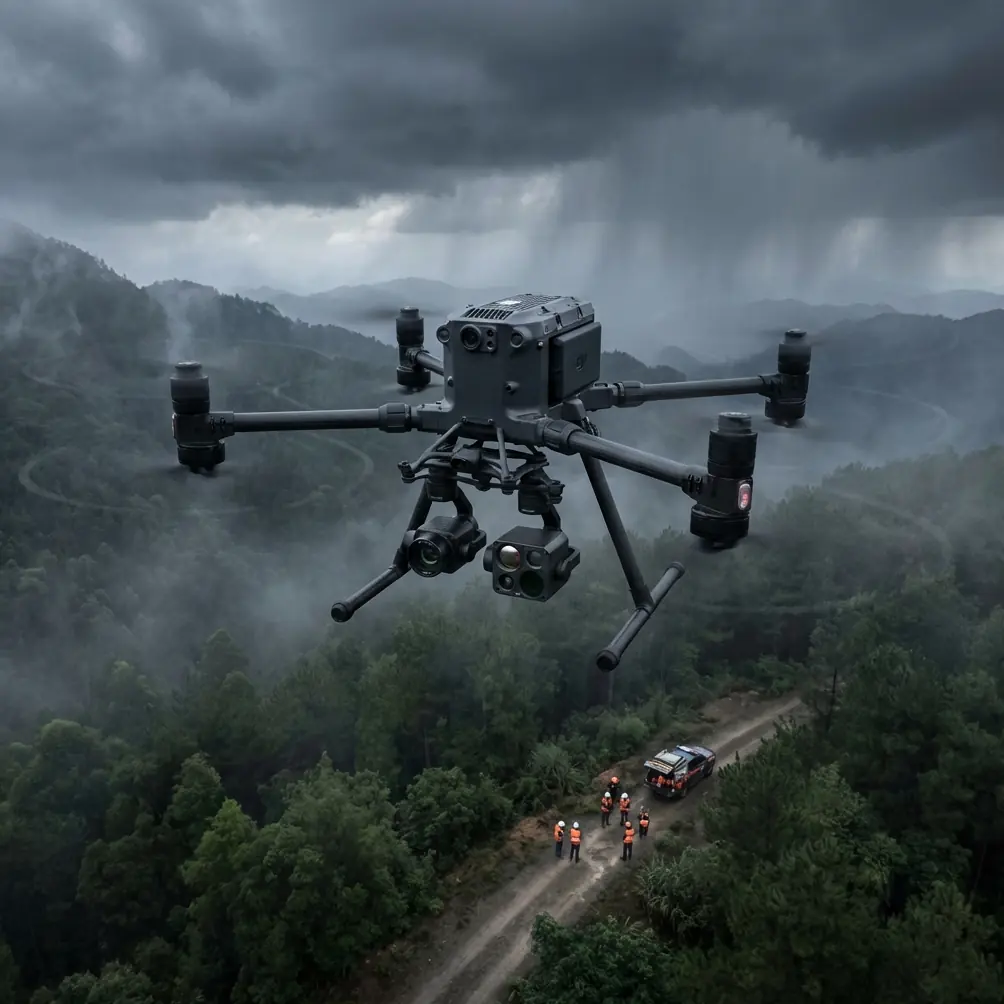
How to Monitor Mountain Highways with Matrice 400
META: Learn how the DJI Matrice 400 transforms mountain highway monitoring with thermal signature detection, BVLOS capability, and robust safety features for alpine terrain.
By James Mitchell | Drone Infrastructure Specialist | 12+ Years in Aerial Highway Monitoring
TL;DR
- The Matrice 400 enables real-time mountain highway monitoring using thermal signature detection and photogrammetry across rugged, high-altitude corridors.
- Hot-swap batteries and O3 transmission keep the M400 operational during extended BVLOS missions where terrain blocks conventional signal paths.
- AES-256 encrypted data streams ensure that critical highway safety data remains secure from takeoff to post-processing.
- A disciplined pre-flight cleaning routine is the most overlooked safety step—and the one that prevents the most catastrophic mid-flight failures in dusty alpine environments.
Why Mountain Highway Monitoring Demands a Purpose-Built Drone
Mountain highways present a uniquely hostile monitoring environment. Landslides, rockfalls, ice formation, pavement degradation, and wildlife crossings all threaten driver safety along corridors that stretch through terrain where ground-based inspection teams struggle to access. Traditional methods—sending crews on foot or using vehicle-mounted sensors—cost time, money, and occasionally lives.
The DJI Matrice 400 was engineered for exactly this kind of operational pressure. With its enterprise-grade sensor integration, encrypted communications, and all-weather flight capability, the M400 transforms a multi-day ground inspection into a single-shift aerial survey covering dozens of kilometers of remote highway.
This guide walks you through every phase of deploying the Matrice 400 for mountain highway monitoring—from the pre-flight cleaning steps most operators skip, through flight planning and data capture, to post-processing deliverables that highway authorities actually need.
Step 1: Pre-Flight Cleaning and Safety Inspection
Here is the step that separates professionals from amateurs. Mountain environments expose your aircraft to fine rock dust, pine resin, morning dew condensation, and salt residue from road treatment chemicals. Every one of these contaminants can compromise the M400's safety systems.
Before you even power on the aircraft, follow this cleaning protocol:
- Wipe all obstacle avoidance sensors with a microfiber cloth and isopropyl alcohol. Dust films on these lenses reduce detection range by up to 35%, turning a reliable safety system into a false-confidence generator.
- Inspect and clean propeller root mounts for grit accumulation. Fine alpine dust wedges into motor bearings and prop attachment points, causing vibration that degrades both flight stability and camera output.
- Clear all ventilation ports of debris. The M400's internal cooling system depends on unobstructed airflow; blocked vents in high-altitude, thin-air environments can trigger thermal shutdowns.
- Clean the IMU and compass housing area to remove any ferrous dust from road construction zones that could cause magnetic interference.
- Verify gimbal movement is smooth and unrestricted after cleaning the gimbal motor assembly of any particulate buildup.
Expert Insight: I once lost an entire survey day on a Colorado mountain pass because pine resin had coated the downward vision sensors overnight. The M400 refused to launch in certain modes because it couldn't get reliable ground readings. Now, sensor cleaning is the first item on every pre-flight checklist—before battery checks, before mission planning, before anything. A two-minute wipe-down prevents a two-hour troubleshooting session.
Step 2: Mission Planning for Mountain Terrain
Mountain highway monitoring requires flight plans that account for rapidly changing elevation, narrow valleys, and unpredictable wind corridors. The Matrice 400's flight planning software allows you to build terrain-following missions that maintain consistent altitude above ground level (AGL) even as the highway climbs and descends through mountain passes.
Setting Ground Control Points (GCPs)
Accurate photogrammetry depends on precisely placed GCPs. For mountain highway work, follow these guidelines:
- Place GCPs at intervals no greater than 500 meters along the highway corridor.
- Position at least 3 GCPs at each major elevation change (switchbacks, summit approaches, tunnel portals).
- Use high-contrast targets (minimum 30 cm × 30 cm) visible from your planned flight altitude.
- Record each GCP position with an RTK-enabled GNSS receiver at sub-centimeter accuracy.
- Avoid placing GCPs on asphalt during sunny conditions—thermal expansion shifts their position by several millimeters over a survey day.
Airspace and BVLOS Considerations
Mountain highways frequently pass through areas where beyond visual line of sight (BVLOS) operations become necessary. The M400's O3 transmission system maintains a reliable command-and-control link even when terrain features block direct line of sight between pilot and aircraft.
Key planning factors for BVLOS mountain missions:
- Identify relay points where visual observers or repeater stations can extend your operational coverage.
- Map all RF dead zones caused by canyon walls and ridgelines before the mission day.
- File appropriate BVLOS waivers with your national aviation authority well in advance—approval timelines of 90+ days are common.
- Pre-program return-to-home altitudes that clear all terrain obstacles along the return path, not just the highest point nearby.
Step 3: Sensor Configuration for Highway Monitoring
The Matrice 400 supports multiple payload configurations. For mountain highway monitoring, the optimal setup combines visual and thermal imaging.
Thermal Signature Detection
Thermal sensors on the M400 reveal critical highway conditions that visible-light cameras miss entirely:
- Subsurface water seepage that precedes road collapse shows as cool thermal signatures against warmer pavement.
- Ice formation zones become visible hours before ice actually forms, based on surface temperature differentials as small as 0.5°C.
- Rockfall risk zones can be identified where thermal cycling causes rock face fracturing—alternating hot daytime and cold nighttime signatures indicate active spalling.
- Vehicle accident detection during low-visibility conditions relies on thermal contrast between engine heat and ambient mountain temperatures.
- Retaining wall integrity assessments use thermal patterns to reveal internal moisture infiltration that precedes structural failure.
Photogrammetry Settings
For highway surface condition assessment, configure your visual sensor with these parameters:
| Parameter | Recommended Setting | Purpose |
|---|---|---|
| Flight Altitude (AGL) | 80–120 meters | Balances resolution with coverage width |
| Forward Overlap | 80% | Ensures dense point cloud generation |
| Side Overlap | 70% | Critical for corridor mapping accuracy |
| Ground Sample Distance | 2–3 cm/pixel | Detects crack widths relevant to maintenance |
| Shutter Speed | 1/1000s minimum | Prevents motion blur at survey speed |
| Image Format | RAW + JPEG | RAW for processing, JPEG for quick review |
| White Balance | Fixed/Manual | Prevents color shifts between overlapping frames |
Pro Tip: When flying photogrammetry missions along mountain highways, always program a cross-hatch pattern at tunnel portals and bridge decks. Single-pass corridor mapping creates geometric distortions at these transition points because the surrounding terrain geometry changes so drastically. A perpendicular overlap pass adds only 8–10 minutes per structure but dramatically improves 3D model accuracy in exactly the areas where engineers need it most.
Step 4: Flight Execution and Real-Time Monitoring
Leveraging Hot-Swap Batteries
Mountain highway corridors can extend 50+ kilometers. The M400's hot-swap battery system allows you to replace depleted battery packs without powering down the aircraft or losing your mission progress. This capability is essential for maintaining survey continuity across long alpine corridors.
Best practices for hot-swap operations in mountain conditions:
- Keep replacement batteries insulated in a thermal case. Lithium cells lose up to 20% capacity when cold-soaked at mountain temperatures.
- Pre-warm batteries to at least 20°C before insertion.
- Swap at no less than 25% remaining charge to maintain adequate power on the active pack during the transition.
- Log each swap event with timestamp and GPS coordinates for post-mission quality control.
Data Security with AES-256 Encryption
Highway monitoring data often includes sensitive infrastructure vulnerability information. The Matrice 400 encrypts all transmitted data using AES-256 encryption, the same standard used by government agencies for classified material.
This encryption protects:
- Real-time video feeds transmitted via O3 to the ground station
- Telemetry data including precise GPS coordinates of infrastructure weaknesses
- Stored imagery on onboard media
- Command-and-control signals that could otherwise be spoofed
For government highway contracts, AES-256 encryption is frequently a mandatory compliance requirement, making the M400 one of the few platforms that qualifies without aftermarket modification.
Step 5: Post-Processing and Deliverables
After flight completion, your raw data transforms into actionable highway intelligence through photogrammetry processing software. Standard deliverables for mountain highway authorities include:
- Orthomosaic maps showing pavement condition across the entire corridor at centimeter-level resolution.
- Digital elevation models (DEMs) that reveal slope changes, drainage patterns, and subsidence.
- Thermal overlay maps highlighting ice risk zones, water infiltration, and heat anomaly locations.
- 3D point clouds of retaining walls, bridge structures, and cut slopes for volumetric change detection over time.
- Annotated inspection reports linking specific GPS coordinates to photographic evidence of defects.
Matrice 400 vs. Alternative Monitoring Methods
| Criteria | Matrice 400 | Ground Crew Inspection | Fixed-Wing Drone | Helicopter Survey |
|---|---|---|---|---|
| Coverage per Day | 30–50 km | 3–5 km | 80–100 km | 60–80 km |
| Ground Resolution | 2–3 cm/pixel | Visual only | 5–8 cm/pixel | 10–15 cm/pixel |
| Thermal Capability | Integrated | Handheld only | Limited payload | Integrated |
| Weather Flexibility | Moderate wind/light rain | Any conditions | Wind sensitive | High wind capable |
| Data Security | AES-256 encrypted | N/A | Varies | Varies |
| Access to Tight Terrain | Excellent (VTOL) | Excellent (on foot) | Poor (runway needed) | Moderate |
| Operational Cost | Low | High (labor intensive) | Low | Very high |
| BVLOS Capable | Yes (O3 transmission) | N/A | Yes | Yes |
Common Mistakes to Avoid
1. Skipping Pre-Flight Sensor Cleaning in Alpine Environments As discussed above, this is the single most preventable cause of mission failure in mountain operations. Budget 15 minutes minimum for cleaning before every flight.
2. Using Sea-Level Battery Estimates for Mountain Flights The M400's flight time estimates assume standard atmospheric pressure. At 3,000+ meters elevation, reduced air density forces motors to work harder. Expect 15–20% shorter flight times than published specifications and plan battery swaps accordingly.
3. Ignoring Thermal Wind Patterns Mountain valleys generate predictable thermal winds—upslope in the morning, downslope in the afternoon. Flying during the transition period (typically 10:00–11:30 local time) gives you the calmest air and the most stable imagery. Afternoon thermal turbulence can make photogrammetry data unusable.
4. Setting Return-to-Home Altitude Too Low A return-to-home altitude that clears obstacles at your launch point may fly the drone directly into a ridgeline 2 kilometers back along the corridor. Always set RTH altitude based on the highest terrain within the entire operational area, not just the immediate surroundings.
5. Neglecting GCP Placement at Elevation Transitions Photogrammetry accuracy degrades dramatically on steep slopes without adequate ground control. Switchbacks and steep grades need double the GCP density of flat highway sections.
6. Transmitting Unencrypted Infrastructure Data Even if your contract doesn't explicitly require AES-256 encryption, transmitting detailed infrastructure vulnerability data over unencrypted channels creates liability exposure. Always enable the M400's encryption features—they exist for exactly this reason.
Frequently Asked Questions
Can the Matrice 400 operate in mountain weather conditions like fog and light snow?
The M400 is rated for operation in light precipitation and reduced visibility conditions. Thermal sensors remain effective in fog that would ground visual-only platforms, making the M400 particularly valuable for detecting ice formation during the low-visibility conditions when it matters most. However, heavy snowfall and icing conditions exceed the aircraft's operational envelope—always check weather forecasts and have clear abort criteria established before launch.
How does O3 transmission maintain signal in deep mountain valleys?
The O3 transmission system uses advanced frequency-hopping and multi-antenna technology to maintain links in challenging RF environments. In deep valleys where direct line of sight is impossible, operators should position relay visual observers with communication links at strategic ridgeline points. The system maintains reliable control at ranges exceeding 15 kilometers in unobstructed conditions, though mountain terrain typically reduces this to 8–12 kilometers of effective range depending on canyon geometry.
What qualifications do pilots need for BVLOS mountain highway monitoring?
Requirements vary by jurisdiction, but most aviation authorities require pilots to hold a commercial remote pilot certificate, obtain a specific BVLOS waiver or exemption, demonstrate operational competency in mountain flying, and maintain a documented safety management system. Many jurisdictions also require detect-and-avoid capability validation and coordination with local air traffic control for operations near heliports or mountain rescue flight corridors. Start the waiver application process at least 90–120 days before your planned operation date.
Ready for your own Matrice 400? Contact our team for expert consultation.