
Matrice 400 for Low-Light Power Line Monitoring
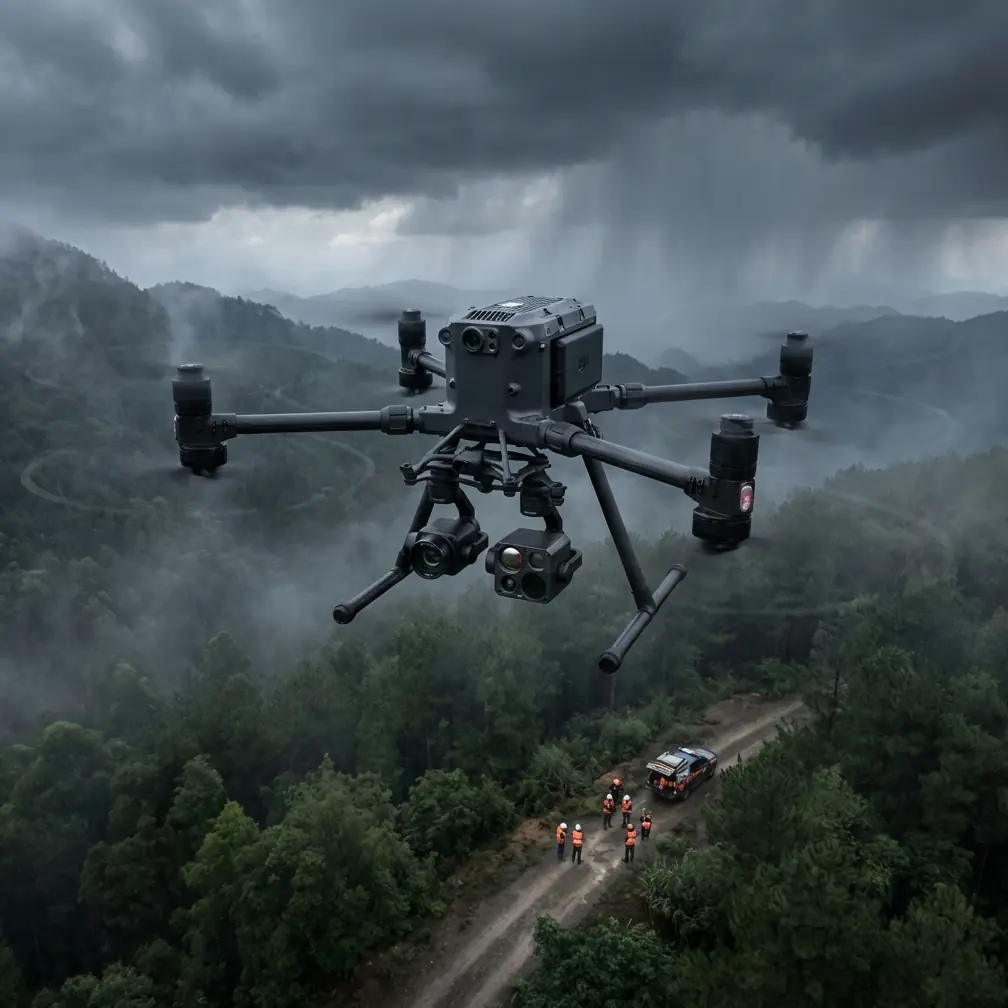
Matrice 400 for Low-Light Power Line Monitoring: What the Cockpit Still Teaches the Drone Crew
META: Specialist guidance on using Matrice 400 for low-light power line monitoring, with practical insight on vertical rate discipline, navigation logic, static protection, battery handling, and secure mission workflow.
Power line inspection after dusk has a different tempo from daytime work. The visual cues flatten out. Depth perception gets less forgiving. Small mistakes in energy management or route discipline become larger than they look on the screen. That is exactly why some of the most useful habits for a Matrice 400 team do not come from marketing sheets. They come from older flight logic and airframe engineering principles that still matter when you are flying a modern UAV over energized infrastructure in low light.
I have seen crews focus heavily on payload choice, thermal signature interpretation, and O3 transmission quality, yet miss the quieter operational details that determine whether a mission feels controlled or rushed. For Matrice 400 operators working around transmission corridors, two ideas deserve more attention: stable vertical profile management and electrostatic awareness. They sound basic. They are not.
Why low-light power line work punishes sloppy vertical control
One reference point worth reviving is the old vertical speed discipline taught in flight simulation and instrument training. In the source material, the vertical speed indicator is described in feet per minute, with each mark multiplied by 100. A pointer at 5 means 500 ft/min. That number matters because it reflects something bigger than instrument reading. It reflects rate awareness.
On a crewed aircraft, vertical speed awareness is fundamental to keeping the aircraft where it should be during reduced-visibility operations. On a Matrice 400 inspecting power lines in low light, the same mindset matters operationally even though your interface is digital and your aircraft architecture is different.
Here is why.
When you are scanning insulators, connectors, spacers, and conductor attachment points using thermal and zoom payloads, your image quality depends on more than sensor resolution. It depends on how predictable the aircraft’s movement is while the camera operator is reading structure detail. If climb and descent inputs are abrupt, three things happen:
- The thermal image becomes harder to interpret because the sensor is constantly re-framing.
- Relative distance to wires and towers changes too quickly, especially when visual contrast is weak.
- The pilot and payload operator lose their shared rhythm.
That old 500 ft/min example is not a target setting for a drone mission. It is a reminder that vertical motion should be intentional, measurable, and easy to call out. With Matrice 400, crews doing night or low-light corridor work should build that into their SOPs: define acceptable ascent and descent behavior for close inspection passes, crossing transitions, and stand-off thermal observation. Smooth rate control is not just about good flying. It improves defect confirmation.
This becomes even more critical when you are doing repeatable comparative work. If a utility wants trend analysis over time, stable geometry matters. A pole-top hardware anomaly that appears marginal on one flight can look more severe on another if the approach angle and vertical movement are inconsistent. That is where photogrammetry habits help even outside classic mapping jobs. If your team already uses GCP-backed workflows for corridor documentation, bring that same discipline to inspection repeatability: fixed viewing windows, repeatable altitude bands, and logged observation positions.
Navigation logic matters more than most drone teams admit
Another useful detail from the source material concerns navigation selection. The training reference describes a NAV/GPS switch with DME distance measurement, allowing the aircraft to follow either radio navigation or GPS-based navigation depending on need. It also notes the difference between VOR1, which includes localizer and glide slope indications for ILS-style approaches, and VOR2, which receives a second VOR signal but does not provide glide slope guidance or autopilot steering.
On the surface, that sounds far removed from a Matrice 400 power line mission. It is not.
The takeaway is that serious flight operations use layered navigation logic, not blind dependence on one source. In manned aviation, different nav instruments provide different kinds of confidence. In drone operations, that principle translates into route planning, map alignment, obstacle intelligence, and pilot judgment.
For low-light utility inspection, your Matrice 400 workflow should not be “GPS is working, therefore we are fine.” It should be:
- satellite positioning is one layer,
- live visual orientation is another,
- corridor preplanning is another,
- distance awareness to structures is another,
- transmission quality and command continuity are another.
That is where O3 transmission earns its place operationally. Reliable link performance is not only about video convenience. In low light, a robust downlink helps the crew preserve orientation when the naked-eye scene is weak and the payload feed becomes the main reference. Add AES-256 into that environment and you also protect the operational data path, which matters when infrastructure imagery and route data are sensitive from a commercial standpoint.
The deeper lesson from the NAV/GPS and VOR references is this: every navigation mode has limits. Smart Matrice 400 crews build cross-checks. If the planned route says one thing but the camera perspective, structure spacing, or tower alignment says another, stop and verify. Night inspection is not the place to let automation quietly drift your assumptions.
The overlooked threat around power line missions: static and conductive environments
The second source document is even more relevant to utility work than it first appears. It discusses electrostatic generation in aircraft, causes of charge buildup, and methods of protection. It notes that static can arise from atmospheric electric fields, collisions with airborne particles during flight, and exhaust-related charging effects. It also outlines mitigation methods such as conductive surface treatments, static discharge devices, proper grounding, and careful electrical bonding. One detail stands out: recommended bonding resistance around 0.10.
You are not flying a crewed composite airframe through thunderstorms, and you should not be operating a Matrice 400 in those conditions anyway. But the engineering logic still applies directly to low-light power line monitoring.
Utility corridors are electrically noisy environments. You may not be taking a lightning strike, but you are operating near structures that change how you think about electrical integrity, static behavior, and sensor reliability. This matters in four ways.
1. Static can distort confidence before it causes obvious failure
Low-light operations often happen in drier, cooler, or transitional weather conditions when crews are moving equipment rapidly from vehicles to field launch points. Static handling becomes a quiet risk to connectors, payload interfaces, and support electronics. You may never see a dramatic fault. Instead, you get intermittent behavior, odd sensor resets, or degraded confidence in system consistency.
That is why disciplined grounding and equipment handling should be part of a Matrice 400 utility workflow, especially for teams rotating payloads or moving between thermal and visual configurations.
2. Composite structures and electronics demand respect
The handbook points out that composite materials do not conduct like metals and that onboard electronics may need shielding measures to ensure proper operation. Modern UAV platforms and payload assemblies are full of tightly integrated electronics. Around transmission assets, you want every cable, mount, and power interface inspected regularly, not just the airframe shell. The inspection aircraft is itself an electrical system, not just a camera carrier.
3. Surface protection is not cosmetic
The structural reference notes that protective coatings on composite parts help slow moisture absorption and aging, while conductive treatments can also play a role in electrical protection. For field teams, this is a maintenance message. Cosmetic wear on a working inspection drone is not purely aesthetic. Surface condition can become part of long-term reliability, especially if the aircraft sees frequent dawn, dusk, and humid corridor missions.
4. Power line work should trigger stricter preflight checks
If a manned-aircraft engineering text goes into detail about discharge paths, bonding, and static protection, drone crews working near energized assets should not treat preflight as a checklist recital. Inspect cable routing. Check payload seating. Confirm battery contact integrity. Review landing light and anti-collision visibility if your operational framework allows their use. The old cockpit reference even lists external systems such as landing lights, taxi lights, navigation lights, anti-collision/strobe lights, and pitot heat as grouped operational controls. The exact hardware differs on a Matrice 400, but the lesson is timeless: external systems are part of mission safety, not accessories.
A battery management habit that saves trouble in the field
Here is the field tip I wish more crews practiced consistently with larger enterprise drones.
When using hot-swap batteries during power line inspections, do not judge the next sortie by percentage alone. Judge it by battery pair behavior across the last two flights and by the mission’s vertical workload.
Low-light utility work creates uneven power demand. You may hover longer while the payload operator studies a thermal anomaly. Then you may climb, reposition, descend, and hold again. That profile is very different from a smooth mapping grid. A pair of batteries that looks healthy on paper can still produce an uneven feel under repeated short-turn missions if one pack has been warming faster, balancing differently, or aging slightly off its mate.
My rule for Matrice 400 crews is simple:
- after each landing, log not just remaining charge but thermal state and any unusual imbalance,
- keep battery pairs matched and track them as working partners,
- if the next mission includes repeated climbs around tower structures, treat that as a higher-energy sortie even if the route is short.
This is where older rate-awareness thinking comes back. Vertical work costs more than crews often estimate. If the previous inspection involved several close vertical repositioning moves and prolonged hover confirmation of a hotspot, the batteries may be less “ready” than the percentage suggests.
Hot-swap capability is invaluable because it keeps workflow moving, especially on utility jobs where the window of suitable low-light contrast can be brief. But hot-swap should not create a false sense of endless continuity. Pause long enough to evaluate the packs as a system.
Building a repeatable Matrice 400 workflow for low-light line inspection
A practical sequence for commercial operators looks like this:
Plan the corridor like an instrument procedure
Predefine tower approach sides, standoff distances, transition heights, and no-fly buffers around conductors. Think in segments, not improvisation.
Use thermal as a diagnostic layer, not a standalone answer
A thermal signature can highlight load imbalance, resistance heating, or component stress. It still needs confirmation from angle, context, and often a visual payload view.
Control vertical movement deliberately
Do not “hunt” above and below the target. Establish stable observation bands. If your crew can describe ascent and descent behavior clearly, your data will be more consistent.
Treat link security and stability as operational requirements
O3 transmission supports cleaner situational awareness, and AES-256 matters when infrastructure imagery and flight data are sensitive within a commercial environment.
Keep electrostatic hygiene in the routine
Clean connectors, inspect mounts, manage equipment transfer carefully, and avoid casual assumptions about electrical exposure near utility assets.
Reserve photogrammetry discipline for inspection too
Even if the mission is not a full corridor map, use repeatable geometry, consistent viewpoints, and, where needed, GCP-supported reference data for asset comparison over time.
Review battery pairs, not just battery percentages
That one habit prevents many avoidable mid-mission compromises.
Why this matters for BVLOS-minded teams
As more operators prepare for BVLOS-style utility workflows, the margin for casual technique disappears. You cannot build scalable inspection programs on “good enough” handling. The reference materials behind this discussion may come from flight training and structural design rather than a Matrice 400 brochure, but that is precisely why they are useful. They remind us that dependable aerial work has always depended on fundamentals: know your vertical profile, know your navigation logic, respect electrical realities, and maintain the aircraft like a mission system.
If your team is refining low-light utility operations and wants to compare workflow notes with someone who has spent time translating aviation discipline into drone field practice, you can message our technical desk here.
The Matrice 400 will earn its place on power line work when crews use it as more than a stable platform with a capable sensor stack. Its real advantage appears when the operation around it becomes deliberate, measurable, and repeatable.
Ready for your own Matrice 400? Contact our team for expert consultation.