
Monitoring Vineyards in Low Light With the Matrice 400
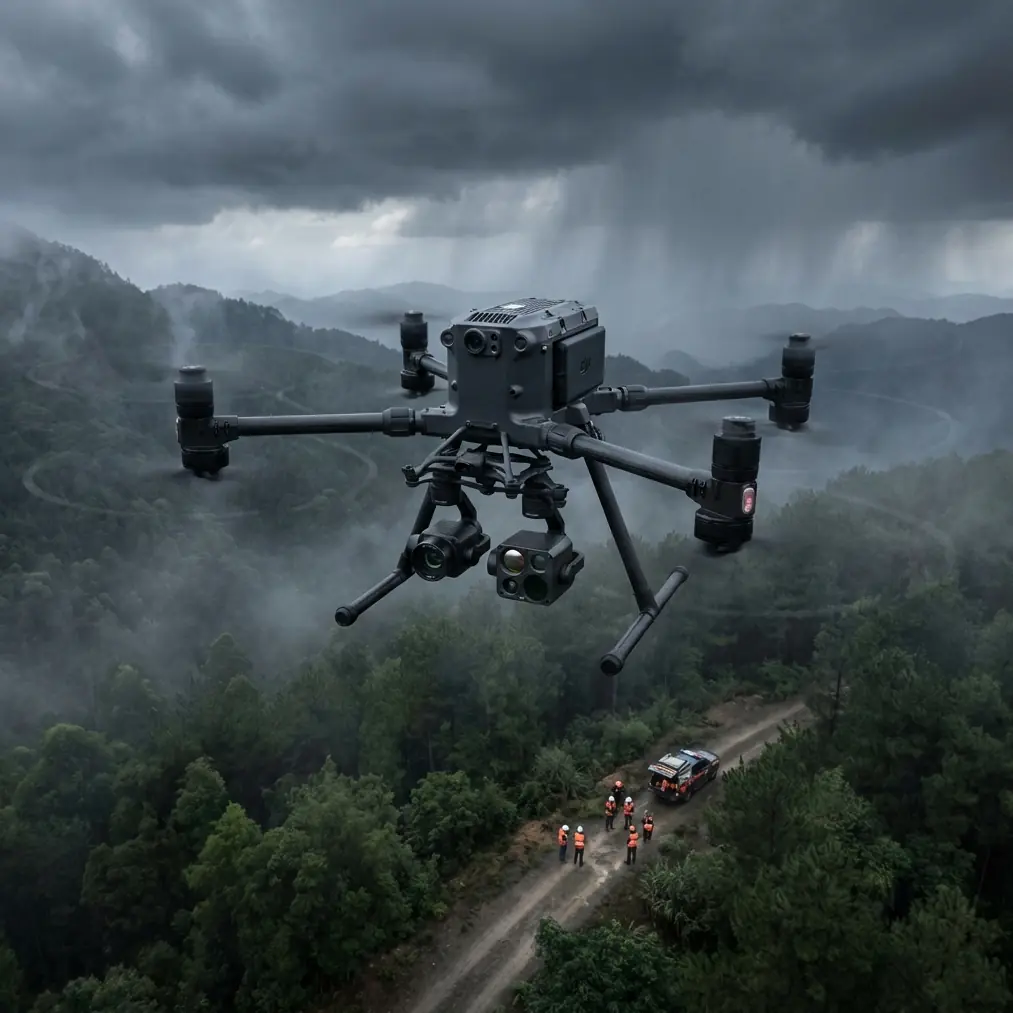
Monitoring Vineyards in Low Light With the Matrice 400: A Field Report From the Edge of First Light
META: Expert field report on using the Matrice 400 for low-light vineyard monitoring, covering thermal signature analysis, photogrammetry, O3 transmission, hot-swap batteries, AES-256 security, and third-party payload integration.
Vineyard work has a narrow window where the most useful information often appears before the human eye can properly see it.
That is the awkward truth of low-light crop inspection. By the time a block looks visibly stressed from the ground, the pattern has usually been forming for hours or days. In vineyards, those early cues matter. Cold pockets settle first in lower rows. Irrigation irregularities reveal themselves in subtle canopy temperature shifts. Wildlife movement leaves a thermal trail before sunrise. Under weak light, the field tells the truth more clearly than it does at noon, but only if the aircraft above it can keep collecting stable, usable data when contrast is poor and operations are still constrained by distance, terrain, and time.
That is where the Matrice 400 stands out.
This is not a generic platform story. In vineyard monitoring, especially in low light, the aircraft only earns its place if it reduces uncertainty. The Matrice 400 does that by combining long-range operational confidence, secure data handling, payload flexibility, and practical endurance features that actually change how a flight team works in the field. For growers and service providers trying to inspect trellis lines before sunrise or during the fading edge of dusk, those details are not technical decoration. They decide whether the mission produces insight or just files.
Why low-light vineyard work is different
A vineyard is visually repetitive from above, which sounds simple until light conditions collapse. The rows create strong geometry, but low sun angles, shadows, fog pockets, and uneven terrain all distort what a standard visual inspection can reveal. A crew walking rows with flashlights will notice obvious issues. They will not reliably map developing canopy stress over multiple blocks before the workday begins.
Low-light monitoring changes the objective. Instead of looking for what is plainly visible, the operator is trying to capture signals that emerge when temperatures diverge and human visibility drops. That usually means paying close attention to thermal signature, not just RGB imagery. It also means preserving positioning accuracy for repeatable mapping so that a suspicious zone in one flight can be checked against the same coordinates later with confidence.
The Matrice 400 fits that task profile because it is built less like a camera carrier and more like a serious utility aircraft. That distinction matters in agriculture. A drone can have excellent image quality and still be the wrong tool if its transmission link degrades across rolling terrain, if the power cycle between sorties wastes the dawn window, or if the payload setup is too rigid for mixed thermal and mapping work.
The real value of thermal signature at first light
In vineyards, thermal data is only useful when interpreted in context. A warm patch does not always mean vine stress, and a cool strip does not automatically signal healthy irrigation. The timing of the flight, previous day heat load, soil moisture variability, canopy density, and even the orientation of rows all influence what the sensor sees.
That said, early morning thermal signature work remains one of the fastest ways to isolate blocks that deserve closer attention. On a Matrice 400 deployment, the operational advantage is not merely that a thermal payload can fly. It is that the aircraft can maintain a stable platform and solid link quality while covering enough ground to make the thermal picture meaningful at the vineyard scale.
This is especially relevant in larger estates where multiple parcels sit across uneven topography. Temperature inversions are rarely uniform. One section may trap cold air overnight while an adjacent slope clears faster. A low-light drone mission lets operators identify those microclimate behaviors before the visual symptoms become obvious. In practical terms, that can help prioritize scouting crews, direct irrigation checks, and flag sections for disease-risk review.
If you are using the Matrice 400 for this kind of work, the thermal feed should not be treated as a standalone verdict. Pair it with georeferenced flight logs and, when possible, repeat missions from comparable times and weather conditions. That is where the platform’s support for structured operations becomes more valuable than raw sensor novelty.
Photogrammetry still matters when the light is poor
Many operators think of photogrammetry as a bright-day mapping discipline, but vineyard monitoring benefits from it even when low-light missions are the main use case. The key is mission design.
The Matrice 400 can be used to establish a repeatable map framework for the property, then revisit specific blocks during low-light periods for thermal comparison and anomaly detection. This layered workflow is far more useful than chasing isolated thermal snapshots. You first build a consistent spatial model of the vineyard. Then you use thermal flights to identify change within that known geometry.
Ground control points, or GCPs, become especially useful here. In vineyards with repetitive rows and limited unique natural features, good control improves confidence when stacking datasets from different dates or payloads. If an operator is comparing canopy variation along a problematic irrigation line over several weeks, positional drift is not a trivial error. It can cause false interpretations row to row. A disciplined GCP workflow reduces that risk.
This is one of the operational reasons the Matrice 400 makes sense for professional agricultural teams instead of casual inspection work. It supports a methodology, not just a flight.
O3 transmission is not a brochure detail in vineyard terrain
Transmission reliability becomes very real when the aircraft drops behind a tree line, skirts the edge of a slope, or works a distant parcel while the pilot remains at a safe launch point. A vineyard may look open on paper, yet still create stubborn radio challenges because of elevation, vegetation, outbuildings, and long row geometry.
That is why O3 transmission deserves more attention in this use case. In low-light conditions, the operator has less visual redundancy from the naked eye. The live feed and telemetry matter more, not less. A dependable O3 link helps preserve control confidence and image continuity when working across long blocks or moving toward operations that may eventually align with BVLOS frameworks, depending on local regulation and approvals.
The significance here is operational rather than theoretical. If your team is trying to complete multiple early-morning sectors before the vineyard staff enters the rows, dropped video and weak situational awareness create delay. Delay burns the best part of the thermal window. Stable transmission protects the mission clock.
For estates evaluating whether to centralize drone operations from fewer launch positions, that link performance can influence labor planning just as much as it influences flight safety.
Hot-swap batteries change the tempo of dawn operations
Anyone who has worked a vineyard before sunrise knows the useful window moves quickly. Air temperature shifts. Ground moisture begins to normalize. Thermal separation changes minute by minute. If the aircraft lands and the crew loses momentum during a battery change, the mission can fragment.
Hot-swap batteries are not glamorous, but they are one of the most practical reasons to use a platform like the Matrice 400 in serious low-light agriculture work. They reduce dead time between sorties and allow crews to keep the aircraft cycling through adjacent blocks while conditions remain consistent enough for comparison.
That consistency is valuable. If block A is flown at the coldest point of dawn and block B is flown much later after ambient conditions have shifted, the thermal relationship between those blocks becomes harder to interpret. Hot-swap capability helps keep the acquisition schedule tight. In data work, that is often the difference between a coherent map and a patchwork of loosely related observations.
It also lowers pressure on the crew. Instead of rushing a restart sequence in the dark with dew on cases and gloves half on, the team can maintain a safer rhythm while preserving the mission window.
Security matters more than many agriculture teams assume
Vineyard operations increasingly generate sensitive location and production data. That includes health patterns in high-value blocks, infrastructure layouts, water-use indicators, and operational routines. Those files may not look sensitive to outsiders, but they are commercially meaningful.
AES-256 support matters here because it brings a serious level of protection to the transmission and handling chain around flight operations. For independent drone contractors working with premium estates, this is not just an IT footnote. It can become part of the trust equation with owners and managers who do not want field intelligence moving around casually.
The Matrice 400’s suitability for agricultural work is strengthened by this kind of security posture. If the aircraft is being used to map problem areas tied to yield forecasting or disease response, protecting that data is part of professional practice. The more mature the vineyard business, the more likely this concern becomes explicit.
The accessory that made the difference in the field
The most effective Matrice 400 vineyard setup I have seen was improved not by a bigger claim about the aircraft itself, but by a third-party strobe and beacon accessory mounted specifically to improve aircraft visibility during dim pre-sunrise launches and recoveries.
That may sound modest compared with thermal sensors and mapping workflows, yet it solved a real operational problem. In low light near uneven terrain, maintaining visual orientation of the aircraft during ascent and approach can be more difficult than many crews admit, especially when working against dark hillsides or tree edges. The added beacon improved sight acquisition for the visual observer and reduced hesitation during transitions near the launch area.
This is a good reminder that capability in the field often comes from thoughtful system building. The Matrice 400 provides the backbone. A well-chosen third-party accessory can remove friction that otherwise eats into the mission.
If your team is thinking through a similar setup and wants to compare notes on payload and accessory combinations, this is the fastest way to reach a field-focused operator: message us here.
Where BVLOS thinking enters the vineyard conversation
BVLOS is often discussed in large infrastructure or public safety contexts, but vineyards are a legitimate part of that conversation. Large estates and distributed parcels create exactly the kind of operational geography where beyond visual line of sight can eventually produce meaningful efficiency gains, provided the regulatory pathway is in place.
The Matrice 400 belongs in that discussion because its architecture aligns with professional fleet use rather than hobby-style field checks. Even if a vineyard operation is not flying BVLOS today, it may still benefit from adopting aircraft, mission planning standards, and communication workflows that prepare for that future.
Why does that matter right now? Because the habits built in VLOS operations carry forward. Reliable transmission, secure data management, disciplined battery rotation, repeatable mapping with GCP support, and payload integration all scale better when the aircraft was chosen with operational maturity in mind from the start.
What the Matrice 400 does best in this specific scenario
For monitoring vineyards in low light, the Matrice 400 is at its best when used as the center of a repeatable inspection program rather than a one-off flying camera. It excels when the operator understands that the goal is not simply to collect images in the dark. The goal is to identify subtle changes early enough that vineyard teams can respond before those changes become visible from the ground.
That means using thermal signature for triage, photogrammetry for structure, GCPs for positional trust, O3 transmission for operational continuity, hot-swap batteries for tempo, and AES-256 for protecting the resulting intelligence. None of those elements alone is the story. Together, they explain why this platform is well suited to vineyards where timing, terrain, and data integrity all matter at once.
The best low-light missions are quiet and uneventful. The aircraft launches cleanly. The link stays solid. The rows align in the map. The thermal anomalies are clear enough to guide a human follow-up. The batteries change fast. The second sortie lifts before the horizon brightens too much. Later that morning, the vineyard manager is not buried in vague images. They are looking at a specific section of vines that now deserves action.
That is what useful drone work looks like in agriculture. Not spectacle. Not abstract capability. Just sharper decisions made early enough to matter.
Ready for your own Matrice 400? Contact our team for expert consultation.