
Matrice 400 for Urban Vineyard Monitoring: What Reliability
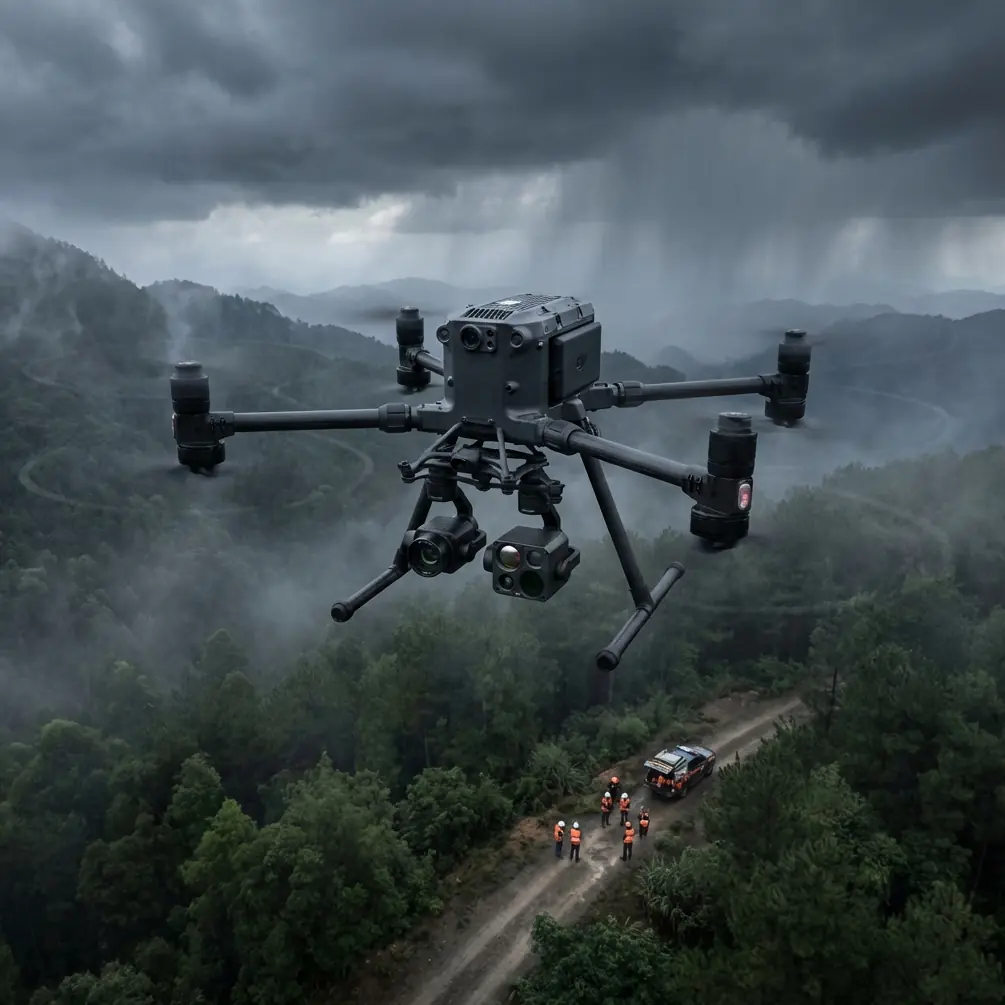
Matrice 400 for Urban Vineyard Monitoring: What Reliability-Centered Design Really Means in the Field
META: Expert technical review of Matrice 400 for urban vineyard monitoring, covering sensor placement logic, reliability design, safe data workflows, thermal surveying, photogrammetry, BVLOS readiness, and practical flight altitude strategy.
Urban vineyard monitoring sounds straightforward until you actually map the job. Vines are compact. Buildings distort wind. RF noise is rarely clean. Access points are awkward, and the mission profile shifts between plant-health review, thermal signature checks, canopy modeling, and repeatable photogrammetry runs that need to line up week after week.
That is where the Matrice 400 conversation gets interesting.
Most product writeups focus on payload capacity, flight time, or transmission range. Those matter, but they do not explain whether a platform is truly suitable for a dense, edge-of-city viticulture environment. For that, the better lens is reliability architecture: how the aircraft, its sensors, and its data path behave when timing, positioning, and operator workload all collide in a constrained airspace.
The reference material behind this article does not discuss the Matrice 400 directly. Instead, it points to a deeper engineering principle from aircraft design: system safety is not just about training operators to avoid mistakes. It is about removing latent hazards in the design itself. One source is explicit that sequence errors, early or delayed actions, and local confusion in operating order can all trigger hidden failure paths. That principle has real weight for a drone mission over an urban vineyard, where the pilot may be juggling GNSS quality, rooftop turbulence, visual obstacles, payload switching, and time-critical imaging windows.
So the right question is not “Can the Matrice 400 fly here?” It is “How should a Matrice 400 workflow be structured so the mission remains accurate, repeatable, and forgiving under real urban conditions?”
Why urban vineyard work is harder than open-field agriculture
A conventional vineyard survey in open rural terrain gives you room to simplify. You can pick a broad altitude, run long straight lines, and rely on clean geometry for photogrammetry. In an urban vineyard, even a small one, the constraints stack up:
- wind shear near buildings and walls
- reflective surfaces affecting image consistency
- mixed thermal backgrounds from pavement, roofs, irrigation lines, and shaded canopy
- tighter launch and recovery zones
- more pressure on stable transmission links
- a greater need for disciplined sensor setup and preplanned routes
This is why the Matrice 400 should be evaluated less as a “flying camera” and more as an aerial measurement system.
The hidden lesson from aircraft design manuals: timing and configuration beat improvisation
One of the reference documents on reliability and maintainability design makes a point that many drone teams still learn the hard way: the system data used for analysis should reflect the actual manufactured and assembled product, not just a high-level schematic. It goes further and recommends collecting this detail after component-level circuit design is complete, before manufacturing begins, because changing drawings is far cheaper than changing the physical product.
Operationally, that translates well to the Matrice 400.
For urban vineyard work, your mission design should not live as a generic template in the flight app. It should be tuned to the actual aircraft-payload-battery-link configuration you will fly. If the vineyard inspection alternates between RGB photogrammetry and thermal signature assessment, those are not interchangeable missions. Different payload geometry, timing, overlap, speed, and altitude logic apply. A mission plan built as if all sensing modes are equivalent introduces exactly the sort of latent pathway the reference warns about: a small sequencing error that becomes a data-quality failure later.
A serious Matrice 400 workflow should therefore lock in these details before routine operations:
- exact payload stack and mounting arrangement
- image timing relative to groundspeed
- overlap targets for urban-edge photogrammetry
- thermal survey window by sun angle and canopy temperature behavior
- transmission and return path assumptions
- battery swap rhythm, especially if using hot-swap batteries for continuous tasking
That final point matters more than many teams admit. Hot-swap batteries are useful because they reduce downtime between sorties, but they also make it easier to keep flying without revisiting mission assumptions. In urban vineyard monitoring, continuity is helpful only if each sortie remains geometrically and radiometrically consistent.
Sensor placement logic matters, even on a drone
The second reference source comes from civil aircraft flight-control design and discusses something drone operators often overlook: sensor quantity and placement are selected based on observability. In plain terms, sensors are not just added for redundancy. They are positioned so the system can see the behavior it needs to control or measure.
The document gives concrete examples. A Boeing 757-based validation aircraft placed one pitch-rate sensor at the center of gravity to observe short-period motion, and mounted symmetric accelerometer groups at a wing location to observe structural modes. Another example describes a 150-seat aircraft using four quadruplex vertical/lateral accelerometer groups at the center of gravity for control-law calculations.
Why does that matter to a Matrice 400 in a vineyard?
Because it clarifies a principle: measurement quality depends on where and how sensing occurs, not just on the sensor spec sheet.
Applied to drone operations, this means:
- GNSS, IMU, vision sensing, and payload alignment all affect map quality
- thermal imagery captured from a poor angle can show false canopy stress patterns
- camera position relative to aircraft motion influences blur, reconstruction, and row-edge definition
- a platform that maintains stable sensor behavior under disturbed airflow is more valuable than one that merely advertises high resolution
In an urban vineyard, the aircraft is often forced to fly adjacent to walls, roads, treelines, and rooftop edges. Those features alter airflow and can provoke micro-corrections from the flight controller. If your photogrammetry altitude is too low, those corrections become visible in your reconstruction as inconsistent side overlap and distorted vine-row geometry. If your thermal pass is too high, mixed pixels from vine canopy and hardscape reduce interpretability.
That is why optimal flight altitude is not a single universal number.
Best flight altitude for a Matrice 400 over an urban vineyard
For most urban vineyard monitoring missions, the practical sweet spot is usually 45 to 70 meters AGL for RGB photogrammetry, with many teams landing near 55 to 60 meters as the best compromise.
Here is why that range works.
At lower altitudes, say 25 to 35 meters, you gain detail but often lose consistency. Perspective effects increase around trellis edges. Building proximity becomes more disruptive. Shorter line spacing increases the number of turns, which adds timing irregularities and can complicate GCP alignment if the site is broken up by urban features.
At higher altitudes, above roughly 80 meters in this scenario, you may still produce a usable map, but subtle canopy differences begin to flatten. That hurts row-by-row interpretation, especially when the purpose is vigor comparison, irrigation diagnosis, or early stress detection.
For thermal signature work, a slightly lower band is often better, commonly 35 to 50 meters AGL, assuming the sensor optics and desired ground sampling distance support it. Thermal analysis in an urban vineyard needs tighter control because heat from nearby surfaces can contaminate the visual story. Lower altitude helps isolate the vine canopy from roads, retaining walls, rooftops, and bare soil transitions.
A practical approach with the Matrice 400 is to split the mission rather than force one altitude to serve every purpose:
- 55 to 60 meters AGL for RGB photogrammetry and 3D canopy modeling
- 40 to 45 meters AGL for targeted thermal signature passes
- slower, more deliberate orbit or oblique captures only where structural context matters, such as slope transitions, irrigation manifolds, or disease-prone corners
If GCPs are being used, that range also helps balance precision with manageable field setup. In urban-adjacent sites, GCP visibility can be compromised by shadows, fences, and narrow access lanes, so a moderate altitude often improves consistency across repeat surveys.
Transmission integrity is not a luxury in city-edge agriculture
The context hints at O3 transmission and AES-256, and both are relevant here, though not for marketing reasons.
Urban vineyards are noisy electromagnetic environments. Nearby homes, Wi-Fi networks, commercial buildings, service roads, and utility infrastructure can all burden the communication link. Strong transmission architecture helps keep command, telemetry, and payload view stable when the aircraft is not operating in a clean rural corridor.
This becomes more significant if the operation is structured for BVLOS readiness within regulatory limits and site-specific approvals. Even if every current mission remains VLOS, an aircraft and workflow designed with dependable long-link behavior offer a stronger base for future scale. What matters is not maximum brochure range. It is stable control and image confidence in cluttered RF conditions.
AES-256 also deserves a practical interpretation. In a vineyard monitoring context, secure transmission protects sensitive operational data: crop condition, asset layout, irrigation patterns, and infrastructure imagery from adjacent private properties. For urban sites, privacy discipline is part of professional flight planning, not an optional extra.
Reliability is built before takeoff, not rescued afterward
The first reference document also describes a method of encoding detailed circuit and wiring information into a computer-processable format, breaking systems into manageable sections and cross-referencing nodes so analysts can identify latent states accurately. That sounds distant from drone fieldwork, but the mindset is exactly right.
A Matrice 400 program for vineyard monitoring should be documented as a repeatable system, not as pilot memory.
That means building a structured checklist around:
- payload-specific preflight logic
- mission file version control
- battery health and hot-swap sequence validation
- lens cleanliness and calibration status
- GCP layout records
- thermal survey timing windows
- upload and naming rules for weekly comparability
When the source says that detailed data must express the real circuit rather than a simplified functional diagram, the field equivalent is this: your real operation is not the same as your intended operation. If your team updates overlap, swaps a payload, changes launch point, or shifts altitude due to rooftop turbulence, the mission record should capture it.
That is how small inconsistencies stop corrupting trend analysis.
How the Matrice 400 fits this mission profile
For urban vineyard monitoring, the Matrice 400 stands out when used as a stable multi-sensor work platform rather than a one-pass drone. Its value is strongest in operations that need:
- repeatable flight behavior over mixed terrain
- secure and dependable data link performance
- fast turnaround between sorties using hot-swap batteries
- support for both photogrammetry and thermal signature acquisition
- future-ready workflows that may expand toward more advanced corridor or BVLOS-style planning where regulations allow
It is especially useful when the vineyard manager does not simply want pretty aerial images. They want decision-grade information: which rows are falling behind, where water stress is emerging, whether canopy growth is becoming uneven, and how those patterns evolve through the season.
That requires system discipline.
A field-tested mission template
If I were deploying a Matrice 400 for this exact scenario, my baseline workflow would look like this:
Mission 1: RGB mapping
- Fly at 55 to 60 meters AGL
- Use consistent overlap suited to dense row geometry
- Establish GCPs where shadows and urban clutter will not obscure them
- Fly when shadows are manageable, not when rooflines create harsh cross-scene contrast
Mission 2: Thermal assessment
- Fly at 40 to 45 meters AGL
- Schedule around agronomic objectives, not just pilot availability
- Avoid late-day heat noise from nearby hardscape unless the aim is to study heat retention effects
- Compare vine canopy zones against known irrigation and soil variability
Mission 3: Targeted obliques
- Use only where useful for drainage paths, retaining structures, access roads, or trellis anomalies
- Keep these separate from the mapping dataset to avoid contaminating a clean reconstruction workflow
For teams refining this kind of operation, a quick technical discussion can save a lot of trial-and-error in urban sites; you can message a Matrice workflow specialist here.
The real differentiator: fewer hidden errors across the season
The best Matrice 400 setup for urban vineyard monitoring is not the one that captures the most dramatic first flight. It is the one that still produces reliable, comparable data after twenty flights, across shifting conditions, with different operators, payloads, and battery cycles.
That is where the reference material quietly becomes powerful.
One source warns that operator sequence errors and timing mistakes can activate hidden failure paths, and that training alone is not enough; hazards should be designed out where possible. Another explains that sensor number and placement must be chosen for what the system actually needs to observe, not just for redundancy on paper. Together, those ideas point to a mature way of using the Matrice 400:
- simplify decisions before launch
- separate mission types by sensing purpose
- choose altitude based on canopy observability, not habit
- document the actual flown configuration
- treat reliability as a design feature of the workflow
For an urban vineyard, that is the difference between collecting imagery and building an inspection program.
Ready for your own Matrice 400? Contact our team for expert consultation.