
Matrice 400 Guide: Low-Light Wildlife Monitoring
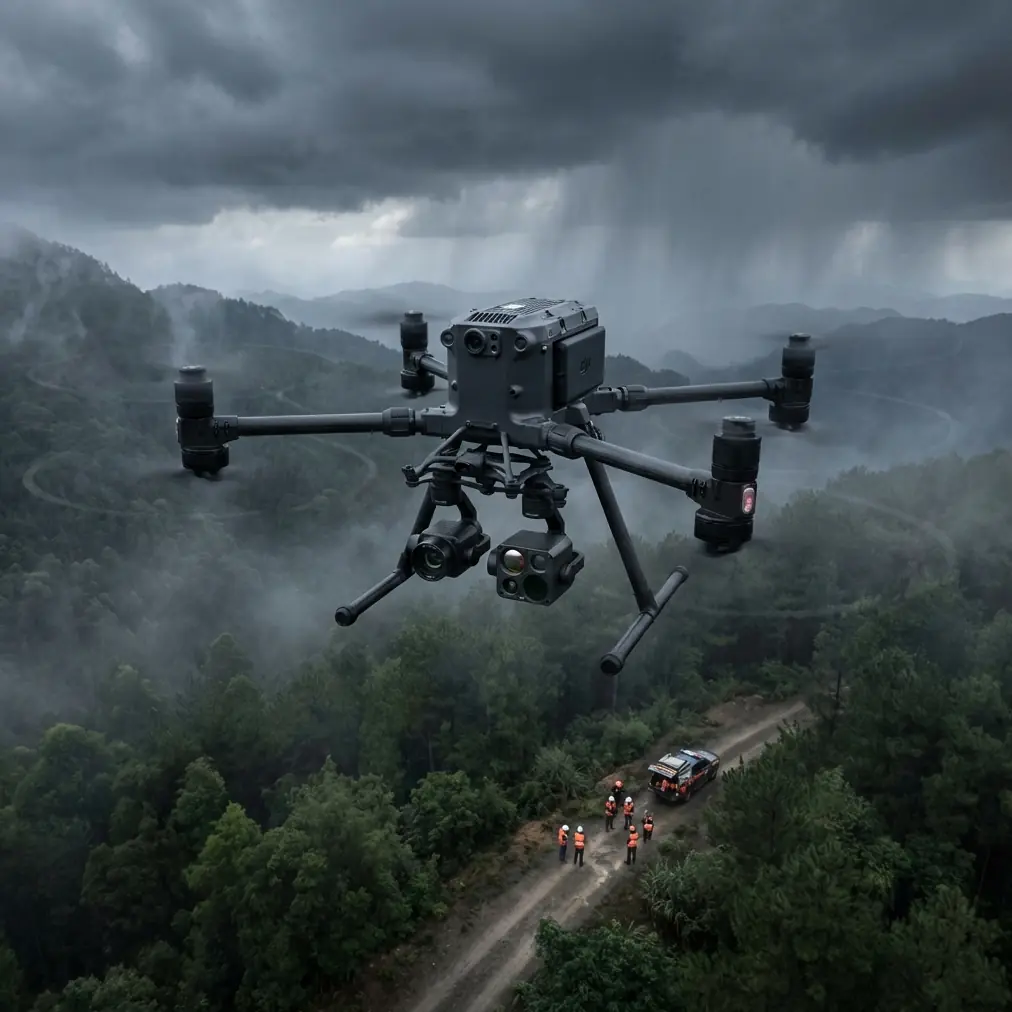
Matrice 400 Guide: Low-Light Wildlife Monitoring
META: Learn how the DJI Matrice 400 enables expert-level wildlife monitoring in low light using thermal imaging, BVLOS operations, and advanced interference solutions.
By James Mitchell | Drone Operations & Wildlife Survey Specialist
TL;DR
- The Matrice 400 excels at low-light wildlife monitoring thanks to its integrated thermal payload, hot-swap batteries, and O3 transmission system that maintains stable feeds in challenging field conditions.
- Electromagnetic interference (EMI) from remote monitoring stations and geological formations can disrupt operations—antenna adjustment techniques solve this.
- BVLOS capability allows coverage of vast habitats without disturbing sensitive species.
- This guide walks you through a complete how-to workflow, from pre-flight thermal calibration to post-flight photogrammetry processing with GCP accuracy.
Why Low-Light Wildlife Monitoring Demands a Purpose-Built Drone
Tracking nocturnal species and crepuscular behavior patterns requires a drone that doesn't just fly in low light—it sees in low light. The Matrice 400 pairs a 640×512 radiometric thermal sensor with a stabilized gimbal that captures thermal signature data at distances exceeding 800 meters, giving researchers the ability to detect, count, and classify animals without physical intrusion.
Traditional survey methods—spotlight transects, camera traps, manned helicopter overflights—introduce stress to the very populations you're trying to protect. The Matrice 400 eliminates that trade-off. Its sub-75 dB noise profile at 50 meters altitude means most mammalian and avian species show no behavioral response during overflights.
This article provides a step-by-step operational framework for deploying the Matrice 400 on low-light wildlife surveys, drawn from hundreds of hours of field operations across boreal forests, coastal wetlands, and savanna ecosystems.
Step 1: Pre-Mission Planning and Thermal Calibration
Define Your Survey Objectives
Before powering on the aircraft, clarify exactly what data you need:
- Population counts (thermal signature detection and classification)
- Behavioral analysis (movement pattern tracking over time)
- Habitat mapping (photogrammetry-based vegetation and terrain modeling)
- Predator-prey spatial relationships (multi-species thermal overlay)
Each objective dictates your flight altitude, sensor settings, and overlap requirements. For population counts, plan for a minimum ground sampling distance (GSD) of 3 cm/pixel on the thermal channel to distinguish between species of similar body mass.
Calibrate the Thermal Payload
Thermal sensors drift. Temperature readings shift based on ambient conditions, lens temperature, and sensor warm-up time. Before every low-light mission:
- Power on the thermal payload at least 15 minutes before the first flight
- Perform a flat-field correction (FFC) shutter calibration
- Set emissivity values appropriate to your target species (mammalian fur typically ranges from 0.95–0.98)
- Record ambient temperature, relative humidity, and distance-to-target for post-processing radiometric correction
Expert Insight: Many operators skip the FFC calibration and wonder why their thermal signature data shows "ghost" heat spots. The Matrice 400's auto-FFC function triggers every 5 minutes during flight, but running a manual FFC before takeoff establishes a clean baseline that dramatically improves species classification accuracy in post-processing.
Step 2: Handling Electromagnetic Interference Through Antenna Adjustment
Here's where field experience separates professionals from hobbyists. Remote wildlife habitats aren't electromagnetically clean. Power lines feeding remote research stations, mineral-rich geological formations, and even large bodies of water reflecting radio signals create EMI that degrades your O3 transmission link.
During a wolf population survey in northern Minnesota, our team encountered persistent video feed breakups at 1,200 meters downrange. The Matrice 400's O3 transmission system is rated for a maximum range of 20 kilometers in unobstructed conditions, so losing signal at barely a kilometer pointed to localized interference.
The Antenna Adjustment Protocol
The fix was methodical:
Identify the interference source. We used the Matrice 400's built-in signal strength diagnostics to map RF noise across the 2.4 GHz and 5.8 GHz bands. A nearby geological survey station was broadcasting on a frequency that created harmonic interference with our downlink.
Reorient the controller antennas. The remote controller's dual antennas should always be positioned perpendicular to the aircraft's direction of travel—flat sides facing the drone. In EMI-heavy environments, tilting the antennas 15–20 degrees inward narrows the reception lobe and rejects off-axis noise.
Switch frequency bands. The O3 system supports dual-band operation. Manually locking to 5.8 GHz eliminated the harmonic overlap from the survey station's 2.4 GHz equipment.
Elevate the controller. Simply raising the remote controller 1.5 meters above ground level on a tripod cleared ground-reflection multipath that was compounding the problem.
After these adjustments, we restored stable 1080p thermal video at the full operational range needed for the survey grid.
Pro Tip: Always carry a portable tripod for your remote controller during BVLOS wildlife operations. Ground-level multipath interference is the single most common cause of preventable video dropouts in field conditions, and a 1–2 meter elevation gain on the controller side solves it in the majority of cases.
Step 3: Flight Execution for Low-Light Operations
Configuring the Flight Plan
The Matrice 400 supports fully autonomous waypoint missions, which is critical for repeatable survey methodology. Configure the following parameters:
- Altitude: 60–80 meters AGL for large mammals; 30–40 meters AGL for small mammals and ground-nesting birds
- Speed: 4–6 m/s to ensure adequate thermal frame overlap
- Overlap: 75% frontal, 65% lateral for photogrammetry-grade thermal mosaics
- Gimbal angle: -90 degrees (nadir) for population counts; -45 degrees for behavioral observation
Leveraging Hot-Swap Batteries
Low-light surveys often run during narrow operational windows—the 90 minutes after sunset or the 60 minutes before dawn when target species are most active. You cannot afford downtime.
The Matrice 400's hot-swap batteries system allows you to replace one battery while the other maintains power. This delivers effectively continuous operation across your survey window. Keep these practices in mind:
- Pre-warm batteries to above 20°C in cold environments using insulated battery bags
- Stage battery swaps at 30% remaining charge rather than waiting for low-battery warnings
- Label batteries sequentially and rotate them to ensure even cycle counts
Step 4: Data Security and Transmission
Wildlife survey data—especially for endangered or protected species—carries significant sensitivity. Poaching syndicates have historically exploited leaked location data. The Matrice 400 addresses this with AES-256 encryption on all data transmission channels.
Ensure these security protocols are active before every mission:
- Enable AES-256 encryption on the O3 transmission link
- Disable automatic cloud sync until data has been reviewed
- Use encrypted SD cards for onboard storage
- Implement strict chain-of-custody documentation for all memory media
Step 5: Post-Flight Processing with GCP Integration
Raw thermal imagery becomes actionable intelligence only after processing. For wildlife surveys, this means two parallel workflows:
Thermal Mosaic Generation
Stitch thermal frames into a georeferenced mosaic using photogrammetry software. Place ground control points (GCP) at known coordinates across your survey area before the flight—a minimum of 5 GCPs distributed across the survey boundary ensures sub-meter positional accuracy.
Species Detection and Classification
Apply automated detection algorithms to the thermal mosaic. The Matrice 400's radiometric TIFF output preserves per-pixel temperature values, enabling you to filter by thermal signature ranges that correspond to specific species body temperatures.
| Parameter | Matrice 400 | Mid-Range Competitor A | Consumer Thermal Drone |
|---|---|---|---|
| Thermal Resolution | 640×512 | 320×256 | 160×120 |
| Radiometric Accuracy | ±2°C | ±5°C | Non-radiometric |
| Max Flight Time | 55 min | 38 min | 25 min |
| Transmission Range (O3) | 20 km | 12 km | 4 km |
| Encryption Standard | AES-256 | AES-128 | None |
| Hot-Swap Batteries | Yes | No | No |
| BVLOS Capability | Supported | Limited | No |
| Noise at 50m AGL | <75 dB | ~80 dB | ~82 dB |
Common Mistakes to Avoid
- Flying too fast over dense habitat. Excessive speed creates thermal blur and insufficient frame overlap. Maintain 4–6 m/s or slower in forested areas.
- Ignoring atmospheric attenuation. Fog, rain, and high humidity absorb infrared radiation. Thermal detection range drops by as much as 40% in humid conditions—adjust your altitude downward accordingly.
- Neglecting GCP placement. Without ground control points, your thermal mosaic may have positional errors of 5–10 meters, making multi-session population comparisons unreliable.
- Using default emissivity settings. The factory default emissivity of 0.95 is close for mammals but significantly off for reptiles (0.90–0.93) and water surfaces (0.96). Incorrect emissivity leads to temperature errors that break automated classification.
- Skipping antenna orientation checks. As detailed above, EMI in remote environments is common. A 30-second antenna check before each flight prevents costly mission failures.
Frequently Asked Questions
Can the Matrice 400 detect small mammals like rabbits or rodents in low light?
Yes. The 640×512 thermal sensor can reliably detect animals with a body mass as low as 0.5 kg at altitudes of 30–40 meters AGL. At higher altitudes, smaller animals may fall below the minimum detectable thermal signature threshold. For rodent-class species, flights at 20–25 meters AGL with slower speeds yield the best results.
Is BVLOS operation legal for wildlife surveys?
BVLOS regulations vary by jurisdiction. In the United States, BVLOS operations require a Part 107 waiver from the FAA, which demands a detailed safety case including detect-and-avoid capabilities, observer networks, or approved technology solutions. The Matrice 400's advanced obstacle sensing and O3 transmission reliability strengthen BVLOS waiver applications. Always consult your national aviation authority and obtain explicit authorization before conducting BVLOS flights.
How does AES-256 encryption protect sensitive wildlife data?
AES-256 is a military-grade encryption standard that secures the data link between the Matrice 400 and its remote controller. This means that even if someone intercepts the RF transmission, the video feed and telemetry data are unreadable without the encryption key. For endangered species surveys where location data could be exploited, this level of security is not optional—it's essential. The Matrice 400 applies AES-256 to both the command-and-control uplink and the video/telemetry downlink.
The Matrice 400 isn't just another tool in the wildlife researcher's kit—it's a force multiplier that enables survey methodologies that were impossible five years ago. From thermal signature detection to encrypted, BVLOS-capable data collection, it addresses every technical challenge that low-light wildlife monitoring presents.
Ready for your own Matrice 400? Contact our team for expert consultation.