
Expert Scouting With Matrice 400 in Dusty Coastal Conditions
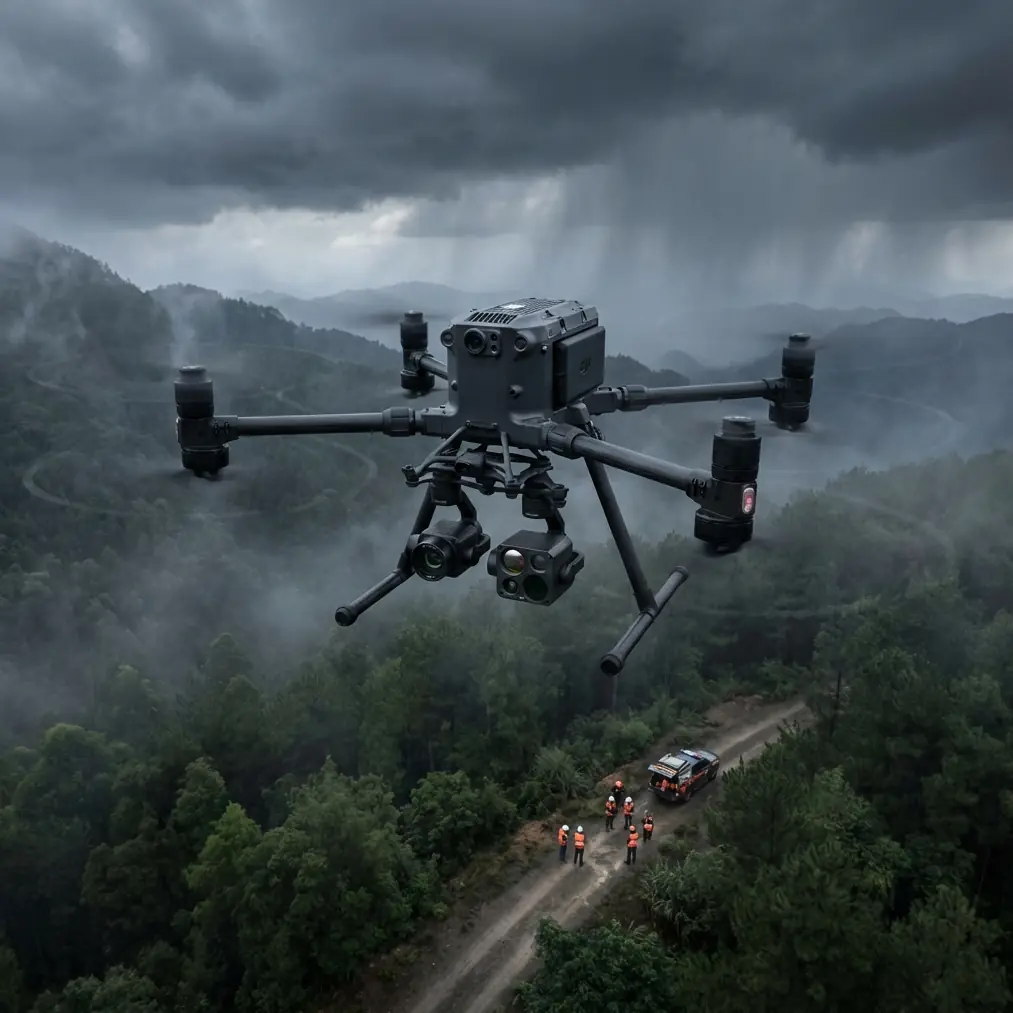
Expert Scouting With Matrice 400 in Dusty Coastal Conditions
META: A technical review of how Matrice 400-class operations benefit from proven aircraft lighting and flight-control design principles when scouting dusty coastlines, with practical antenna and mission-planning advice.
Coastal scouting looks simple until the environment starts stacking penalties against the aircraft. Salt haze cuts contrast. Fine dust gets everywhere. Wind direction shifts between dunes, cliffs, and access roads. The pilot is often trying to maintain reliable video and control links while collecting usable thermal and visual data over long, repetitive corridors. That is exactly where a platform like the Matrice 400 becomes more interesting—not because of headline specs alone, but because serious field performance depends on old, stubborn engineering truths that were settled long before today’s enterprise UAV marketing language.
Two of those truths show up clearly in the reference material behind this article: lighting must be isolated and purposeful, and flight-control confidence must be earned through simulation and system testing. Those may sound like design-office concerns, yet they directly affect how a Matrice 400 should be evaluated and operated for civilian shoreline work.
What the old aircraft design rules still teach us about a modern enterprise drone
One source states that anti-collision lighting should be controlled by a switch independent of other exterior lights. That is not trivia. It reflects a broader design principle: visual systems with different operational purposes should not be bundled into one blunt control logic. For coastal scouting, this matters more than many crews realize.
When you are flying near reflective water, airborne salt, and light-colored sand, every unnecessary lumen can become noise. External lighting that helps a crew maintain aircraft awareness may be useful during launch, recovery, or low-visibility coordination near ground personnel. But the illumination needed for situational conspicuity is not the same as the lighting profile that minimizes glare in the pilot’s view or unwanted reflections into a payload sensor. The source material pushes this separation even further in its landing-light guidance by stressing that installation should avoid direct or reflected light in the cockpit area. Translate that into UAV practice and the lesson is obvious: any auxiliary lighting, beacon behavior, or payload-facing illumination on a Matrice 400 mission should be managed with sensor performance in mind, not merely visibility.
That becomes especially relevant if your coastline task involves thermal signature analysis. A thermal sensor is not “seeing” light the way an RGB camera does, but mission quality still suffers when crews overlook light management. Why? Because the human operator’s ability to interpret the scene, maintain orientation, and react to changing terrain is influenced by glare, reflections, and visual clutter. If a pilot is fighting the display rather than reading it cleanly, thermal anomalies near rock edges, debris lines, or infrastructure transitions are easier to miss.
Why beam geometry matters even when you are not using traditional landing lights
The same aircraft design reference gets unusually specific about landing-light effectiveness. It calls for enough landing lights to deliver at least 21 lx vertical illuminance at a defined point ahead of the aircraft on the ground. Again, this is not about copying fixed-wing lighting architecture onto a drone. It is about respecting geometry.
The text also emphasizes that the illuminated area must remain visible to the operator through the landing profile, without being blocked by the aircraft’s own structure. On a Matrice 400 scouting coastline, the equivalent question is this: can the aircraft’s payload and sensor arrangement continue to provide a clean, unobstructed look where the mission actually needs it, across all relevant attitudes and transitions?
That matters during low-altitude shoreline passes, especially in dusty conditions where the aircraft may need to climb and descend frequently to maintain safe stand-off from terrain or to preserve line-of-sight over scrub and ridge features. If the gimbal or sensor suite is positioned in a way that works perfectly in brochure footage but becomes compromised in forward flight attitude, the resulting dataset will have gaps exactly where the client needs consistency.
This is one reason photogrammetry over coastlines is less forgiving than inland mapping. Water edges are already difficult because wave motion, specular reflections, and texture-poor surfaces challenge reconstruction. Add airborne dust and directional sun, and now your image overlap can remain numerically acceptable while practical reconstruction quality drops. A well-run Matrice 400 mission should therefore be planned around payload view geometry, not just overlap percentages. If you are capturing shoreline condition reports, erosion baselines, or access-track assessments, your GCP strategy also needs to account for surfaces that stay visually stable and recoverable between tidal and wind changes.
Dusty coastline work is really a systems discipline
The second reference document, focused on helicopter flight-control development, makes a stronger point than most drone buyers ever hear: mathematical simulation should begin early, system behavior should be tested in theory before hardware decisions harden, and half-physical simulation should then validate whether the product actually satisfies requirements. It also notes that simulation accuracy can become the source of serious disagreement, and describes a case where teams only aligned after using unified models, unified aerodynamic data, unified initial conditions, and unified operating states.
That should resonate with anyone selecting or deploying a Matrice 400 for BVLOS-style corridor scouting, even if the operation itself remains inside current local authorization limits. A mature enterprise drone is not just a flying camera. It is a stack of control laws, sensor assumptions, link behavior, automation logic, obstacle responses, and operator workflows. If you are scouting coastlines in dust, you are putting stress on all of them at once.
The practical takeaway is that evaluating Matrice 400 readiness should look more like system validation than a casual field demo. Before the first production mission, teams should simulate their real operating profile as closely as possible:
- long linear route segments
- repeated turns along irregular shoreline geometry
- variable altitude bands above dunes, rocks, and man-made structures
- degraded visual contrast from haze and dust
- thermal/RGB switching under shifting surface temperatures
- communications reliability at the edge of acceptable range
This is where features hinted at in the project context—such as O3 transmission, AES-256, hot-swap batteries, and potential BVLOS workflows—become operationally meaningful rather than promotional.
O3 transmission matters because coastline scouting often forces the aircraft farther laterally than a compact industrial site would. Range is never just a published maximum. It is a live negotiation with antenna alignment, terrain masking, atmospheric clutter, and pilot discipline. AES-256 matters because shoreline surveys frequently involve critical infrastructure, private land boundaries, or commercially sensitive inspection data. Hot-swap batteries matter because coastlines reward continuity; if you can rotate power with minimal mission disruption, you preserve environmental consistency between passes and reduce the odds that changing tide, light, or airborne dust will fragment the dataset.
Antenna positioning advice for maximum range on coastal routes
The simplest range mistake I see in shoreline work is crews aiming the controller at the aircraft like a flashlight. That is rarely optimal.
For maximum practical range with an O3-class link, think about antenna orientation in terms of radiation pattern, not pointing drama. In most field setups, the strongest part of the pattern is broadside to the antenna face rather than off the tip. If you point the antenna ends directly at the drone, you may actually be presenting a weaker part of the pattern. Instead, keep the antenna faces oriented toward the aircraft’s flight path corridor so the side of the pattern, not the tip, is doing the work.
A few habits make a measurable difference:
- Stand where the first third of the route is clean. Do not launch from behind a vehicle, a concrete utility hut, or a dune crest and expect the link to sort itself out.
- Gain elevation before you gain distance. A short climb early can clear scrub, beach furniture, parked machinery, and micro-relief that silently degrades signal quality.
- Avoid body shadowing. When the aircraft moves laterally down the coast, operators often twist at the waist while the controller stays low and partly blocked by the torso.
- Use the coastline shape, not just the map. A straight line on your planning screen may still place the aircraft behind rocky outcrops or embankments from your actual controller position.
- Reposition before the link becomes marginal. In corridor work, walking the controller team forward between flight legs can outperform trying to nurse one heroic flight from a poor spot.
If you want to compare route geometry or controller stance for a specific shoreline layout, you can message the flight team here and sanity-check antenna placement before going on site.
Sensor discipline beats sensor abundance
Matrice 400 discussions often drift toward payload versatility, and fairly so. But on dusty coasts, too many teams treat payload flexibility as a substitute for mission discipline. It is not.
If your goal is thermal signature review, decide early what thermal contrast actually matters. Buried moisture migration? Warm electrical components in coastal infrastructure? Wildlife exclusion for maintenance planning? Retained heat in recently disturbed ground? Each target behaves differently across the day. Dust and salt haze can flatten your visual interpretation of context even when the thermal layer still appears useful, so collect enough RGB reference to explain what the thermal image is showing. That is the difference between an impressive-looking heat map and a defensible report.
For photogrammetry, maintain consistent altitude and overlap, but do not stop there. Coastline reconstruction quality often collapses at boundaries: wet sand to dry sand, rock to foam, riprap to shadow, vegetated berm to access track. Use GCPs where they will remain identifiable and legally accessible, and avoid assuming natural features at the tide line will remain stable enough for repeatable control. The mission is not complete when the aircraft lands. It is complete when the model closes with the accuracy the client expects.
Why testing philosophy should influence how you buy and deploy Matrice 400
The helicopter design reference makes another point that deserves more attention: poor simulation accuracy can delay development, create disagreement, and waste time until teams standardize assumptions. Drone operators run into a smaller version of the same problem when procurement, pilots, and data teams evaluate aircraft from different mental models.
One group may care about transmission range. Another may care about mapping throughput. Another may care about automation stability over repetitive tracks. Another may focus on how quickly battery changes can occur without resetting the whole rhythm of the mission. If those groups test under different conditions, they can reach contradictory conclusions about the same airframe.
A serious Matrice 400 evaluation for coastal work should therefore use unified conditions:
- same route shape
- same wind window
- same payload set
- same launch location
- same image and thermal deliverables
- same battery rotation plan
- same controller stance and antenna orientation
- same criteria for acceptable link margin and data quality
That sounds strict because it should be. The reference case in the flight-control document shows how even technically competent teams can diverge when the model is not aligned. In UAV operations, that divergence appears as arguments over whether the aircraft underperformed or the test was sloppy.
The real value of a mature platform offshore and along shore
What makes a Matrice 400-class platform compelling for coastline scouting is not one isolated feature. It is the way stable control behavior, secure transmission, sensible power management, and payload utility reinforce each other in a difficult environment.
The lighting-design reference reminds us that visibility systems must serve distinct purposes without interfering with the operator. The flight-control reference reminds us that trust in an aircraft comes from careful modeling and staged validation, not wishful thinking. Put those together and you get a better way to judge Matrice 400 suitability: not by chasing spec-sheet superlatives, but by asking whether the aircraft can deliver clean sensor work, predictable handling, and resilient link performance in the exact coastal conditions you actually face.
For dusty shoreline scouting, that means disciplined antenna setup, realistic route testing, thoughtful sensor timing, and a payload view that stays useful through attitude changes and terrain transitions. The crews who get the best results with enterprise drones are rarely the ones trying to do something flashy. They are the ones quietly applying sound aircraft thinking to unmanned work.
Ready for your own Matrice 400? Contact our team for expert consultation.