
Matrice 400 scouting tips for remote fields
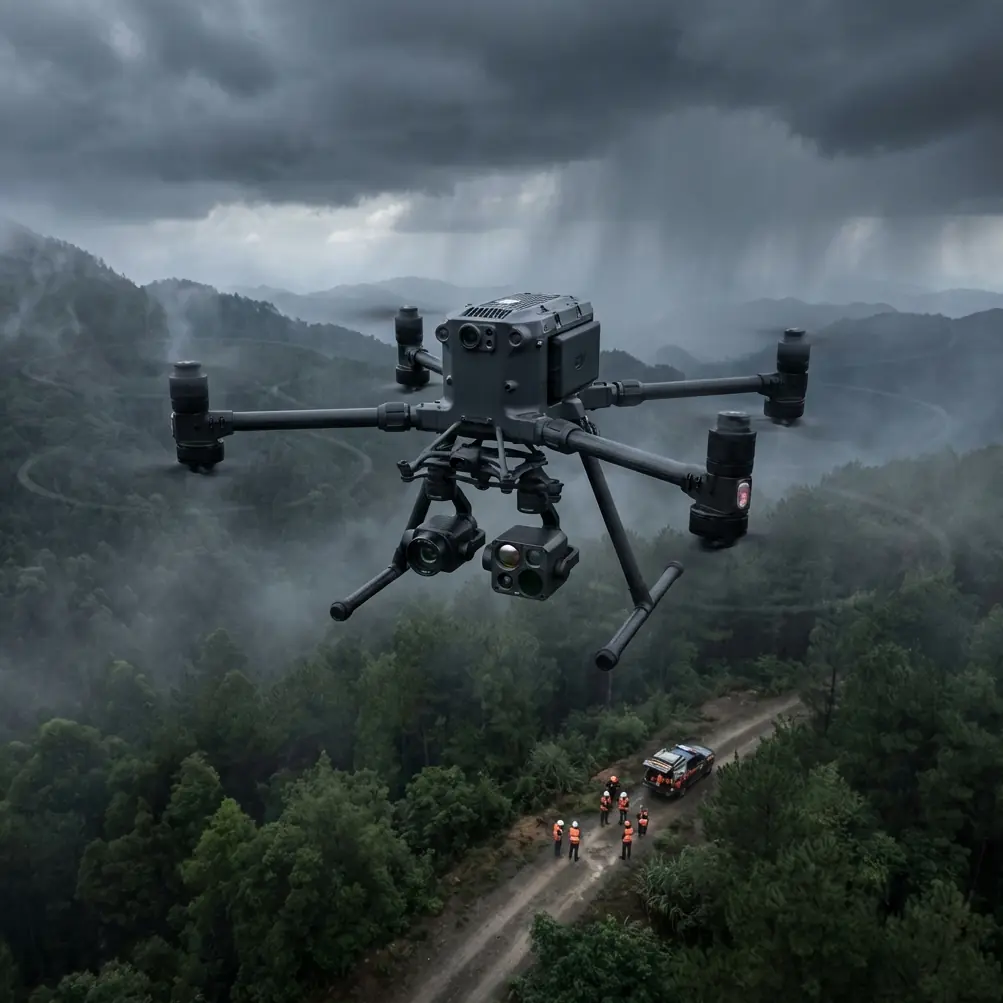
Matrice 400 scouting tips for remote fields: what actually matters in the first hour on site
META: Practical Matrice 400 field scouting methods for remote operations, with expert insight on flight stability, thermal workflow, photogrammetry planning, transmission reliability, and why classic aircraft design principles still matter.
Remote field scouting looks easy on a map. In practice, it rarely is.
The first time I had to assess a large, wind-exposed agricultural block far from paved access, the aircraft was only half the challenge. The real problem was control during takeoff and landing on uneven ground, keeping image quality consistent while the aircraft absorbed crosswind effects, and making sure the mission data was usable before we lost daylight. That experience changed how I judge any new enterprise platform, including the Matrice 400.
If you are evaluating the Matrice 400 for remote field scouting, don’t start with the brochure mindset. Start with the first 20 minutes of the mission: launch, stabilize, verify link quality, capture a usable thermal and visible baseline, and recover safely from rough terrain. That is where platform quality shows up.
What makes this especially interesting is that some of the most relevant lessons are not new at all. They come from older aircraft design logic that still governs how any airframe behaves close to the ground.
Why takeoff and landing discipline matters more than most scouting teams admit
One of the reference materials behind this discussion is a section from an aircraft design handbook focused on takeoff and landing control, specifically Chapter 27. It deals with lateral and directional behavior, wheel side-force relationships, and body-axis motion equations during ground handling. On the page cited, the handbook explicitly references the front wheel equivalent side-force coefficient and ties it to side-force gradient behavior. It also presents the body-axis lateral-directional equations and a practical solving method using iterative trial steps when unknowns interact.
That sounds academic until you operate in remote fields.
A Matrice 400 may not be a crewed aircraft, but the operational lesson carries over cleanly: when your aircraft transitions through the lowest and most vulnerable parts of the envelope, small lateral disturbances matter. Crosswind, uneven launch points, soft ground, and abrupt pilot inputs can all compound into poor mission starts. For a field team, that has consequences beyond simple inconvenience:
- thermal frames captured immediately after launch may be skewed by unstable attitude,
- early photogrammetry overlap can degrade if the platform has not settled,
- return-to-home accuracy depends on a clean initial positioning state,
- and rough recoveries cost time, confidence, and component life.
The handbook’s emphasis on lateral-directional equations is the deeper point. Stability is not a vague feeling. It is a system response. In remote scouting, that system response determines whether your aircraft gives you crisp, repeatable data or noisy, partially compromised imagery.
So when I assess a Matrice 400 for field work, I watch the launch and landing behavior first. Not because they are dramatic, but because they reveal how forgiving the aircraft is when the environment is not.
Build your scouting plan around the payload sequence, not just the route
For remote field scouting, teams often default to a simple pattern: fly the perimeter, collect nadir imagery, then decide what to inspect more closely. That works, but it wastes one of the strongest advantages of a platform like the Matrice 400: the ability to merge detection and mapping in a single sortie.
My preferred sequence is different.
1. Establish a fast thermal signature pass
If the mission objective includes irrigation anomalies, stressed crop zones, livestock location, drainage issues, or heat-producing equipment near the field edge, a thermal signature pass should come first. Early in the sortie, battery state is highest, link margin is strongest, and you get a quick operational read on whether deeper inspection is needed.
Thermal data is especially useful in remote areas because it compresses the decision cycle. You do not need to visually inspect every acre at equal intensity if thermal contrast already tells you where the real deviations are.
2. Follow with a structured visible-light mapping segment
Once the hot spots or suspect zones are identified, switch to a more disciplined photogrammetry pattern. This is where overlap, altitude consistency, and speed control matter more than enthusiasm. If you are producing a stitched map or crop health baseline, a stable platform is more valuable than a fast one.
3. Add targeted low-altitude passes only after the map logic is secure
Remote teams often get tempted into “just one closer look” too early. That can break the mission flow. First secure the broad dataset. Then use the Matrice 400’s transmission and control confidence to conduct selective detail passes.
That sequencing protects mission value. If weather or access constraints cut the operation short, you still return with useful intelligence.
Photogrammetry in remote fields: where Matrice 400 can save you from redo work
Photogrammetry is unforgiving about sloppiness. The aircraft may fly beautifully, but your map can still fail if your field process is casual.
This is where older engineering references help frame modern UAV practice. The same source material that discusses lateral-directional control during takeoff and landing also includes a note about solving coupled unknowns through iterative steps, rather than pretending a single variable can be isolated cleanly. That is exactly how real photogrammetry missions behave in remote fields. Accuracy is not created by one factor. It emerges from interaction among airframe stability, camera geometry, overlap, terrain variation, light conditions, and control precision.
For the Matrice 400, that means your best results usually come from these habits:
- Set and verify your GCP strategy before the aircraft leaves the ground if the deliverable needs measurement-grade confidence.
- Avoid changing altitude logic mid-mission unless terrain forces it.
- Review first-image sharpness and exposure immediately, not after the entire block is flown.
- If the field is remote and recovery opportunities are limited, prioritize the segment most likely to be requested later by agronomy or operations teams.
A strong airframe and transmission link reduce the chances of blur, overlap inconsistency, and yaw-related stitching artifacts. That matters because redo flights in remote areas are expensive in time, energy, and logistics even if nobody calls them expensive.
O3 transmission is not a comfort feature in remote scouting
In city demos, transmission specs are easy to treat as marketing language. In remote field operations, they are operational infrastructure.
O3 transmission matters because field scouting often happens where line quality changes from excellent to marginal with very little warning. Terrain folds, tree belts, irrigation infrastructure, and long stand-off distances can all interfere with signal behavior. A stable transmission system does three things that directly improve scouting output:
- It preserves pilot confidence during long inspection legs.
- It keeps framing decisions precise when investigating anomalies.
- It reduces the urge to fly more aggressively “just to see better.”
That third point is underrated. Weak or inconsistent link quality leads pilots to make bad decisions: closer approaches than necessary, rushed camera work, or abandoning systematic coverage for improvised peeking. A robust transmission layer keeps the mission disciplined.
If your remote field program includes sensitive land-use data, AES-256 also becomes more than a technical footnote. Agricultural scouting increasingly involves proprietary crop plans, infrastructure layouts, and operational patterns. Secure transmission and data handling help protect that information chain, especially when teams work across contractors, landowners, and agronomy partners.
Hot-swap batteries change the pace of a real field day
Battery workflow is one of the fastest ways to tell whether a UAV platform fits remote scouting or merely visits it.
Hot-swap batteries matter because remote field operations are usually constrained by travel time, weather windows, and fatigue more than by flight theory. If you can replace power quickly without rebuilding the whole launch rhythm, you preserve mission continuity. That affects more than convenience:
- the pilot stays inside the mental model of the field,
- the observer keeps track of anomalies without restarting the survey logic,
- and the team can maintain a consistent sequence of thermal check, mapping, and spot inspection.
On large rural properties, this can be the difference between completing one coherent block and ending up with fragmented datasets that need stitching at both the map and workflow level.
When a platform supports efficient battery turnover, you spend less of the day recovering momentum.
How BVLOS thinking should shape even VLOS field scouting
Even if your current operation remains within visual line of sight, planning with BVLOS discipline improves outcomes.
That means asking harder questions before launch:
- Where are your terrain-induced blind sectors?
- Which segment of the route has the weakest recovery options?
- What is the trigger point for abandoning a detail pass and preserving survey completion?
- How will you validate that the thermal signature anomaly you found is worth a second orbit?
The Matrice 400 makes this kind of planning more practical because it sits in the class of aircraft expected to support serious industrial workflows, not casual overflight. Remote field scouting benefits from that mindset. You stop flying “to look around” and start flying to answer defined operational questions.
That shift is where conversion to useful field intelligence happens.
A note on materials and why durability should not be treated as an afterthought
The second reference source is a materials handbook table of contents, and at first glance it looks less directly relevant. But the sections it highlights are exactly the ones serious operators should care about: density, thermal conductivity, linear expansion coefficient, mechanical properties, stress-strain curves, and fatigue performance. One cited page references the stress-strain curve; another points to broader mechanical and physical property sections.
Why does this matter for a Matrice 400 buyer focused on remote scouting?
Because remote field work punishes hardware in a specific way. It is not only about crashes. It is about repeated transport vibration, temperature swings, dusty pack-downs, uneven landing surfaces, and constant setup cycles. A platform designed for enterprise use has to survive recurring mechanical loads without gradually compromising alignment, fit, or structural confidence.
The materials-handbook angle reminds us that durability is engineering, not branding. Stress-strain behavior affects how components tolerate repeated loading. Fatigue behavior affects long-term reliability. Thermal expansion matters when equipment moves between cool transport cases and hot open fields. For remote operations, these are not abstract lab concerns. They influence calibration stability, payload mounting consistency, and the confidence to deploy the same aircraft day after day.
If you are comparing platforms, ask not only how they fly when new, but how they hold tolerances after a season of field work.
My practical tutorial workflow for a first Matrice 400 field-scouting day
If I were introducing a team to the Matrice 400 for remote field scouting, I would use this workflow.
Pre-launch
Confirm mission objective before payload selection. Not every field job needs the same balance of thermal inspection and photogrammetry. Lay out GCPs if output accuracy demands them. Review wind direction relative to launch and recovery area. Identify the safest initial climb corridor.
First lift
Keep the first minute boring. That is good. Watch for clean attitude stabilization and verify link health immediately. If the environment is rough, this is where the aircraft tells you whether the rest of the mission will be easy or annoying.
Thermal reconnaissance
Run a fast, deliberate pass to identify irrigation issues, equipment heat, drainage contrast, or biological anomalies. Do not chase every heat source at once. Mark and move.
Mapping segment
Fly the structured photogrammetry block while aircraft state, light, and operator attention are still fresh. Lock in your overlap logic and avoid mid-course improvisation.
Targeted inspections
Return to the marked anomalies for closer visible or thermal review. Use the stronger baseline context from the mapping segment to decide what actually deserves attention.
Battery transition
Use hot-swap rhythm to continue the same mission logic rather than restart with a different mindset. Continuity is a hidden efficiency.
Recovery
Treat landing as part of data quality assurance. Rough recoveries can create avoidable downtime, especially in remote areas where the next mission may depend on the same aircraft within hours.
If your team wants a field-specific mission checklist, this direct WhatsApp discussion for Matrice 400 planning is often the fastest way to sort out payload mix, battery rotation, and mapping workflow before deployment.
The real value of Matrice 400 for remote fields
The Matrice 400 should be judged by what it removes from the job.
Not glamour. Friction.
It reduces the friction between launch and first usable data. Between anomaly detection and mapped context. Between one battery cycle and the next. Between secure transmission and practical field distance. Between a rough field edge and a professional-grade result.
And that is why the older aircraft and materials references are more relevant than they appear. The aerodynamics material points us back to control authority and stability where operations are most fragile: takeoff, landing, lateral correction, coupled motion. The materials material reminds us that enterprise performance depends on physical endurance, not just electronics and software.
For remote field scouting, those fundamentals still decide whether a platform is merely capable or genuinely dependable.
That is how I would frame the Matrice 400 after years of seeing what goes wrong in the field. The best aircraft is not the one that looks strongest on a spec sheet. It is the one that makes the whole scouting day calmer, cleaner, and easier to trust.
Ready for your own Matrice 400? Contact our team for expert consultation.