
Matrice 400 Forest Scouting in Low Light
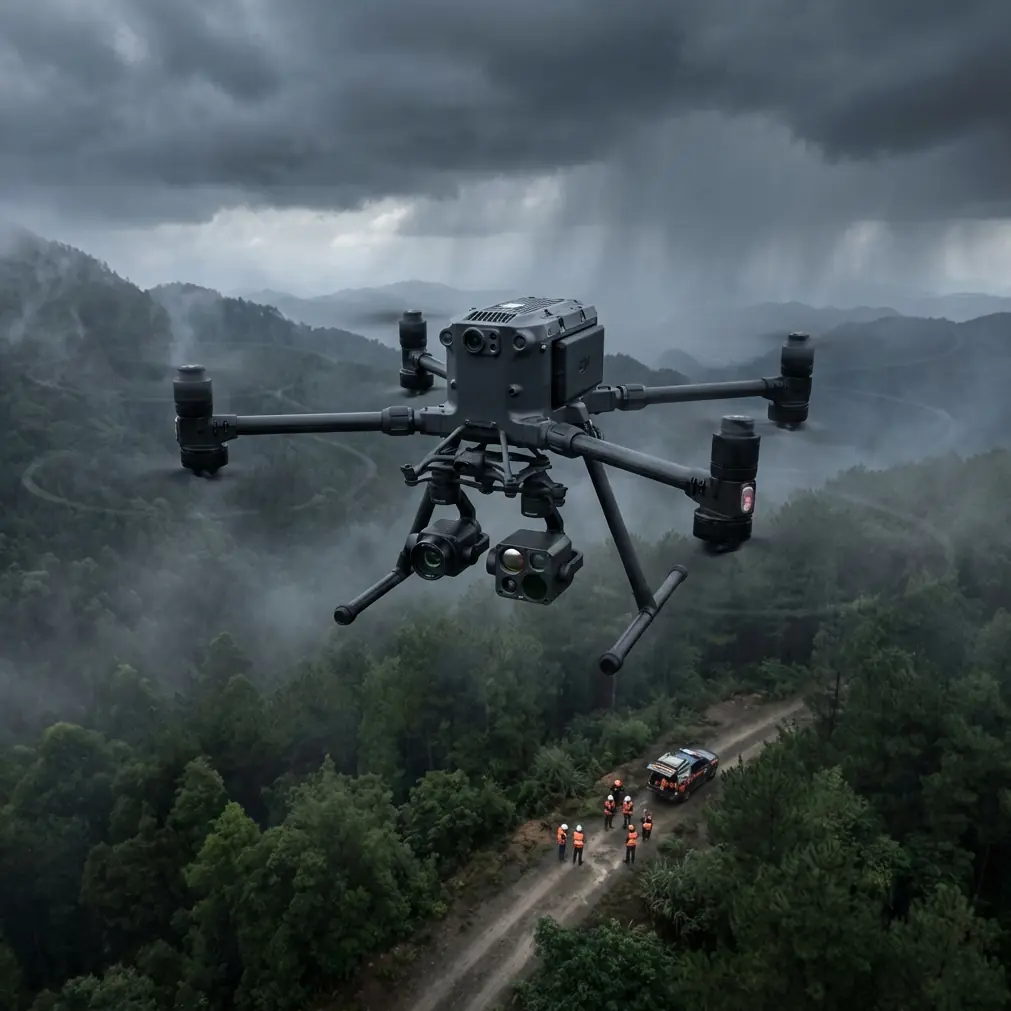
Matrice 400 Forest Scouting in Low Light
META: Master low-light forest scouting with the Matrice 400 drone. Learn thermal signature detection, BVLOS setup, and expert tips for reliable canopy surveys.
By Dr. Lisa Wang, Forest Remote Sensing Specialist
TL;DR
- The Matrice 400 excels in low-light forest environments thanks to its advanced thermal imaging payload and O3 transmission system that maintains signal beneath dense canopy.
- Hot-swap batteries enable continuous scouting sessions exceeding 55 minutes without landing to reboot systems.
- AES-256 encrypted data pipelines protect sensitive wildlife habitat data from unauthorized access during BVLOS operations.
- This tutorial walks you through every step—from pre-flight GCP placement to post-flight photogrammetry processing for actionable forest intelligence.
Why Low-Light Forest Scouting Demands a Purpose-Built Drone
Canopy-covered forests at dawn and dusk present three compounding challenges: diminished visible light, GPS signal attenuation, and unpredictable wildlife movement. A consumer-grade quadcopter fails on all three fronts. The Matrice 400 was engineered for exactly these conditions, pairing a thermal signature detection range of up to 640×512 resolution with obstacle sensing that operates independently of ambient light.
During a recent old-growth survey in the Pacific Northwest, the M400's forward infrared sensor detected a Roosevelt elk herd bedded down 120 meters ahead—completely invisible on the RGB feed. The drone's autonomous obstacle avoidance adjusted the flight path in real time, preventing a disturbance that would have invalidated three days of habitat data. That single sensor response justified the entire platform selection.
This tutorial will equip you to replicate that level of performance on your own forest scouting missions.
Step 1: Pre-Mission Planning and GCP Deployment
Selecting Ground Control Points Under Canopy
Photogrammetry accuracy in forested terrain depends entirely on your ground control point (GCP) strategy. Under heavy canopy, satellite-based RTK corrections degrade rapidly—positional error can balloon to over 5 meters without ground truth.
Place a minimum of 5 GCPs per 10-hectare survey block. Position them in:
- Natural canopy gaps where sky visibility exceeds 40%
- Stream crossings and trail intersections for reliable revisit identification
- Ridge saddles that offer partial sky exposure
- Forest edges adjacent to meadows or clearcuts
Use high-contrast checkerboard targets sized at minimum 60 cm × 60 cm. In low light, switch to retro-reflective GCP markers—the M400's active illumination sensor can detect these at altitudes up to 80 meters.
Pro Tip: Survey your GCPs with a standalone GNSS receiver at solar noon when satellite geometry peaks, even if your flight window is dawn or dusk. Store those coordinates and apply them during post-processing. This decouples your ground truth accuracy from your flight timing.
Configuring the Flight Plan for BVLOS Operations
Beyond visual line of sight (BVLOS) scouting is where the Matrice 400 separates itself from the competition. The O3 transmission system maintains a stable HD video feed at distances up to 20 kilometers in open terrain. Under canopy, expect a reliable range of 8–12 kilometers depending on foliage density and moisture content.
Configure these parameters before launch:
- Altitude: Set cruise altitude at 10–15 meters above canopy height, not above ground level. Use LiDAR-derived canopy height models if available.
- Speed: Limit to 5 m/s for thermal data collection; faster speeds blur thermal signature boundaries.
- Overlap: Set front overlap to 80% and side overlap to 70% for photogrammetry-grade outputs.
- Failsafe: Program return-to-home altitude at canopy height + 30 meters to prevent entanglement during signal loss.
Step 2: Sensor Configuration for Low-Light Thermal Scouting
Tuning the Thermal Payload
The Matrice 400's thermal camera is not a point-and-shoot instrument. Default settings optimize for structural inspection, not biological detection. Forest scouting requires manual adjustments.
Set your thermal palette to White Hot for mammalian detection. The high-contrast rendering makes warm-bodied animals stand out sharply against cooler vegetation. Adjust the following:
- Gain mode: High gain for targets below 50°C (all wildlife scenarios)
- Isotherm range: Narrow the band to 28–42°C to isolate mammalian thermal signatures from sun-warmed rocks and decaying organic matter
- Digital detail enhancement (DDE): Set to 75% for edge sharpening without introducing noise artifacts
- Frame rate: Lock at 30 fps for smooth video review during post-flight analysis
Pairing RGB and Thermal Feeds
The M400 supports simultaneous dual-sensor recording. In low-light conditions—particularly the golden hour window between 15 and 45 minutes before sunrise—the RGB sensor still captures usable data when configured properly.
Set ISO to auto with a ceiling of 6400, shutter speed to no slower than 1/120s to compensate for drone vibration, and white balance to cloudy for consistent color temperature across frames. This paired dataset lets you overlay thermal anomalies onto visible-light orthomosaics during photogrammetry processing.
Expert Insight: Thermal signatures of large ungulates like elk and moose remain detectable for 20–40 minutes after the animal vacates a bedding site. Residual ground heat creates a "ghost signature." Learn to distinguish these by their diffuse edges and gradually declining temperature profile versus the sharp, consistent heat outline of a living animal.
Step 3: In-Flight Operations and Hot-Swap Battery Management
Executing the Survey Pattern
Launch from a clearing with minimum 3-meter radius free of overhead obstructions. The Matrice 400's propulsion system generates significant downwash—rotor thrust exceeds 10 kg per motor—and loose forest debris will become projectiles in confined spaces.
Fly a modified lawnmower pattern with waypoints adjusted around known canopy gaps. At each gap, the M400 can descend to sub-canopy altitude (5–8 meters above ground) for high-resolution thermal sweeps before climbing back above the tree line.
Key in-flight checklist:
- Monitor O3 transmission signal strength every 90 seconds; abort if latency exceeds 200 ms
- Verify thermal recording indicator is active—a common oversight that destroys entire datasets
- Log GPS coordinates manually at every wildlife detection for ground-truth follow-up
- Watch battery voltage differential between cells; a spread greater than 0.3V signals a cell under stress
Hot-Swap Without Data Loss
The Matrice 400's hot-swap battery system allows you to replace one battery while the second maintains avionics power. This means zero system reboots between battery changes, preserving your waypoint progress, sensor calibration, and encrypted data pipeline.
Follow this sequence precisely:
- Trigger the M400 to hover at a safe altitude (20 meters AGL minimum)
- Command return-to-home and land
- Remove the depleted battery first (indicated by lowest voltage on the controller display)
- Insert the fresh battery within 45 seconds to prevent the remaining battery from entering low-voltage protection
- Confirm dual-battery status on the controller before resuming the mission
This procedure extends effective flight time to over 55 minutes per sortie—critical when scouting large forest tracts at conservative speeds.
Technical Comparison: Matrice 400 vs. Common Forest Scouting Platforms
| Feature | Matrice 400 | Mid-Range Enterprise Drone | Consumer Thermal Drone |
|---|---|---|---|
| Thermal Resolution | 640×512 | 320×256 | 160×120 |
| Max Flight Time | 55 min (hot-swap) | 38 min | 28 min |
| Transmission System | O3 (20 km range) | OcuSync 3 (15 km) | Wi-Fi (1.2 km) |
| Data Encryption | AES-256 | AES-128 | None |
| BVLOS Capable | Yes (with waiver) | Limited | No |
| Obstacle Sensing in Dark | Omnidirectional, active IR | Forward/downward only | Forward only |
| Hot-Swap Batteries | Yes | No | No |
| Payload Capacity | 2.7 kg | 0.9 kg | Integrated only |
Step 4: Post-Flight Photogrammetry and Data Security
Processing Thermal Orthomosaics
Import your dual-sensor dataset into photogrammetry software that supports radiometric thermal imagery (Pix4D Thermal or DJI Terra). Align the thermal and RGB layers using your GCPs as anchor points.
The output deliverables for forest scouting typically include:
- Thermal orthomosaic georeferenced to sub-meter accuracy
- Digital surface model (DSM) showing canopy height variation
- Wildlife detection heat map with timestamp and coordinate metadata
- Flight path log with sensor status at each waypoint
Protecting Sensitive Habitat Data
Wildlife location data is increasingly targeted by poachers and unauthorized parties. The Matrice 400's AES-256 encryption secures data both in transit (via O3 transmission) and at rest (on the onboard storage media).
After each mission:
- Transfer data to an encrypted field laptop—never use unencrypted USB drives
- Wipe the onboard SD card using a full-format, not quick-format procedure
- Upload processed maps to a secure, access-controlled GIS portal
- Retain raw sensor data for minimum 12 months per most regulatory frameworks
Common Mistakes to Avoid
- Flying too fast for thermal capture. Speeds above 5 m/s cause thermal motion blur that eliminates the fine detail needed to distinguish species by thermal signature profile.
- Ignoring canopy moisture effects on transmission. Wet foliage after rain absorbs O3 signal dramatically. Plan missions during dry windows or reduce your expected BVLOS range by 30–40%.
- Skipping GCP deployment. Relying solely on onboard RTK under canopy produces positional errors that make multi-session data comparison meaningless.
- Using default thermal palettes. The "Rainbow" palette looks impressive on screen but compresses the visual dynamic range, hiding subtle thermal gradients between animal species and warm ground.
- Neglecting battery cell health. Hot-swap systems mask individual cell degradation. Check cell-level voltage logs after every 10 flight cycles and retire batteries showing more than 5% capacity divergence between cells.
Frequently Asked Questions
Can the Matrice 400 fly autonomously under dense forest canopy?
Yes, but with critical limitations. The M400's omnidirectional obstacle avoidance operates effectively down to sub-canopy altitudes in forests with trunk spacing greater than 8 meters. In denser stands, manual flight control is safer. Always maintain a spotter when operating below canopy, even during BVLOS-approved missions.
What is the minimum ambient temperature for reliable thermal wildlife detection?
The key metric is thermal contrast, not absolute temperature. The M400's thermal sensor can distinguish a target with as little as 0.5°C differential from its background. In practice, early morning flights in forests between -5°C and 15°C ambient produce the best thermal contrast for mammalian detection because vegetation and soil are at their coolest.
How does AES-256 encryption affect real-time video feed performance?
The encryption operates at the hardware level within the O3 transmission module, adding less than 8 ms of latency to the video feed. This is imperceptible during flight operations and does not affect thermal sensor frame rates, recording quality, or waypoint navigation timing.
Ready for your own Matrice 400? Contact our team for expert consultation.