
Matrice 400 for Coastal Highway Scouting
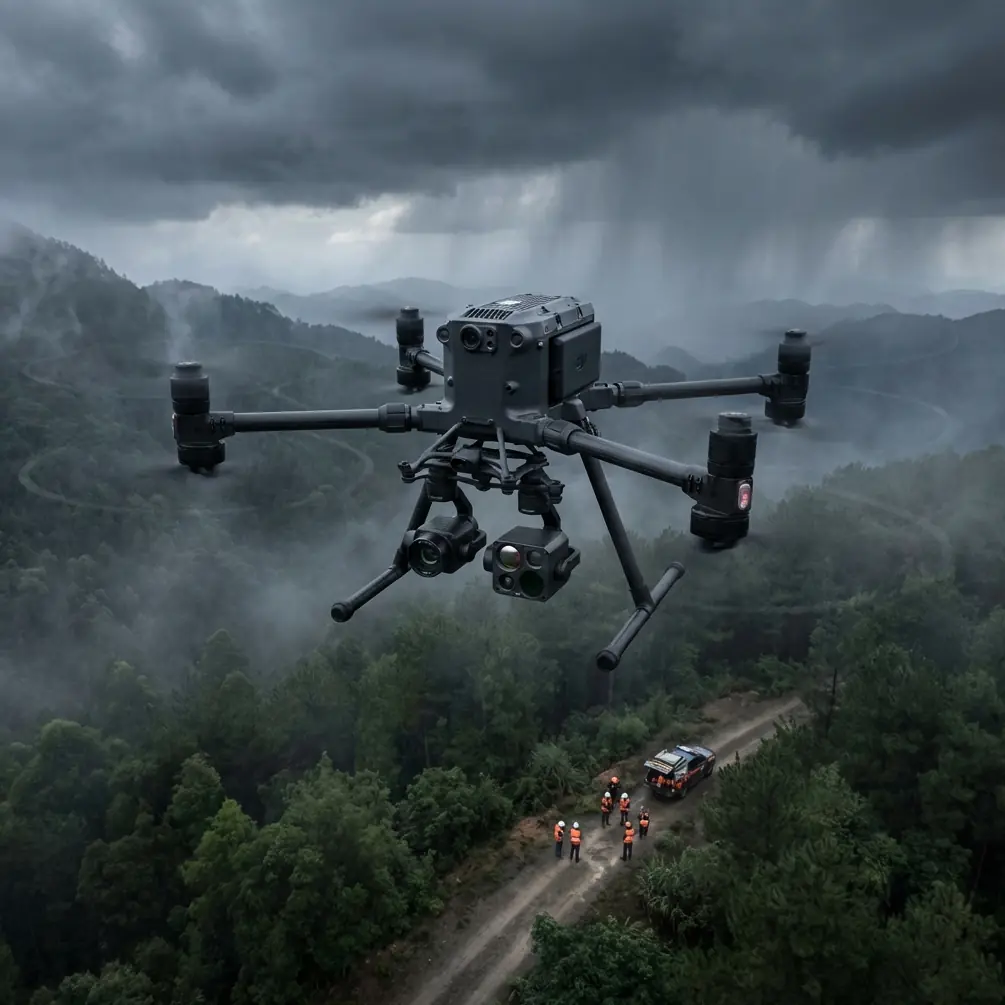
Matrice 400 for Coastal Highway Scouting: A Technical Review from the Field
META: Expert technical review of the Matrice 400 for coastal highway scouting, covering thermal imaging, photogrammetry, O3 transmission, AES-256 security, hot-swap batteries, GCP workflows, and BVLOS-ready operations.
Coastal highway scouting is one of those missions that looks straightforward on paper and turns awkward the moment the aircraft lifts off. Salt haze eats contrast. Crosswinds build around overpasses and cuttings. Traffic patterns shift faster than a ground team can reposition. And if the corridor crosses wetlands or cliff edges, the job stops being only about pavement, culverts, and retaining walls. It becomes an exercise in reading terrain, wildlife movement, and signal reliability at the same time.
That is exactly where the Matrice 400 deserves a hard, technical look.
I have approached this platform from the perspective of corridor intelligence rather than broad marketing claims. For a team surveying highways along a coastal route, the central question is not whether the aircraft is “advanced.” The real question is whether it reduces operational friction while preserving data quality under difficult environmental conditions. In that context, the Matrice 400 stands out not because of one headline feature, but because several system-level capabilities line up unusually well with the demands of linear infrastructure work.
The most practical of those capabilities starts with endurance management. Highway scouting rarely rewards repeated shutdowns and re-launches. If your aircraft has to come down every short interval for power changes, the mission fragments. Ground control points go cold in changing light. Traffic queues move. Tidal edges shift. Wind along the carriageway evolves. A platform built around hot-swap batteries changes the operational rhythm in a meaningful way. Instead of treating each battery cycle as a hard break, crews can keep the aircraft available with far less dead time between legs. That matters in coastal work because survey windows are often narrow. You may have a brief period when glare is manageable, tide height is acceptable, and traffic density allows clean visual coverage of shoulders, drainage channels, and embankment surfaces. A hot-swap architecture protects that window.
The transmission stack matters just as much. Coastal highways often run through areas where line-of-sight is visually open but radio behavior is messy. Reflections from water, interference near industrial zones, and terrain masking around bluffs can all compromise confidence in the link. O3 transmission is not just a spec-sheet phrase in this setting. Operationally, it means a more stable control and video connection when the aircraft is pushed down long roadway segments or flown near complex shoreline geometry. For scouting teams, that translates into fewer conservative aborts and better continuity in the inspection record. If your objective is to identify shoulder erosion, delamination in bridge approaches, blocked drainage outlets, or vegetation encroachment before sending a manned crew, confidence in the live feed is part of mission safety, not a convenience.
Security is another point that serious infrastructure operators should not gloss over. Highway reconnaissance can involve sensitive imagery: bridge supports, access roads, service compounds, and sometimes adjacent energy or port infrastructure. AES-256 encryption has operational significance here because it supports a cleaner chain of custody for mission data and command links. When agencies or contractors are working under strict information-handling rules, secure transmission is not an abstract IT preference. It can be the difference between a deployable workflow and one that gets trapped in compliance review. For teams planning beyond visual line of sight operations, that security posture becomes even more important. BVLOS is always discussed in terms of range and regulations, but the less glamorous piece is data assurance. If the aircraft is gathering corridor intelligence over a long route segment, the integrity of the link and associated mission data cannot be treated as secondary.
What makes the Matrice 400 especially relevant for coastal highway scouting is how these systems combine with sensor-driven decision making. A standard visible-light inspection can tell you a lot about lane markings, barrier damage, washout risk, and rockfall debris. It cannot reliably tell you everything you need to know about moisture migration, heat anomalies in electrical roadside assets, or hidden animal presence near culverts and marsh crossings. Thermal signature analysis adds a second layer of truth.
One field scenario illustrates this well. During an early-morning coastal corridor exercise, a thermal sweep near a drainage crossing revealed a compact heat cluster moving irregularly along the vegetation edge just off the shoulder. On the RGB feed, the area looked like wind-tossed reeds and shadow. On thermal, it resolved into a small deer and her fawn moving toward a gap in the barrier near a culvert mouth. That is not an anecdote for color alone. It shows why thermal sensing can materially change flight behavior and ground-team planning. Instead of dropping lower for a closer visual pass that might have stressed the animals and added risk near traffic, the pilot maintained safer standoff, marked the location, and flagged the crossing as a recurrent wildlife interface zone. For highway authorities in coastal regions, wildlife movement is not peripheral to infrastructure scouting. It affects collision risk, fence planning, drainage design, and the timing of maintenance work. A platform that lets the crew detect and interpret those signatures early creates a better operating picture.
This is also where photogrammetry enters the discussion. Coastal roads degrade in ways that are spatially subtle at first. A shoulder edge begins to unravel. A drainage swale changes profile after repeated saturation. A retaining slope starts to creep by centimeters rather than meters. Those changes can be missed in casual visual inspection but become visible when repeatable map products are built correctly. The Matrice 400 is well suited to this sort of corridor documentation because it supports the disciplined capture needed for consistent photogrammetry rather than just ad hoc aerial viewing.
The key phrase there is “built correctly.” A lot of teams still overestimate what aerial imagery can do without a proper control framework. If the scouting mission has any intention of supporting engineering interpretation, GCP placement still matters. Ground control points anchor the map products to real-world coordinates and keep comparisons honest across multiple missions. In a coastal highway environment, that is especially important because shifting light, moisture sheen, and wind-disturbed vegetation can introduce noise into reconstruction. The aircraft can collect excellent image sets, but if the workflow ignores GCP discipline, the final surface model may look polished while quietly drifting in accuracy. The Matrice 400 does not remove the need for professional survey method. What it does is provide a more dependable airborne platform for carrying out that method at scale.
That scale is where the platform starts to separate itself from smaller aircraft. A coastal road inspection is often not a single isolated task. It may include pavement distress checks, bridge approach documentation, ditch and culvert review, erosion screening, signage inventory, and thermal inspection of associated roadside systems within one sortie block. A platform built for heavier-duty mission profiles can support more deliberate payload planning and less compromise between sensor priorities. For corridor teams, that reduces the number of separate deployments required to assemble a complete site picture.
There is also a less obvious advantage in how the Matrice 400 supports decision tempo. Coastal projects tend to involve overlapping stakeholders: transportation agencies, environmental monitors, survey contractors, and maintenance crews. The faster an aircraft can produce a trustworthy overview, the faster those groups can move from observation to action. That may mean scheduling shoulder repairs before a storm cycle, updating wildlife mitigation measures near a marsh crossing, or validating whether a suspicious warm area in a roadside cabinet requires an electrical inspection team. High-end platforms earn their keep when they shorten that interval between sensing and response.
Of course, none of this means the aircraft should be treated as a substitute for field judgment. BVLOS capability, for example, expands the geometry of what is possible along a highway corridor, but it also raises the standard for planning. Coastal wind gradients, temporary signal occlusion behind terrain, emergency landing analysis, and airspace coordination all become more consequential as distances increase. The Matrice 400 fits this future-oriented operating model better than lighter systems because its architecture aligns with longer, more structured missions. But the operator still has to build the safety case, understand local rules, and integrate the aircraft into a disciplined aviation workflow.
That same discipline applies to data handling. If a mission collects thermal evidence of wildlife activity, high-resolution imagery of road defects, and georeferenced models used for maintenance decisions, the output is no longer “just drone footage.” It is operational intelligence. Here, the pairing of secure transmission through AES-256 and a professional capture workflow becomes strategically useful. Infrastructure teams are under growing pressure to document not only what they observed, but how they observed it, how securely the data moved, and whether the information can withstand scrutiny later. A mature platform helps, but only if the organization uses it with that level of intent.
For teams trying to decide whether the Matrice 400 is truly suited to coastal highway scouting, my view is straightforward. The aircraft makes sense when the mission requires continuity, layered sensing, and a reliable link over linear infrastructure. Its hot-swap batteries matter because they preserve narrow operational windows. Its O3 transmission matters because coastal routes are deceptively difficult radio environments. AES-256 matters because transport and utility-adjacent imagery can carry real sensitivity. Thermal capability matters because not every hazard is visible in daylight color imagery. And photogrammetry supported by proper GCP workflow matters because maintenance budgets are shaped by measurements, not impressions.
If you are building a corridor program rather than flying occasional spot checks, those points are not minor. They determine whether the drone becomes a trusted scouting instrument or a flying camera that creates more files than decisions.
For organizations mapping out a deployment plan, I often recommend starting with a pilot corridor that includes at least one bridge approach, one drainage-heavy segment, and one wildlife-sensitive stretch. Run RGB and thermal collection in the same operational block. Place GCPs with intention rather than as an afterthought. Evaluate link stability over the full route, not only at the launch area. Then compare how quickly your team can turn airborne observations into maintenance or planning actions. That process reveals the aircraft’s value far better than a checklist ever will. If you need a technical sounding board for that kind of mission design, you can reach me through this field coordination channel: https://wa.me/example.
The Matrice 400 is not interesting because it is new or large or feature-dense. It is interesting because, in the specific context of coastal highway scouting, its design choices map closely to the operational problems that actually slow professionals down. That is the standard worth using.
Ready for your own Matrice 400? Contact our team for expert consultation.