
Matrice 400 for Remote Highway Scouting: Power Architecture
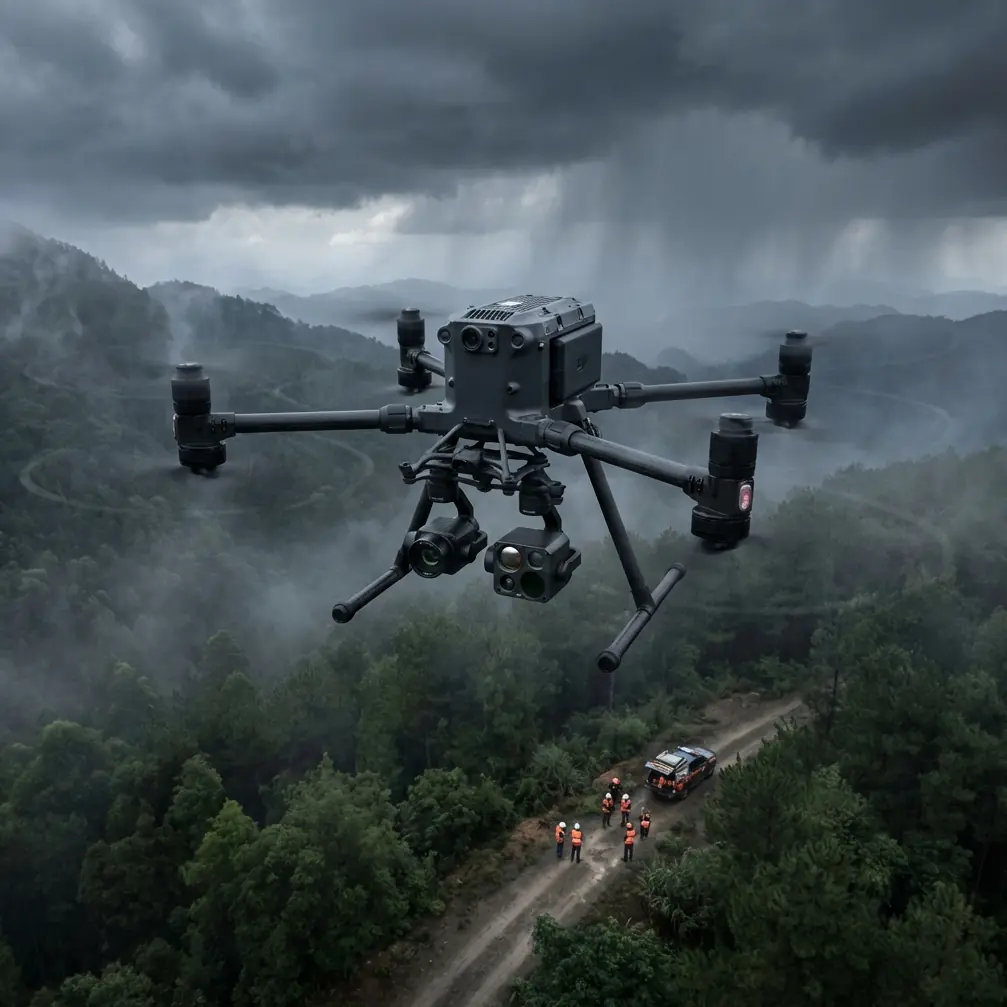
Matrice 400 for Remote Highway Scouting: Power Architecture, Flight Altitude, and Sensor Workflow That Actually Matter
META: A technical review of Matrice 400 best practices for remote highway scouting, with practical insight on flight altitude, power redundancy, payload reliability, thermal survey logic, and mapping workflow.
Remote highway scouting sounds simple until you stretch the mission profile. Long linear corridors, sparse infrastructure, weak recovery options, changing surface temperatures, and pressure to bring back usable data in one sortie—that combination punishes weak aircraft architecture.
That is why the most useful way to evaluate the Matrice 400 for this job is not by headline specs alone. It is by asking a tougher question: what design logic helps a large multirotor stay productive when a mission moves far from the nearest easy landing point?
For that, two technical ideas from classical aircraft design are surprisingly relevant. The first is electrical prioritization: critical loads must remain powered even when the primary generation path degrades. The second is mechanical acceptance discipline: the hidden quality of threaded assemblies and fastening interfaces matters because small geometric errors accumulate over time and vibration. Those may sound like handbook topics far removed from a modern UAV, but for remote highway scouting, they go straight to mission continuity.
Why power hierarchy matters more than raw endurance
A remote highway survey aircraft does not just need “enough battery.” It needs a power system that behaves intelligently when conditions worsen.
One of the reference design principles divides onboard equipment into three categories based on safety impact: critical equipment, important equipment, and non-important equipment. In the source material, critical equipment is the class whose failure would obstruct continued safe flight or landing, with a target failure rate on the order of 2×10^-7. Important equipment has a less severe but still major safety consequence, with a target below 10^-7. The practical lesson for Matrice 400 operators is clear: not every electrical load deserves equal protection during a long scouting run.
On a real highway mission, that means the aircraft should effectively prioritize flight control, navigation, command link integrity, and obstacle awareness above secondary mission loads. If conditions force energy conservation, the drone that can shed lower-priority functions while preserving essential ones is the drone that comes home with data instead of becoming a roadside recovery case.
The handbook language around an “important bus” and an “emergency bus” maps neatly onto field thinking for the Matrice 400. Even if operators never see that terminology in the user interface, the concept matters operationally. A resilient drone platform should preserve power to the equivalent of its emergency functions if all primary generation paths are compromised. The same source also notes that when only one generator remains, supply to the important load bus should still be maintained, while non-important equipment can be removed from service through automatic or manual load shedding. That is exactly the kind of logic you want in a heavy-lift commercial UAV carrying thermal and mapping payloads over remote pavement.
For corridor work, this affects planning in a very specific way: do not build your mission assumptions around full-load, full-feature operation from launch to landing. Build them around graceful degradation. If the aircraft needs to preserve the command link, nav solution, and stabilized imaging while trimming less essential load, that is not a failure. That is good system design.
Hot-swap batteries are not just convenient
Operators often talk about hot-swap batteries as a turnaround advantage. True, but that understates their value for remote highway work.
In a corridor operation, every minute on the ground can create a new problem: shifting shadows, altered thermal contrast, vehicle interference, or weather movement across the inspection segment. Hot-swap support helps keep the aircraft in rotation with less mission interruption. But more importantly, it supports a workflow built around preserving critical subsystems while reducing downtime between sorties. The same design philosophy seen in conventional aircraft electrical planning—maintain the loads that matter most, ensure capacity exceeds essential demand—shows up here as an operational benefit, not just a convenience feature.
One detail from the reference is especially relevant: the source stresses that single-generator capacity must exceed the electrical load of the important bus. Translate that into UAV field logic and the takeaway is straightforward. You should not plan payload combinations, lighting, data links, and onboard processing so aggressively that the mission becomes dependent on every energy source performing perfectly at all times. Highway scouting in remote terrain is not the place to fly at the edge of your power budget.
The best flight altitude for remote highway scouting with Matrice 400
Altitude is where many surveys are won or wasted.
For Matrice 400 highway scouting, my preferred starting point is usually 70 to 100 meters AGL for broad visual corridor assessment, then lower targeted passes where thermal signature analysis or high-detail defect review is required. That range gives a practical balance between lateral coverage, image consistency, and obstacle margin in uneven roadside environments.
Why not simply go higher? Because roads are not just centerlines. You are often trying to understand shoulder erosion, drainage patterns, culvert heat contrast, encroaching vegetation, fence breaks, slope instability, parked equipment, and surface anomalies near transitions and joints. Once altitude climbs too far, the road becomes legible but the margins become generic. Thermal interpretation also gets weaker when pixel density drops across narrow target features.
Why not fly lower by default? Because remote highways introduce poles, wires, signage, overpasses, tree edges, and terrain undulation. Lower altitude also increases the number of turns, battery consumption per inspected kilometer, and risk of uneven overlap for photogrammetry. If your objective is route scouting rather than single-point defect diagnosis, low flight can become inefficient fast.
Here is the practical altitude logic I use:
- 70–100 meters AGL for first-pass corridor reconnaissance and route condition screening
- 50–70 meters AGL when thermal signature details on shoulders, drainage zones, or subsurface moisture indicators are central to the mission
- 100–120 meters AGL only when wider situational context is more valuable than surface-level detail, such as access planning, work-zone overview, or terrain-linked route constraints
The number itself is not the whole story. The point is to match altitude to decision quality. For remote highway scouting, the aircraft should bring back imagery that lets a civil team act, not just admire the route from above.
O3 transmission and AES-256 are operational tools, not brochure items
In remote environments, transmission reliability is not a luxury. It changes how aggressively you can work.
The Matrice 400’s O3-class transmission capability matters because highway scouting often pushes aircraft along elongated paths where terrain and roadside structures interfere with line quality in subtle ways. Corridor missions are not like hovering above a fixed asset with a clear launch area. The link is constantly changing as the aircraft moves relative to berms, cut slopes, trucks, utility lines, and tree belts.
A strong transmission system does two things. First, it preserves pilot confidence during route extension. Second, it supports better real-time interpretation of thermal and visual data, which reduces the number of repeat passes. That directly improves sortie efficiency.
AES-256 also deserves a more practical reading than the usual checkbox treatment. Highway reconnaissance may involve infrastructure layouts, contractor staging areas, utility crossings, or sensitive pre-construction data. Strong link encryption is part of a disciplined civilian infrastructure workflow. It is not abstract cybersecurity theater. It protects survey integrity, client confidence, and in some cases contractual compliance.
Thermal and photogrammetry should not be flown as separate worlds
Many teams still split thermal work and mapping work too rigidly. For Matrice 400 corridor scouting, that can waste field time.
A better workflow is layered. Start with a reconnaissance pass at moderate altitude to establish the corridor context. Use RGB for route geometry, access points, washout evidence, and slope behavior. At the same time, use thermal to flag patterns that deserve second-look inspection: drainage concentration, unusual heat retention zones, culvert signatures, embankment moisture, or surface delamination tendencies visible through temperature contrast.
Then decide whether photogrammetry needs survey-grade outputs or only planning-grade outputs. If survey-grade accuracy is required, deploy GCPs where the corridor geometry justifies them—intersections, bridge approaches, abrupt elevation changes, and critical work zones. If the mission is scouting rather than final design documentation, lighter GCP density can be enough, especially when the goal is to identify where detailed follow-on survey crews should go next.
That distinction matters. The Matrice 400 is often most valuable not as a one-flight-does-everything machine, but as a high-confidence triage platform. It helps engineering teams decide where to spend expensive ground effort.
Why fastening quality belongs in the conversation
The second reference document focuses on thread inspection standards and tolerance control. At first glance, that seems far removed from UAV operations. It is not.
The source discusses inspection systems such as ANSI/ASME B1.3M system 22 and 23, and it emphasizes that pitch and thread angle can require separate evaluation depending on the inspection method. It also gives a vivid example of cumulative deviation over long engagement lengths, where an added clearance of 0.0044 in leads to a nonstandard thread designation change from 0.3750-24UNF-2A to 0.3706-24UNS-2A.
Why does this matter for a Matrice 400 used in remote highway scouting? Because long-route flights expose the aircraft to sustained vibration, repeated transport cycles, frequent payload changes, and field maintenance pressure. Mounting points, gimbal interfaces, landing gear hardware, accessory brackets, and transport-frame fasteners all depend on dimensional discipline. Tiny thread geometry errors do not always show up as immediate failures. They show up as loosening trends, inconsistent torque retention, or alignment drift after repeated sorties.
For operators, the lesson is not to become machinists. It is to adopt an aerospace mindset toward hardware integrity:
- inspect fasteners that see repeated payload swaps
- watch for wear in threaded interfaces after transport over rough roads
- treat nonstandard replacement hardware as a reliability risk
- document torque and replacement cycles for high-vibration components
The handbook’s message is that hidden geometric quality affects acceptance. In the field, hidden hardware quality affects uptime.
BVLOS thinking starts before the waiver paperwork
Even if your mission remains within local visual-operation limits, remote highway scouting benefits from BVLOS-style planning discipline.
That means:
- define emergency landing options before launch
- segment the route into recoverable blocks
- pre-plan low-link zones
- identify thermal targets worth interrupting the corridor for
- reserve enough battery margin for a changed recovery point, not just a return to home point
This is where the earlier electrical reference becomes operationally significant again. The source describes a parallel supply concept where, if one power channel fails, the faulty channel exits while the remaining source continues feeding the bus; lower-priority loads can then be removed to preserve important supply. For Matrice 400 teams, that is a model for how to think about mission resilience in general. Assume subsystems may degrade. Design the flight so the mission can still produce safe, useful outcomes.
A field-ready mission profile for highway scouting
If I were briefing a remote highway scouting team around the Matrice 400, I would keep it tight:
- Launch with a corridor-first objective, not a defect obsession.
- Begin at 80 meters AGL as a default baseline unless obstacle density or thermal targets suggest otherwise.
- Use RGB and thermal together on the first pass to classify sections, not just record them.
- Drop lower only where the first pass justifies the extra battery cost.
- Place GCPs selectively where map-grade precision changes project decisions.
- Monitor energy and link status with the assumption that essential functions must always win over convenience loads.
- Inspect payload mounts and threaded interfaces regularly, especially after transport and repeated swaps.
If your team is comparing payload setup, altitude planning, or corridor workflow options for a remote deployment, it can help to discuss the mission profile directly with a specialist familiar with this class of aircraft. A quick technical exchange via project mission planning chat is often faster than trying to force a generic template onto a very specific route environment.
The Matrice 400 stands out when you evaluate it the way infrastructure professionals actually work: as a platform whose value depends on stable power logic, disciplined hardware reliability, secure transmission, and altitude choices that produce actionable data. Remote highway scouting rewards that kind of thinking. It does not reward flying blind with impressive equipment.
Ready for your own Matrice 400? Contact our team for expert consultation.