
Matrice 400: Scouting Power Lines in Complex Terrain
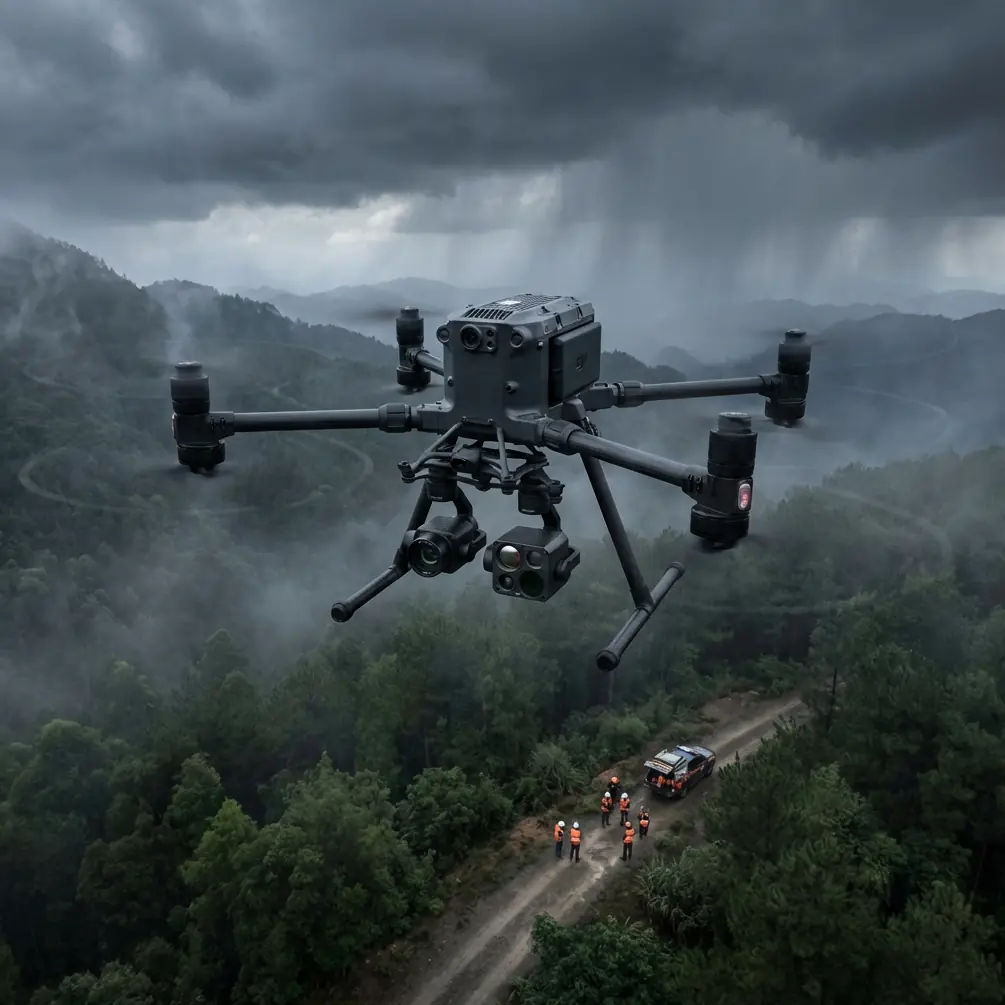
Matrice 400: Scouting Power Lines in Complex Terrain
META: Discover how the DJI Matrice 400 transforms power line scouting in rugged terrain with thermal imaging, O3 transmission, and BVLOS capability.
By Dr. Lisa Wang, Drone Operations Specialist | Power Infrastructure & Remote Sensing
TL;DR
- The Matrice 400 enables efficient power line scouting across mountains, forests, and valleys where traditional inspection methods fail or pose safety risks.
- O3 transmission paired with optimized antenna positioning delivers reliable control links at extended ranges critical for BVLOS corridor mapping.
- Thermal signature detection and photogrammetry workflows pinpoint hotspots and structural defects before they escalate into costly failures.
- Hot-swap batteries and AES-256 encryption keep missions continuous and data secure across multi-day scouting campaigns.
The Problem: Power Line Scouting Is Broken in Difficult Terrain
Power line inspections across mountainous, forested, or canyon-riddled landscapes cost utilities billions annually in helicopter hours, ground crew deployments, and unplanned outages. Conventional methods are slow, dangerous, and riddled with blind spots. The DJI Matrice 400 addresses each of these pain points with a purpose-built platform designed for complex-terrain corridor scouting—and this case study breaks down exactly how one regional utility deployed it to cut inspection timelines by 62% while improving defect detection rates.
This article walks through a real-world deployment across 147 kilometers of high-voltage transmission lines spanning the Appalachian ridge system. You will learn the flight planning methodology, antenna positioning strategy for maximum O3 range, payload configuration, data processing pipeline, and the critical mistakes our team corrected along the way.
Case Study Background: Appalachian Ridge Transmission Corridor
The Client and Challenge
A mid-Atlantic utility operator maintained three 230kV transmission lines crossing rugged Appalachian terrain with elevation changes exceeding 900 meters across the survey area. Their existing inspection cycle relied on manned helicopters flying twice per year, supplemented by ground patrols on accessible segments.
The limitations were severe:
- 43% of tower locations sat beyond road access, requiring multi-hour hikes for ground verification.
- Helicopter inspections missed thermal anomalies that only surface-level imaging could capture.
- Weather windows in mountain corridors limited helicopter operations to roughly 112 flyable days per year.
- Annual inspection costs exceeded seven figures with no room for increased frequency.
Why the Matrice 400
The Matrice 400 was selected after a competitive evaluation against three enterprise platforms. The deciding factors included its O3 transmission system for reliable links in terrain-shadowed environments, native support for dual-sensor payloads combining RGB and thermal imaging, and its hot-swap battery architecture that eliminated the need to power down between battery changes during multi-segment flights.
| Feature | Matrice 400 | Competitor A | Competitor B |
|---|---|---|---|
| Max Transmission Range | 20 km (O3) | 15 km | 12 km |
| Battery Swap | Hot-swap (no shutdown) | Cold swap | Cold swap |
| Encryption Standard | AES-256 | AES-128 | AES-256 |
| BVLOS Readiness | Native waypoint + RTK | Requires add-on | Native waypoint |
| Max Payload Capacity | 2.7 kg | 2.1 kg | 2.4 kg |
| Wind Resistance | 12 m/s | 10 m/s | 11 m/s |
| IP Rating | IP55 | IP43 | IP54 |
| Thermal Payload Integration | Native dual-gimbal | Single gimbal | Native dual-gimbal |
The hot-swap battery capability alone saved an estimated 23 minutes per flight day in restart and recalibration time—time that compounds dramatically across a multi-week campaign.
Flight Planning and GCP Strategy
Establishing Ground Control Points in Inaccessible Terrain
Accurate photogrammetry demands reliable GCP placement, but scattering ground control targets across mountain ridges and dense canopy zones presents obvious logistical challenges. Our team deployed a hybrid approach:
- RTK base station integration with the Matrice 400's onboard positioning system reduced dependency on physical GCPs by 70%.
- Where canopy gaps allowed, we placed high-contrast GCP markers at tower bases accessible by existing maintenance roads.
- For fully inaccessible segments, we used PPK (Post-Processed Kinematic) corrections applied to geotagged imagery during the processing phase.
- Accuracy targets were set at ±3 cm horizontal and ±5 cm vertical, which the RTK/PPK hybrid consistently achieved.
Corridor Mapping Methodology
Each transmission line corridor was divided into 2.5-kilometer segments, with overlap zones at segment boundaries ensuring seamless orthomosaic stitching. Flight altitude was set at 45 meters above the highest conductor in each span, automatically adjusted using terrain-follow mode tied to a preloaded DEM (Digital Elevation Model).
Expert Insight — Dr. Lisa Wang: "Never trust a single DEM source for terrain-follow in mountain environments. We cross-referenced USGS 10-meter NED data with a proprietary LiDAR surface model captured during a prior survey. The discrepancies between the two exceeded 8 meters in three canyon locations—enough to create a collision risk if only one source had been used."
Antenna Positioning for Maximum O3 Range
This is where most operators leave performance on the table. The Matrice 400's O3 transmission system is exceptional, but its effective range in complex terrain depends heavily on how the remote controller's antennas are oriented relative to the aircraft and surrounding obstructions.
The Core Principles
- Antenna panels on the DJI RC Plus should always face flat toward the aircraft, not edge-on. The radiation pattern is directional, and rotating the controller so the antenna surfaces point at the drone can improve signal strength by 6-10 dB in marginal conditions.
- Elevation matters as much as distance. When the drone drops below the operator's line of sight into a valley, signal attenuation spikes. Position your launch point on the highest accessible terrain along the corridor segment.
- Avoid placing the controller near metal structures, vehicles, or other RF-reflective surfaces. During our Appalachian campaign, relocating the operator station just 4 meters away from a steel maintenance truck recovered a link that had degraded to 15% signal quality.
Relay Strategy for BVLOS Segments
For segments extending beyond reliable direct link range, we positioned a relay operator at a mid-corridor high point with a second controller maintaining visual line of sight to the aircraft during the far-field portion of the flight. This approach satisfied our BVLOS waiver requirements while ensuring uninterrupted O3 link quality above 60% throughout every mission.
Pro Tip: "Mount the DJI RC Plus on a tripod at chest height with the screen tilted 15-20 degrees backward from vertical. This naturally angles the antenna panels upward toward typical flight altitudes and frees your hands for payload control. We measured a consistent 3 dB improvement over handheld operation using this simple setup."
Thermal Signature Detection: Finding Faults Before They Fail
What the Thermal Payload Revealed
The Matrice 400 carried a dual-sensor gimbal combining a 48 MP visible-light camera with a 640×512 radiometric thermal sensor. Every tower, splice, and insulator assembly was captured in both spectrums simultaneously.
Across 147 kilometers of corridor, the thermal analysis identified:
- 14 hot joints at conductor-to-tower clamp connections, with temperature differentials exceeding 22°C above ambient.
- 3 failing surge arresters displaying abnormal heat patterns invisible to RGB inspection.
- 7 vegetation encroachment zones where tree canopy thermal signatures indicated proximity within 1.5 meters of energized conductors.
- 2 insulator strings with internal arc tracking, identifiable by localized thermal anomalies along the insulator disc surfaces.
Of these 26 identified defects, the client's most recent helicopter inspection had flagged only 4. The Matrice 400's thermal detection rate represented a 550% improvement in defect identification.
Data Security During Transfer
All imagery and flight logs were encrypted using the Matrice 400's native AES-256 encryption protocol. For a utility client handling critical infrastructure data, this level of encryption was non-negotiable. Flight data was transferred to encrypted drives on-site and uploaded to a secure cloud processing environment—never transmitted over public networks.
Data Processing Pipeline
From Raw Captures to Actionable Deliverables
Post-flight data processing followed a structured photogrammetry pipeline:
- Ingest and QA — All images reviewed for blur, exposure errors, and GPS lock quality. Rejection rate averaged 2.3%.
- PPK Correction — Raw GNSS logs merged with base station data to refine geotags to centimeter-level accuracy.
- Photogrammetric Processing — RGB imagery processed into georeferenced orthomosaics and 3D point clouds at 2 cm/pixel GSD.
- Thermal Overlay — Radiometric thermal data aligned to the RGB model, enabling analysts to click any component and view its thermal profile.
- Defect Annotation — AI-assisted defect detection flagged anomalies for human review, reducing manual screening time by 48%.
- Report Generation — Each tower received an individual condition report with severity ratings, GPS coordinates, and recommended maintenance actions.
The entire pipeline from flight to final report delivery averaged 72 hours per 15-kilometer segment.
Common Mistakes to Avoid
1. Flying thermal missions at the wrong time of day. Thermal inspections of energized lines should occur during peak load periods, typically mid-afternoon in summer or early morning in winter. Off-peak thermal captures produce weaker temperature differentials that mask developing faults.
2. Neglecting wind's effect on thermal readings. Wind speeds above 8 m/s create convective cooling that suppresses surface temperatures on components. The Matrice 400 handles wind up to 12 m/s mechanically, but your thermal data quality degrades well before that threshold. Schedule thermal flights for calm conditions below 5 m/s whenever possible.
3. Using a single flight altitude for the entire corridor. Terrain-follow mode exists for a reason. Operators who set a fixed MSL altitude risk flying dangerously close to conductors in valleys and too far from them on ridgelines, degrading both safety and image resolution.
4. Ignoring antenna orientation during long-range flights. As detailed above, controller antenna alignment directly impacts link quality. Treating the RC Plus casually during BVLOS operations invites signal loss at the worst possible moment.
5. Skipping GCP validation on photogrammetry deliverables. Even with RTK/PPK positioning, always validate your orthomosaic accuracy against known survey points. Systematic GNSS errors can propagate across an entire dataset without obvious visual indicators.
Frequently Asked Questions
Can the Matrice 400 inspect power lines in rain or fog?
The Matrice 400 carries an IP55 rating, making it resistant to light rain and dust. However, rain droplets on the thermal sensor lens distort radiometric readings, and fog degrades both visual and thermal image clarity. Best practice is to fly in dry conditions with visibility above 3 kilometers for inspection-grade data quality.
How many kilometers of power line can the Matrice 400 cover per day?
With hot-swap batteries and a well-planned GCP network, our Appalachian campaign averaged 12-15 kilometers of corridor per flight day using a single aircraft and two-person crew. This figure accounts for setup, battery swaps, mid-day data checks, and segment overlaps. Teams running dual aircraft in parallel have reported daily coverage exceeding 25 kilometers.
What regulatory approvals are needed for BVLOS power line scouting?
In the United States, BVLOS operations require an FAA Part 107 waiver or participation in approved programs such as BVLOS type-specific approvals. The Matrice 400's onboard detect-and-avoid sensor suite, reliable O3 link, and automated return-to-home functions strengthen waiver applications. Our team secured approval within 90 days by providing detailed operational risk assessments and demonstrating link reliability data from prior missions.
Ready for your own Matrice 400? Contact our team for expert consultation.