
Matrice 400 Field Report: Scouting Coastal Power Lines When
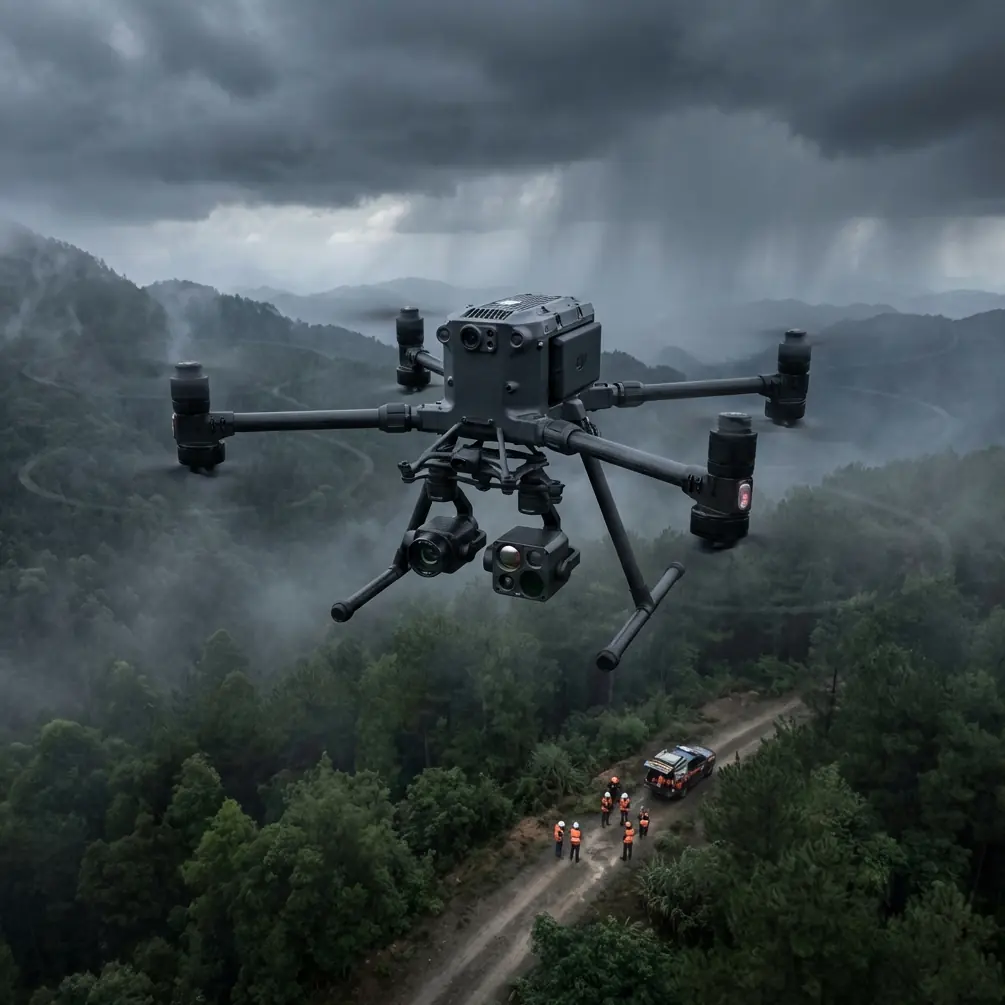
Matrice 400 Field Report: Scouting Coastal Power Lines When EMI, Wind, and Data Integrity All Matter
META: Expert field report on using the Matrice 400 for coastal power line scouting, with practical insight on electromagnetic interference, thermal inspection workflow, software reliability, and ground-test discipline.
Coastal transmission corridors expose weak drone workflows fast. Salt air shortens equipment life. Crosswinds arrive sideways off the water. Towers, conductors, and substations create a messy electromagnetic environment. On paper, a mission to scout power lines with a Matrice 400 can look routine. In practice, it is a test of system discipline.
That is why the most useful way to think about the Matrice 400 is not as a flying camera platform, but as a field system whose reliability depends on how well its hardware, software, sensing payloads, and pre-mission validation work together. For operators surveying long coastal spans, that distinction matters more than any headline spec sheet.
I’ve seen this become obvious during line inspection work where the problem was not flight time or image quality. It was coordination. The aircraft was fine. The payload was fine. The link was mostly fine. Yet the mission quality degraded because the operating environment forced every subsystem into closer interaction than expected: antennas needed repositioning to maintain clean transmission, thermal passes needed tighter speed control, and the inspection software had to handle faults without introducing confusion into the workflow.
That is exactly the kind of operational lesson buried in older aircraft design practice and still relevant to the Matrice 400 today.
Why coastal power line scouting stresses the whole drone system
A coastal line patrol usually combines at least three jobs in one sortie set.
First, visual inspection of conductors, insulators, hardware, and tower structures.
Second, thermal signature collection to identify abnormal heating.
Third, route intelligence for maintenance planning, often supported by photogrammetry for spatial context.
Each task pushes the aircraft differently. Thermal work cares about stable geometry, predictable speed, and repeatable sensor angles. Photogrammetry needs overlap discipline and often benefits from GCP-supported accuracy if the outputs will inform engineering decisions. Long linear missions demand robust transmission performance, especially if the team is trying to maintain confidence for extended-distance operations or BVLOS planning under the local regulatory framework.
Near energized infrastructure, interference is rarely dramatic in the cinematic sense. It is usually subtle. Telemetry may remain available while link quality fluctuates. Video may soften before dropping. Compass confidence may need closer interpretation. The right response is usually not panic. It is adjustment.
One of the simplest high-value corrections is antenna management. In coastal scouting, I’ve had operators improve O3 transmission stability not by changing the route, but by changing their own body position and antenna orientation relative to the line corridor. Conductors, steel lattice structures, and terrain edges can create multipath behavior that punishes lazy controller handling. The Matrice 400 may be capable, but capability is not immunity.
The old aviation lesson that still applies: test interactions, not just components
A particularly relevant principle from aircraft fuel-system development is that engineers do not rely only on calculation when multiple components interact in ways that are hard to model precisely. One cited case involved 7 control valves operating in parallel in a pipeline, where testing was arranged specifically to verify coordination and deal with mutual interference between units. That is not a drone example, but the logic maps directly onto modern UAV operations.
For a Matrice 400 coastal power-line mission, the “7 valves in parallel” problem shows up in another form: aircraft control logic, transmission link, gimbal behavior, thermal payload, flight planning app, onboard storage, and pilot inputs all influencing one another at once. None of those elements can be validated in isolation if your goal is dependable field performance.
This is where too many teams cut corners. They test whether the drone flies. They test whether the camera records. They do not test whether the entire inspection stack behaves correctly under realistic mission stress.
The older aircraft design material also makes another point that deserves more attention in drone operations: some safety-critical or performance-critical parameters are difficult to determine accurately through engineering calculation alone, so ground simulation becomes essential. In the source example, even when pipe-flow calculation accuracy was considered reasonably high, the final behavior of emergency fuel jettison depended on system limits elsewhere, including pressurization and venting flow constraints. The result was operational uncertainty until testing resolved it.
That is a powerful analogy for the Matrice 400 in coastal inspection. You can estimate link margin, battery consumption, thermal collection windows, and waypoint timing. But once sea wind, tower geometry, EMI, and payload switching enter the picture, estimated performance stops being enough. Ground and near-ground simulation work becomes the difference between professional operations and hopeful operations.
What a serious Matrice 400 pre-mission validation looks like
If I were building a repeatable coastal power-line scouting program around the Matrice 400, I would structure validation the way mature aviation systems do: prove the concept, simulate the mission, then fly with purpose.
1. Principle-level testing
Before the team worries about full route execution, test the key uncertainty.
For coastal power-line work, that might be:
- O3 transmission resilience near tower steel and conductor corridors
- thermal payload behavior at inspection stand-off distances
- controller and antenna orientation effects in EMI-heavy zones
- hot-swap batteries workflow timing during multi-sortie operations
- data handoff from aircraft to processing environment with no missing logs or media
This is not glamorous work. It is how you expose the weak link before a long route does it for you.
2. Ground simulation of the full mission
The aircraft design reference describes ground simulation as a direct and reliable method for discovering system faults, especially by simulating a full mission profile and critical operating conditions. That exact logic should govern M400 inspection planning.
For power-line scouting, a realistic simulation bench is not a literal full-aircraft fuel rig, but the equivalent mindset still applies:
- build the mission in the actual software stack
- load the real payload configuration
- simulate handovers between visual inspection and thermal passes
- verify storage allocation and file naming logic
- test return-to-home behavior against corridor geometry
- confirm AES-256 protected data workflows if client security requirements demand it
- rehearse battery changeover and relaunch timing
The point is to validate workflow continuity, not just airworthiness.
3. Flight testing in near-critical conditions
The older guidance stresses that tests should be run as close to critical values as practical when a parameter has a range. That matters in drone work. If your coastal site usually sees moderate winds and occasional EMI spikes, don’t validate only on an easy inland day.
Run short trial flights where the environment actually resembles the job:
- sea breeze active
- reflective water nearby
- towers in the line of sight
- controller positions similar to planned operations
- intended stand-off distances maintained
This is where operators often discover that a minor antenna adjustment or a slight route offset improves downlink stability enough to preserve thermal interpretation quality.
Software reliability is not abstract when you’re inspecting infrastructure
The second reference document, focused on reliability and maintainability design, reads like a warning against sloppy software assumptions. Several details are especially relevant to Matrice 400 operations.
One recommendation is that systems should include a watchdog timer or similar mechanism to ensure the processor or computer continues operating correctly. Another states that the software should record all detected errors. There is also guidance that systems should detect unintended software transfers and recover to a known safe state. Finally, operation and support software should include only the features actually required, with no undocumented extras.
For infrastructure teams, these are not academic design notes. They explain what a trustworthy drone workflow looks like in the field.
When a Matrice 400 crew is scouting coastal power lines, software reliability affects:
- whether a mission resumes coherently after interruption
- whether flight logs preserve evidence for post-flight review
- whether a glitch becomes a recoverable event or a confusing cascade
- whether the interface supports the crew’s real tasks rather than distracting them with unused complexity
A known safe state matters. If software behavior becomes erratic near energized infrastructure, the team needs predictability, not improvisation. Error logging matters too. When a mission produces questionable thermal data or intermittent downlink degradation, the logs can help separate environmental EMI from internal system issues.
Another source detail is especially timely: systems should be designed to resist electromagnetic radiation, electromagnetic pulse, or electrostatic interference. For civilian drone crews in coastal utility work, the practical takeaway is simpler than the wording sounds. Do not treat interference as a rare anomaly. Treat it as an expected design input.
That changes field behavior. You become more deliberate about controller placement, cable routing in your ground station kit, firmware discipline, shielding practices for accessories, and preflight checks after transport in dry, static-prone environments.
Handling EMI near coastal lines: what actually helps
The context for this article called for a practical note on antenna adjustment, and that is exactly where many crews recover performance.
Here is the reality: when inspecting coastal power lines, the best antenna setup is not static. The alignment that works in open shoreline air may become suboptimal as the aircraft moves adjacent to structures or changes relative altitude. O3 transmission is robust, but robust links still benefit from operators who understand geometry.
What helps in the field:
- Keep the controller antennas oriented for the aircraft’s actual corridor position, not where you launched from.
- Avoid standing directly against vehicles, fences, or large metallic surfaces that can worsen reflections.
- Reposition the pilot slightly if towers or terrain edges create intermittent masking.
- Watch for repeatable downlink degradation at specific headings; that often points to geometry rather than random malfunction.
- If the aircraft is collecting thermal data, prioritize stable transmission during critical capture windows so the crew can confirm target framing in real time.
On one coastal job, the difference between a frustrating mission and a clean one was no bigger than a few meters of operator movement and disciplined antenna re-aiming during each leg. The aircraft did not need rescuing. It needed correct handling.
Thermal, photogrammetry, and maintenance planning on one platform
The Matrice 400’s appeal for utility scouting is that one airframe can support multiple information layers in the same operation. That matters because line owners increasingly want more than defect spotting. They want spatial context, trending, and maintenance prioritization.
Thermal signature collection identifies suspect hotspots on connectors, terminations, or other components. Visual imaging confirms condition clues such as corrosion, damage, or contamination. Photogrammetry can create route context for vegetation encroachment, access planning, or structure modeling. When engineering-grade outputs are expected, GCP strategy may still enter the workflow depending on terrain, required accuracy, and whether the deliverable will be used for design decisions rather than general situational awareness.
This is where disciplined data handling becomes just as important as flight execution. AES-256-secured workflows may be relevant when utility clients require protected transfer and storage practices for inspection records. And because coastal programs often involve many short launches rather than one continuous sortie, hot-swap batteries can improve tempo only if the team has already standardized their relaunch checklist. Fast turnaround without process control just creates faster mistakes.
The field report takeaway
For readers looking at the Matrice 400 specifically for scouting power lines in coastal areas, the real advantage is not a single feature. It is the ability to build a dependable inspection system around it. But that only happens when the team borrows the right habits from mature aircraft engineering.
Two lessons stand out from the reference material.
First, when multiple subsystems interact, don’t trust isolated checks. The old example of 7 parallel fuel-control valves was about coordination and interference between components. In Matrice 400 operations, the same principle applies to payloads, links, software, storage, and crew actions. Test the interactions.
Second, ground simulation and near-critical testing are indispensable when performance depends on variables that are difficult to calculate accurately. Coastal power-line scouting is full of those variables: EMI, sea wind, reflective surfaces, changing geometry, and mixed sensing tasks. Simulate the mission before the mission.
If your team is building a coastal utility workflow and wants a practical conversation about route design, payload setup, or transmission behavior near energized infrastructure, you can message our field team directly here.
The Matrice 400 is capable. The harder question is whether the operation built around it is equally mature. That is the line between collecting footage and delivering inspection-grade intelligence.
Ready for your own Matrice 400? Contact our team for expert consultation.