
Matrice 400 scouting tips for mountain power lines
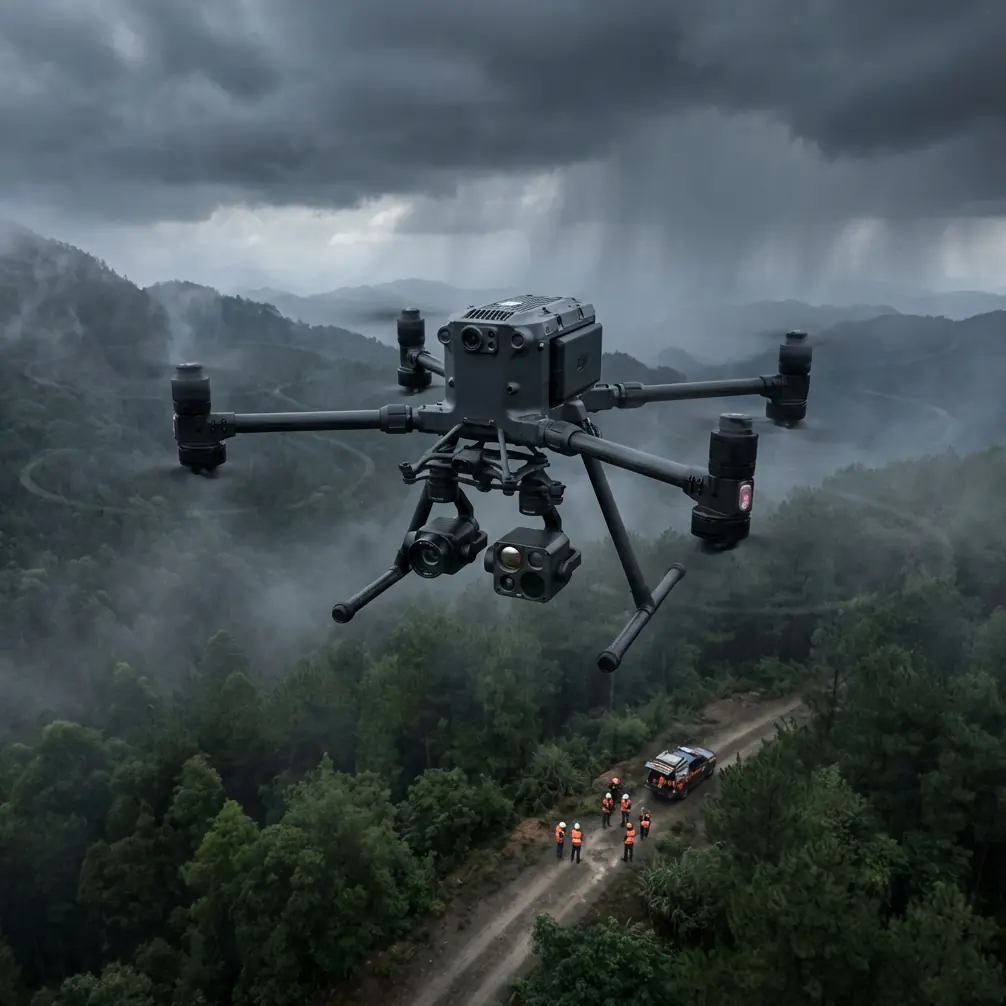
Matrice 400 scouting tips for mountain power lines: what actually matters in the field
META: Practical Matrice 400 guidance for mountain power line scouting, with expert tips on EMI handling, thermal workflows, transmission stability, battery management, and inspection discipline.
Mountain transmission work exposes every weakness in a drone operation. Wind rolls off ridgelines. Signal paths break behind terrain. Conductors and towers create electromagnetic noise right where you need stable control and clean sensor data. If you are evaluating the Matrice 400 for this kind of work, the real question is not whether it can fly a route. The question is whether your workflow stays reliable when the aircraft, payload, operator, and inspection standard all get stressed at once.
That is the lens I would use for the Matrice 400 in mountain power line scouting.
This article is not a generic product overview. It is a field tutorial built around two ideas that come from mature aircraft-system practice: first, modern aviation systems are expected to work inside standardized test and verification frameworks rather than as improvised one-off tools; second, small physical details in the system chain, including routing, interfaces, and protective components, often decide whether the mission produces trustworthy results. Those principles show up clearly in the reference material, and they translate well to drone inspection work.
Start with the mission profile, not the airframe
Power line scouting in mountains usually splits into three jobs that look similar from the ground but demand different flight behavior:
- Rapid corridor reconnaissance to flag damaged spans, vegetation encroachment, landslide risk, or access issues
- Thermal inspection to spot hot connectors, stressed hardware, or load imbalance indicators
- Photogrammetry and asset documentation for tower condition records, right-of-way mapping, and maintenance planning
The Matrice 400 can support all three, but your setup should change depending on which one dominates the sortie.
For example, thermal signature capture has a different tolerance for aircraft movement than photogrammetry. A mapping pass cares about overlap, GCP alignment strategy, and consistent altitude more than a thermal scan does. A thermal run often benefits from slower, more deliberate viewing geometry around suspect fittings and insulator strings. Treating all inspection flights as “just another line patrol” wastes the platform.
Why EMI discipline matters more in mountain corridors
The prompt specifically calls for handling electromagnetic interference with antenna adjustment, and that is the right place to focus. Power lines in mountainous terrain create a layered signal problem:
- electromagnetic activity near energized infrastructure
- multipath reflections from metal structures
- terrain masking behind ridges and cuts
- operator temptation to stand in the wrong place for visual convenience
With the Matrice 400, O3 transmission gives you a strong foundation, but transmission quality is still a geometry problem. If you are getting intermittent drops or noisy video near towers, do not jump straight to blaming the aircraft. First examine your antenna orientation and the operator’s position relative to the corridor.
A simple field rule: aim for clean line-of-sight to the aircraft, not to the tower you are visually interested in. These are not always the same thing.
When scouting a line that bends around a mountainside, I prefer to reposition the pilot station before the aircraft goes behind terrain rather than trying to “push through” with the same stance and antenna angle. Keep the controller antennas aligned to the aircraft’s likely path, not fixed toward the origin of the flight. Small adjustments can stabilize the downlink long before you hit the limit of the radio link itself.
Operationally, this matters because line patrol work is less forgiving than landscape flying. If you lose feed for a few seconds near a conductor crossing or while framing hardware on the lee side of a tower, you may not lose the aircraft, but you can lose the inspection event. That means a repeat orbit, extra battery use, and reduced confidence in the data.
What aviation test philosophy can teach a drone team
One of the strongest details in the reference material is the reliance of automated test equipment on established standards such as ARINC 608A, ARINC 625-1, ARINC 626-2/-3, and ARINC 627-1, along with software assurance thinking based on RTCA DO-178B / EUROCAE ED-12B. The point here is not that your Matrice 400 field team needs to read avionics standards cover to cover. The point is that high-consequence inspection systems are expected to be documented, repeatable, and testable.
That mindset is extremely useful for mountain utility operations.
If your Matrice 400 program is going to support recurring power line scouting, build a lightweight “drone ATE mindset” into the operation:
- a preflight checklist that tests payload behavior, storage status, sensor calibration, and link quality in a consistent order
- a standard naming structure for towers, spans, defect classes, and thermal anomalies
- a repeatable procedure for verifying that the payload records the right metadata before launch
- a validation step after landing so crews do not leave the site with unusable thermal or mapping files
Why does this matter? Because the reference text highlights that formal systems are designed around documentation, verification, and submission requirements tied to airworthiness and procurement oversight. In drone terms, that translates into fewer subjective judgments and fewer “I thought it recorded” mistakes.
For utilities, the value is immediate. A repeatable inspection method makes trend comparison possible. If tower 37 on a mountain ridge shows a mild heat anomaly this month and a stronger one next month, you need confidence that both captures were obtained under disciplined settings, not random field improvisation.
The hidden lesson from hose assemblies: details in routing and protection
The second reference item may seem far from drones at first glance. It discusses hose assemblies, protective sleeves, flare fittings, dimensional coding, and inspection conventions, including a 0.250 in max dimensional callout and a length code where the fourth digit represents eighths of an inch. It also notes a check method using a gauge ball through the hose assembly and mentions PTFE hose with stainless braid and abrasion protection.
Why bring this into a Matrice 400 article? Because it captures a truth every serious drone operator eventually learns: system reliability lives in the details you barely notice until they fail.
In mountain power line work, this principle applies to:
- payload cable routing
- gimbal clearance during oblique inspection angles
- connector seating after vehicle transport over rough access roads
- weatherproofing around repeated battery swaps
- abrasion points on cases, mounts, and field harnesses
- antenna positioning when crews keep resetting the ground station
Aviation hardware standards obsess over fit, measurement, and wear protection because small deviations create big downstream failures. Drone crews should be just as fussy. Before a Matrice 400 mission in steep terrain, physically inspect all exposed interfaces the way a good maintenance technician inspects a hose end or sleeve transition: look for looseness, rubbing, contamination, strain, and anything that has shifted out of tolerance.
This is more than neatness. If your thermal payload connector is slightly compromised or a cable jacket has been chafing in transport, the mission may still launch, but the weak link often shows up at the worst time—during a cold, windy hover on the side of a ridge when the aircraft has already consumed half the pack.
A practical mountain workflow for Matrice 400 line scouting
Here is the field routine I recommend.
1) Build the route around observation windows, not just waypoints
Mountain corridors have dead zones. Mark them in advance. If you have flown the area before, note where ridges obscure signal, where wind shears hit, and where towers create framing difficulties. A corridor plan that looks efficient on a map can be clumsy in the air.
For thermal scouting, identify the likely hold points where the aircraft can pause for a clean look at:
- dead-end assemblies
- jumpers
- clamps and connectors
- insulator chains
- areas of vegetation contact risk
For photogrammetry, define overlap requirements before takeoff and decide whether GCPs are realistic in that terrain. In many mountain utility scenarios, GCP deployment is possible only at access roads, laydown areas, or substation edges, so be honest about where ground control improves the result and where it simply slows the team.
2) Use antenna discipline from the first minute
Do not wait for signal trouble to think about antennas. Set the operator position and antenna orientation before launch based on the aircraft’s intended first leg. As the aircraft tracks the line, adjust body position and antenna alignment in a deliberate way. In EMI-prone zones, a few degrees of orientation change can clean up the feed.
If you want to compare notes on controller posture and antenna setup for ridge flights, I’d use this quick field contact: message James directly.
3) Separate reconnaissance from measurement-quality capture
A common mistake is trying to gather every possible data type in one pass. Use the Matrice 400’s capability wisely. One pass can be a fast scout to identify suspect structures. A second, slower pass can capture thermal or high-detail visual evidence. This improves pilot attention and reduces the chance of missing a fault while the team argues over camera settings.
4) Plan battery changes as a continuity problem
Hot-swap batteries are not just about convenience. In mountain line work, they protect your inspection rhythm. The more remote and vertical the site, the more valuable it is to keep payload state, mission context, and crew focus intact during battery turnover.
Operational significance here is simple: on a steep hillside staging area, minimizing restart friction reduces errors. The best crews treat battery replacement as part of the inspection sequence, not as downtime. That means:
- confirming the next target span before the swap
- verifying sensor status immediately after power continuity is restored
- checking whether wind or lighting changed while the aircraft was on the ground
5) Secure the data path, not just the aircraft
AES-256 matters most when inspection files move through multiple hands or networks. Utility and infrastructure data often contains sensitive location and asset-condition information even when it is entirely civilian. If your Matrice 400 workflow supports encrypted transmission and disciplined storage, use it. The practical payoff is not abstract cybersecurity theater. It is reduced friction with infrastructure owners and cleaner compliance conversations with enterprise clients.
6) Keep BVLOS planning tied to terrain reality
BVLOS is often discussed as a capability milestone, but in mountains it is really a risk-management exercise. A line may run far beyond easy visual coverage, yet the terrain may create communication and contingency complications long before the legal envelope becomes the main issue. If you are structuring BVLOS procedures around the Matrice 400, terrain-informed staging, observer strategy, and contingency landing logic deserve as much attention as the aircraft specification sheet.
Thermal signatures are only useful when the geometry is clean
One more point that deserves emphasis: thermal anomalies on power infrastructure can be subtle. If your aircraft is yawing in gusts, your standoff distance varies too much, or your viewing angle changes from one structure to the next, comparisons become weaker.
This is why stable transmission and careful positioning matter so much. The operator needs a clean live view to hold the right angle on the target hardware. In mountains, that often means avoiding the dramatic shot and taking the boring one—the angle with the least background clutter, best contrast, and lowest signal risk.
The Matrice 400 becomes more valuable here when the crew treats it as an inspection instrument, not a flying camera.
What separates strong teams from average ones
Average teams fly the route and hope the aircraft smooths out the problems.
Strong teams borrow from mature aviation practice. They standardize checks. They document settings. They inspect the physical system closely. They understand that a tiny interface issue can matter as much as a headline feature. They reposition before signal degrades. They use thermal and photogrammetry for different purposes instead of muddling the workflow. They see hot-swap batteries, O3 transmission, AES-256, and BVLOS planning as parts of one inspection architecture.
That is the right way to think about the Matrice 400 for mountain power line scouting.
The aircraft may provide the lift, endurance, and sensor platform. But the inspection result comes from method. And method, as the reference materials quietly remind us, is built on standards, verification, protection of small physical details, and disciplined repeatability.
Ready for your own Matrice 400? Contact our team for expert consultation.