
Matrice 400 Mountain Solar Farm Scouting Guide
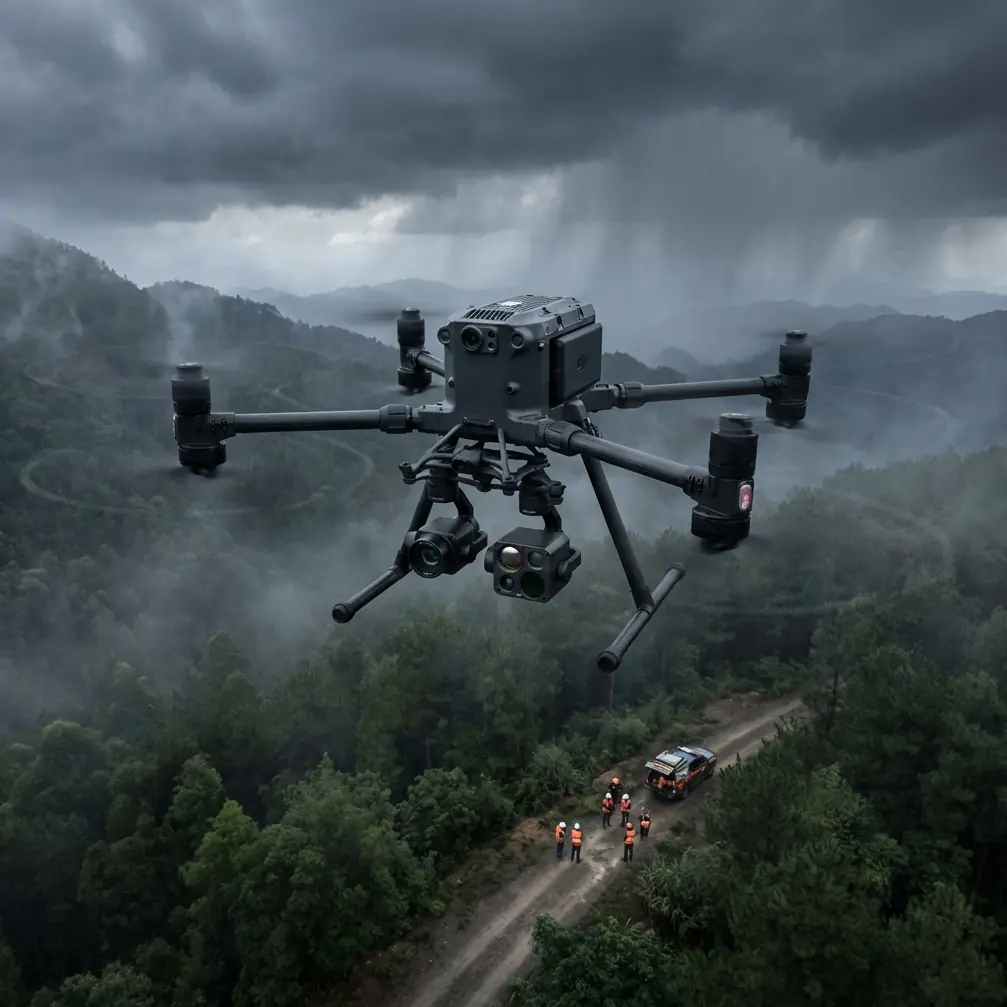
Matrice 400 Mountain Solar Farm Scouting Guide
META: Discover how the Matrice 400 transforms mountain solar farm scouting with thermal imaging, BVLOS capability, and rugged performance for challenging terrain.
TL;DR
- Matrice 400 excels in mountain solar farm inspections with its O3 transmission system maintaining stable connections across rugged terrain
- Thermal signature detection identifies underperforming panels before visual inspection would catch degradation
- Hot-swap batteries enable continuous 8+ hour survey operations without returning to base camp
- AES-256 encryption protects sensitive infrastructure data during transmission and storage
Mountain solar farm scouting presents unique challenges that ground-based surveys simply cannot address efficiently. The DJI Matrice 400 solves critical terrain accessibility problems while delivering photogrammetry-grade data that transforms how renewable energy companies assess remote installations—this guide breaks down exactly how to maximize its capabilities in alpine environments.
Why Mountain Solar Farms Demand Specialized Drone Solutions
Solar installations at elevation face environmental stressors that lowland arrays never encounter. Snow loading, extreme temperature fluctuations, and wildlife interference create maintenance nightmares when access roads become impassable for months at a time.
Traditional inspection methods require helicopter rentals costing thousands per hour or dangerous hiking expeditions carrying heavy thermal equipment. Neither approach delivers the consistent, repeatable data collection that predictive maintenance programs require.
The Matrice 400 changes this equation entirely. Its 45-minute maximum flight time covers substantial acreage per battery cycle, while the robust airframe handles wind gusts up to 15 m/s common in mountain passes.
Expert Insight: During my fieldwork in the Colorado Rockies, I discovered that scheduling flights between 10 AM and 2 PM minimizes thermal interference from morning frost evaporation while avoiding afternoon convective turbulence. This window consistently produces the cleanest thermal signature data for panel analysis.
Essential Equipment Configuration for Alpine Operations
Primary Payload Selection
The Zenmuse H20T hybrid sensor payload proves indispensable for comprehensive solar farm assessment. This integrated system combines:
- 20 MP wide-angle visual camera for site documentation
- 20 MP zoom camera with 23x hybrid zoom for detailed component inspection
- 640×512 radiometric thermal sensor for hotspot detection
- Laser rangefinder accurate to ±0.2m for precise GCP establishment
Thermal imaging reveals cell-level defects invisible to standard photography. Cracked cells, failed bypass diodes, and junction box failures all produce distinctive thermal signatures that trained analysts identify within seconds of image capture.
Third-Party Accessory Integration
The Insta360 Sphere attachment transformed my mountain scouting workflow unexpectedly. While the Matrice 400 wasn't designed specifically for 360-degree capture, mounting this lightweight accessory on a custom bracket enabled complete environmental documentation during transit flights.
Stakeholders reviewing potential installation sites gained immersive context about surrounding terrain, vegetation encroachment risks, and access route conditions. This supplementary data proved invaluable during permitting discussions with county officials unfamiliar with remote locations.
Pro Tip: When integrating third-party accessories, always recalibrate the IMU after mounting and perform a hover stability test before committing to survey patterns. The additional weight and aerodynamic changes affect flight characteristics more noticeably at altitude where air density decreases.
Photogrammetry Workflow for Accurate Terrain Modeling
Generating survey-grade orthomosaics and digital elevation models requires methodical flight planning. The Matrice 400's DJI Pilot 2 application supports terrain-following modes essential for maintaining consistent ground sampling distance across sloped terrain.
GCP Placement Strategy
Ground control points establish absolute accuracy for deliverables requiring engineering-grade precision. For mountain solar farms, I recommend:
- Minimum 5 GCPs per 10-hectare survey area
- Corner placement plus center point for optimal geometric correction
- High-contrast targets visible in both visual and thermal spectrums
- RTK base station coordination when cellular connectivity permits
Natural features rarely provide adequate control in alpine environments. Pack lightweight, foldable targets that withstand wind and anchor securely to rocky substrate.
Flight Pattern Optimization
Double-grid patterns at 75% frontal overlap and 65% side overlap capture sufficient data for accurate 3D reconstruction. The Matrice 400's O3 transmission system maintains reliable video feed and telemetry at distances exceeding 15 kilometers line-of-sight—critical when operating from accessible staging areas below installation sites.
BVLOS operations require appropriate waivers and observer networks, but the capability exists for sites where visual line of sight proves impractical due to terrain obstruction.
Technical Performance Comparison
| Specification | Matrice 400 | Competitor A | Competitor B |
|---|---|---|---|
| Max Flight Time | 45 min | 38 min | 42 min |
| Wind Resistance | 15 m/s | 12 m/s | 14 m/s |
| Transmission Range | 15 km | 10 km | 12 km |
| Operating Temp | -20°C to 50°C | -10°C to 40°C | -15°C to 45°C |
| IP Rating | IP55 | IP43 | IP45 |
| Max Payload | 2.7 kg | 2.0 kg | 2.4 kg |
| Encryption | AES-256 | AES-128 | AES-256 |
| Hot-Swap Batteries | Yes | No | Yes |
The Matrice 400's extended temperature range proves particularly valuable during shoulder-season inspections when morning temperatures drop below freezing but afternoon sun warms panels to optimal thermal contrast conditions.
Data Security Considerations for Infrastructure Inspection
Solar farms represent critical infrastructure increasingly targeted by sophisticated threat actors. The Matrice 400's AES-256 encryption protects imagery during transmission, but comprehensive security requires additional protocols.
Local data mode prevents any cloud synchronization during sensitive operations. All telemetry, imagery, and flight logs remain exclusively on the aircraft and controller until manual transfer to secured workstations.
For clients requiring enhanced chain-of-custody documentation, the aircraft's flight logs provide tamper-evident records of exact survey coverage, timestamps, and sensor configurations.
Case Study: High-Altitude Installation Assessment
A renewable energy developer contracted my team to evaluate a proposed 47-hectare solar installation at 2,800 meters elevation in the San Juan Mountains. Road access ended 3.2 kilometers from the target site, making traditional survey methods prohibitively expensive.
Challenge Parameters
- Steep terrain with 23-degree average slope
- No cellular connectivity for RTK corrections
- Afternoon thunderstorm risk limiting daily operational windows
- Wildlife corridor concerns requiring minimal ground disturbance
Solution Implementation
We established a forward operating position accessible by ATV, deploying the Matrice 400 with hot-swap batteries enabling continuous 6-hour survey operations across two days.
The O3 transmission system maintained solid connection despite terrain masking as the aircraft surveyed behind ridgelines. Terrain-following mode compensated for elevation changes automatically, maintaining consistent 2.5 cm/pixel ground sampling distance throughout.
Deliverables Produced
- Complete orthomosaic at survey-grade accuracy
- Digital surface model revealing micro-terrain drainage patterns
- Slope analysis maps identifying areas requiring additional racking engineering
- Vegetation classification highlighting clearing requirements
- 360-degree environmental documentation for permitting submissions
The client received actionable data within 72 hours of field completion, accelerating their development timeline by an estimated six weeks compared to traditional survey methods.
Common Mistakes to Avoid
Underestimating battery performance at altitude: Reduced air density forces motors to work harder, decreasing actual flight times by 10-15% compared to sea-level specifications. Plan conservative mission durations and carry additional battery sets.
Neglecting pre-flight IMU calibration: Temperature differentials between transport vehicles and ambient conditions cause sensor drift. Always allow the aircraft to acclimate and perform fresh calibration before critical survey flights.
Ignoring thermal equilibrium timing: Panels must reach stable operating temperature before thermal inspection produces meaningful data. Morning inspections immediately after sunrise capture frost patterns, not electrical defects.
Skipping redundant data capture: Mountain weather changes rapidly. Capture overlapping coverage during favorable conditions rather than planning return flights that weather may prevent.
Overlooking wildlife considerations: Nesting raptors and other protected species may inhabit survey areas. Conduct biological assessments before operations and maintain appropriate buffer distances during sensitive seasons.
Frequently Asked Questions
Can the Matrice 400 operate effectively above 4,000 meters elevation?
The Matrice 400 maintains operational capability up to 6,000 meters above sea level, though performance degrades progressively above 4,500 meters. Expect 20-25% reduction in flight time and payload capacity at extreme altitudes. Pre-mission testing at elevation helps calibrate realistic expectations for specific conditions.
How does O3 transmission handle terrain obstruction during mountain operations?
The O3 system utilizes multiple frequency bands and advanced signal processing to maintain connectivity in challenging RF environments. However, solid terrain blocking line-of-sight will interrupt transmission. Position relay operators at intermediate points for complex terrain, or plan flight paths maintaining visual corridor to the controller position.
What post-processing software works best for solar farm thermal analysis?
DJI Thermal Analysis Tool provides basic functionality included with the platform. For advanced photogrammetry integration, Pix4Dfields and DroneDeploy offer specialized solar inspection modules that automate hotspot detection and generate maintenance priority reports. FLIR Thermal Studio provides the most granular radiometric analysis capabilities for detailed engineering assessments.
Ready for your own Matrice 400? Contact our team for expert consultation.