
Matrice 400 Guide for Dusty Vineyard Scouting
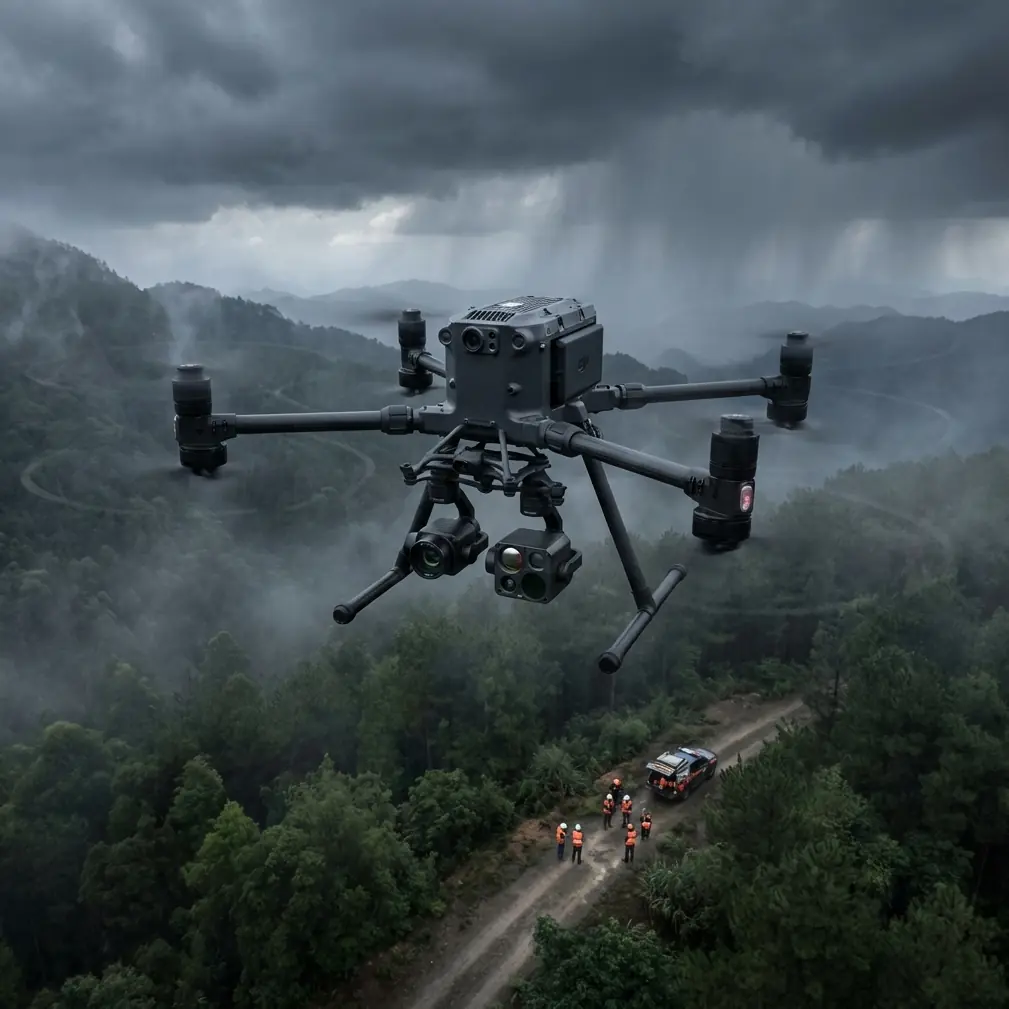
Matrice 400 Guide for Dusty Vineyard Scouting: Reliability Lessons That Actually Matter
META: A field-focused Matrice 400 guide for vineyard scouting in dusty conditions, covering thermal workflows, photogrammetry, BVLOS planning, battery strategy, and why fuel-system conductivity and fault-tolerant design principles matter in real operations.
I still remember a late-summer vineyard survey where the dust became the real mission commander.
The brief sounded ordinary enough: map stress patterns across several blocks, verify irrigation consistency, and check whether a suspected disease corridor was spreading downslope. By 10 a.m., every passing utility vehicle had kicked fine particulate into the air. Visibility was still acceptable. Data quality was not. Thermal contrast was shifting, surfaces were heating unevenly, and every landing turned into a contamination event for the aircraft and payload.
That kind of job is where the Matrice 400 conversation gets practical. Not theoretical. Not brochure-deep. Practical.
If you are scouting vineyards in dusty conditions, the right aircraft is only part of the answer. The bigger question is whether your platform and workflow can stay dependable when the environment starts interfering with sensors, power management, and data confidence. That is why I want to frame the Matrice 400 through two engineering ideas drawn from aircraft design references: fluid behavior under temperature variation, and fault-tolerant decision logic in real-time systems.
At first glance, those sound far removed from viticulture. They are not.
Why dusty vineyard work is harder than many teams expect
Vineyards create a messy sensing environment. Rows generate repeated patterns that can fool weak photogrammetry workflows. Sloped terrain changes sun angle and thermal loading. Dust softens contrast and increases the chance that takeoff and landing will introduce contaminants into cooling paths, connectors, and moving parts. Add summer heat, and power performance becomes a planning issue rather than a footnote.
On paper, a Matrice 400 setup for vineyard scouting may look straightforward: fly a mapping mission, capture RGB for photogrammetry, add thermal signature analysis where needed, process, compare, act. In the field, the friction appears elsewhere:
- repeated launches across dispersed blocks
- pressure to maintain continuity over long workdays
- thermal surveys that only make sense inside narrow time windows
- changing atmospheric conditions that affect image consistency
- communication reliability across broken terrain and long row structures
This is where features such as O3 transmission, AES-256-secured links, hot-swap batteries, and a stable payload workflow become operational tools rather than checklist items.
The overlooked engineering lesson: temperature changes everything
One of the reference materials behind this article discusses aviation fuels and shows measured and calculated specific heat capacity values changing substantially across temperature ranges. In one table, measured values for a fuel type rise from 1871 J/(kg·°C) to 2503 J/(kg·°C) across the listed temperatures, with calculated values for RP-2 moving from 1896 to 2545 J/(kg·°C). Even if you never touch aviation fuel in your drone operation, the lesson is direct: thermal behavior is not static.
That matters in vineyard scouting because every mission is a temperature-management problem disguised as a data-collection task.
Batteries, onboard processors, thermal sensors, and even airframe cooling all respond to changing heat loads. In a dusty vineyard, those shifts become more pronounced because dust alters surface heating, can reduce cooling efficiency, and often pushes crews toward faster turnaround cycles between sorties. A Matrice 400 workflow benefits when the operator thinks like a systems engineer:
Do not treat battery endurance as a fixed number.
In hot, dusty vineyards, sortie planning should account for temperature-driven performance variation. If your mission design assumes perfect repeatability from morning through late afternoon, your overlap, reserve margin, and landing thresholds will drift.Respect thermal imaging windows.
Thermal signature collection for irrigation leaks, vine stress, or canopy anomalies only works when the temperature story is coherent. As ambient conditions rise and dust hangs in the air, the interpretation burden increases. The aircraft can collect data; the operator has to decide whether the thermal conditions still support a valid agronomic conclusion.Use hot-swap batteries for continuity, not just speed.
Hot-swap capability is often discussed as convenience. In vineyards, it is more than that. It preserves workflow continuity during narrow imaging windows and reduces the stop-start rhythm that introduces preventable contamination during repeated power-downs and restarts in dusty staging areas.
In other words, the Matrice 400 becomes easier to trust when you stop asking, “How long will it fly?” and start asking, “How does this entire system behave as temperature and dust change through the day?”
What conductivity data teaches drone crews about dust discipline
The same aircraft design source includes a striking detail on conductivity in fuel systems. Pure fuel may show conductivity around 0.1 to 1.0 pS/m, while conductivity in the 4 to 12 pS/m range is described as the condition where electrification is strongest. The text also notes that flow, filtering, contaminants, and material interactions can intensify charging effects.
No, your vineyard drone is not a jet fuel tank. But the engineering principle is transferable: when materials move through systems under friction, contamination and charge effects can create risks that are easy to underestimate.
For drone crews in dusty vineyards, that translates into a simple but under-practiced discipline:
- manage takeoff and landing zones to reduce particulate entrainment
- avoid placing batteries, sensors, or connectors directly on dusty surfaces
- inspect air inlets, gimbal interfaces, and exposed contacts between sorties
- slow the pace just enough to prevent contamination-based errors from compounding
This is one reason I advise teams to set up a clean field station even for “quick” vineyard missions. A folding table, sealed battery case, soft brushes, sensor cloths, and defined swap procedures save more time than they cost. Dust is not only a maintenance nuisance. It is a reliability multiplier. Once it reaches the wrong interface, it can distort thermal readings, affect stabilization behavior, or compromise data consistency across flights.
That matters especially when you are building repeatable orthomosaics or comparing thermal maps over time. Small inconsistencies at acquisition stage become expensive ambiguities in analysis.
A better Matrice 400 vineyard workflow: trust the data, then trust the aircraft
If I were building a repeatable Matrice 400 program for dusty vineyard scouting, I would structure it as a layered workflow.
1. Start with a clean mission objective
Do not launch to “see what’s happening.” Launch to answer a vineyard question.
Examples:
- Which blocks show irrigation irregularity?
- Is heat stress clustering along a particular elevation band?
- Are there replant gaps or canopy density changes affecting vigor?
- Does the block need high-accuracy photogrammetry for drainage planning or row reconstruction?
That choice determines payload, time of day, flight altitude, overlap, and whether GCP placement is worth the labor.
2. Separate thermal and photogrammetry missions when needed
Trying to collect perfect RGB photogrammetry and perfect thermal data in one rushed pass often produces two mediocre datasets. Vineyards punish compromises.
For orthomosaic and surface modeling, prioritize consistent overlap, stable lighting, and accurate ground control if the output will influence earthworks, irrigation redesign, or trellis planning. For thermal signature work, prioritize timing and interpretation conditions instead.
The Matrice 400 is most useful when it gives you the confidence to split workflows intelligently rather than forcing one all-purpose sortie.
3. Use GCPs where agronomic decisions justify them
In many vineyard jobs, relative accuracy is enough. But if you are aligning repeat surveys, measuring terrain-driven water flow, or integrating UAV data with other farm spatial layers, GCP-backed photogrammetry still matters.
Dusty sites tend to encourage shortcuts because field teams want to move fast. That is understandable. It is also how small geospatial errors become management mistakes. If your downstream use involves drainage fixes, row alignment checks, or detailed topographic interpretation, give the mapping workflow the control points it deserves.
4. Plan around transmission reality, not line-of-sight optimism
O3 transmission is valuable in vineyard terrain because rows, low ridges, tree lines, and infrastructure can all interrupt the clean radio picture crews imagine during planning. A robust link helps maintain command confidence and stable live view over larger properties and more complex geometry.
For teams exploring BVLOS-ready workflows where regulations and approvals allow, transmission reliability and link security stop being abstract technology claims. They become risk controls. AES-256 matters because operational data from agricultural properties is still sensitive: block conditions, production patterns, irrigation issues, and infrastructure layouts all have commercial value.
If your team is building a serious program and wants to compare mission architecture before deployment, I usually suggest starting with a field-use conversation rather than spec-sheet debates. A direct WhatsApp briefing can be easier than a long email chain: talk through your vineyard setup here.
The software reliability lesson that fits the Matrice 400 mindset
The second reference document deals with software fault tolerance, specifically N-version programming. The principle is simple but powerful: when N > 2 independent versions of a program solve the same task, their outputs can be compared, and a majority vote can determine the best result when one version behaves incorrectly. The source also stresses that fault-tolerant operation includes four activities: error detection, error assessment, error recovery, and fault handling.
This is not just software theory. It is a mindset vineyard drone teams should borrow.
Because dusty operations fail gradually before they fail obviously.
A mature Matrice 400 scouting workflow should include its own version of multi-source voting:
- compare RGB visual findings with thermal anomalies
- compare live observations with previous orthomosaics
- compare software-generated alerts with agronomist field checks
- compare automated outputs against operator intuition when terrain or dust complicates the picture
The reliability reference also highlights something especially relevant: voting logic should be kept simple, and where outputs are not perfectly discrete, systems may need to group similar results into classes before choosing the most reliable answer. That is exactly what experienced UAV teams do when interpreting vineyard data.
Suppose thermal imagery suggests mild stress in one block, RGB shows no obvious canopy color issue, and field notes indicate a clogged emitter line from last week. Instead of treating one signal as absolute truth, you classify evidence and look for the strongest cluster. The operational equivalent of majority voting improves decisions.
That is how the Matrice 400 makes work easier when used well. Not because it removes uncertainty, but because it gives you enough stable data channels to resolve uncertainty intelligently.
A field-tested checklist for dusty vineyard missions
Here is the tutorial version I wish more crews used.
Before launch
- Define the decision you need from the mission.
- Match payload and timing to that decision.
- Check forecasted wind, heat, and dust-generating activity on nearby roads.
- Prepare a clean battery and sensor handling area.
- Confirm O3 link expectations against terrain, not just map distance.
- Decide whether GCPs are necessary before anyone is tempted to skip them.
During operations
- Use the least dusty takeoff zone available, even if it adds a short walk.
- Watch thermal data quality trends as conditions heat up.
- Track battery behavior across the day rather than assuming morning performance will continue.
- If data from one sortie looks questionable, refly early instead of defending weak inputs later.
- Keep image acquisition parameters consistent inside each block.
After each sortie
- Inspect for dust at payload interfaces and cooling paths.
- Review a sample of images before moving to the next block.
- Log anomalies immediately: haze, drift, weak overlap, inconsistent thermal contrast, communication interruptions.
- Swap batteries with a clean routine, not a rushed one.
During analysis
- Use a fault-tolerant mindset.
- Cross-check thermal, RGB, map geometry, and field observations.
- If outputs conflict, do not average them mentally. Investigate why.
- Treat ambiguous data as an operational issue to solve, not a result to force.
Where the Matrice 400 earns its place
The Matrice 400 is most valuable in vineyard scouting when the property is large enough, dusty enough, or operationally complex enough that reliability becomes the bottleneck. Not lift capacity alone. Not headline range alone. Reliability.
That includes:
- maintaining secure, stable mission control over dispersed blocks
- handling repeated sorties with hot-swap battery efficiency
- supporting both thermal signature analysis and photogrammetry workflows
- fitting into more advanced operational planning, including BVLOS-oriented program design where permitted
- preserving enough consistency that agronomic decisions are based on signals, not guesswork
The references behind this article may come from aircraft fuel-system physics and software fault-tolerance design, but they point to the same truth. Serious field systems succeed when operators respect the behavior of heat, contamination, and uncertainty.
Dusty vineyard scouting exposes all three.
If your current workflow feels fragile, the answer is rarely just “buy a better drone.” It is to pair a capable platform like the Matrice 400 with cleaner field handling, tighter mission logic, and a more disciplined way of judging data quality. That is what turns a long summer survey day from a sequence of compromises into a dependable scouting program.
Ready for your own Matrice 400? Contact our team for expert consultation.