
Matrice 400 for Dusty Vineyard Scouting: What Actually
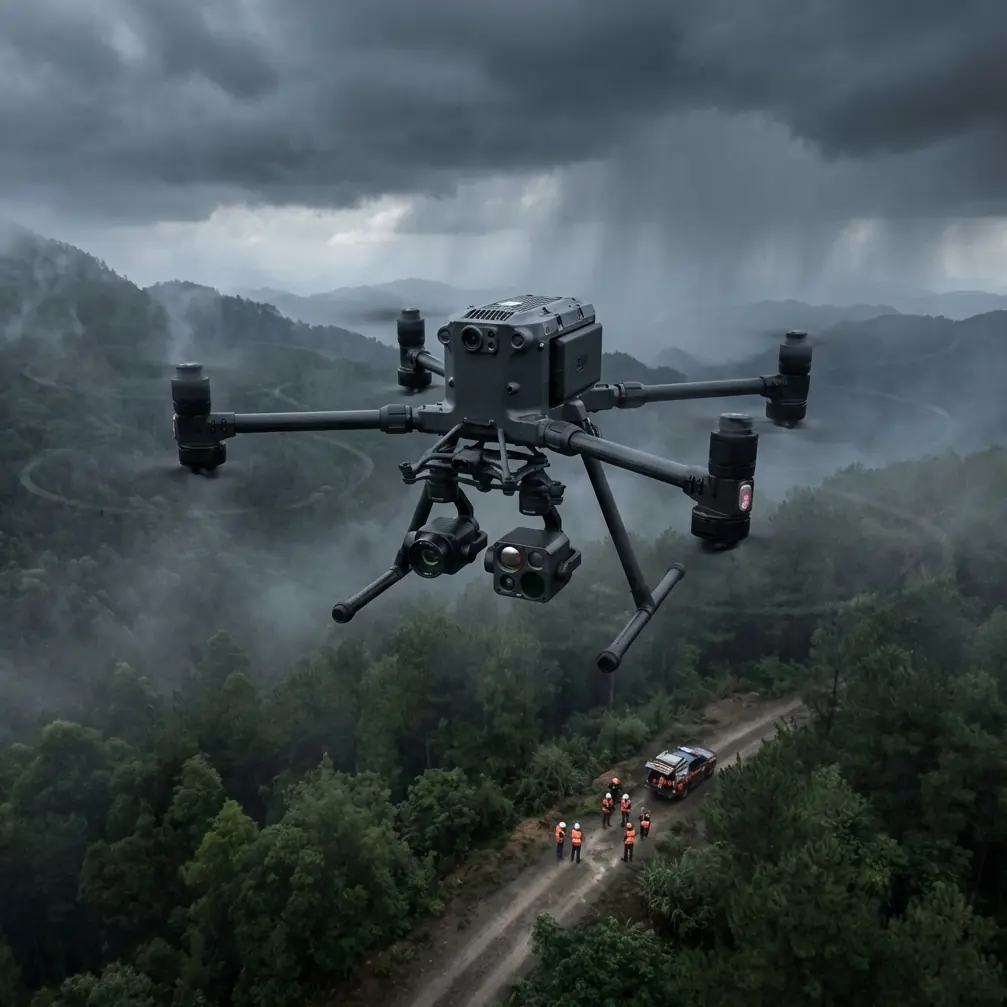
Matrice 400 for Dusty Vineyard Scouting: What Actually Matters in the Field
META: A technical review of Matrice 400 for vineyard scouting in dusty conditions, focusing on reliability, structural stability, transmission resilience, thermal workflows, and maintenance logic that matter during long commercial missions.
When people evaluate a heavy-duty drone for vineyard work, they often jump straight to payloads, sensor options, or headline flight time. That is not where experienced operators start.
In a dusty vineyard environment, especially across large blocks with uneven terrain and repeated daily sorties, the real question is simpler: will the aircraft stay predictable, recover gracefully from faults, and remain maintainable after months of hard use?
That is the right lens for assessing the Matrice 400.
I approach this as a systems problem, not a spec-sheet exercise. Vineyard scouting places a drone in a strange middle ground. It is not a one-off cinematic flight. It is not a short urban inspection either. It is repetitive, data-driven, and exposed to fine dust, heat loading, wind shifts over rows, and pressure to keep flying on schedule. If you are collecting thermal signature data for water stress, running photogrammetry over large parcels, or revisiting the same GCP-backed mapping corridor week after week, platform behavior matters more than brochure drama.
The Matrice 400 stands out because it aligns with two disciplines that serious aviation design has treated as non-negotiable for decades: structural dynamic stability and fault-tolerant propulsion control. Those themes may sound abstract, but they have direct consequences in a vineyard.
Why dusty vineyard work punishes weak aircraft design
A scouting mission over vines sounds gentle until you repeat it all season. Fine particulate gets everywhere. The aircraft climbs and descends repeatedly to adapt to terrain. It carries imaging payloads long enough for vibration trends to show up in the data. It flies routes where image overlap and thermal consistency matter, so sloppy handling is not just annoying; it compromises the dataset.
In these conditions, the best aircraft are not merely powerful. They are disciplined.
That is where the Matrice 400 has an advantage over lighter competitors that feel good in a demo but become less convincing in industrial rotation. Many smaller platforms are acceptable when the mission is short, the environment is clean, and the cost of a reflight is low. Vineyard operations are none of those things. If a thermal pass has to be repeated because the platform wandered, the image geometry shifted, or the transmission link became unreliable at the far edge of a block, your labor cost quietly rises and your agronomy schedule slips.
Structural stability is not an academic issue
One of the more useful reference points from classical aircraft design is the warning around T-tail layouts and coupled surfaces. The source material states that in a T-tail arrangement, the horizontal and vertical tails can develop severe inertial and aerodynamic coupling, which significantly reduces structural dynamic stability. It also highlights that tail dihedral is extremely sensitive in flutter-speed behavior, and that changes in dihedral can alter rolling moments enough to become a major driver in self-excited vibration.
Why bring that up in a Matrice 400 discussion?
Because it reminds us what mature airframe engineering looks like: not just making a vehicle fly, but making sure geometry, load paths, and unsteady aerodynamic effects do not quietly erode stability under operational stress. A commercial drone used for vineyard scouting does not need a textbook T-tail to suffer from the same category of mistake. Any aircraft carrying sensors over long sorties in variable wind can expose weak coupling, poor damping, or vibration pathways that only show up after sustained use.
The practical significance is straightforward. If the airframe is dynamically well behaved, your photogrammetry output is cleaner, your thermal signature interpretation is more trustworthy, and your gimbal has less correction work to do. In other words, good structural stability shows up as better agricultural decisions.
This is one area where the Matrice 400 should be judged above the level of consumer-adjacent competitors. A serious industrial platform has to remain composed when payload mass, crosswind exposure, and route repetition combine. That matters in vineyards because row-level scouting often depends on consistent altitude control and stable sensor orientation, not just raw airborne time.
Reliability is the hidden productivity feature
The second reference source is even more relevant to daily drone operations. It outlines a core reliability principle for engine systems: when digital electronic control is used, there should be a mechanical-hydraulic backup so that if the electronic system fails, the aircraft can automatically switch and still complete the mission or at least return safely. It also notes a strong maintainability discipline, including design-stage analysis and replacement-time demonstration, plus concrete lifecycle logic such as an engine total life of 1,500 flight hours for a 3,000-hour airframe, or 2,000 flight hours for a 4,000-hour airframe, with overhaul intervals of 300 or 500 hours respectively.
No, the Matrice 400 is not a manned aircraft engine program. But the philosophy is exactly right for enterprise UAV selection.
The operational significance for vineyard teams is this: redundancy and maintainability are not “nice extras.” They are the difference between a drone that can anchor a season-long scouting program and one that becomes a scheduling risk.
That is where features like hot-swap batteries deserve more respect than they usually get. In vineyard work, battery exchange is not merely about convenience. It is about preserving workflow continuity, keeping payload initialization intact where possible, and reducing downtime between adjacent blocks. If your scouting team is trying to capture comparable thermal data across multiple vineyard sections within a narrow temperature window, every minute on the ground matters. A platform built around efficient turnaround behaves more like professional equipment and less like a hobby tool wearing industrial clothes.
The same logic applies to transmission resilience. O3 transmission is not just a marketing shorthand for “long range.” In a vineyard, it matters because row geometry, topographic variation, dust haze, and vegetation density can all complicate link quality. A robust link helps preserve confidence at the edge of a route, especially when the aircraft is collecting overlapping mapping imagery or thermal scans that become expensive to repeat. Stable transmission reduces the temptation for the pilot to “nudge and rescue” the aircraft manually, which improves consistency in both photogrammetry and thermal inspection missions.
Dust changes the maintenance equation
Dusty vineyard operations expose an ugly truth: many drones are easy to buy and annoying to keep mission-ready.
This is why the maintainability concept in the reference material matters so much. The text explicitly calls for analysis during the concept phase and removal-replacement demonstration during the metal prototype phase. That mindset translates perfectly to enterprise UAV ownership. The best commercial aircraft are designed so service actions are anticipated, not improvised.
For Matrice 400 operators, the question is not just whether the drone can fly dusty routes today. It is whether routine cleaning, battery rotation, sensor swaps, and periodic inspections can be done without turning a one-hour mission into an all-day support event.
Competitor platforms often fail here. They may offer respectable imaging performance, but the supporting ecosystem feels fragile once you factor in repeated field setup, contamination control, battery logistics, and data handoff between sorties. A heavy-use vineyard program needs a machine that fits into a repeatable operational rhythm. That is one of the reasons the Matrice line has remained attractive to industrial teams: it tends to be adopted not for novelty, but for repeatability.
Thermal and photogrammetry workflows demand discipline from the aircraft
Vineyard scouting often splits into two data missions.
The first is thermal. You are looking for patterns tied to irrigation irregularities, blocked emitters, plant stress, drainage issues, or disease progression that changes canopy temperature. Thermal signature work punishes unstable platforms because slight shifts in angle, altitude, and timing can distort interpretation. If the aircraft holds its route consistently and maintains dependable transmission, the resulting maps become easier to compare over time.
The second is photogrammetry. Here, row uniformity can trick less disciplined operators into thinking any drone will do. It will not. Good reconstruction depends on overlap consistency, camera stability, route repeatability, and accurate control through GCP-referenced processing when high confidence is required. If the aircraft introduces unnecessary vibration or the link causes interruptions that affect mission flow, your orthomosaic quality and 3D surface output can degrade quietly rather than catastrophically. That is often worse, because the error is discovered after the crew has already left the site.
A stable, enterprise-grade platform like the Matrice 400 earns its value by reducing those quiet failures.
Security and remote operations are becoming operational issues, not IT issues
Enterprise teams also need to think about data protection. In agriculture, people sometimes underestimate this. They should not. Vineyard datasets may include block productivity trends, irrigation layouts, infrastructure positions, and operational patterns that a grower would not want exposed casually.
That is why AES-256 matters. Not because it sounds sophisticated, but because secure transmission and handling are part of making drone operations acceptable to commercial landowners and management teams. Security features become especially relevant when flights are conducted by service providers working across multiple client properties.
The same is true of BVLOS planning, where allowed by local regulation and approved operating frameworks. For expansive vineyard estates or distributed parcels, BVLOS can reshape labor economics and scouting cadence. But BVLOS only becomes realistic if the aircraft platform is trusted for link performance, system awareness, and predictable fault behavior. A drone that is merely “capable” in close-range VLOS work does not automatically graduate to serious corridor or estate-scale agricultural operations.
Where Matrice 400 separates itself from lighter alternatives
The easiest mistake in this market is comparing the Matrice 400 to aircraft that are cheaper to mobilize for occasional flights but weaker under sustained professional use.
For vineyard scouting in dusty conditions, the Matrice 400’s edge is not one dramatic feature. It is the way the whole platform concept supports continuity:
- stable mission behavior for repeated mapping and thermal passes
- stronger suitability for industrial maintenance routines
- resilient transmission for large-property operations
- battery workflow advantages through hot-swap support
- enterprise-grade security with AES-256
- a better fit for structured scaling toward BVLOS-ready operations where permitted
That combination matters more than any single headline specification.
If you are choosing between a lighter platform and the Matrice 400, ask a blunt question: which one would you trust to fly the same blocks twice a week, in dust, through peak season, with thermal and photogrammetry deliverables expected on schedule? Usually the answer becomes clear very quickly.
The real standard: can it keep earning trust after month three?
The best compliment I can give the Matrice 400 for vineyard scouting is this: it should be evaluated like working equipment, not like a gadget.
The reference material on aircraft design reminds us that subtle coupling effects can undermine dynamic stability if engineers do not treat them seriously. The propulsion-system reference reminds us that reliability must include backup logic, maintainability targets, and life-cycle planning, with real numbers such as 300-hour and 500-hour overhaul intervals used to keep systems economically sensible over time. Those are not random aviation details. They are a mindset. And that mindset is exactly what separates durable enterprise drone operations from trial-phase enthusiasm.
For vineyard teams, the operational significance is immediate. Better structural composure supports better maps. Better reliability planning supports better dispatch confidence. Better maintainability supports more sorties per week with fewer surprises. That is how a platform earns its place.
If you are currently designing a scouting workflow for dusty vineyards and need help matching payload choice, mission profiles, and data outputs to the Matrice 400 platform, you can message a field integration specialist here.
The Matrice 400 is not interesting because it is new. It is interesting because the jobs that matter most in agriculture reward aircraft that are stable, recoverable, secure, and maintainable. Vineyard scouting is one of those jobs.
Ready for your own Matrice 400? Contact our team for expert consultation.