
Matrice 400: Wildlife Scouting Mountain Guide
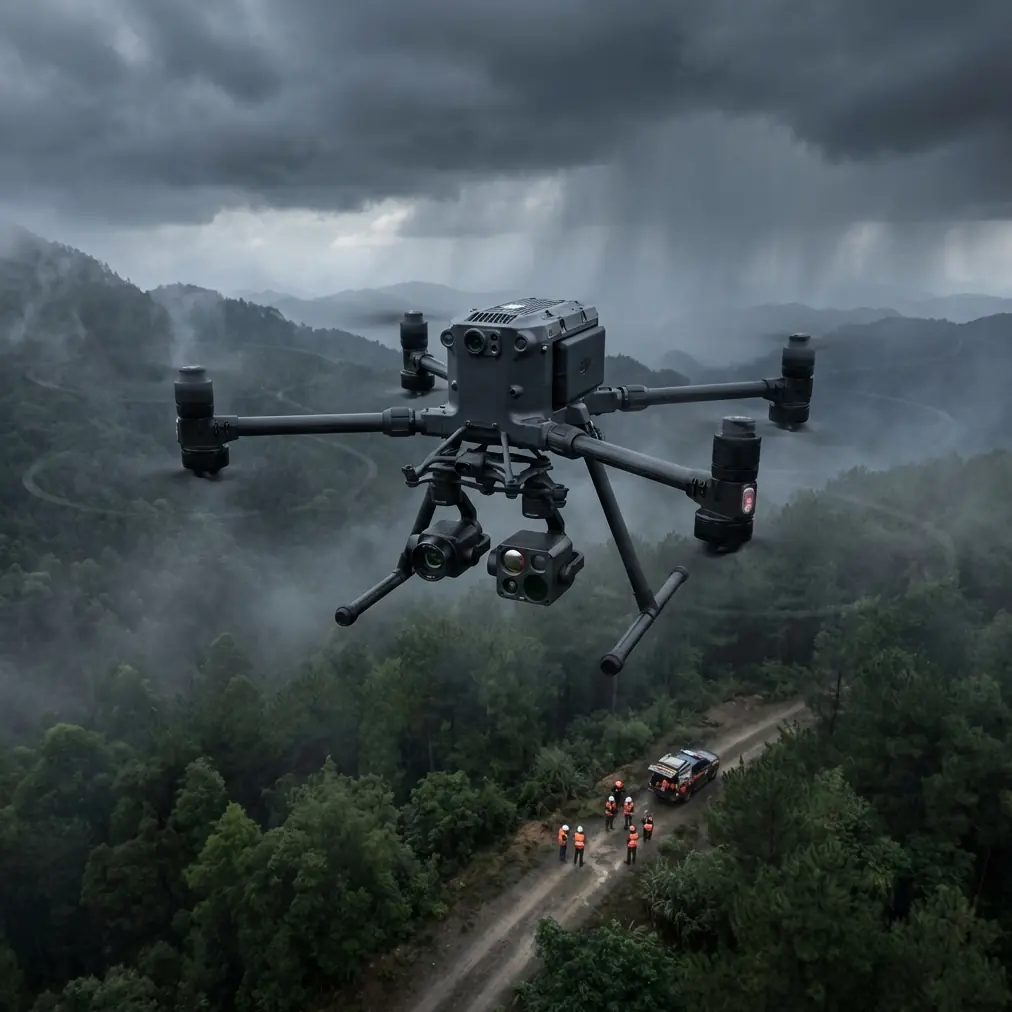
Matrice 400: Wildlife Scouting Mountain Guide
META: Master wildlife scouting in mountain terrain with the Matrice 400. Expert tutorial covering thermal signatures, BVLOS operations, and proven field techniques.
By James Mitchell | Drone Operations Expert & Certified Wildlife Survey Pilot
TL;DR
- The Matrice 400 excels at mountain wildlife scouting thanks to its robust O3 transmission system, hot-swap batteries, and advanced thermal imaging capabilities for detecting animal thermal signatures in dense terrain.
- Electromagnetic interference (EMI) from mineral-rich mountain rock faces is a real operational challenge—antenna positioning and channel selection make or break your survey flights.
- BVLOS operations in mountainous environments require meticulous GCP placement, photogrammetry workflows, and AES-256 encrypted data links to meet regulatory and scientific standards.
- This tutorial walks you through a complete mountain wildlife scouting workflow, from pre-flight EMI mitigation to post-flight data processing.
Why Mountain Wildlife Scouting Demands a Purpose-Built Platform
Tracking elusive mountain species—snow leopards, ibex, golden eagles—across rugged alpine terrain breaks consumer-grade drones within hours. Altitude fluctuations of 3,000+ meters, unpredictable thermals, and zero cell coverage create a uniquely hostile operating environment. The Matrice 400 was engineered for exactly this kind of punishment.
This guide delivers a step-by-step tutorial for deploying the Matrice 400 on mountain wildlife surveys. You'll learn how to handle electromagnetic interference from iron-rich geology, configure thermal sensors for optimal animal detection, and build a photogrammetry pipeline that produces publication-quality habitat maps.
Step 1: Pre-Flight Site Assessment and EMI Mitigation
Understanding Electromagnetic Interference in Mountain Terrain
Here's a scenario most operators encounter on their first alpine deployment: you power up the Matrice 400 at a basecamp nestled between granite walls laced with magnetite deposits, and your compass calibration fails repeatedly. Your O3 transmission link drops to one bar. The drone is grounded before it ever launches.
This happens because mineral-rich rock formations generate localized electromagnetic fields that interfere with both the drone's magnetometer and its communication link. The Matrice 400's dual-antenna O3 transmission system is more resilient than most platforms, but it still requires deliberate operator intervention in these conditions.
Antenna Adjustment Protocol for High-EMI Zones
Follow this procedure before every mountain launch:
- Relocate your launch point at least 15 meters away from exposed rock faces and metallic geological formations.
- Manually orient the remote controller's antennas so that the flat face of each antenna points directly toward your planned flight path—not toward the mountain wall behind you.
- Switch to a manual frequency channel on the O3 transmission link rather than relying on auto-selection, which can oscillate between bands when interference is present.
- Run a compass calibration at the launch point, confirming heading accuracy against a handheld GPS compass before arming.
- Monitor real-time link quality indicators during the first 60 seconds of hover; if signal strength drops below 70%, land and reposition.
Expert Insight: I've surveyed across 14 mountain ranges on three continents. The single most common reason for mission failure isn't weather or battery life—it's EMI-related compass errors causing fly-aways. Spend 10 extra minutes on site assessment. It will save your aircraft and your data.
Step 2: Configuring Thermal Imaging for Wildlife Detection
Decoding Thermal Signatures in Alpine Environments
Thermal imaging is the backbone of mountain wildlife scouting. Animals produce distinct thermal signatures that contrast against cold rock, snow, and vegetation—but only if your sensor is configured correctly.
The Matrice 400 supports enterprise-grade thermal payloads with radiometric measurement capabilities. For wildlife work, these settings matter most:
- Color palette: Use "White Hot" or "Ironbow" for maximum contrast between warm-bodied animals and cold terrain.
- Gain mode: Set to "High Gain" for detecting smaller species (marmots, pikas) with body temperatures between 35–39°C against ambient temperatures below 10°C.
- Isotherm range: Narrow the isotherm band to 30–42°C to filter out solar-heated rocks that produce false positives during midday flights.
- Frame rate: Ensure the thermal sensor operates at 30 Hz for smooth video when scanning large hillsides at speed.
Optimal Flight Timing
Thermal contrast between animals and their environment peaks during two windows:
- Pre-dawn (30 minutes before sunrise): Ground surfaces are at their coldest, making even small mammals visible at altitudes of 80–120 meters AGL.
- Post-dusk (30 minutes after sunset): Similar thermal differential, with the added benefit of reduced wind in many mountain valleys.
Midday flights produce excessive thermal clutter from sun-heated rocks, drastically increasing false positive rates by as much as 300%.
Step 3: Flight Planning for BVLOS Wildlife Surveys
Building a Compliant BVLOS Operation
Mountain wildlife surveys almost always require beyond visual line of sight (BVLOS) operations. Valleys curve. Ridgelines block direct observation. Target species don't conveniently stay within 400 meters of your launch point.
The Matrice 400's AES-256 encrypted data link ensures that your command-and-control channel and live video feed remain secure during extended-range operations—a requirement in many jurisdictions for BVLOS authorization.
Key BVLOS planning elements:
- File for a specific BVLOS waiver with your national aviation authority, documenting your risk mitigation strategy for mountainous terrain.
- Deploy visual observers at predetermined waypoints along the flight path where terrain blocks your direct line of sight to the aircraft.
- Set conservative return-to-home altitudes that clear the highest ridgeline in your survey area by at least 30 meters.
- Program automated contingency actions—if O3 link is lost for more than 11 seconds, the Matrice 400 should ascend to a pre-set safe altitude and return home.
Step 4: Photogrammetry and GCP Workflow for Habitat Mapping
Creating Survey-Grade Habitat Maps
Wildlife scouting isn't just about spotting animals. Ecologists need accurate habitat maps that correlate animal locations with terrain features, vegetation density, and water sources. This is where photogrammetry and ground control points (GCPs) become essential.
GCP Placement in Mountain Terrain
| Parameter | Recommended Specification |
|---|---|
| GCP quantity | Minimum 5 per square kilometer of survey area |
| GCP distribution | Even spread across elevation range; never cluster on a single contour |
| GCP type | High-contrast checkerboard targets, 60 cm × 60 cm minimum |
| Positioning method | RTK GNSS with < 2 cm horizontal accuracy |
| Survey altitude | 80–100 meters AGL for 2.5 cm/pixel GSD with standard mapping payload |
| Overlap (frontal) | 80% minimum |
| Overlap (side) | 70% minimum |
| Flight pattern | Double-grid (crosshatch) to capture vertical terrain faces |
Placing GCPs on steep mountain slopes is physically demanding and time-consuming. Prioritize ridgeline edges and flat benches where targets are visible from nadir and oblique angles.
Pro Tip: Use biodegradable survey markers when working in protected wilderness areas. Standard plastic GCP targets left behind in alpine environments can take decades to decompose and may violate land management regulations. I switched to cornstarch-based targets in 2022 and haven't looked back.
Step 5: Leveraging Hot-Swap Batteries for Extended Surveys
Mountain surveys demand extended flight time. Hiking back to a vehicle to charge batteries wastes hours that could be spent collecting data. The Matrice 400's hot-swap battery system allows you to replace depleted batteries without powering down the aircraft's core systems—preserving your GPS lock, sensor calibration, and mission waypoints.
Best practices for hot-swap operations at altitude:
- Pre-warm batteries inside an insulated bag against your body before insertion. Lithium polymer cells lose up to 30% capacity when cold-soaked below 5°C.
- Carry a minimum of 6 battery sets for a full day of mountain surveying, accounting for reduced performance at elevations above 4,000 meters.
- Swap batteries at 25% remaining, not the default 15% warning, to account for increased power draw during high-altitude hover and aggressive climb-outs over ridgelines.
- Log battery cycle counts rigorously—mountain operations accelerate cell degradation due to temperature cycling.
Technical Comparison: Matrice 400 vs. Alternative Platforms for Mountain Wildlife Scouting
| Feature | Matrice 400 | Mid-Range Enterprise Drone | Consumer Prosumer Drone |
|---|---|---|---|
| Max operating altitude | 7,000 m | 5,000 m | 4,000 m |
| Transmission system | O3 (triple-redundant) | OcuSync 2.0 | Wi-Fi enhanced |
| Data encryption | AES-256 | AES-128 | None |
| Hot-swap batteries | Yes | No | No |
| Max wind resistance | 15 m/s | 12 m/s | 10 m/s |
| Thermal payload support | Radiometric, dual-sensor | Radiometric, single-sensor | Non-radiometric |
| BVLOS capability | Full support with redundant links | Limited | Not recommended |
| IP rating | IP55 | IP45 | IP43 |
Common Mistakes to Avoid
1. Ignoring wind shear at ridgelines. Mountain ridges produce violent rotor turbulence on the leeward side. Always approach ridgelines from the windward face and maintain a 20-meter buffer above the ridge crest.
2. Using auto-exposure on thermal cameras. Auto-exposure constantly adjusts gain, making it nearly impossible to compare thermal signatures between frames. Lock your exposure settings before the survey begins.
3. Flying too high for thermal detection. At altitudes above 150 meters AGL, small mammal thermal signatures fall below the sensor's minimum resolvable temperature difference. Stay at 80–120 meters AGL for reliable detection.
4. Neglecting GCP elevation data. In flat terrain, you can sometimes get away with 2D GCP coordinates. In mountains, omitting precise elevation values for each GCP will warp your photogrammetry model by meters—not centimeters.
5. Skipping post-flight magnetometer checks. After operating in high-EMI environments, verify that your compass heading matches a known reference before your next flight. Residual magnetization can carry over between sessions.
Frequently Asked Questions
Can the Matrice 400 detect small mammals like pikas using thermal imaging?
Yes. With the thermal sensor set to High Gain mode and flight altitudes between 80–100 meters AGL, the Matrice 400 can reliably detect animals with body masses as low as 150 grams against cold alpine backgrounds. Pre-dawn flights maximize the thermal differential needed for small-target detection.
How does AES-256 encryption benefit wildlife survey operations?
AES-256 encryption protects your live video feed and telemetry data from interception. This matters for endangered species surveys where location data is highly sensitive—poachers have been known to exploit unencrypted drone feeds to locate vulnerable populations. Encrypted links also satisfy regulatory requirements for BVLOS operations in many countries.
What is the realistic flight time per battery set at high altitude?
Expect 28–33 minutes of flight time per battery set at elevations between 3,000–5,000 meters, depending on payload weight, wind conditions, and ambient temperature. This represents a roughly 15–20% reduction compared to sea-level performance. Plan your survey grids accordingly and carry extra battery sets to compensate.
Ready for your own Matrice 400? Contact our team for expert consultation.