
How I’d Approach Spraying Construction Sites at High Altitud
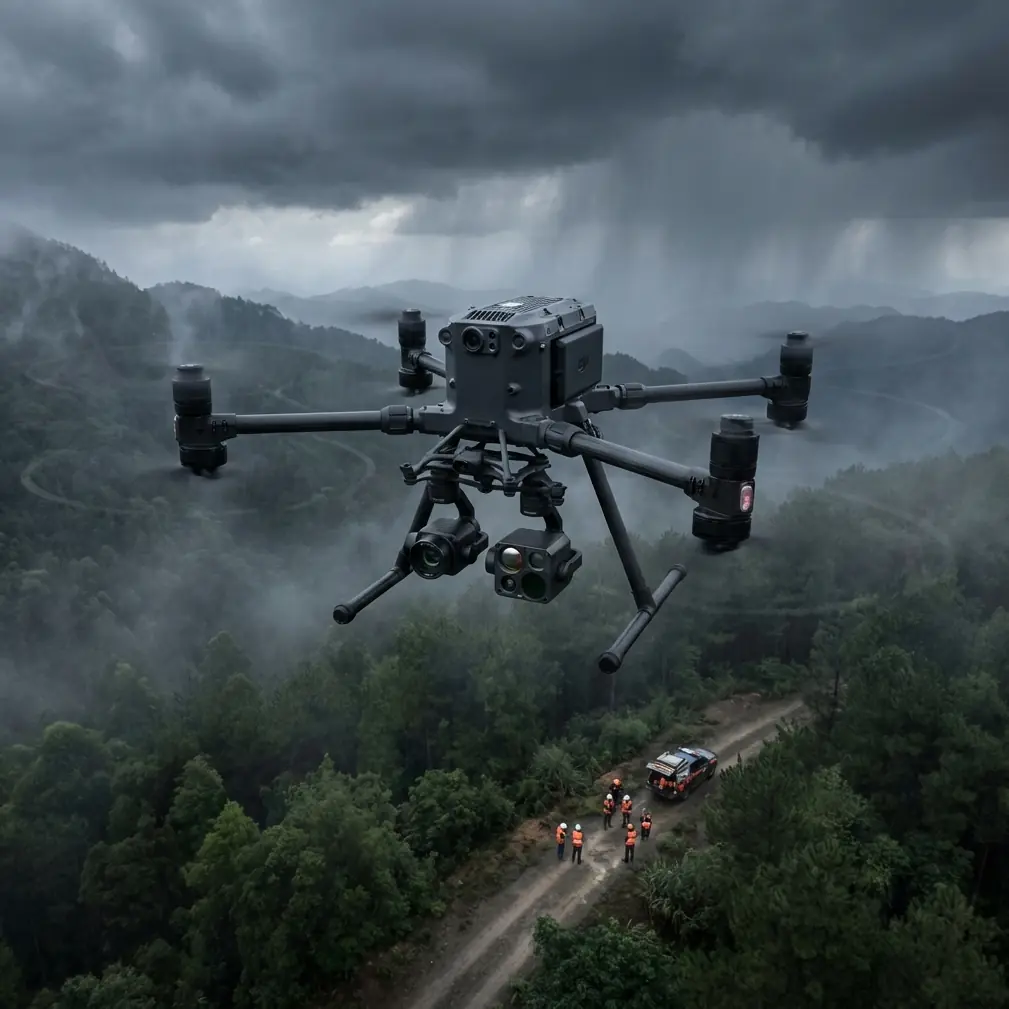
How I’d Approach Spraying Construction Sites at High Altitude With the Matrice 400
META: Practical expert guidance on using the DJI Matrice 400 for high-altitude construction site spraying, with workflow tips for mapping, link security, battery strategy, and safer operations.
High-altitude construction spraying is one of those jobs that looks straightforward until the site starts fighting back. Wind behaves differently around unfinished structures. Signal paths get blocked by steel and concrete. Temperature shifts can distort what crews assume they are seeing. And when the work zone sits on a mountain grade, a tower foundation, or an elevated road project, every delay becomes expensive in labor hours, access planning, and safety exposure.
I’ve dealt with this firsthand. On one early mountain-side infrastructure project, the team tried to treat drone spraying as if it were a flat, open-field task. That assumption collapsed fast. The aircraft had to work around abrupt elevation changes, patchy GNSS conditions near retaining walls, and spray paths that looked clean on paper but became uneven once wind curled around rebar cages and half-completed vertical surfaces. We spent more time correcting coverage gaps than actually advancing the job.
That kind of site is exactly where a platform like the Matrice 400 changes the equation—not because it magically removes complexity, but because it gives you better control over it.
This is not a generic “how to use a drone” article. If your real question is how to spray construction sites at high altitude with a Matrice 400-class workflow, here is the method I would use, and why each part matters operationally.
Start with a site model before a spray plan
The biggest mistake on elevated construction work is beginning with the spray mission itself. You need a site model first.
At high altitude, “level” is rarely meaningful in practice. Even when the project footprint seems compact, the drone may be crossing embankments, scaffold faces, stepped foundations, access roads, utility trenches, and partial superstructure elements. If you define a spray path without understanding those vertical relationships, your overlap and standoff will drift throughout the mission.
My preferred first step is a photogrammetry pass. Not as a box-checking exercise, but as the backbone for everything that follows.
A proper map gives you three things:
- surface geometry for planning altitude-relative flight lines
- obstacle awareness near cranes, temporary fencing, and protruding steel
- a record you can compare against later for coverage verification
Ground control points, or GCPs, matter more here than many crews realize. On a high-altitude site, terrain compression and irregular slopes can produce planning errors if you rely on uncorrected positioning. A few well-placed GCPs tighten the map and reduce the risk that your spray route is flying a neat pattern over the wrong vertical reference.
This is especially valuable when the target is not just bare ground. If you are applying dust suppression agents, curing compounds, or specialized treatments to graded surfaces and concrete-adjacent work zones, consistency matters. A route that is two or three meters off its intended vertical relationship can mean uneven application, wasted payload, or overspray into protected areas.
The Matrice 400 fits this workflow well because it is built for more than one narrow task. On complex sites, that flexibility matters. You are not just sending up an aircraft to dump liquid. You are building an operational loop: map, assess, apply, verify.
Use thermal signature data when the surface lies to you
One of the reasons spraying at altitude becomes messy is that the visual surface does not always tell the full story.
A site can look uniformly dry and still have major thermal differences across retaining structures, recently poured sections, aggregate stockpiles, and shaded haul paths. Those differences affect evaporation, adhesion, and how certain sprayed materials behave once they hit the surface.
Thermal signature data helps you avoid treating the entire site as one condition set.
For example, if one area is heating rapidly due to solar exposure while another remains cooler under structural shadow, your application window may not be equally efficient across both zones. That has operational significance. It affects not only where you spray first, but whether the crew should split the mission into separate blocks with different timing.
On high-altitude projects, the atmosphere can also turn quickly. Temperature and wind shifts arrive faster than many teams expect, especially on exposed ridgelines or elevated deck work. A thermal-informed preflight check can help you identify where material is likely to flash off too quickly or where moisture retention may alter effectiveness.
This is where a multi-sensor mindset helps the Matrice 400 stand out. The aircraft becomes less of a flying nozzle and more of a decision platform. If you are responsible for both output quality and site safety, that distinction matters.
Build the mission around transmission reliability, not brochure range
Signal stability is not a side issue on construction sites. It is one of the main constraints.
Steel frames, temporary towers, concrete cores, and moving equipment all interfere with clean control and video links. At high altitude, line-of-sight can look open from a distance while the actual signal path is cluttered by the jobsite geometry. That is why I pay close attention to O3 transmission performance in real-world conditions, not just its headline capability.
Strong transmission changes the way you plan the job:
- you can maintain clearer situational awareness while working around vertical obstacles
- the pilot can verify edge coverage instead of guessing from delayed or degraded video
- spotters and supervisors can make faster decisions when conditions change
On an exposed construction site, those seconds matter. If wind starts channeling around a partially enclosed structure, the pilot needs a stable view and immediate control response. Weak downlink quality does not just make the mission annoying. It increases the odds of inconsistent coverage and unnecessary repositioning.
If your operation includes sensitive project data, AES-256 encryption is not a trivial spec either. Construction spraying often happens on sites tied to infrastructure, energy, transport, or industrial development. Flight routes, imagery, thermal data, and progress records can all carry operational sensitivity. Secure transmission protects more than the aircraft link; it protects the work product and the client relationship.
That security layer becomes even more relevant if you are documenting treatment areas for compliance or internal reporting. A secure data path is part of professional practice now, not an optional add-on.
Plan battery swaps like a production manager
Battery strategy is where many drone spraying operations quietly lose efficiency.
On high-altitude sites, transit time between launch area and work area may be longer than expected. Add colder conditions, heavier payload operations, and the energy cost of climbing relative terrain, and your battery plan can unravel quickly if it is based on ideal assumptions.
Hot-swap batteries are one of those features that sound procedural until you are trying to keep a project moving between weather windows. They matter because they compress downtime without forcing a full system reset every time you need fresh power.
Operationally, that means:
- less interruption between adjacent spray blocks
- more consistent mission pacing across a narrow weather window
- reduced temptation to stretch a pack longer than prudent
I like to divide a high-altitude site into battery-sized segments before the first lift. Not “the whole north side,” but specific work cells with clear start and stop boundaries. Each cell should be small enough that the aircraft can finish the application, verify completion, and return with comfortable reserve. That reserve matters more on sloped or elevated sites, where the return leg may be less forgiving than the outbound leg.
If the Matrice 400 is supporting a mixed workflow—mapping in the morning, spraying during the stable window, verification later—the hot-swap approach becomes even more useful. You keep the platform active while reducing dead time for the field team.
Treat BVLOS as an operational discipline, not a buzzword
Some high-altitude construction sites are long, segmented, or difficult to access by vehicle. Think road cut stabilization, utility corridors, mountain foundations, or elevated transport alignments. In those environments, BVLOS becomes part of the planning conversation quickly.
But BVLOS is not just about flying farther. It is about building a system that can maintain safety, awareness, and accountability when the site layout limits direct proximity.
For spraying work, that changes several habits:
- route segmentation has to be tighter
- lost-link procedures need to be rehearsed, not assumed
- visual observers, if required, need meaningful placement
- mission triggers for pause or abort must be defined in advance
The Matrice 400’s value in this context is not merely endurance or connectivity. It is that the platform can support a more structured operational framework for difficult environments. On a high-altitude site, especially one with changing topography and restricted access lanes, your best outcome comes from combining aircraft capability with disciplined airspace and ground coordination.
If your site team is still improvising communications between pilot, spotter, and ground crew, fix that before you scale mission distance. A reliable aircraft cannot compensate for a loose operating culture.
My preferred field workflow for a high-altitude spray day
If I were setting this up for a real project, my day would look something like this.
First, I would walk the site with the superintendent or safety lead and identify three categories: surfaces to treat, surfaces to avoid, and zones likely to create airflow distortion. That last category gets overlooked constantly, yet it is often the difference between an efficient mission and a frustrating one.
Second, I would run or review a recent photogrammetry model with GCP-backed accuracy wherever the terrain or structures make elevation assumptions risky. I want a planning base that reflects the site as it is now, not last week.
Third, I would use visual and thermal assessment together to identify sequence. Areas with stronger sun load, faster drying, or unusual heat retention may need to be treated at a different time than cooler or shaded areas.
Fourth, I would break the site into mission cells sized for safe completion within realistic battery margins. This is where hot-swap efficiency starts paying off.
Fifth, I would confirm control-link quality from the actual launch and working positions, with special attention to structures that may interfere with O3 transmission once the aircraft descends near the treatment zone.
Sixth, I would brief the team on contingencies: wind threshold, pause criteria, reroute criteria, and recovery protocol. If the operation is approaching BVLOS conditions, that briefing gets even tighter.
Then I would fly.
Not aggressively. Not to prove how much ground we can cover in one sortie. I would fly for repeatability. Consistent pathing and predictable application rates beat rushed output every time on a complicated site.
After each block, I would verify coverage before moving on. That might be a visual review, an imagery check, or a thermal comparison depending on what material is being applied and how the treated surface responds. The key is not to save all validation for the end of the day. By then, corrections are slower and usually more expensive.
Where crews usually struggle, and how the Matrice 400 helps
The most common failure points I see are not dramatic crashes or obvious mistakes. They are smaller operational weaknesses that compound.
One is assuming the aircraft can compensate for bad planning. It cannot.
Another is treating site elevation as a single number. On high-altitude construction projects, the real issue is local relief and obstacle geometry, not just overall altitude above sea level.
A third is underestimating communication latency—between people, not machines. When the pilot sees one thing, the ground crew reports another, and the supervisor changes priorities mid-mission, coverage quality deteriorates fast.
The Matrice 400 helps because it supports a more integrated way of working. Strong transmission via O3 improves live awareness. AES-256 supports secure handling of flight and site data. Hot-swap batteries make a segmented workflow more practical. And the platform’s broader mission flexibility supports the combination of photogrammetry, thermal assessment, and application planning that high-altitude jobs actually require.
That does not remove the need for judgment. It sharpens the value of good judgment.
One practical recommendation I’d make before your next project
Before the first spray day, run a non-application rehearsal mission on the exact site.
Map it. Test the link. Check thermal behavior. Validate return routes. Time the battery swap process. Watch how wind behaves near unfinished structures during the part of the day when you expect to work. That rehearsal will tell you more than a week of conference-room planning.
If you want a fast operational checklist tailored to your terrain and treatment type, you can message my field team here and use that discussion to pressure-test your plan before mobilization.
That kind of preparation may feel excessive until the site starts changing underneath you. Then it feels cheap.
The core lesson is simple: high-altitude construction spraying is not hard because the drone is in the air. It is hard because the environment is unstable, vertical, and unforgiving of loose assumptions. A Matrice 400-based workflow gives you the structure to handle that reality if you use the platform as a system—for mapping, sensing, secure coordination, controlled application, and verification.
That is the difference between merely flying a job and actually owning it.
Ready for your own Matrice 400? Contact our team for expert consultation.