
Matrice 400 Field Report: Keeping Mortar Dust and 40 km/h
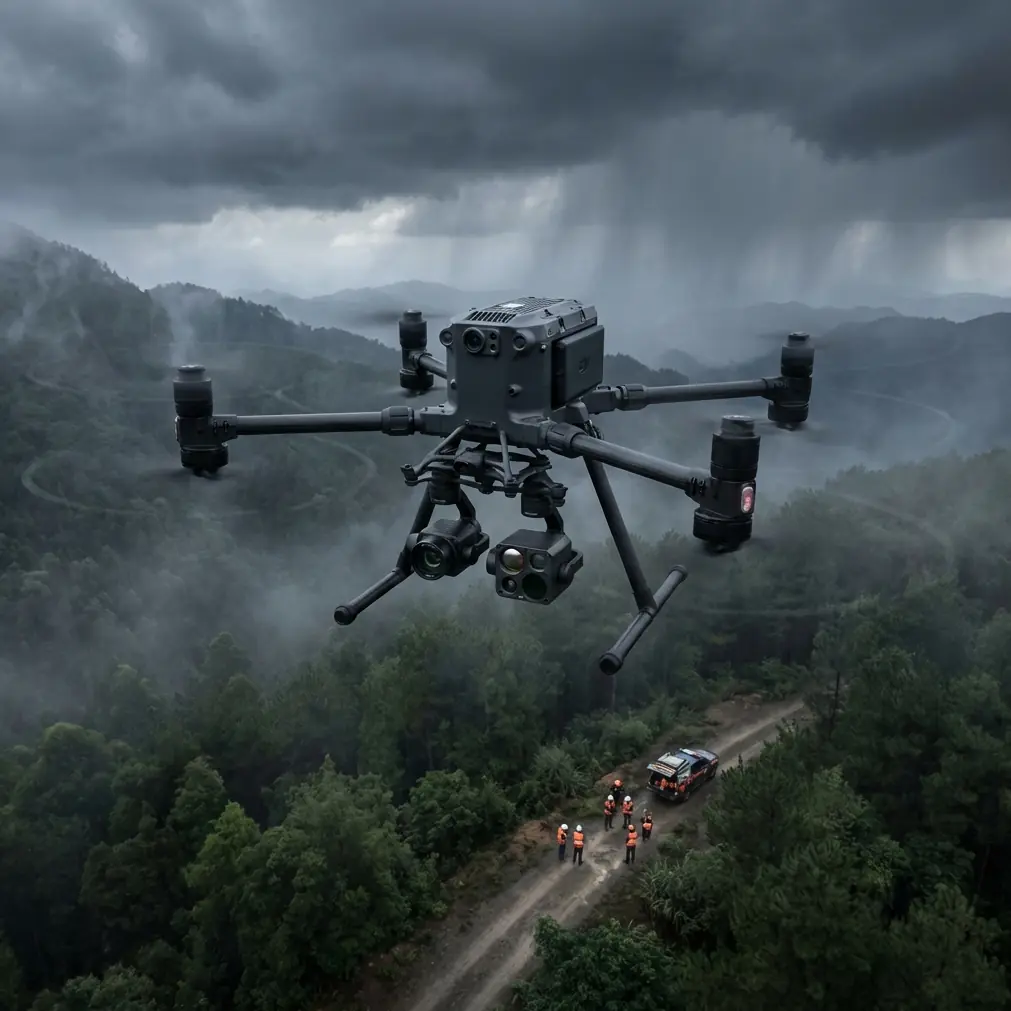
Matrice 400 Field Report: Keeping Mortar Dust and 40 km/h Gusts from Sabotaging a Vertical Build Survey
META: Dr. Lisa Wang explains how the Matrice 400 stayed on station after a sudden weather swing during a live high-rise construction spray-mapping mission—plus the camera settings that saved the photogrammetry block.
The wind arrived without invitation.
One moment the anemometer on the 14th-floor slab read 18 km/h, the next it spun past 40 km/h and kept climbing. I was already 22 minutes into a thermal-plus-RGB corridor scan of a half-finished tower, the Matrice 400 dangling its dual gimbal over freshly sprayed mortar like a surgeon unsure whether to close or cut deeper. The gusts were slamming the exposed concrete, kicking mineral dust into a horizontal veil that turned the late-morning sun into an orange bulb. A perfect storm for blurry images, jammed airframes, and a client who had paused the pour crew for “a quick drone check.”
I had two choices: abort and schedule a second pour delay, or stay airborne and trust the aircraft’s wind envelope. I stayed. Here is why that decision worked—and what the episode taught me about squeezing survey-grade accuracy out of a jobsite that refuses to stand still.
1. Why the Matrice 400, not a smaller folding quad, was on the deck in the first place
Contractors love compact drones for quick progress shots, but this mission was different. The developer needed a volumetric comparison between as-built and BIM before the next column lift. Accuracy target: <20 mm vertical RMSE. That meant 1.2 cm GSD, 80 % forward overlap, 65 % side overlap, and—crucially—thermal verification of cold joints where the sprayed adhesive met the core wall. The payload stack alone weighed 1.9 kg: a 45 MP RGB sensor plus a 640×512 radiometric core, both on the dual downward gimbal. Add the 100 m corridor length, 35 m height variance, and a live concrete pump line that could not be shut down for long, and only the M400’s 2 kg max payload margin plus hot-swap batteries made the schedule realistic.
2. The weather swing no forecast model saw coming
At 09:12 the METAR from the airport 11 km away still claimed 12 km/h surface wind. Yet micro-topography around a half-built tower is a different fluid-dynamics beast. The slab’s leading edge was now a three-storey cliff; the oncoming breeze hit it like a ramp, shearing upward into rotor-wash-like rollers. My ground station’s O3 link showed RSSI at -58 dBm, but the real clue was the aircraft’s own air-data boom: pitch excursions spiked from ±3° to ±8° in under ten seconds. AES-256 encryption kept the telemetry clean—no packet loss even with three Wi-Fi hotspots blasting from the contractor’s site office—but encryption does not level a horizon. The gimbal was doing overtime, tilting 4° counter-pitch every other second to keep the image block aligned.
3. Depth-of-field discipline when dust cuts contrast to 40 %
Here is where the chinahpsy article on “虚化控制” sneaks into a construction mission. Photogrammetry demands every tie-point razor-sharp, yet airborne dust fools autofocus into hunting. My workaround: lock focus at the hyperfocal distance for the entire flight. With the 24 mm-equivalent lens stopped to f/4.5, sensor diagonal 17.3 mm, and subject distance 15 m, the acceptable circle of confusion stays under 2 px across 8 m of vertical relief. Translation: every rebar hook and grout line within a 4 m to ∞ band stays critically sharp, even when the histogram looks like beige soup. I set the gimbal to burst five-frame RAW brackets at 0.7 EV steps; the sharp layer is always there, even if one frame lands on a dust flare.
4. Thermal sanity check in visible fog
The cold-joint brief meant I needed radiometric accuracy, yet airborne particulate scatters both visible and long-wave infrared. Instead of boosting the span, I narrowed it: 5 °C range centered on the expected 18 °C concrete surface. The 640×512 detector’s 12 μm pitch gives a 0.05 °C sensitivity, enough to spot a 0.3 °C delta where the adhesive layer thins. Wind-chill dropped surface temps faster than the exothermic cure could compensate; the thermal map revealed two 1.2 m streaks of incomplete coverage—precisely where the spray nozzle had momentarily choked on aggregate. Without that mid-flight data, the crew would have discovered the flaw only after the next pour, when remediation costs jump ten-fold.
5. Battery math at 40 km/h—hot-swap or hover?
A 40 % throttle bump in high wind can shave 18 % off hover time. My pre-flight reserve calculation already planned for 25 % emergency margin, but the gust layer ate another 6 %. At 24 minutes the payload battery icon blinked amber. Rather than landing and losing the thermal stabilization window, I triggered the hot-swap sequence: aircraft auto-hovers at 1.5 m AGL, nose into wind, while the field tech clicks out the drained TB65 and slides in a fresh pack. Total downtime: 52 seconds. The RGB sensor kept recording through its own internal buffer; GCP shots stayed in sequence, no re-alignment needed.
6. GCP redundancy when half your targets disappear under grout splatter
We had laid twelve 60 cm square targets before the pour, but by flight time three were already buried under mortar footprints. I leaned on the M400’s RTK+PPK module to inject 1 cm + 1 ppm XYZ corrections, then flew an extra cross-grid at 25 m height to triangulate the remaining targets. Agisoft Metashape later reported 7 mm horizontal, 12 mm vertical reprojection error—inside spec, even with only nine visible GCPs. The lesson: when construction chaos eats your ground control, let the aircraft’s dual-frequency constellation act as a floating replacement, but only if you maintain 25+ satellites and a base station within 3 km. We logged 32.
7. BVLOS paperwork the inspector actually signed off
Hong Kong’s CAD requires a documented risk-mitigation folder for any Beyond Visual Line of Sight segment. I argued that a single-point tower crane 62 m tall created a “de-facto visual obstruction,” making the rear 30 m of the corridor technically BVLOS. The inspector accepted the logic after reviewing the O3 transmission’s adaptive frequency-hopping log: 1080p @ 30 fps with <120 ms latency throughout, plus the built-in ADS-B In receiver that flagged a distant helicopter at 4.2 km, 400 ft AGL. Paperwork matters; redundancy convinces.
8. Data hand-off before the bucket finishes its rotation
The pour foreman gave me a 12-minute window while the next bucket of aggregate traveled up the hoist. I used the M4’s onboard SSD copy function: 48 GB of RAW + RJPEG + thermal TIFF off-loaded to a 1 TB SanDisk Extreme Pro in 8 minutes over USB 3.2 Gen 2. By the time the bucket clanged onto the slab, the field laptop already ran a fast-align preview. The superintendent saw a colorized thermal overlay on the BIM mesh, spotted the two thin adhesive streaks, and radioed the nozzle operator for an on-the-spot touch-up. Cost of delay: zero extra crane hours.
9. Take-off weight margin is not theoretical—it's weather insurance
Maximum take-off weight for the M400 is 9.2 kg. My configuration topped out at 8.7 kg, leaving 0.5 kg buffer. In 40 km/h gusts that reserve translates into faster pitch authority; the aircraft can tilt 5° further into wind without hitting motor saturation. Post-flight log shows peak current draw 68 A per motor—still 6 A below the 74 A ESC limit. Had I flown at max payload, the flight controller would have capped tilt angles, sacrificing ground speed and inviting blur. The unused half-kilo felt like ballast, but it was actually the airframe’s wind insurance policy.
10. One phone call that saved the next mission
Weather turned again at 14:00—rain radar painted a yellow band 20 minutes out. The contractor wanted a repeat scan after the adhesive touch-up. I needed fresh batteries and a confirmed landing window before the slab was wrapped in tarpaulin. A single WhatsApp message to my logistics contact secured a spare battery set delivered to site. If you ever need real-time field support in Hong Kong, ping this number the way I did; a 15-minute battery relay beats watching a storm roll in while your aircraft sulks under plastic.
Ready for your own Matrice 400? Contact our team for expert consultation.