
Matrice 400 for Remote Construction Site Spraying
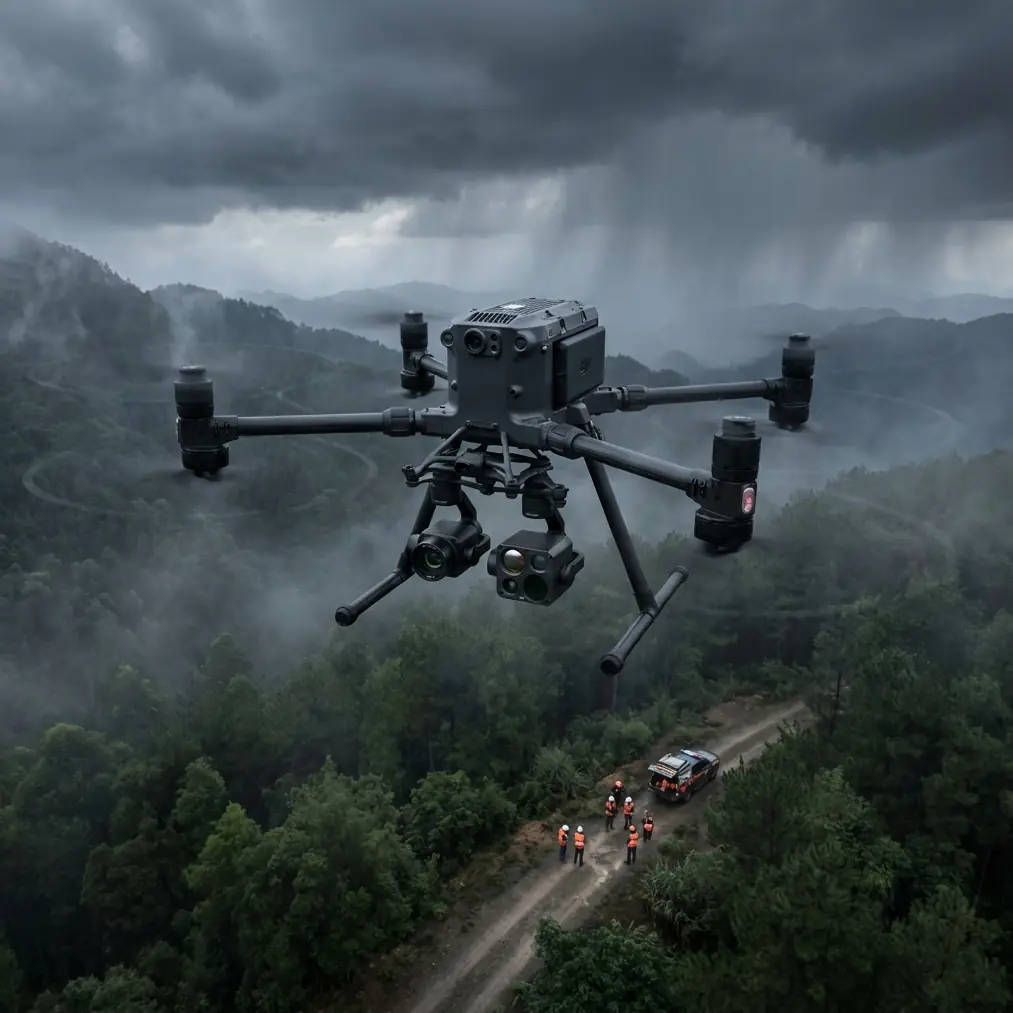
Matrice 400 for Remote Construction Site Spraying: What Really Matters When Conditions Shift
META: Expert analysis of how Matrice 400 fits remote construction site spraying, with practical insight on weather changes, transmission reliability, battery continuity, and why civilian UAV progress matters in real operations.
Remote construction spraying sounds straightforward until the site reminds you it is not a laboratory. Dust lifts off unfinished access roads. Wind channels between half-built structures. Signal conditions change as terrain rises and drops. A clean mission plan can unravel in minutes if the aircraft, payload strategy, and operator decisions are not built for interruption.
That is where the Matrice 400 conversation becomes interesting.
Not because the platform exists in isolation, but because it sits at the latest point in a much longer civilian drone story. Civilian UAVs only began to gain real momentum in the 1980s, which is a short runway compared with the roughly century-long development arc behind military unmanned systems. That gap matters. It explains why today’s commercial aircraft feel so mature in areas like stability, sensing, encrypted communications, and mission continuity: civilian drones inherited a wave of technical transfer, then adapted those capabilities to agriculture, inspection, mapping, logistics, and industrial work.
For remote construction spraying, that history is not trivia. It helps explain why operators now expect one aircraft to do more than carry liquid from point A to point B. They expect it to stay connected over distance, hold its line when weather drifts, support documentation, and protect operational data. A platform in the Matrice 400 class is judged less by brochure language and more by how it behaves when a normal site turns messy.
The real problem at remote construction sites
Spraying at a remote build location is rarely just about coverage. The mission usually sits inside a wider workflow.
Maybe the team is applying dust suppression on haul roads. Maybe it is targeted surface treatment around foundation work, temporary stockpiles, or graded zones where manual coverage is slow and inconsistent. In many cases, the spray operation is tied to survey updates, progress records, or thermal checks around equipment-heavy areas. That means the aircraft is part of a jobsite system, not a standalone tool.
The weak point in that system is interruption.
Remote sites often suffer from three operational pressures at once:
- uncertain weather windows
- limited access for battery turnaround and maintenance support
- changing terrain or structures that complicate transmission and route consistency
This is where many spraying plans break down. A pilot may start under stable conditions, then a crosswind appears from an exposed cut in the terrain. Fine droplets begin to drift. The flight path that looked efficient over open ground becomes less predictable beside scaffolding, steel framing, or stacked materials. If the connection is fragile, the operator starts managing signal anxiety instead of spray quality. If battery swaps are slow, the site loses tempo. If the aircraft cannot support adjacent data collection, the crew ends up sending a second team later.
The better way to assess Matrice 400 is to ask a harder question: can it keep the operation controlled when the mission stops being neat?
Mid-flight weather changes are the test, not the exception
One of the most revealing moments in a remote spraying mission is not takeoff. It is the point when weather changes halfway through the job.
Picture a graded construction corridor in a remote zone. Morning air is steady enough for planned coverage. The aircraft launches, follows its route, and the operation is progressing well. Then the conditions shift. A cooler gust starts pushing across exposed ground, and dust movement becomes visible at the edge of the treatment area. That is when the drone’s value stops being theoretical.
In practical terms, a platform like Matrice 400 needs to do four things well in that moment:
- maintain command link quality
- give the operator enough situational awareness to judge drift risk
- support stable repositioning or route adjustment
- avoid turning a pause into a full mission collapse
This is where features such as O3 transmission and AES-256 matter operationally, not cosmetically. Reliable long-range transmission is not just about distance on a spec sheet. On a remote construction site, it preserves pilot confidence when terrain, structures, or environmental interference begin to complicate the link. If video and telemetry remain usable while the weather changes, the operator can make a disciplined decision: continue with adjusted parameters, segment the remaining area, or pause and resume safely.
AES-256 also has a real place here. Construction spraying missions can involve location data, site imagery, and progress information that contractors do not want loosely exposed. Encrypted transmission protects more than the aircraft connection. It protects a commercial workflow that may include sensitive infrastructure details, subcontractor coordination, and site development records. For enterprise users, secure communication is part of operational professionalism.
When conditions shifted mid-flight, the aircraft’s ability to remain responsive is what kept the mission useful. Instead of abandoning the entire run, the team can isolate the wind-exposed segment, maintain coverage where conditions remain acceptable, and preserve the flight record for later review. That is a very different outcome from a system that simply forces a retreat the moment the environment becomes dynamic.
Why battery continuity changes the economics of the day
Remote sites punish downtime.
If the job is far from paved access, every interruption expands. A battery cycle is no longer a minor pause. It can mean crews waiting, treatment windows shrinking, and the best weather of the day disappearing before the site is covered. This is why hot-swap batteries deserve more respect in enterprise spraying conversations.
Hot-swap capability is not glamorous, but it directly affects mission continuity. On a remote construction site, that continuity supports three practical outcomes:
- less idle time between sorties
- less disruption to route logic and treatment sequencing
- more predictable output during short weather windows
The significance grows when conditions are unstable. If wind begins to build in the afternoon, the crew cannot afford a long reset every time energy management comes into play. Fast battery turnover helps the operator preserve momentum while staying within safe planning limits. In other words, the aircraft does not just fly longer across a day. It uses the available day better.
For site managers, this matters because spraying is usually competing with other operations. Earthmoving, concrete delivery, surveying, and access control all share the same calendar. A drone that can be turned around quickly is easier to fit into a live site without causing workflow friction.
Spraying is stronger when paired with site intelligence
A common mistake is to think of remote construction spraying as separate from mapping or inspection. In reality, the most efficient UAV teams combine those functions whenever possible.
Photogrammetry can help define treatment zones with more accuracy before the spray mission begins. A recent surface model, supported by GCP planning where survey-grade consistency is required, gives the operator a cleaner understanding of slopes, disturbed ground, stockpile edges, and access constraints. That reduces over-application and helps crews focus treatment on the areas that actually need it.
This is one reason the Matrice 400 discussion belongs in a broader enterprise category rather than a narrow “spraying only” box. A site team may use the same platform ecosystem to document terrain changes, update progress records, inspect temporary works, and then carry out a spraying task under a different operational setup. That flexibility matters in remote projects where mobilizing extra hardware and personnel is expensive.
Thermal signature analysis can also support smarter decision-making around the jobsite. Not for anything sensational, but for ordinary industrial awareness. Heat patterns around active equipment zones, material staging areas, or recently worked surfaces can inform timing and access planning. If the site needs both treatment work and visual or thermal records, it is far more efficient when the aircraft platform supports that wider mission logic.
The point is simple: the best spray result often begins before liquid leaves the tank. It starts with data.
Civilian drone maturity is why this level of trust is possible
The historical context behind modern UAVs deserves a moment because it explains why enterprise operators now place such high demands on platforms like Matrice 400.
Civilian drones did not emerge with a century of dedicated commercial refinement behind them. Their development took off from the 1980s onward, and much of that progress was accelerated by technology transfer from earlier unmanned aviation work. Compared with the approximately 100-year development history associated with military UAV systems, civilian adoption is much newer.
Yet in a relatively compressed timeline, civilian platforms have become practical work machines for inspection, agriculture, mapping, and industrial site management. That evolution is exactly why a remote construction spraying mission today can depend on encrypted links, advanced transmission, battery continuity, and multipurpose sensing expectations. Those features are signs of a sector that matured quickly by adapting proven technical foundations to commercial needs.
For operators, this history has a practical takeaway: today’s enterprise UAV workflows are not improvised experiments. They are the result of civilian platforms absorbing and refining technologies into safer, more usable tools for day-to-day field work.
That does not remove the need for planning. It does mean the tools are finally capable of supporting professional standards in environments that used to defeat smaller systems.
A problem-solution framework for remote spraying with Matrice 400
When teams ask whether Matrice 400 is the right fit for remote construction spraying, the answer depends on whether they are solving the actual problem.
The problem is not “How do we get a drone over the site?”
The problem is closer to this: “How do we execute controlled, documented, low-friction treatment work on a changing site where weather, access, and communications can all shift during the same shift?”
Seen that way, the solution stack becomes clearer.
First, stable transmission matters because remote spraying depends on command confidence. O3 transmission supports that confidence when the site is broad, uneven, or cluttered with developing structures.
Second, secure communications matter because enterprise flights carry commercial information, not just control inputs. AES-256 supports data discipline in environments where site imagery and mission records have real business value.
Third, operational continuity matters because remote sites amplify every delay. Hot-swap batteries help crews preserve tempo and make better use of short treatment windows.
Fourth, site intelligence matters because spraying is more effective when it is informed by mapping and documentation. Photogrammetry, GCP-supported planning, and thermal awareness are not extra luxuries. They help make the spray mission more precise and more defensible.
That combination is where a Matrice 400-class workflow begins to justify itself.
What experienced operators do differently
Experienced UAV teams do not wait for the weather to prove a point. They build for variability from the start.
On remote construction sites, that usually means:
- planning spray blocks that can be paused and resumed cleanly
- keeping visual and thermal context available for better field judgment
- treating battery swaps as a mission design issue, not a last-minute inconvenience
- preserving mapping-grade references when treatment zones overlap with measured site changes
- prioritizing link reliability and data security as part of standard operations
When the wind changed mid-flight in the scenario above, the aircraft did not “save the day” by ignoring environmental reality. It helped the crew respond intelligently. That is the right benchmark. A professional drone does not erase site complexity. It gives operators enough control and awareness to manage it without losing the mission.
If you are evaluating how to configure a remote spraying workflow around Matrice 400, it helps to talk through the specifics of terrain, coverage goals, data needs, and communications conditions with someone who understands enterprise UAV deployment in the field. For direct coordination on site-specific planning, you can reach a specialist team here: https://wa.me/85255379740
The bottom line for remote construction spraying
Matrice 400 makes sense for remote construction spraying when the job demands more than lift and payload. Its value shows up in continuity, control, and information quality.
That matters because remote sites are unforgiving. A weather shift halfway through the mission is not unusual. It is normal. A reliable platform must keep the operator informed, connected, and flexible enough to adapt without turning every change into a cancellation.
The larger civilian UAV story supports this reading. Commercial drones have had a shorter development timeline than military systems, with major acceleration beginning in the 1980s through technology transfer into civilian use. What we see now in enterprise aircraft is the result of that compressed but serious evolution: tools capable of real industrial work, not just demonstration flights.
For construction teams managing remote treatment operations, that is the real promise of a platform like Matrice 400. Not hype. Not generic capability claims. Practical resilience when the site stops cooperating.
Ready for your own Matrice 400? Contact our team for expert consultation.