
Spraying Construction Sites in Windy Conditions with Matrice
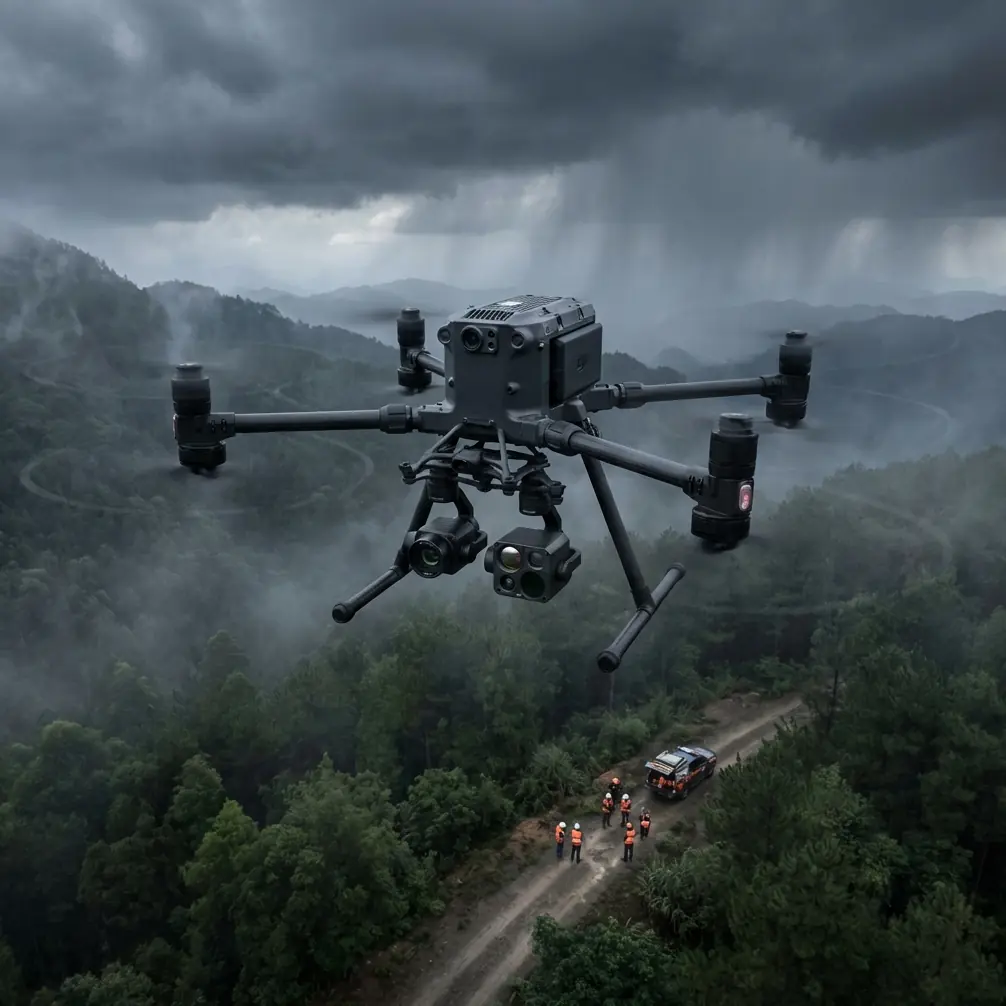
Spraying Construction Sites in Windy Conditions with Matrice 400: Altitude, Stability, and Smarter Mission Planning
META: Expert Matrice 400 spraying tips for windy construction sites, including optimal flight altitude, transmission reliability, battery strategy, and safe mission planning.
Wind changes everything on a construction site.
Not in theory. In practice. Dust lifts off half-finished roads, air curls around steel frames, and wind behaves differently at slab level than it does above open ground. If you are trying to spray a site with the Matrice 400, that matters more than any brochure headline. The aircraft may be capable, but the result still comes down to one operational question:
How high should you fly when wind is working against you?
That is the real issue for construction spraying. Too low, and rotor wash can scatter product, especially near loose aggregate, rebar mats, trenches, and temporary barriers. Too high, and crosswind starts pulling droplets away from the target zone before they settle. The Matrice 400 gives operators a serious platform to manage that tension, but only if the mission is built around site airflow, payload behavior, and flight discipline rather than generic spray settings.
This article focuses on that exact scenario: spraying construction sites in windy conditions with the Matrice 400, and how to think about altitude, stability, and mission continuity when the environment is messy.
The core problem on construction sites is not just wind speed
Open farmland often gives you broad, readable patterns. Construction sites rarely do.
Wind on a jobsite is fragmented. A concrete wall can create turbulence on one side and a lull on the other. Partially enclosed structures may funnel airflow through gaps. Stockpiles, cranes, scaffolding, and containers all distort the air. That means your aircraft may experience a stable pass for 40 meters, then hit a pocket of disturbed air right where precision matters most.
For spraying, that creates three immediate risks:
- Drift away from the intended surface
- Uneven deposition across the work area
- Reduced operational efficiency because repeat passes become necessary
On top of that, construction spraying often involves irregular geometry. You are not always treating a flat, uninterrupted field. You may be applying liquid to haul roads, dust-prone staging areas, embankments, retaining edges, stockpile faces, or newly graded zones that change week to week.
The Matrice 400 is valuable here because it is designed as a high-end enterprise aircraft rather than a single-purpose tool. That matters in wind, because site work rewards aircraft that can maintain link integrity, support multiple sensor workflows, and recover quickly from battery transitions or changing mission demands.
Optimal flight altitude in wind: lower than many operators assume, but not too low
If the goal is controlled spraying on a windy construction site, the best working altitude is usually just high enough to maintain a consistent spray pattern without letting rotor wash or ground effect create its own problem.
For many site-spraying situations, that often means working in a relatively low band, typically around 2 to 4 meters above the target surface, then adjusting based on droplet behavior, obstacle density, and local turbulence.
Why that range?
- At around 2 meters, you reduce the time droplets spend exposed to lateral wind.
- At 3 to 4 meters, you gain a little more clearance over uneven terrain, barriers, and equipment while still keeping drift manageable.
- Above that, wind often starts taking a larger bite out of placement accuracy, especially on exposed pads or elevated sections of the site.
But “fly lower” is not universal advice. Construction sites punish rigid rules. If you are working over highly uneven grade, protruding materials, or sharp elevation changes, forcing a low-altitude pass can create unstable corrections and a poorer application result than flying slightly higher with smoother control inputs.
So the right answer is this: start low, validate the pattern, then adjust in small increments rather than jumping to a fixed altitude based on habit.
A practical method is to test one short pass at roughly 2.5 meters, observe drift and surface coverage, then compare it with a second pass at 3.5 meters. On windy sites, that 1-meter difference can reveal whether your bigger enemy is rotor disturbance or horizontal drift.
Why Matrice 400 is a strong fit for this kind of work
The Matrice 400 becomes especially useful on construction jobs because it is not just about staying airborne. It is about keeping the mission stable when the site itself is unstable.
Two details matter here.
1. O3 transmission supports more dependable control and video awareness
On a construction site, spraying decisions are often made in real time. An operator may need to verify the edge of a treatment zone, judge drift against a haul road shoulder, or avoid a newly placed obstacle that was not there that morning. That requires a transmission system you trust.
The inclusion of O3 transmission is operationally significant because it helps maintain strong command and live situational awareness across a noisy, obstruction-heavy work environment. On paper, transmission sounds like a communications spec. In the field, it affects whether you can confidently hold a clean line near structures, monitor edge coverage, and react early when airflow changes near buildings or elevation transitions.
In windy spraying, that kind of visibility matters because by the time drift is obvious to the naked eye from a distance, you may already be off target.
2. Hot-swap batteries reduce interruption during time-sensitive site windows
The second detail is hot-swap batteries. That is not a convenience feature. On construction projects, timing windows are often narrow. You may be spraying before crews move into an area, between machine cycles, or during a temporary lull in site traffic.
Hot-swapping allows the aircraft to return to operation faster without forcing a fully cold restart of the workflow. Operationally, that means:
- less downtime while weather is acceptable,
- fewer delays when site access windows are short,
- and better continuity when you are trying to finish a treatment zone before wind picks up another notch.
That matters even more on windy days because good conditions may only last for part of the morning. If you waste those windows on slow battery transitions, your best spray quality can disappear before the mission is done.
Windy construction spraying requires altitude to be tied to droplet behavior, not just obstacle clearance
A common mistake is choosing height based only on what the aircraft needs to clear. Spraying needs another layer of thinking.
Your flight altitude should account for:
- target surface roughness
- wind direction relative to pass direction
- presence of vertical structures
- droplet size and intended deposition
- whether the site is open, enclosed, or partially shielded
For example, a broad compacted pad with few structures may allow predictable passes at 3 to 4 meters. A trench-adjacent corridor with stacked materials and scaffold sections may force you closer to 2 to 3 meters, with shorter, segmented runs to keep drift controlled.
If wind is crossing the route, one of the simplest improvements is to reduce altitude slightly and tighten line spacing rather than trying to fight drift with aggressive stick correction. Let the mission design do the work.
Use thermal and mapping workflows before spraying, not after problems appear
This is where a broader enterprise aircraft like the Matrice 400 earns its keep.
The reader scenario is spraying, but on construction sites, spraying should not be isolated from survey intelligence. If you are already using thermal signature review or photogrammetry, the spray plan can become much sharper.
Thermal signature for dust, moisture, and treatment prioritization
Thermal data can help identify surface variations that are not obvious in standard visual imagery. On a site, those differences may correspond to moisture retention, heat buildup, recently compacted sections, or zones that dry faster and become dust-prone sooner. That makes thermal signature useful for deciding where spray effort needs to be concentrated instead of applied evenly across every area.
Operationally, this cuts waste and improves consistency. In wind, shorter targeted missions are usually better than broad blanket passes.
Photogrammetry and GCP-backed site modeling for route precision
If you build a current site model through photogrammetry, ideally anchored with GCPs, you get more than pretty maps. You get a way to understand slope, changing grade, obstacle placement, and edge definition before the aircraft lifts off.
That matters because a “3-meter pass” is only really 3 meters if your terrain reference is accurate. On construction sites with fresh grading, spoil piles, or uneven sub-base, bad terrain assumptions can make a planned low-altitude spray mission inconsistent from one section to the next.
A GCP-supported model helps establish better route planning, more reliable altitude consistency, and fewer surprises when the aircraft moves from one work zone to another.
AES-256 and BVLOS matter differently in construction operations
Not every job will use them in the same way, but they are worth framing correctly.
AES-256 is significant because construction projects often involve sensitive infrastructure layouts, proprietary development phases, or controlled industrial locations. If your site data, live video, and operational workflows are part of a larger contractor ecosystem, secure transmission is not just an IT checkbox. It helps protect planning data and site imagery as teams coordinate.
BVLOS deserves care. For construction spraying, most operations will still be close-range and highly controlled. But where regulations and approvals allow broader inspection or logistics workflows tied to the same platform, BVLOS capability can influence fleet standardization. In plain terms: the same Matrice 400 ecosystem may support spraying one day and larger-area industrial oversight on another. That versatility can matter to contractors trying to reduce platform fragmentation.
For the spraying mission itself, though, the main takeaway is simpler: choose the platform because it helps you execute safely and accurately on site, not because you are chasing the longest possible mission envelope.
A practical windy-site workflow for Matrice 400 operators
Here is the approach I recommend.
1. Walk the wind, don’t just read it
A weather reading tells you the general condition. It does not tell you what happens beside concrete barriers, open stair towers, stockpiles, or framed structures. Walk the site edge and note channeling zones.
2. Start with a short validation pass
Begin near 2.5 to 3 meters above the target surface in a representative section. Watch the deposition pattern. If drift is pulling too much product, come lower if obstacle clearance allows. If rotor disturbance is scattering material, move slightly higher.
3. Fly into consistency, not speed
On a windy site, faster is often sloppier. Use stable, repeatable passes and accept that mission tempo may need to drop to preserve application quality.
4. Segment the site
Treat open pads, haul roads, embankments, and structure-adjacent areas as different environments. One altitude does not fit all four.
5. Use battery windows intelligently
Because the Matrice 400 supports hot-swap batteries, schedule replacements around logical zone transitions rather than waiting for disruption at the wrong moment.
6. Keep communication and visuals strong
The value of O3 transmission shows up when site clutter increases. Maintain a clear operational picture and do not rely on memory for obstacle position on active jobsites.
If you want to compare route ideas or discuss how to tune a windy construction spraying workflow around the Matrice 400, this direct WhatsApp line is a simple place to start.
The altitude answer, distilled
If you want the shortest expert answer: for windy construction-site spraying with the Matrice 400, begin low, usually around 2 to 4 meters above the surface, and fine-tune based on observed droplet behavior, site turbulence, and obstacle density.
Not 10 meters because it feels safer. Not 1 meter because lower sounds more precise. The correct altitude is the one that keeps spray where it belongs while preserving stable aircraft control.
That is why this is a Matrice 400 conversation rather than a generic spraying conversation. Features like O3 transmission, AES-256, hot-swap batteries, and compatibility with broader enterprise workflows such as thermal signature analysis and photogrammetry with GCP support all change how well an operator can manage a difficult site. They do not remove the need for judgment. They make good judgment easier to execute.
On a windy construction site, that distinction is everything.
Ready for your own Matrice 400? Contact our team for expert consultation.