
Matrice 400 Field Report: Spraying Construction Sites
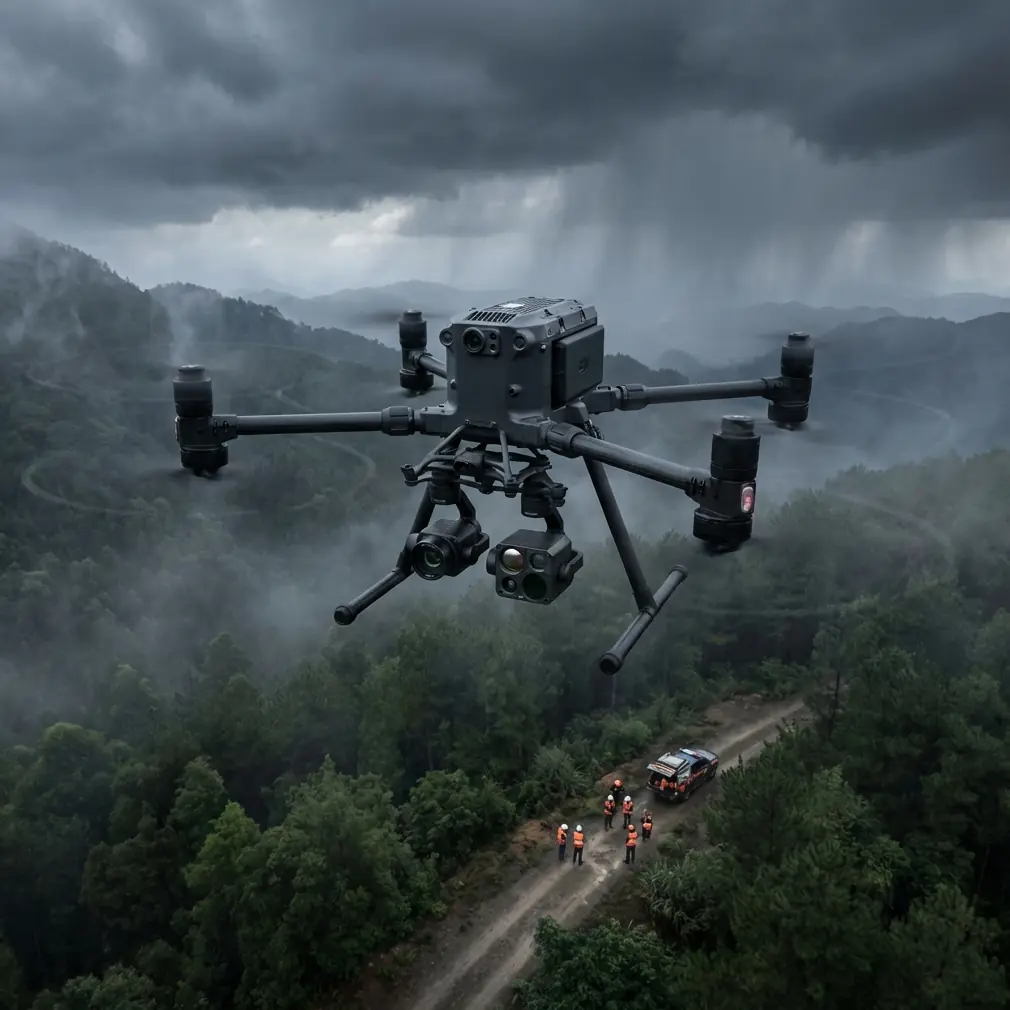
Matrice 400 Field Report: Spraying Construction Sites in Extreme Temperatures Without Losing Control Margin
META: Expert field report on using Matrice 400 for construction-site spraying in extreme heat and cold, with practical altitude guidance, control-system insight, and airflow considerations that affect safe, consistent coverage.
Construction-site spraying looks simple from a distance. Put liquid over a surface, move on. In the field, especially in extreme temperatures, it is nothing like that.
The Matrice 400 enters this job class as a serious platform because construction sites are messy aerodynamic environments. Heat pours off steel decks, concrete pads create rising pockets, scaffolding disturbs local flow, and partially enclosed structures can turn a routine pass into a stability problem in seconds. If you are spraying dust suppressants, curing compounds, or surface treatments near hot materials or winter-chilled structures, the aircraft is not just carrying payload. It is constantly negotiating airflow distortion, control inputs, and power integrity under stress.
That is where a more aircraft-centered way of thinking pays off. Not marketing language. Real flight logic.
I want to frame this around two engineering ideas from civil aircraft design that matter more than most operators realize when they move into harsh jobsite conditions: control-system fault tolerance and airflow management around lifting surfaces. Those may sound distant from a multirotor spraying mission, but they directly shape how a Matrice 400 should be flown if you want repeatable coverage and a clean safety margin.
Why extreme-temperature spraying is mostly an airflow and control problem
On a construction site, temperature is not just a number on a screen. It changes the air the aircraft is standing in.
In high heat, thermals rising from rebar, asphalt staging areas, and sun-soaked slab sections create vertical disturbances that can momentarily unload or overwork parts of the control system. In severe cold, denser air can improve lift response, but it also sharpens gust effects around exposed structures and can alter droplet behavior once liquid leaves the nozzles. Either way, the spray pattern is only as consistent as the aircraft attitude and speed control.
This is why pilots who come from open-field agricultural work often need to reset their instincts on construction sites. The obstacle density is higher. The microclimate changes every few meters. Coverage quality depends less on raw productivity and more on staying inside a narrow band of stable flight conditions.
For the Matrice 400, the operational goal should be straightforward: preserve control authority, minimize abrupt pitch and roll corrections, and keep the spray cloud inside a predictable downwash envelope.
The aircraft-design principle that should change how you plan these missions
One of the most useful reference points from civil aircraft certification guidance is the requirement that a flight control system must be designed so the aircraft can continue safe flight and landing even after failures in important power-related systems, unless the failure itself makes safe flight impossible. That standard comes from a world far larger than drones, but the operational lesson is immediate.
When you spray in extreme temperatures, you should plan as though every mission is exposing the aircraft to elevated power stress and greater control workload. Heat affects battery output and cooling margins. Cold affects discharge behavior and recovery. Add payload mass, repeated deceleration near structures, and frequent altitude correction, and you are asking more from the platform than a simple transit mission.
So for Matrice 400 spraying work, power integrity is not a background issue. It is central to mission design.
That means:
- using hot-swap batteries strategically rather than treating swaps as simple endurance resets,
- avoiding long final segments on low reserve after repeated hover-intensive passes,
- building shorter work blocks around the hottest or coldest parts of the site,
- and reviewing whether your route geometry is forcing unnecessary attitude changes.
The certification concept matters because it reminds us that safe continuation after a power-side issue is not luck. It is a design target. On the operator side, the equivalent is disciplined mission architecture.
If your site team needs a quick planning checklist for these conditions, send the layout and temperature window through this direct field coordination channel before deployment.
The overlooked issue: control-surface thinking still matters on a multirotor
Another reference detail worth bringing in is the requirement to account for the maximum possible control deflection under the most unfavorable system tolerances during pitch maneuvers. In fixed-wing terms, that is about making sure the aircraft remains structurally and dynamically acceptable even when the control system is working at its limits.
Why should a Matrice 400 operator care?
Because the drone version of that problem appears when the aircraft is forced into repeated aggressive corrections in turbulent air near obstacles. You may not have flaps and tail loads to calculate in the field, but you absolutely do have moments where the control system is compensating hard for upset conditions. Every abrupt pitch-up, braking maneuver, crosswind correction, or roll input near a facade changes the spray outcome and raises workload on the aircraft.
Operationally, this means your spraying profile should avoid “stop-start” geometry wherever possible. The smoother the path, the less time the aircraft spends making large corrective inputs, and the tighter your droplet placement stays.
In practice, I advise crews to treat construction spraying as a corridor mission, not a point-to-point mission. Build each run so the Matrice 400 enters, stabilizes, applies, exits, then resets outside the disturbed air zone. That one change often improves uniformity more than nozzle tinkering.
Optimal flight altitude: my field recommendation for extreme-temperature construction spraying
Here is the most useful practical insight for this scenario.
For most construction-site spraying tasks in extreme temperatures, the best starting altitude is typically 3 to 5 meters above the target surface, then adjusted only after observing drift, rebound from structures, and thermal distortion. Not 8 meters because it feels safer. Not 1.5 meters because you want aggressive penetration.
Three to five meters is the range where the Matrice 400 can usually maintain a stable downwash-assisted deposition zone without becoming overly exposed to surface-generated turbulence or obstacle-induced recirculation. Below that, especially over hot slabs or near protruding steel members, the aircraft can enter dirty air that produces constant micro-corrections. Above that range, drift tends to increase, and the spray pattern becomes more vulnerable to crossflow and thermal lift.
There are exceptions.
- If the surface is radiating intense midday heat, start nearer 5 meters and step down only if droplet placement remains coherent.
- If you are working in cold, stable morning air with low gusting and minimal vertical structures, 3 to 4 meters may give tighter placement.
- If spraying along vertical elements such as retaining walls or partially enclosed facades, you may need to offset laterally and hold a slightly higher line to keep recirculated mist from climbing back into the rotors.
This is where thermal signature observation becomes valuable. Even if your mission is not primarily a thermal inspection task, a quick thermal pass can reveal hot zones that will generate the most troublesome lift and spray distortion. On large sites, that data is often more useful than a generic wind reading from the perimeter.
What wing-design airflow logic teaches us about spray consistency
A second reference from aircraft aerodynamic design focuses on something subtle but highly relevant: the shape of pressure distribution and the need to delay flow separation by avoiding excessive suction peaks and harsh adverse pressure gradients. Another detail warns against local flow conditions crossing critical thresholds such as a local Mach number above 1.25, because separation risk rises sharply.
Obviously, the Matrice 400 is not a transonic aircraft. That number is not operationally applicable to your drone mission. But the aerodynamic logic behind it is.
The lesson is that once airflow gets too aggressive, too abrupt, or poorly managed, it separates and becomes unpredictable. On a construction site, you see the drone-scale version of this every time rotor wash interacts with parapets, scaffolding mesh, wall edges, and partially open roofs. Airflow detaches, rolls back, and feeds disturbed air into the flight path. When that happens, you get three problems at once: unstable attitude, uneven droplet deposition, and contaminated sensor readings.
So while the reference text discusses flap-slot and pressure-distribution design, the field translation is simple: avoid flying the Matrice 400 where the local airflow has no clean exit path.
That means:
- do not spray deep into corners from directly overhead,
- do not hold extended hovers beside large vertical faces in midday heat,
- and do not assume a route that worked on one side of a structure will work on the opposite side after the sun shifts.
Air moves differently as the site warms. Your spray plan should too.
Mapping the site before spraying is not overkill
A lot of teams separate mapping and spraying as if they belong to different days and different budgets. On complex construction sites, that is short-sighted.
A quick photogrammetry mission, ideally tied to a few well-placed GCPs, can identify elevation changes, partially obstructed zones, and tighter corridors that will later punish a spray aircraft trying to maintain constant height above target. If the Matrice 400 is being used across a multi-phase site, that terrain model becomes the backbone of safer autonomous or semi-automated routing.
The operational significance is not just prettier data. It is altitude discipline.
A spray line that is nominally 4 meters AGL can become 2.2 meters over a stockpile edge or 6 meters over a recessed slab if you are relying on visual judgment alone. On hot days, those differences amplify drift and instability. On cold windy days, they amplify overcorrection.
If you are planning BVLOS-compatible workflows for larger industrial campuses, this front-end site model matters even more. You need communication stability, obstacle awareness, and route predictability working together. That is where O3 transmission resilience and AES-256-secured data handling fit into the broader mission picture. Not as buzzwords, but as practical tools for maintaining command quality and protecting site documentation when operations extend across sensitive commercial infrastructure.
Battery strategy in heat and cold: don’t let endurance math fool you
Extreme-temperature construction spraying punishes lazy battery assumptions.
A pack that looks acceptable on paper can degrade faster when the aircraft is hovering repeatedly, holding position near reflective surfaces, and correcting for thermal burbles. In cold conditions, usable performance may return unevenly after high-demand segments. In hot conditions, you can lose confidence in your final pass window long before the nominal reserve threshold arrives.
Hot-swap batteries are valuable here because they reduce ground delay and keep your operational tempo clean, but they are not a reason to stretch each sortie. Use them to maintain consistency, not to chase every last minute of airborne time.
I recommend structuring sorties so that each battery cycle covers a clearly bounded spray block with a conservative exit margin. If the site has both shaded and high-radiation sections, split those into separate flight groups. The aircraft behavior will differ enough that they should not be treated as one uniform mission.
Pilot technique that works better than brute-force stability
When crews struggle in extreme temperatures, the instinct is often to slow down and hover more. That usually makes things worse.
The Matrice 400 tends to deliver cleaner results when it is flown with intention: moderate, constant groundspeed; shallow direction changes; brief stabilization before application; then continuous movement through the treatment strip. Hover only when necessary for edge detailing or obstacle verification.
Think less like a spot sprayer, more like a low-altitude aerial applicator operating inside a confined industrial envelope.
The best pilots in this environment are not the busiest on the sticks. They are the ones who avoid forcing the aircraft to repeatedly display its full correction capability.
Final field view
The deeper lesson from the reference materials is not that a construction spraying drone should be analyzed like a transport aircraft. It is that serious aerial work benefits from the same engineering mindset: preserve controllability after stress, understand how airflow breaks down, and never let mission design ignore the physics.
For the Matrice 400, that translates into a few hard rules for extreme-temperature construction spraying:
Fly the air, not the spec sheet. Start around 3 to 5 meters above the target surface. Use thermal clues to find the bad air before it finds you. Keep your route smooth enough that the control system is making small corrections, not rescuing the mission every few seconds. And treat battery swaps, transmission integrity, and site modeling as part of spray quality, not separate technical categories.
That is how you get repeatable coverage on difficult job sites.
Ready for your own Matrice 400? Contact our team for expert consultation.