
Spraying Forests at High Altitude With the Matrice 400
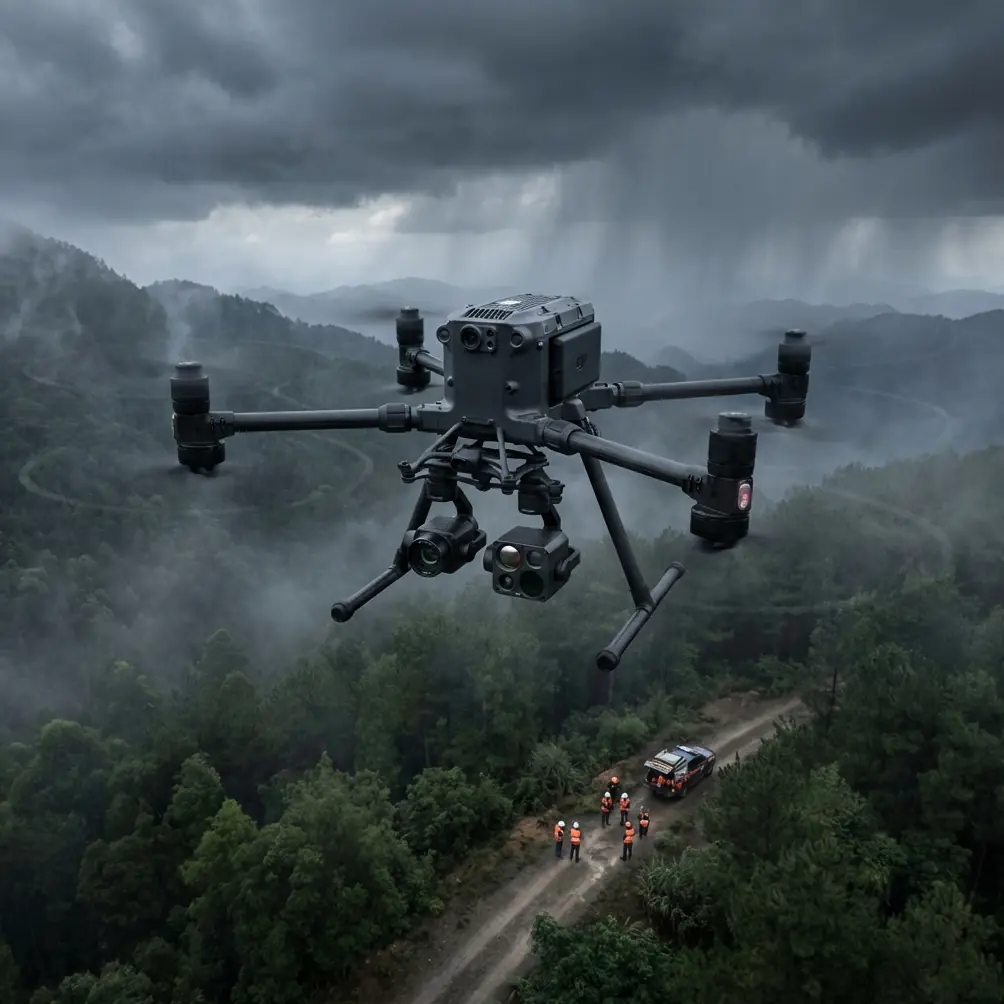
Spraying Forests at High Altitude With the Matrice 400: A Practical Field Method
META: A specialist how-to for using the Matrice 400 in high-altitude forest spraying, with pre-flight cleaning, payload planning, transmission, thermal workflow, and mission safety tips.
High-altitude forest spraying punishes weak planning long before it exposes weak aircraft. Thin air changes lift behavior. Mountain wind shears do not care what the spec sheet promised at sea level. Sap mist, dust, pollen, and fine chemical residue build up where crews often forget to look. If you are preparing a Matrice 400 for forestry work in steep terrain, the real advantage is not just platform size or endurance. It is how well you build a repeatable operating method around the aircraft.
I approach this as a systems problem, not a single-flight problem.
For a forestry team working at elevation, the Matrice 400 becomes most valuable when it is treated as a coordinated mission platform: stable flight, reliable link margin, disciplined battery handling, clean sensors, and a mapping workflow that reduces guesswork before a single droplet leaves the spray system. That matters even more in forests, where canopy density can hide gaps in coverage and terrain can distort your depth perception from the ground.
This guide lays out a practical workflow for spraying forests at high altitude with the Matrice 400, with special attention to the pre-flight cleaning step many crews rush through and later regret.
Why high-altitude forest spraying is different
Forest spraying in the mountains is not simply agriculture moved uphill. Tree height variation, irregular canopy structure, and changing terrain angles force the aircraft to work harder and the operator to think in three dimensions. A route that looks clean on a top-down map can produce inconsistent stand-off distance once the aircraft starts crossing ravines, ridgelines, and broken tree lines.
At altitude, reduced air density can influence how the aircraft responds under load. Any contamination on obstacle sensing surfaces, landing sensors, thermal imagers, or vision modules can compound that risk. Add atomized liquid, cold morning condensation, and resin-rich forest debris, and you have a recipe for degraded perception at exactly the moment you need precise terrain following and confident obstacle handling.
That is why I start with cleaning, not flight mode.
Step 1: Do the pre-flight cleaning that protects the safety stack
Before each mountain spraying mission, I recommend a deliberate cleaning pass on every sensor and surface involved in navigation, perception, and cooling. This is not cosmetic maintenance. It is a flight safety step.
Pay attention to the following:
- Vision and obstacle sensing windows
- Thermal camera lens and visible camera glass
- Downward sensing modules
- Radar or range-related surfaces, if fitted in your configuration
- Air intakes, fan outlets, and heat-dissipation paths
- Battery contacts and bay interfaces
- Gimbal seating points and payload connectors
- Arm joints and landing gear surfaces where residue accumulates
In forestry environments, sap film and dust can build a light haze that is almost invisible until backlit. That haze reduces contrast and can affect machine perception. A small amount of residue on a sensor face may not matter over an open field. It matters a great deal when the aircraft is moving along a slope with branches entering the flight path from multiple angles.
The thermal payload also deserves special attention. If you are using thermal signature data to identify plant stress, canopy moisture variation, or uneven application patterns after a mission, a contaminated lens can flatten thermal contrast and lead to poor interpretation. Crews sometimes assume thermal is “forgiving.” It is not. A dirty lens can quietly degrade the entire diagnostic value of the sortie.
Use non-abrasive lens tools and approved cleaning materials only. Avoid over-wetting. Clean in a sheltered area when possible, especially at high altitude where wind-driven dust can undo your work in seconds. Finish with a short powered-on systems check to verify that all perception and payload feeds are stable and clear.
This is also the moment to inspect seals, wiring, and connectors for chemical exposure. Spray work creates its own maintenance burden. If your aircraft comes back tacky, you need to know where that residue traveled.
Step 2: Build the mission from mapping, not from guesswork
The biggest operational mistake I see in forest spraying is treating the canopy like a flat crop block. It is not. The Matrice 400 is at its best when you use it as part of a structured mapping-to-application workflow.
Start with photogrammetry if your site allows it. Even in dense forestry conditions, a properly planned survey can give you a useful terrain and canopy model for route development. If slope complexity is high, adding GCP checkpoints can improve your confidence in elevation consistency and help you validate that your planned spray corridor reflects actual terrain rather than a rough estimate.
Why does this matter operationally?
Because at high altitude, you cannot afford sloppy height management over trees. Too high, and your application pattern becomes inefficient and vulnerable to drift. Too low, and you increase the risk of rotor wash interaction with canopy edges, branch strikes, and poor escape margins along uneven slopes.
Photogrammetry plus GCP validation helps you define repeatable stand-off distances in areas where human visual judgment is unreliable. That makes your spray path safer and your coverage more consistent. It also gives the pilot and visual observers a mission model they can trust before the aircraft disappears behind terrain folds or dark tree lines.
If you are running recurring treatment in the same forest section, build a site library. Over time, these terrain-anchored models become one of your strongest risk controls.
Step 3: Protect your link margin before you lose it
Mountain forests are famous for eating signal quality. Ridge shadowing, vegetation density, reflected interference, and aircraft orientation all chip away at connection stability. This is where a robust transmission architecture matters.
If your Matrice 400 setup uses O3 transmission, treat that capability as a planning asset, not a reason to get casual. Good transmission performance is still highly dependent on line geometry, takeoff point selection, antenna positioning, and terrain awareness. In practical terms, a strong link budget gives you more room to work around tree cover and elevation shifts, but only if your launch site and route were chosen intelligently.
For high-altitude spraying, I recommend choosing the control position based on route visibility and ridge behavior, not crew convenience. A flat patch beside the truck may be the wrong place if the first ridge shoulder blocks your outbound segment. Walk the site. Look at where the aircraft will dip relative to the controller position. Think about return path visibility, not just departure.
Operationally, O3 transmission matters most when the aircraft transitions across broken terrain and you need clean telemetry, stable video, and fast command response during route corrections. That becomes even more critical if you are operating under a BVLOS framework or preparing for one within a regulated environment. BVLOS is not just about legal authorization. It is about proving that your communications, procedures, and contingency planning are robust enough for reduced direct visual contact.
In forestry work, those contingencies should include defined lost-link actions that reflect actual terrain. A generic return-to-home altitude can be a poor choice in mountain timber if it fails to account for ridgeline clearance and variable tree height.
Step 4: Treat batteries like mission infrastructure
Battery management becomes less forgiving in the cold, at elevation, and under repeated spray loads. The Matrice 400’s hot-swap batteries are not just a convenience feature. In mountain forestry, they support continuity and reduce turnaround time during narrow weather windows.
That has real operational significance.
Morning wind may be ideal for only a short period. Cloud cover can shift quickly. Temperature changes can alter spray behavior and battery performance in the same half hour. If your crew can rotate hot-swap batteries efficiently, you spend more of the workable window flying and less of it rebooting your workflow.
But speed only helps if discipline comes with it.
Before insertion, inspect every battery body, contact point, and latch interface. Confirm that the bay is dry and free of residue. Track pack temperature and rotation history. If packs have been stored in a cold vehicle at altitude, bring them into the usable thermal range before demanding peak performance on a climbing outbound leg.
I also advise crews to think in terms of reserve logic, not nominal percentages. Climb segments, headwind return paths, and evasive routing around terrain all consume margin faster than flatland operators expect. In forest spraying, a conservative battery policy is not wasted productivity. It is what keeps your landing decision ahead of the aircraft instead of behind it.
Step 5: Use thermal intelligently, not theatrically
Thermal imaging can be genuinely useful in forestry operations, but only when tied to a clear question. Do not launch thermal because it looks advanced. Launch it because you need to detect something specific.
Examples include:
- Identifying moisture variation across treated zones
- Spotting stress signatures in canopy sections that may absorb differently
- Verifying whether certain stands are reacting unevenly after application
- Distinguishing shaded and sun-exposed thermal patterns that may affect timing
Thermal signature interpretation in forests is tricky because canopy density, sun angle, wind exposure, and recent weather can all distort what the sensor appears to show. This is why I favor pairing thermal review with your mission map, terrain context, and application records rather than treating the thermal image as a standalone truth source.
The Matrice 400 platform supports this kind of integrated workflow well because the aircraft can function as part of a broader decision chain: map first, apply with discipline, inspect with purpose, then adjust the next sortie. That sequence is where value is created.
Step 6: Secure data as if the mission record matters
In forestry contracting, the data trail increasingly matters. Route records, imagery, treatment verification, and site intelligence are not administrative leftovers. They may be relevant to compliance, client reporting, internal QA, or operational review after an incident.
That is why secure handling features such as AES-256 matter in real-world operations. Encryption is not only for sensitive government work. It is also relevant when your aircraft is collecting location-specific operational data in managed forests, near protected areas, or across client-owned land where route intelligence and imagery should not be casually exposed.
For the crew, this means two things:
First, configure your data workflow intentionally. Know what is stored locally, what is transmitted, what is exported, and who handles it.
Second, treat mission logs and imagery as operational assets. If you later need to explain why a spray block was flown a certain way, or why a route was modified because of terrain or weather, those records can do real work for you.
Step 7: Brief the team on escape options, not just the route
Every high-altitude forest mission should include a route brief and an escape brief. These are not the same thing.
The route brief covers intended track, altitude logic, loading sequence, communication roles, and landing criteria. The escape brief covers where the aircraft goes if the route becomes unsafe because of wind shift, link degradation, unexpected canopy movement, payload irregularity, or visibility loss.
In mountainous forests, the safest immediate move is not always “go home.” Sometimes the smarter move is to climb to a pre-identified safe corridor, hold clear of the slope rotor zone, and reassess. Sometimes the right choice is an alternate landing zone that preserves the aircraft and prevents a bad decision under pressure.
The Matrice 400 gives you a strong operating platform, but the aircraft does not replace crew judgment. A precise brief does.
If your team wants to compare setup logic for steep forestry blocks, this direct field contact can save time: message our UAV specialists.
A practical mountain workflow for the Matrice 400
If I had to reduce the whole process to a field-ready sequence, it would look like this:
- Inspect and clean all sensing, camera, cooling, and battery-contact surfaces.
- Validate terrain data, mission geometry, and canopy height assumptions.
- Confirm controller position based on terrain visibility and transmission quality.
- Check battery temperature, insertion condition, and reserve thresholds.
- Review route plus escape corridors with the entire team.
- Fly the mission with conservative stand-off logic over variable canopy.
- Review thermal and visual outputs against the mapped plan, not from memory.
- Log maintenance findings immediately, especially residue or sensor contamination.
That sequence is not flashy. It works.
What experienced crews get right
The best Matrice 400 forestry teams do a few unglamorous things consistently. They clean before they calibrate. They map before they improvise. They choose launch positions for signal geometry, not for comfort. They treat hot-swap batteries as a tool for disciplined tempo, not as an excuse to stretch every sortie. They use thermal data to answer operational questions. And they protect flight records because good documentation solves arguments before they start.
High-altitude spraying rewards that kind of rigor. The forest is irregular, the weather is impatient, and the margin for lazy assumptions is thin.
If you are flying the Matrice 400 in this environment, think less about “maximum capability” and more about stable repeatability. That is what keeps application quality consistent across slopes, keeps perception systems reliable in dirty conditions, and keeps your crew making good choices when the mountain starts changing the rules.
Ready for your own Matrice 400? Contact our team for expert consultation.