
Spraying Forest Blocks in Extreme Temperatures with the Matr
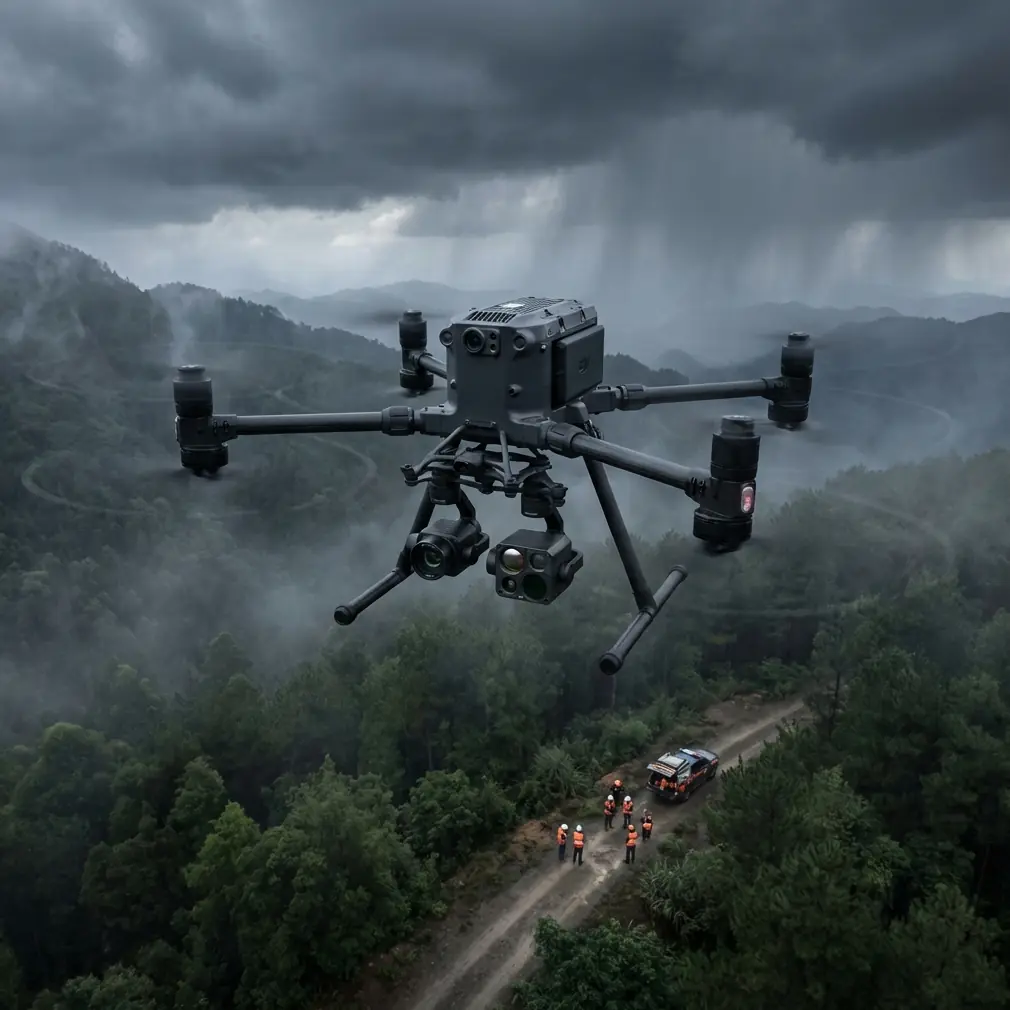
Spraying Forest Blocks in Extreme Temperatures with the Matrice 400: A Field Case Study
META: Expert case study on using the DJI Matrice 400 for forest spraying in extreme temperatures, with practical notes on thermal workflows, hot-swap batteries, O3 transmission, AES-256 security, BVLOS planning, and third-party payload integration.
Forestry spraying looks straightforward on paper. A block is marked, a route is planned, the aircraft flies, the liquid goes where it should. In the field, that neat sequence falls apart fast.
Temperature bends chemistry. Wind behaves differently at the tree line than it does over open ground. Dense canopy hides problems until they become expensive. Battery performance shifts. Signal quality changes as terrain rolls away behind ridges and timber. When crews are working in extreme heat or cold, the drone is no longer just a flying tool. It becomes the hinge point between a clean treatment window and a missed operation.
This is where the Matrice 400 deserves a closer look.
Rather than treating it as a generic enterprise platform, it makes more sense to look at how a forestry team might actually use it when spraying remote forest sections in punishing temperatures. The value is not in any single specification. It is in how several capabilities fit together under pressure: stable transmission, secure data handling, practical battery management, thermal awareness, and the ability to expand the aircraft with a third-party accessory when the mission demands more than the default setup.
The operational problem: forest spraying when the temperature is working against you
A forestry contractor I’ll model this case around had a simple brief with difficult conditions. They needed to treat a mixed forest block where daytime surface temperatures swung hard, from cold dawn launches to hot midday canopy conditions. The target area was too large to manage comfortably with repeated low-confidence visual checks, and too uneven to trust a one-size-fits-all route.
Their challenge had three parts.
First, the team needed a way to identify areas where heat stress and moisture differences were changing the behavior of the spray treatment. That is where thermal signature became useful, not as a flashy extra but as a field decision tool. In forests, temperature variance across canopy zones often reveals things the visible camera misses. A section of stressed trees can present a different heat pattern than a healthier stand, and that matters when deciding timing, route spacing, and whether a block should be treated in one pass or split into separate windows.
Second, they needed continuity. In extreme temperatures, downtime has a cost far beyond operator frustration. Every delay risks moving the operation into a less suitable temperature band, especially in the middle of the day when evaporation and drift concerns can become harder to manage.
Third, the aircraft had to maintain dependable connectivity beyond easy line-of-sight work. This is where planning for BVLOS-style workflows matters, even if the legal operating profile varies by region and approval. In forestry, long corridors, valleys, and dense vegetation all conspire to turn a short mission into a communications test.
Why the Matrice 400 fits this kind of forestry work
The Matrice 400’s appeal in this environment is not that it replaces a dedicated spraying platform in every scenario. It is that it acts as the coordination and intelligence layer around the spraying operation, especially when conditions are changing faster than crews can keep up manually.
The inclusion of O3 transmission matters here. Not because transmission standards sound impressive in a brochure, but because in forested terrain, a robust link is often the difference between flying confidently and constantly second-guessing the aircraft position and payload output. Tree cover, elevation changes, and distance all put stress on signal stability. A stronger transmission ecosystem gives the pilot and mission lead a better chance of preserving situational awareness when the aircraft moves behind terrain features or deeper into a treatment area.
There is also the security side. Forestry work is increasingly tied to environmental reporting, land management records, contractor accountability, and in some cases insurance documentation. AES-256 encryption is operationally significant because it reduces the exposure of mission data and live feeds when teams are handling sensitive location information, treatment maps, or proprietary client data. That is not abstract. If you are documenting treatment zones for a landowner or a commercial timber manager, secure handling of route and survey data becomes part of professional practice.
Then there is the practical field advantage of hot-swap batteries. This is one of those details that sounds ordinary until you’ve watched a crew lose a treatment window while waiting through a full power-down and restart sequence. Hot-swapping keeps momentum intact. In extreme temperatures, that continuity can preserve calibration, mission pacing, and pilot focus. It also reduces the temptation to stretch battery cycles beyond comfortable margins just to avoid restarting the platform. That alone improves discipline in the field.
A smarter workflow: mapping first, spraying second
One mistake I still see is treating spraying as a first-pass activity instead of the final step in a layered workflow.
With the Matrice 400, the more disciplined approach is to run an intelligence cycle first. Start with photogrammetry. Build a current model of the forest block. Then tie that model to properly placed GCPs, or ground control points, so your map products are not merely pretty but spatially reliable. That distinction matters when you are trying to define exact treatment boundaries, identify exclusion zones, or compare before-and-after canopy conditions.
Photogrammetry gives the team topographic context. GCPs tighten positional confidence. Together, they allow route planning that reflects what is actually on the ground rather than what last season’s map happened to show.
This becomes especially useful in forests where the terrain shifts gradually enough to fool a quick visual review. A route that looks efficient on a standard map can create inconsistent application if the canopy height changes sharply or if a drainage cut introduces local airflow changes. By building the mission on updated data, the operator can shape spray plans around terrain-driven realities rather than assumptions.
Thermal imagery then adds another layer. If visible data tells you what the block looks like, thermal data often tells you how it is behaving at that moment. In extreme temperatures, this can help crews avoid treating sections at the least favorable time of day. It can also help identify areas where plant stress or moisture retention may justify an adjusted strategy.
The third-party accessory that changed the mission
The most useful enhancement in this case was not a cosmetic add-on. It was a third-party loudspeaker and coordination module used strictly for civilian field operations.
That might sound unrelated to spraying until you put it into a real forestry setting. The team was working across a large block with ground personnel handling refills, exclusion-zone checks, and perimeter safety. Dense trees and variable terrain made radio coordination less reliable in certain pockets. By integrating a third-party communication accessory with the Matrice 400, the aircraft became a moving coordination point. It could relay clear instructions to ground crew near the active edge of the operation without requiring the team to reposition constantly.
The significance was simple: fewer pauses, cleaner handoffs, and less confusion during temperature-sensitive treatment windows.
This sort of accessory also helps in training. New operators often underestimate how much time is lost to field communication friction rather than flight performance. A platform that supports practical add-ons can become more valuable over a season than one with a longer feature sheet but less flexibility.
If you’re trying to evaluate which accessory stack makes sense for your own forestry workflow, I’d suggest starting with a practical discussion rather than a shopping list. This direct channel can help with that: message a drone specialist here.
Extreme heat and extreme cold are different problems
People often talk about “extreme temperatures” as if heat and cold produce the same operational strain. They do not.
In cold conditions, battery behavior and launch discipline become the first concern. You need a predictable power strategy, clean pre-flight checks, and a crew that is not fumbling through resets with gloves on while the light changes. Hot-swap battery capability is especially valuable here because it limits interruptions and keeps the operation moving without repeated full shutdown cycles.
In hot conditions, the pressure shifts toward timing and treatment quality. Canopy and ground surfaces can produce uneven thermal signature patterns that affect how a crew reads the block and schedules passes. Heat also changes the operator’s margin for error. A delay of 20 or 30 minutes may move the mission into a less favorable environmental window, which is why continuity, route confidence, and rapid turnaround matter so much.
The Matrice 400 helps not because it eliminates these variables, but because it gives the operator better tools to respond to them with less wasted motion.
BVLOS thinking without losing discipline
BVLOS is often discussed as a future-state buzzword. In forestry, that misses the point. Even when an operator is not flying under a formal beyond visual line of sight approval, the mission architecture should still be built with BVLOS discipline in mind.
That means planning for link resilience, terrain masking, handoff procedures, emergency contingencies, and clear data confidence before launch. O3 transmission supports that mindset by improving the communication backbone of the mission. It does not remove the need for regional compliance or operational authorization, but it does support more dependable execution in landscapes where easy visual management is unrealistic.
For large forest blocks, this matters because the aircraft’s role often extends beyond spraying support. It may be documenting progress, verifying coverage, checking exclusion zones, and helping supervisors make live decisions about whether to continue, pause, or split the job into additional segments.
That is where the Matrice 400 becomes more than a platform. It becomes a decision support system.
What this means for forestry teams
If you strip away the marketing language that often clouds enterprise drone discussions, the real case for the Matrice 400 in forest spraying support comes down to four practical outcomes.
One, it improves pre-treatment understanding through photogrammetry and GCP-backed mapping. That reduces guesswork before liquid ever leaves the tank.
Two, it gives crews a way to interpret thermal signature changes in extreme temperatures, which can influence treatment timing and route decisions.
Three, it reduces operational drag through hot-swap batteries, helping teams preserve narrow working windows instead of losing time to repeated restart cycles.
Four, it supports secure and dependable mission management with O3 transmission and AES-256 encrypted data handling, both of which are relevant when work spans remote terrain and sensitive client records.
Add a well-chosen third-party accessory, and the aircraft becomes even more useful. Not because accessories are exciting on their own, but because the right one removes a friction point that the standard configuration does not fully solve.
The lesson from the field
The strongest forestry drone operations are rarely built around a single dramatic feature. They are built around small advantages that stack up.
A stable link keeps the aircraft usable deep into a block. Secure data handling protects the mission record. Hot-swapping preserves tempo. Thermal and photogrammetric workflows sharpen decisions. GCPs make the map trustworthy enough to act on. A third-party coordination accessory cleans up the ground game.
That combination is what makes the Matrice 400 compelling for forest spraying in extreme temperatures. Not as a slogan. As a system that helps crews make fewer bad assumptions when conditions stop being forgiving.
Ready for your own Matrice 400? Contact our team for expert consultation.