
Matrice 400 for Dusty Highway Spraying: A Field Tutorial
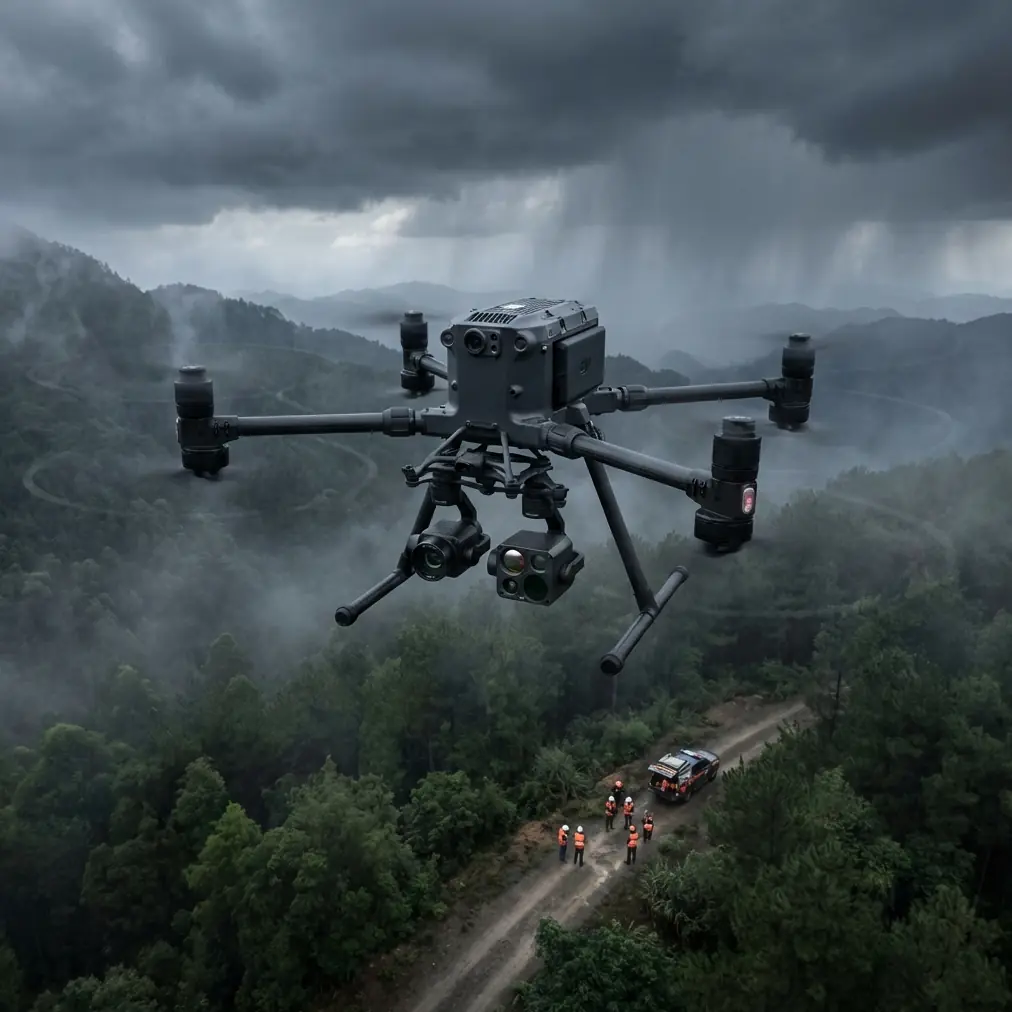
Matrice 400 for Dusty Highway Spraying: A Field Tutorial from an Operator’s Perspective
META: Practical Matrice 400 tutorial for dusty highway spraying, covering payload planning, O3 transmission, hot-swap batteries, AES-256 security, thermal checks, photogrammetry, GCP workflow, and BVLOS-ready operations.
Highway spraying looks simple on paper. Long corridors. Repeating passes. Plenty of room. Then the dust starts moving.
I learned that the hard way on a roadside vegetation control job where every passing truck changed the air, every shoulder gave off loose grit, and visibility near the pavement edge could go from clear to hazy in seconds. The aircraft we were using at the time could do the work, but the workflow was fragile. Battery changes broke momentum. Link stability became a constant concern when the route stretched farther than a comfortable visual bubble. Dust contamination forced more inspection downtime than anyone liked. We got the job done, but it took too much operator attention just to keep the platform stable and the mission safe.
That is the lens I use when I look at the Matrice 400.
This is not a generic drone overview. It is a practical guide for crews planning to spray highways in dusty conditions and wanting to understand how a Matrice 400-class workflow changes the job. If your work involves long linear assets, shifting visibility, payload changes, and the need to document every segment properly, the Matrice 400 stands out less because of one headline feature and more because its system architecture removes friction at several critical points.
Why dusty highway spraying stresses the platform
Dust is not only a maintenance problem. It is an operational problem.
On highway corridors, you are often dealing with:
- long, narrow mission geometry rather than compact blocks
- vehicle-induced turbulence
- reduced contrast between road shoulder, gravel, and sparse vegetation
- repeated takeoff and landing cycles if the route is segmented badly
- pressure to keep treatment accuracy tight near signs, barriers, drains, and live traffic
Those constraints expose weaknesses fast. A platform can have excellent raw lift and still become inefficient if the command link is inconsistent, battery turnover is clumsy, or sensor switching requires too much compromise. For this kind of work, the Matrice 400 matters because it supports a more disciplined corridor workflow.
Two details are especially significant in dusty roadside operations: O3 transmission and hot-swap batteries.
O3 transmission is not just a specification sheet talking point. On a highway, your aircraft is often moving along a linear route where terrain undulation, roadside structures, and passing heavy vehicles can all affect link quality. A robust transmission system matters because corridor work punishes weak connectivity more than a compact survey over an open field. Stable video and command performance means fewer pauses, fewer repositioning decisions, and better confidence when the aircraft is extending down the route.
Hot-swap batteries are equally practical. In dust, every unnecessary power-down and restart cycle adds friction. When the platform supports battery replacement without collapsing the whole mission rhythm, crews can maintain continuity, reduce idle time on the shoulder, and spend less time re-establishing settings or rebuilding the mental picture of where the operation left off. On a live roadside, that is not a convenience feature. It is one of the things that keeps the day organized.
Start with mission design, not the spray tank
Most spraying mistakes begin before fluid is loaded.
For a dusty highway job, I build the mission in four layers:
- corridor mapping
- treatment segmentation
- comms and contingency planning
- verification workflow
The Matrice 400 is at its best when you respect that sequence.
1. Corridor mapping
Before you think about application, create a clear spatial understanding of the route. This is where photogrammetry and GCP discipline come into play.
If you are preparing a long roadside section with irregular shoulders, culverts, signposts, and vegetation encroachment, a photogrammetric pre-mission gives you something a hand-drawn treatment plan never will: consistent spatial context. Ground control points are not always mandatory for every operational spray mission, but when accuracy really matters around infrastructure boundaries, using GCPs sharpens confidence in what your map is telling you.
Operationally, that means cleaner georeferencing of treatment zones and fewer arguments later about whether a section was overrun or skipped. On a highway contract, documentation is often nearly as important as application. A Matrice 400 workflow supports that because it is comfortable carrying the sensing burden needed to build the route model before the spray mission starts.
2. Treatment segmentation
Do not build one giant route just because the road is long.
Dusty highways should be divided into logical sections based on:
- traffic exposure
- shoulder width
- line-of-sight quality
- refuel and battery access points
- terrain changes
- vegetation density
This is where many teams lose efficiency. They either segment too aggressively and waste time landing, or they overextend the route and create recoverability problems.
With the Matrice 400, hot-swap battery support changes the balance. You can plan segments around safe, repeatable shoulder staging rather than around hard system interruptions. That lets you choose operationally sensible breaks instead of purely battery-driven ones.
Managing visibility when dust strips away contrast
Dust does something subtle to operators. It narrows their confidence.
Even if the aircraft is performing well, the pilot can begin second-guessing terrain separation, shoulder edge position, and obstacle proximity when the visual scene gets washed out by airborne grit. That is why sensor strategy matters. This is also where thermal signature becomes more useful than many crews expect.
Thermal is not only for public safety, inspections, or search work. In roadside spraying, thermal data can help confirm conditions that are less obvious in standard visual imagery. Heat differences between pavement, embankment, vegetation clusters, and recently sunlit infrastructure can provide an extra layer of scene understanding when the visible channel loses clarity.
That does not mean you fly the entire spraying job by thermal feed alone. It means thermal can support pre-mission assessment and spot checks in conditions where dust masks important distinctions. For example, sections with stressed vegetation or uneven moisture retention may present different thermal behavior than surrounding ground. That can help crews refine where treatment is actually needed rather than relying on a broad assumption across the whole corridor.
On a practical level, the Matrice 400’s value here is not simply that it can participate in a multi-sensor workflow. It is that the platform is stable enough, scalable enough, and mission-oriented enough to make that workflow normal rather than awkward.
Transmission reliability affects spray quality more than people admit
There is a tendency to treat transmission as a pilot comfort issue. It is not. It is a treatment quality issue.
If you are spraying a narrow roadside strip and your downlink becomes unreliable at the exact moment the aircraft approaches a sign cluster, drainage cut, or crossover, you do not only lose confidence. You lose precision. Hesitation shows up in path consistency, pass spacing, and decision timing.
That is why O3 transmission deserves special attention in this use case. Highway work is linear, repetitive, and often deceptively exposed. A route may look open while still containing dozens of micro-obstructions to signal behavior. The stronger and more resilient the transmission system, the easier it is to maintain a calm operational tempo.
For crews preparing for BVLOS-aligned workflows, this becomes even more significant. Whether your operation is currently flying under visual constraints or building procedures for future beyond visual line of sight approvals, the discipline is the same: command link integrity, route planning, and contingency logic need to be treated as core mission components. The Matrice 400 sits naturally in that conversation because it supports serious corridor operations rather than hobby-style hopscotch flying.
Security is part of the job now
Many spray teams still think cybersecurity is somebody else’s department. That mindset is out of date.
If you are operating around public infrastructure, rights-of-way, contractor networks, or government-adjacent projects, data security matters. This is where AES-256 encryption is operationally relevant, not just technically impressive.
When your platform is transmitting command, video, and mission-related data, strong encryption helps protect the integrity of that operational stream. On a highway spraying project, you may be handling route files, imagery, infrastructure context, and treatment records tied to specific corridors. Keeping those data flows protected reduces exposure and supports professional standards that more clients now expect automatically.
For operators, this matters in two ways:
- it protects mission data during transmission
- it strengthens trust with infrastructure stakeholders
That second point is easy to overlook. The more your drone program touches public roads, utilities, or managed vegetation corridors, the more scrutiny it attracts. Security features like AES-256 help position your workflow as mature and contract-ready.
A practical field setup for the Matrice 400 on highway jobs
If I were setting up a dusty highway spraying day around a Matrice 400, the workflow would look like this.
Pre-deployment
Confirm the route segmentation in advance. Do not improvise corridor chunks in the field unless conditions force a change.
Review traffic patterns and identify staging points that keep takeoff and battery service away from the heaviest dust plume zones. A shoulder might be legal and accessible while still being a terrible place to manage sensitive equipment. Move 50 meters if it buys cleaner air and better visibility.
Load the route data, verify geofencing or airspace constraints, and brief contingencies for signal degradation, vehicle interference, and aborted passes.
Sensor and mapping check
If the corridor has not been modeled recently, conduct a photogrammetry pass first. Use GCPs where positional confidence matters, especially near structures, drains, retaining features, and boundaries where spray placement must be defensible.
Run thermal spot checks on sections that historically show irregular vegetation response. This can reveal patterns that visual inspection misses, especially early or late in the day when thermal contrast is more informative.
Link and control verification
Before moving down the route, validate O3 transmission performance in the actual corridor environment, not just at the launch point. Dust, roadside clutter, and traffic can affect performance differently a few hundred meters downrange.
If your team is developing longer-range procedures, structure the mission as if BVLOS discipline already matters: clear handoff logic, hard contingency points, and defined criteria for return or reroute.
Battery rhythm
Use hot-swap battery capability to preserve mission continuity. The real advantage is not speed alone. It is maintaining operational context. The pilot, payload operator, and spotter all stay mentally synced when the aircraft returns, swaps, and resumes without a messy reset.
In dusty work, that continuity reduces mistakes.
Post-mission verification
Do not end the job when the fluid is gone. End it when the data is organized.
Review route completion, imagery, and any anomaly notes while still on site. If a section needs a second look, it is far better to identify that immediately than discover it later from incomplete logs or uncertain visual evidence.
If you want to compare workflows or discuss corridor setup details with an experienced team, this quick field contact is a practical place to start: message a UAV specialist here
What changed for me after using a platform like this
The biggest shift was not raw performance. It was workload distribution.
Older workflows made the aircraft feel like the center of attention. Every stage demanded extra babysitting: signal confidence, restart sequencing, sensor compromise, and uncertainty about whether the route data would hold up later under scrutiny.
A Matrice 400-class approach changes that dynamic. The aircraft still matters, obviously, but it stops stealing attention from the mission itself. That is a major difference on dusty highway spraying jobs, where the operation is already busy enough. Better transmission stability, hot-swap battery continuity, support for thermal and photogrammetric workflows, and AES-256-secured data handling all add up to something practical: less cognitive drag.
That matters because roadside spraying is not won by having the flashiest platform. It is won by staying consistent for hours in messy conditions without letting small failures accumulate.
Final takeaway for operators planning dusty corridor work
If your environment is a dusty highway corridor, evaluate the Matrice 400 through an operations lens rather than a brochure lens.
Ask these questions:
- Can the transmission system stay dependable along a long, narrow route?
- Can battery swaps happen without wrecking the mission flow?
- Can the platform support both treatment and verification logic?
- Can thermal and photogrammetry improve route quality before and after spraying?
- Can your team defend the data handling standard on infrastructure work?
That is the real test.
The Matrice 400 makes sense when the job is more than lifting a payload into the air. It earns its place when you need corridor discipline, cleaner transition between mission phases, and a setup that keeps working when dust, traffic, and documentation pressure all show up at once.
Ready for your own Matrice 400? Contact our team for expert consultation.