
Matrice 400 Field Report: Spraying High-Altitude Highways
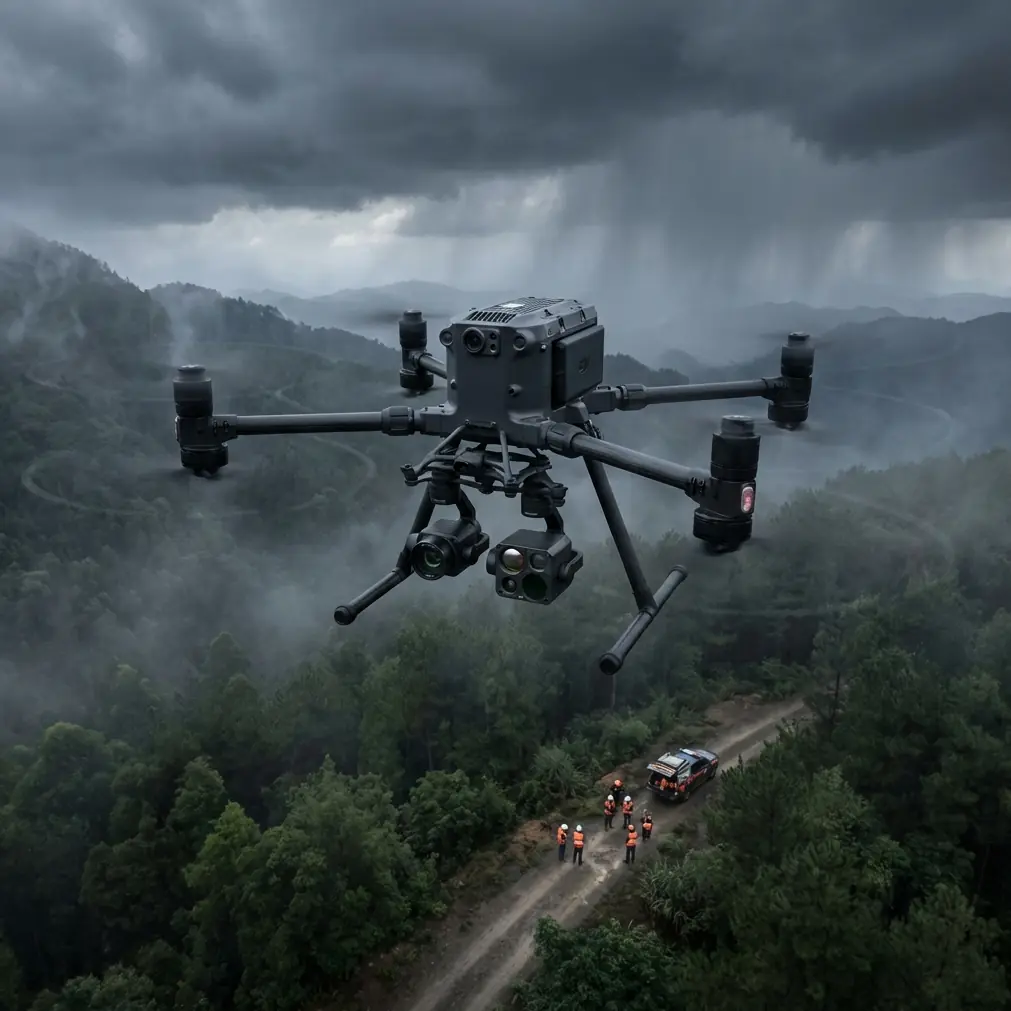
Matrice 400 Field Report: Spraying High-Altitude Highways When Wind, Terrain, and Wildlife Refuse to Cooperate
META: Expert field report on using the Matrice 400 for high-altitude highway spraying, covering sensor strategy, thermal signature, BVLOS planning, O3 transmission, AES-256 security, hot-swap batteries, and operational risk control.
High-altitude highway spraying looks straightforward on paper. A long corridor. Repetitive coverage. Clear mission objective. In the field, it becomes something else entirely.
The road cuts across mountain shoulders, climbs through thin air, bends around blind ridgelines, and creates its own wind behavior. One minute the aircraft is flying above a stable lane edge. The next, it is dealing with a lateral gust spilling off rock face, a temperature shift over sunlit asphalt, and wildlife moving out of brush toward the shoulder. If you are planning spraying operations in that environment, the platform matters less as a spec sheet and more as a working system. That is where the Matrice 400 deserves a serious look.
This report focuses on the kind of mission that exposes weak assumptions quickly: spraying along highways at elevation, where terrain compression, signal reliability, battery logistics, and situational awareness all decide whether the job stays efficient or becomes a chain of compromises.
Why high-altitude highway spraying is its own category
A mountain highway is not an open agricultural field stretched into a line. It is a constrained corridor with changing geometry. Guardrails, signs, lighting poles, drainage cuts, retaining walls, and intermittent traffic management zones all create edge complexity. Add altitude, and the aircraft has to work harder in air that gives you less lift margin than crews at lower elevation take for granted.
Spraying here is usually tied to vegetation control, shoulder treatment, embankment management, or selective application along difficult access zones. Precision matters because overspray near active traffic corridors or drainage pathways can create obvious operational and compliance problems. Endurance matters because staging points are limited. Transmission integrity matters because the road may disappear around topography while the mission still continues along a mapped corridor.
That is why the Matrice 400 is interesting in this role not as a single-feature platform, but because several system-level traits align with the job: stable long-corridor mission planning, strong transmission architecture, sensor-led situational awareness, and battery workflows that reduce dead time between sorties.
The field reality: asphalt heat, mountain wind, and one deer that changed the timing
On one recent mountain corridor assessment, the operational problem was not spray delivery. It was timing the flight path safely through a wildlife movement window that the crew did not expect to matter.
A mule deer emerged from low brush on the shaded side of a bend just above a drainage culvert, then paused near the shoulder as the sun began warming the road surface. That sounds like a minor event until you remember what happens at altitude on a winding highway: the aircraft may be fine, the map may be correct, and the route may still need a hold because the environment has changed in a way the mission planner did not fully capture.
This is where thermal signature becomes more than a buzzword. Early in the day, heat contrast between the animal, shaded vegetation, and the surrounding terrain can give the crew a faster visual cue than standard optical imagery alone, especially when terrain texture and low-angle light flatten depth perception. In mountain work, that extra layer of awareness is not abstract. It gives the remote crew time to slow, reposition, or temporarily suspend the pass before the aircraft reaches the bend.
For highway spraying, that matters operationally in two ways. First, it protects the mission from reactive flying near unpredictable movement. Second, it protects the application plan itself, because a rushed correction near a road edge can disrupt line consistency and leave uneven treatment on the section you were trying to finish cleanly.
O3 transmission is not just a convenience in corridor work
Long, narrow highway missions expose weaknesses in communications faster than block-area flights. The aircraft may be following a legal and carefully planned route, but the operator’s line to the machine is constantly challenged by terrain shielding, roadside infrastructure, and changes in elevation between staging point and flight segment.
O3 transmission matters here because corridor work is unforgiving when link quality degrades around ridgelines or concrete structures. On a mountain road, a brief drop in confidence is enough to force slower mission pacing, more conservative segmenting, or additional repositioning of the ground team. That costs time and introduces friction into an operation that already has tight windows due to weather and access.
For a spraying crew, reliable transmission does more than keep the video feed stable. It helps preserve decision quality. When the aircraft is moving along a route where the shoulder drops off sharply or the road curves out of sight, the pilot and visual support team need clean situational awareness without second-guessing the data path. The more stable that link is, the less mental bandwidth gets wasted managing uncertainty.
This becomes even more relevant in BVLOS-oriented planning frameworks, where operational discipline depends on layered reliability rather than optimism. Even if a specific team is flying within local constraints and approvals that stop short of full BVLOS execution, the same planning mindset applies. Highway work at altitude rewards systems designed around corridor confidence, not short-hop improvisation.
AES-256 is a practical feature, not a brochure detail
Security tends to get discussed as if it only matters to inspection, public safety, or critical infrastructure teams. That is too narrow. Highway spraying projects often intersect with government agencies, contractors, environmental documentation, and treatment records tied to geographic locations. The mission data itself can have operational sensitivity, especially when it includes exact route plans, imagery, infrastructure context, or maintenance schedules.
AES-256 matters because it reduces one more category of exposure in a workflow that already involves mobile teams, field devices, and shared reporting pipelines. If a crew is documenting treatment sections, recording sensor imagery, and building post-mission records for accountability, encrypted transmission and secure handling are not luxuries. They are part of professional operations.
For firms bidding on corridor vegetation contracts or supporting public works programs, this becomes a credibility issue as much as a technical one. A mature drone workflow is not only about flying well. It is about showing that your aerial operation can handle route data and mission records responsibly.
Hot-swap batteries change the economics of mountain staging
Anyone who has worked roadside mountain operations knows the hidden cost is not always flight time. It is downtime between flights.
You may have narrow pull-off areas, uneven ground, weather moving in across elevation bands, and only a limited safe window before traffic conditions or wind patterns shift. In those moments, hot-swap batteries are not a convenience feature. They preserve momentum. The faster the crew can turn the aircraft without rebuilding the whole workflow around shutdown and restart delays, the more usable the weather window becomes.
That is especially important on mountain highways because spraying rarely happens as one continuous, ideal pass. There are interruptions. Segment breaks. Safety holds. Coordination checks. If the aircraft can return, swap power efficiently, and get back out with minimal lag, the team protects mission continuity. That is a very different outcome from watching the best part of the day disappear while the road surface warms, crosswinds build, and the next section becomes harder to treat accurately.
At altitude, battery management also becomes part of risk management. Crews should not be trying to stretch a sortie just because access back to the launch point is inconvenient. A platform designed for efficient battery turnover supports more disciplined decision-making. That often leads to better coverage quality than chasing one extra segment on a depleted power margin.
Photogrammetry and GCP still matter, even in spraying operations
Many operators treat photogrammetry as something reserved for mapping teams and survey deliverables. That misses its value in highway spraying.
Before treatment begins, a high-quality corridor model built from photogrammetry can reveal slope transitions, runoff paths, shoulder irregularities, and obstacle zones that are easy to underestimate from ground level. Add GCP-backed accuracy where the workflow calls for it, and the resulting terrain reference becomes much more than a visual aid. It becomes a planning layer for safer altitude management, cleaner route offsets, and more consistent application across broken terrain.
This matters because mountain highways are deceptive. A shoulder that looks uniform from one staging point may drop into a sharp embankment 150 meters ahead. A drainage feature may redirect material movement in a way that changes how the team wants to treat vegetation nearby. A retaining wall may create airflow behavior that is not obvious until the aircraft is already in position.
Photogrammetry with GCP support helps crews see those issues early and design around them. In practice, that can mean splitting a route into smarter segments, adjusting altitude bands, or assigning no-spray buffers around infrastructure transitions. The result is not just prettier mapping. It is better operational judgment before the spray mission ever launches.
Sensor fusion is what makes the Matrice 400 useful here
The Matrice 400 becomes valuable in high-altitude highway spraying when teams stop thinking in isolated payload features and start using sensor fusion as a decision framework.
Optical imagery tells you where the corridor sits relative to road furniture and vegetation lines. Thermal signature helps identify living movement, heat differentials on asphalt, and subtle contrasts during early or late operating windows. Terrain-derived planning data from photogrammetry and GCP gives the route a real spatial backbone instead of a rough sketch. O3 transmission keeps that information usable in actual field conditions. AES-256 helps protect the chain of custody around mission data. Hot-swap batteries keep the whole system moving without wasting the mountain window.
Individually, each of those details is easy to mention. Together, they describe a platform philosophy that fits corridor spraying in demanding environments.
That is why the Matrice 400 should be evaluated less as “can it spray this highway?” and more as “can it sustain safe, consistent, documentable operations on this highway when the environment becomes unstable?” Those are different questions. The second one is the question professionals actually need answered.
What crews should pay attention to before launch
If your mission profile involves elevated highways, do not let the aircraft’s capabilities push you into lazy planning. Good hardware is not a substitute for disciplined setup.
Start with terrain-informed route design. Build the corridor model first, and do not skip control points if your application requires stronger positional confidence. Check where the road bends behind ridgelines and where launch positions may compromise link quality. Plan battery swaps around actual staging reality, not idealized segment lengths. Review likely wildlife movement areas near culverts, brush lines, and shaded shoulders. Use thermal capability intentionally rather than treating it as a novelty sensor.
Most importantly, decide in advance what triggers a hold. Wildlife on shoulder. Sudden signal degradation. Crosswind increase at a known ridge gap. Traffic-related constraint near a work zone. The strongest field teams are rarely the ones with the most dramatic flights. They are the ones that make clean, boring decisions before small issues become big ones.
If you are building out that kind of operating template, it helps to compare notes with teams already working similar corridors. I usually recommend starting that conversation through a direct field planning chat rather than trying to solve every edge case from the office.
The bigger takeaway
High-altitude highway spraying forces a drone platform to prove itself in layers. The aircraft must hold stability in thinner air. The link must stay trustworthy around terrain. The sensor stack must help the crew detect what a map missed. The power system must support fast re-entry into the mission. The data pathway must be secure enough for professional infrastructure workflows.
That is the real lens for the Matrice 400.
Not whether it looks capable in marketing imagery. Not whether one specification sounds impressive in isolation. What matters is whether the aircraft helps a field team make better decisions, maintain cleaner treatment lines, and manage risk when the mountain corridor stops behaving like a simple route and starts acting like a living environment.
In that context, details such as O3 transmission, AES-256 security, hot-swap batteries, thermal signature analysis, photogrammetry support, GCP-backed planning, and BVLOS-oriented corridor discipline are not scattered talking points. They are the operating logic behind a workable mission.
And on a high mountain highway, workable beats impressive every time.
Ready for your own Matrice 400? Contact our team for expert consultation.