
Matrice 400 for Coastal Power Line Spraying
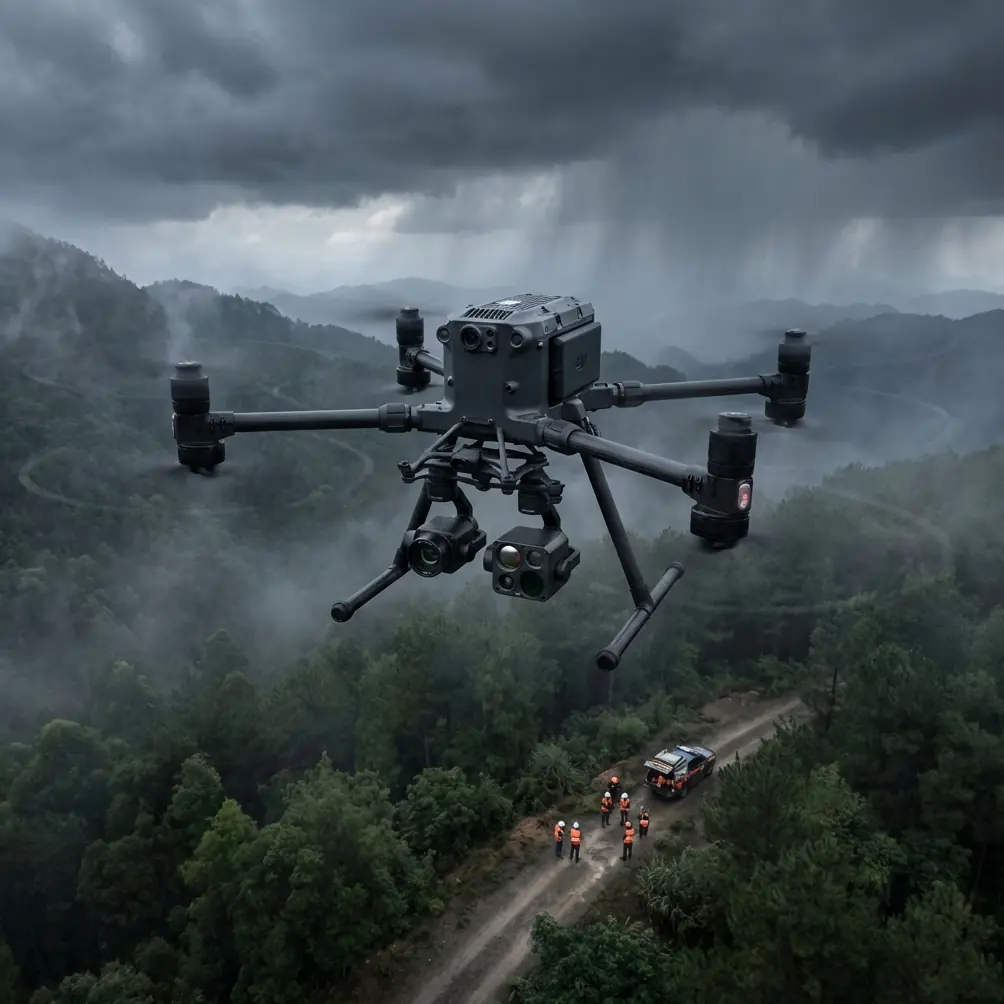
Matrice 400 for Coastal Power Line Spraying: What Biomimicry Teaches Real-World Flight Planning
META: Expert Matrice 400 how-to for coastal power line spraying, with biomimicry insights, antenna positioning advice, BVLOS planning, payload stability, and environmental adaptation.
Coastal power line spraying is one of those jobs that exposes every weakness in an aircraft. Salt-laden air, shifting crosswinds, glare off water, and long linear corridors all punish poor flight stability and weak signal discipline. If you are planning this kind of operation around the Matrice 400, the smartest place to start is not with marketing language or broad feature lists. It is with a design principle that has shaped serious UAV thinking for years: adapt the aircraft to the environment, not the other way around.
That idea sits at the center of an older but still relevant industry reference on biomimetic drones. The core point is simple. Drones modeled on birds, bats, and flying insects are designed to improve flight performance by optimizing both outer form and internal structure. The operational goal is not novelty. It is stronger environmental adaptability. The source even frames biomimetic UAV development as an important future direction for the industry. For a Matrice 400 operator working coastal power lines, that matters more than it may seem at first glance.
The lesson is not that the Matrice 400 must flap like a gull. The lesson is that aircraft performance in hard conditions comes from structural and aerodynamic thinking that respects the operating environment. Coastal spraying is exactly the sort of mission where that mindset pays off.
Why environmental adaptability matters more on coastal line work
Spraying power lines near the coast is not the same as spraying a uniform agricultural block. The aircraft is asked to move along narrow infrastructure, maintain stand-off from conductors and structures, handle variable wind angles, and keep a stable spray profile while the surrounding air behaves differently over land, water, embankments, and vegetation.
This is where the biomimetic reference becomes practical. It highlights two specific design priorities: optimizing external shape and improving internal structure to increase flight performance. Translate that into mission planning terms, and you get a very useful framework for the Matrice 400:
- external aerodynamic stability affects how consistently the aircraft tracks a corridor in shifting coastal wind
- internal structural optimization affects how the platform handles payload changes, vibration, and control precision under stress
For power line spraying, those are not abstract engineering talking points. They directly affect droplet placement, obstacle clearance, and the pilot’s ability to keep the aircraft predictable when conditions start changing mid-route.
A coastal operator should think like a field biologist as much as a pilot. Birds survive shoreline turbulence because their movement is responsive to constant micro-adjustment. Your Matrice 400 mission setup should aim for the same outcome through disciplined configuration, route design, and control link management.
Start with route logic, not the tank
When crews prepare for line spraying, it is tempting to focus immediately on payload volume, nozzle output, and battery cadence. Those matter. But for coastal infrastructure, the first real decision is route geometry.
Power lines create a long, repeating flight path, which is good for efficiency but risky when the environment is uneven. The shoreline can produce wind direction changes over surprisingly short distances. One section may be sheltered by terrain, while the next opens to direct gust exposure. If your flight plan treats the corridor as a single uniform lane, the aircraft can end up compensating too aggressively, and spray quality suffers.
A better approach is to divide the route into short operational segments based on environmental behavior. In practice, that means identifying:
- exposed spans near open water
- sections with towers or structures that disturb airflow
- transitions where land cover changes from open ground to trees or built surfaces
- turns or offsets where line direction changes relative to prevailing wind
This is where the biomimetic principle earns its keep. A platform designed or configured for environmental adaptability performs best when the operator also adapts the mission to the environment. The aircraft can only do part of the work. The rest comes from how intelligently the route is broken down.
Antenna positioning advice for maximum range
For Matrice 400 operations along coastal power lines, antenna discipline is not a side issue. It is one of the biggest determinants of stable control and clear video downlink over long corridor flights.
The simplest rule is this: keep the broad face of the antennas aimed toward the aircraft’s projected path, not the tips pointed at it. Many crews still make the mistake of “pointing” antennas like laser pointers. That usually reduces link quality instead of improving it.
For maximum practical range and cleaner O3 transmission performance, use this field method:
- stand so the aircraft remains in front of your body, not off your shoulder
- angle the controller antennas so their flat sides face the route
- if the line runs left to right across your position, rotate your body with the aircraft instead of locking your stance
- avoid placing yourself behind metal fencing, vehicles, or tower structures that can block or reflect the signal
- whenever possible, operate from slightly elevated ground to improve line of sight across the corridor
Coastal work adds another variable: reflective surfaces. Water can create multipath effects that confuse an already compromised signal path. Good antenna orientation will not eliminate that, but poor orientation can make it much worse.
If your team is building a long-range coastal workflow and wants a second opinion on control link layout, corridor staging, or field setup, a quick message through our Matrice 400 planning desk is often faster than learning by signal dropouts.
How payload behavior changes over salt air and open exposure
Environmental adaptability is not only about whether the aircraft stays airborne. It is about whether it stays precise.
A spraying mission changes the aircraft’s behavior as fluid mass decreases. On coastal power lines, that shift can combine with uneven wind loading to alter how the aircraft reacts at the same stick input or waypoint command. If you also add salt-heavy moisture, the mission stops being forgiving very quickly.
That is why the biomimetic reference’s emphasis on internal structural optimization deserves attention. In real operations, internal stability is what helps a drone remain composed as external conditions fluctuate. For the Matrice 400 operator, the practical takeaway is to preserve consistency wherever possible:
- keep spray runs short enough that aircraft behavior does not change dramatically during a single pass
- reassess handling after partial payload depletion rather than assuming the first pass predicts the last
- avoid pushing corridor speed when crossing exposed shoreline gaps
- monitor hover stability before each new segment, especially after battery or payload service
The aim is to make the aircraft’s workload smaller. When the drone is fighting wind, changing mass, and signal reflections all at once, precision starts slipping before failure becomes obvious.
Thermal signature and visual confirmation near energized infrastructure
Thermal signature data can help identify problem areas around power assets, especially where heat patterns suggest contamination, vegetation interaction, or component stress. For a coastal spraying mission, thermal imaging is not necessarily the primary sensor, but it can improve pre-spray assessment and post-task verification in a way that visible imagery alone often cannot.
The key is not to overcomplicate the workflow. Use thermal passes to identify sections where salt exposure, insulator contamination, or surrounding vegetation create unusual conditions that may require extra caution or a revised treatment approach. Then confirm geometry and spacing with standard visual imaging before the spray task proceeds.
This matters because coastal line work often includes glare, haze, and visual clutter. A clean thermal signature can reveal operational context that helps the crew avoid rushed decisions. It is another expression of environmental adaptation: use the sensing mode that best matches the environment instead of forcing one method everywhere.
Photogrammetry, GCPs, and corridor accuracy
Photogrammetry may seem more relevant to mapping than spraying, but on linear infrastructure it can strengthen mission planning considerably. A corridor model built from recent imagery helps crews understand clearances, tower geometry, vegetation encroachment, and staging locations before the aircraft ever leaves the ground.
If you are mapping the route ahead of treatment, Ground Control Points, or GCPs, remain useful where high positional confidence is needed around towers, crossings, or difficult terrain. You do not need to turn every maintenance mission into a full survey program. But selective use of GCP-backed photogrammetry can reduce uncertainty in the parts of the corridor where mistakes are most expensive.
Operationally, that means better waypoint validation, more reliable stand-off planning, and fewer surprises when the aircraft transitions between structures or terrain types.
Again, this aligns with the source material’s central point. Better performance comes from adapting design and planning to the environment. A photogrammetry-backed corridor model is simply the planning equivalent of that same idea.
BVLOS discipline begins with predictability
Many operators use the term BVLOS as if it only describes regulatory distance. In practice, BVLOS success depends on whether the aircraft, route, sensors, and control link remain predictable when the pilot is no longer relying on close visual cues.
Coastal power line spraying is an area where that distinction matters. Long linear routes are natural candidates for advanced corridor workflows, but they also amplify small weaknesses in communication, environmental modeling, and aircraft behavior.
For Matrice 400 planning, BVLOS readiness should be judged through four questions:
- does the route maintain reliable line-of-sight geometry for the control link at every segment
- does the aircraft remain stable enough in exposed wind to hold a repeatable spray envelope
- do thermal and visual checks provide enough confidence about line condition and nearby obstacles
- can battery service and hot-swap procedures be executed without disrupting mission continuity or decision-making
Hot-swap batteries are valuable here because they reduce turnaround friction on long corridor jobs. But they only help if the crew uses them within a disciplined reset process. After each battery change, verify aircraft status, link quality, route segment, and wind behavior before resuming. Fast turnover is useful. Blindly rushing back into the next leg is not.
AES-256, data handling, and infrastructure clients
Utilities and infrastructure owners increasingly care about more than flight performance. They want confidence that route data, inspection imagery, and operational records are handled properly. If your Matrice 400 workflow includes AES-256-protected data paths or storage, that is not a trivial spec-sheet detail. It can be part of the reason a contractor is trusted with sensitive commercial infrastructure documentation.
For coastal power line work, this matters because missions often combine imagery, operational notes, maintenance observations, and corridor models. Treating that data securely helps the operator look like what the client actually needs: a disciplined aviation service provider, not just someone who can fly a large drone.
A practical setup sequence for coastal power line spraying
If I were building a repeatable Matrice 400 procedure for this scenario, I would structure it like this:
First, assess the corridor in segments, not as one continuous line. Mark exposure changes, reflective water sections, tower congestion points, and likely wind transitions.
Second, conduct a visual and thermal pre-check on the highest-risk spans. Use thermal signature differences to identify sections that deserve slower, more deliberate treatment planning.
Third, validate route geometry with recent imagery. If the corridor is complex or tight, use photogrammetry and selected GCPs to tighten spatial confidence around structures.
Fourth, set up the pilot position around signal integrity, not convenience. Antenna orientation should support the route axis, with the flat antenna faces aligned toward the aircraft’s path and clear line of sight preserved as much as possible.
Fifth, break the spraying work into short operational blocks with planned battery decision points. Hot-swap efficiency is useful only when paired with a consistent restart checklist.
Sixth, if the mission extends toward BVLOS-style corridor management, verify control link behavior conservatively before expanding operational distance. Stable O3 transmission, clear antenna geometry, and predictable aircraft response come first.
That sequence may sound methodical, but coastal infrastructure rewards methodical crews.
What the biomimicry reference gets right for Matrice 400 operators
The most valuable part of the source is not the word “bionic.” It is the argument behind it. The article states that drones inspired by birds, bats, and flying insects improve performance through optimization of shape and internal structure, with the explicit goal of stronger environmental adaptability. It also identifies that direction as important for the future of UAV development.
For Matrice 400 operators, the operational significance is immediate.
Environmental adaptability is not just an engineering ambition. It is the standard that separates a smooth coastal power line mission from a stressful one. Any aircraft can look capable in calm air over open ground. Coastal infrastructure asks a harder question: can the platform and the crew stay precise when the environment refuses to stay constant?
That is why the biomimetic idea belongs in a how-to article about a modern industrial UAV. It reminds us that good drone operations are never only about raw power or payload. They are about fit between aircraft behavior and mission environment.
On coastal spraying jobs, that fit is everything.
Ready for your own Matrice 400? Contact our team for expert consultation.