
Matrice 400 in Wind: A Field Report on Power-Line Spraying
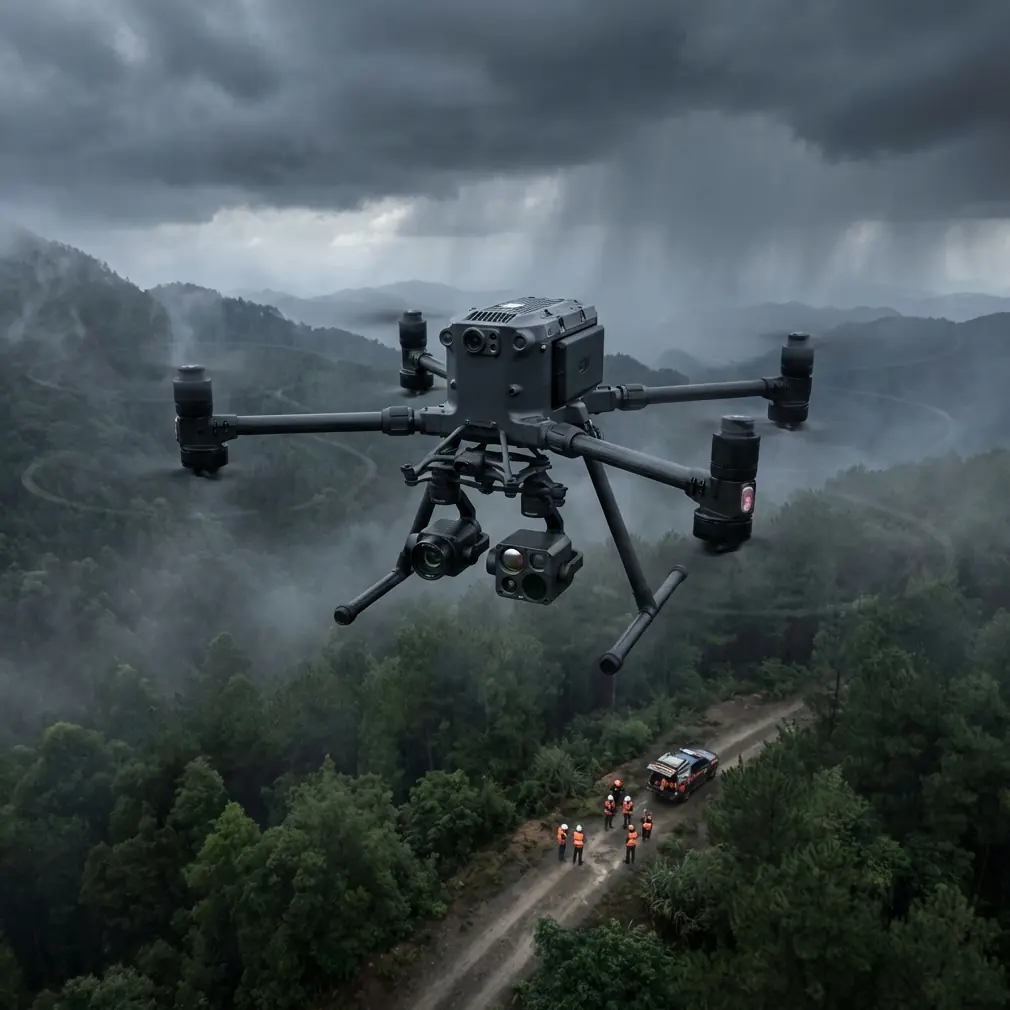
Matrice 400 in Wind: A Field Report on Power-Line Spraying, Airspace Risk, and Why Interceptor Logic Matters
META: Field report on using the Matrice 400 for windy power-line spraying, with practical insights on low-altitude airspace risk, sensor use, O3 transmission, hot-swap batteries, AES-256, and BVLOS-oriented workflow.
I spent part of last month reviewing a utility corridor job that looked simple on paper and messy in the air. The assignment was straightforward: spray along power-line infrastructure during a windy weather window without losing coverage quality, without pushing too close to conductors, and without creating unnecessary risk in a low-altitude environment that is getting more crowded every season.
That last point matters more than many operators admit.
The current reality of low-altitude operations is not just about wind, drift, route planning, and battery timing. It is also about airspace congestion. As drone adoption has widened, the shape of risk below controlled airspace has changed with it. Small, slow, low-cost aircraft now create operational problems that older protection models were never built to solve efficiently. One of the more useful ideas emerging from that shift is deceptively simple: use drones to respond to drones.
That concept comes from a recent industry discussion about interceptor UAVs, and while the original framing was broader than utility work, the operational lesson applies directly to Matrice 400 missions around power lines. Traditional defenses can be a poor fit for small aerial intrusions. The source material makes the cost mismatch plain: one missile may cost dozens of times more than the target. Laser systems, meanwhile, can be heavily affected by weather and require a high deployment threshold. For civilian infrastructure teams, the takeaway is not about adopting dramatic countermeasures. It is about recognizing that modern low-altitude safety has to be agile, proportional, and deployable in the field.
That is exactly the lens through which I would evaluate the Matrice 400 for spraying in windy utility environments.
The day the route changed
We launched just after first light along a transmission corridor bordered by mixed scrub and a wet drainage channel. Wind was inconsistent at lower altitude and more aggressive above the line. Gust behavior was the real problem, not average speed. The aircraft had to hold a predictable path while the spray mission remained close enough to target assets to be effective, but not so close that turbulence around towers and conductors would force ugly corrections.
About 14 minutes into the second segment, one of the spotters called out movement ahead and to the right. Through the sensor feed, a large bird lifted from the top of a lattice structure and crossed the corridor at an awkward angle. The thermal signature showed clearly against the cooler background, and the visual feed confirmed enough detail to break the route before it became a conflict. That brief wildlife encounter did two things at once: it justified the sensor stack, and it reminded everyone on site that aerial work around infrastructure is never just about the infrastructure.
For operators who treat imaging as a box-checking exercise, that kind of moment is where the argument changes. Thermal data is not only for inspection diagnostics. In utility spraying, especially in broken terrain or low-contrast dawn conditions, it can help identify moving hazards before they become close-proximity problems. That reduces unnecessary evasive movement, which in turn protects spray accuracy and line safety.
Why a windy spraying mission is really a systems test
People often talk about spraying power lines as if it were merely a payload question. It isn’t. It is a systems integration question.
Wind complicates everything. It affects droplet behavior, aircraft attitude, route geometry, communications confidence, crew coordination, and the time margin you have for each pass. Around linear infrastructure, there is very little room for sloppy decision-making because the environment itself funnels you into repeatable patterns. If those patterns are disrupted by terrain, bird activity, signal interference, or unauthorized drones, the mission quality drops quickly.
This is where the reference discussion about interceptor drones becomes unexpectedly relevant. The article describes interceptor UAVs as specialized aircraft built to detect, pursue, and physically stop hostile drones, relying on maneuverability and intelligent algorithms rather than heavy ground infrastructure. Strip away the security framing, and there is a broader operational principle underneath: small aerial problems are best handled with equally responsive, airborne tools.
For utility operators, that principle translates into layered awareness. A Matrice 400 conducting a spraying mission in wind should not be thought of as an isolated aircraft doing one job. It is part of an airspace management workflow. If a “black flight” intrusion or unauthorized hobby aircraft appears near a corridor, waiting for slow, centralized intervention may not be operationally acceptable. Agile drone-based detection and response architectures make more sense in these environments because they match the speed and scale of the threat.
That does not mean every utility crew needs an interceptor platform in the truck. It means planners should stop assuming that low-altitude safety can rely on legacy ideas that were built for larger, faster, and far more expensive aerial targets.
What the Matrice 400 needs to get right
On a windy power-line route, a useful aircraft has to do three things well.
First, it must preserve control authority and pilot confidence when the air becomes uneven near structures. That sounds obvious, but the downstream effect is what matters. Stable handling reduces overcorrection, and reduced overcorrection improves spray consistency.
Second, it must maintain a resilient link. O3 transmission is not a marketing detail in this sort of work. Along utility corridors, you can encounter signal complexity from terrain masking, infrastructure geometry, and long linear routes that keep the aircraft moving away from ideal operator position. A strong transmission backbone matters because route discipline depends on low-latency situational awareness. When the aircraft is threading a spraying pass in changing wind, a shaky link does not just feel uncomfortable. It degrades decision quality.
Third, it must support mission continuity. Hot-swap batteries are a practical advantage here because power-line jobs are rarely elegant from a logistics perspective. You are often balancing weather windows, access constraints, crew fatigue, and line-owner timing. If the aircraft supports battery changes that minimize downtime, you preserve the mission rhythm. That improves not only productivity but also consistency, because long interruptions force crews to re-establish timing, overlap, and environmental assumptions.
These are not glamorous features. They are the features that determine whether a field day holds together.
Security is operational, not abstract
Most utility teams understand physical safety. Fewer think hard enough about digital safety in the field.
AES-256 matters for a Matrice 400 workflow because utility missions often involve sensitive infrastructure data, route coordinates, asset conditions, and operational patterns. In many cases, that information is more valuable than people assume. If you are documenting line conditions while conducting spraying work, your data trail can reveal maintenance priorities, corridor vulnerabilities, and network geography. Secure transmission and data protection are not extras for enterprise operators. They are part of responsible infrastructure practice.
The same applies to BVLOS-oriented planning, even when the final mission remains within current approval boundaries. A platform and workflow designed with beyond visual line of sight discipline tend to be better organized in general. You see more formal route segmentation, clearer contingency logic, stronger communication procedures, and better handoff planning between field teams. For long utility corridors, that mindset is useful even before BVLOS enters the picture operationally.
Why photogrammetry and GCP still belong in a spraying conversation
At first glance, photogrammetry and GCP workflows seem more relevant to mapping than to spraying. In reality, they are part of the same quality chain.
Utility corridors are not static. Vegetation encroachment, access tracks, tower footing conditions, slope behavior, and drainage changes all affect how a spraying mission should be planned. Photogrammetric outputs can give planners a better baseline model of the route environment, especially when updated on a useful schedule. Add well-managed GCPs where appropriate, and positional confidence improves further.
The value is practical. Better corridor models help identify where wind is likely to accelerate, curl, or become erratic near terrain breaks and structures. They also help crews pre-visualize safe staging areas, obstacle clusters, and likely signal weak points. A Matrice 400 operating in wind benefits from that front-loaded planning because fewer surprises in the route mean fewer abrupt decisions in the air.
This is one place where experienced operators quietly separate themselves from casual crews. They do not treat spraying as an isolated act. They treat it as the final output of a data-informed workflow.
Low collateral risk is not just for security teams
One point from the interceptor drone discussion deserves more attention: low collateral damage.
The source describes interceptor UAVs as attractive partly because they can be deployed quickly and produce less collateral harm than heavier traditional methods. That principle has a close parallel in utility operations. Around power lines, roads, vegetation, and occasionally public interfaces, the best aerial system is often the one that solves a problem with the least secondary disruption.
That mindset should shape how spraying missions are designed. Use enough aircraft capability to handle the corridor and weather, but not so much complexity that field deployment becomes brittle. Build enough sensing to avoid wildlife, structures, and intrusions, but not so much procedural burden that crews stop using the tools properly. Put another way: the smartest operation is often the one that remains responsive without becoming overbuilt.
A note on the airspace nobody controls perfectly
The source article’s warning about changing low-altitude threats should not be dismissed as someone else’s problem. Even in civilian utility work, unauthorized drones can appear near lines, substations, and maintenance activity. Some are careless. Some are curious. A few are simply operating without understanding the consequences.
When your aircraft is already working in wind near energized infrastructure, an unexpected drone in the same slice of airspace is not a minor annoyance. It is an operational hazard. That is why the “drone against drone” idea has traction. Not because every situation needs interception, but because small aerial conflicts demand fast, proportionate, mobile responses.
For companies building Matrice 400 programs, the lesson is strategic. Future-ready utility operations should include not only aircraft performance and payload selection, but also low-altitude awareness policy: who monitors nearby air activity, how crews react to unauthorized aircraft, when routes are paused, and what technical measures support safe recovery of the mission.
If you are currently refining those procedures, this is a practical way to compare field setups with other enterprise teams: message a utility drone specialist here.
My read as a field operator
The Matrice 400 story in windy power-line spraying is not really about whether the aircraft can fly a route. Plenty of aircraft can fly a route in decent conditions. The real question is whether the platform supports disciplined work when the corridor becomes dynamic.
Dynamic means gusts near structures. It means wildlife crossing the line. It means sensitive infrastructure data moving through your workflow. It means battery turnover under time pressure. It means maintaining a trustworthy link over a long, awkward route. And increasingly, it means operating in low-altitude airspace where small external aerial risks can emerge with little warning.
That is why the recent interceptor-UAV discussion is more useful than it first appears. It highlights a larger truth about modern drone operations: the low sky is changing, and systems that succeed there will be the ones built for precision, agility, and proportional response.
For utility spraying teams, that same formula holds. A Matrice 400 deployment should not just be robust enough to finish the mission. It should be nimble enough to adapt when the mission stops behaving like the plan.
That morning by the transmission corridor, the bird crossed, the route shifted, and the aircraft settled back into its pattern after a short hold. No drama. That was the point. Good systems make adjustment look ordinary. In utility aviation, ordinary is the standard worth chasing.
Ready for your own Matrice 400? Contact our team for expert consultation.