
How I’d Set Up a Matrice 400 for Power-Line Spraying
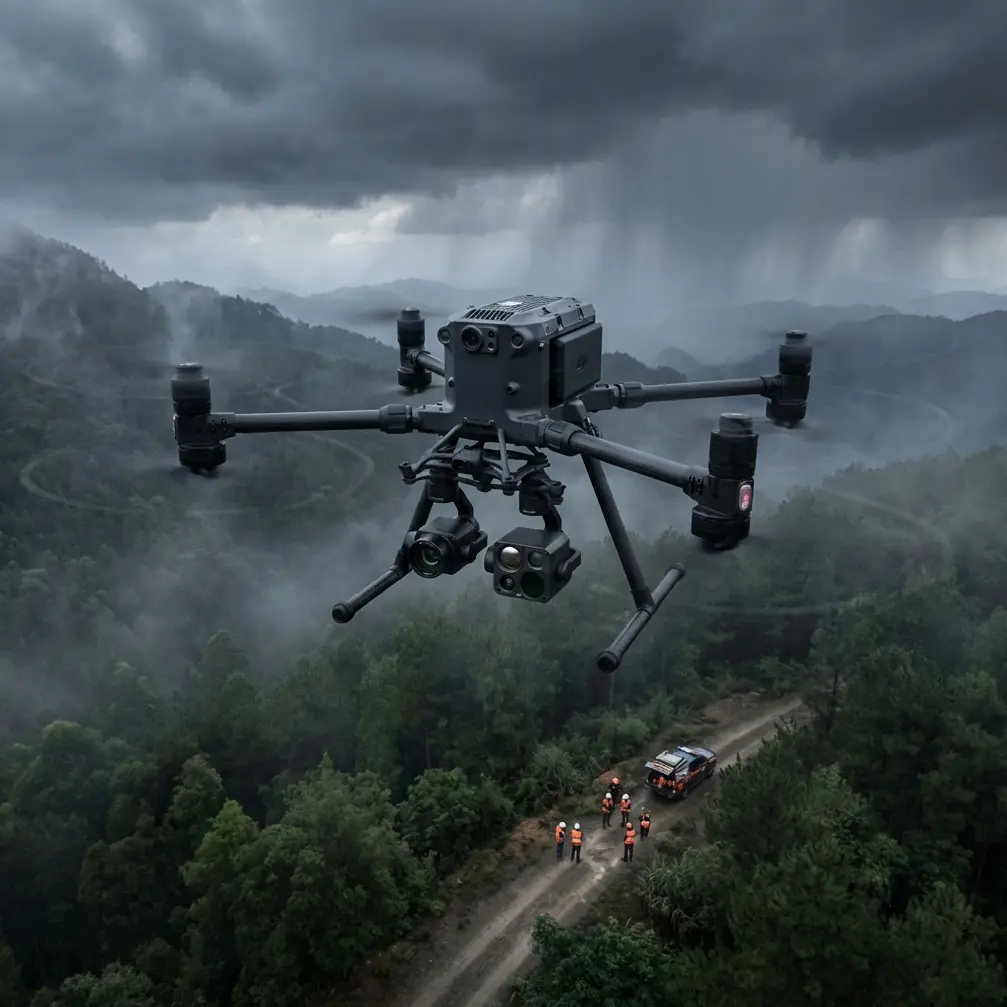
How I’d Set Up a Matrice 400 for Power-Line Spraying in Extreme Temperatures
META: A field-tested Matrice 400 setup strategy for spraying power lines in extreme temperatures, with practical guidance on mechanism reliability, inspection discipline, and why actuator geometry and NDT standards matter.
I learned this lesson the hard way on a winter transmission-corridor job that started below freezing and ended with equipment warm to the touch by mid-afternoon sun. The aircraft itself was not the only system under stress. Payload mounts stiffened. Linkages responded differently after repeated cycles. Surface contamination built up where it shouldn’t. The flying part was manageable. The mechanical consistency was the real fight.
That is why, when people ask me how I’d configure a Matrice 400 for spraying power lines in extreme temperatures, I don’t start with app menus or route planning. I start with mechanism behavior and inspection discipline. If the mission involves repetitive actuation, chemical exposure, temperature swings, and long corridor work, the weak point is rarely the headline spec. It’s the part that has to unlock, move, support load, and return to position hundreds of times without hesitation.
The reference material behind this article comes from classic aircraft design practice, not drone marketing copy, and that is exactly why it matters. One section describes a special unlocking actuator with a follower stroke that first shortens, then changes direction as the geometry passes through an aligned condition. Another section focuses on inspection: surface condition can reduce the effectiveness of magnetic-particle and fluorescent checks, and for heavily loaded structural parts, strength values alone are not enough without plasticity, toughness, or fracture-toughness verification.
If you’re flying a Matrice 400 around energized infrastructure in cold mornings, hot afternoons, and wind coming off open right-of-way, those ideas are far from academic.
Start with the mechanism, not the mission plan
Power-line spraying sounds straightforward until you break it into what the aircraft is actually doing.
It is flying precise lateral tracks near narrow targets. It is carrying fluid. It is exposing mounts, brackets, and moving interfaces to vibration, residue, and thermal cycling. If you are changing tanks or batteries quickly between sorties, you are also repeatedly loading and unloading interfaces that must stay dimensionally consistent.
The old aircraft mechanism reference describes an unlocking actuator that does something subtle but critical. In its first phase, hydraulic action shortens the actuator to release an eccentric lock. Then, after the support geometry reaches a straight-line condition, the actuator must reverse its motion behavior and extend in a follower movement so the structure can keep folding. That is not trivia. It’s a reminder that moving hardware often behaves in phases, not in one smooth, simple stroke.
The source even gives a concrete number: a 21 mm compression stroke before the follower travel begins. Operationally, that kind of detail matters because it tells you there is a threshold where the mechanism changes state. Below that threshold, you’re unlocking. Beyond it, you’re transitioning and following the geometry.
On a Matrice 400 spraying platform, the equivalent lesson is this: do not treat every actuator, latch, tank coupler, nozzle mount, or deployment mechanism as if it has one uniform response across temperature extremes. Some parts will break free, then drag. Some will hold tension until they suddenly relax. Some spring-assisted components will help movement in one phase and resist it in another.
If I were setting up the aircraft for this kind of work, I would create a preflight check that specifically isolates those phase changes.
My practical sequence would look like this:
- Cycle every spray-related moving part before first launch of the day
- Repeat that cycle after the aircraft has thermally soaked in the current conditions
- Watch for delayed release, uneven return, or increased effort near end-of-travel
- Compare cold-start behavior with post-flight behavior, not just one or the other
That sounds basic. It isn’t. Many teams only verify whether a component moves. I want to know how it moves across the full stroke and whether its motion profile changes with temperature.
Why spring behavior matters more than crews expect
The source mechanism uses a compressed spring to maintain lock pressure and then assist extension during the follower phase. That’s a useful mental model for drone payload systems exposed to severe weather.
In cold conditions, elastomers harden, lubricants thicken, and spring-backed parts may release differently than they did in the shop. In heat, the opposite problem appears: expansion, reduced damping, and residue softening can create a mechanism that feels freer right up until contamination starts to bind it.
When spraying along power lines, that can show up as:
- inconsistent nozzle deployment
- slight asymmetry in spray boom positioning
- latch hesitation after refill or battery change
- vibration transfer into the payload frame after repeated cycles
I’ve seen experienced crews blame flight tuning when the root cause was mechanical inconsistency at the payload interface. That is where the Matrice 400 should be treated like a professional airframe, not a disposable tool. If you’re asking it to work in extreme temperatures, don’t just verify that the sprayer is attached. Verify that the entire actuation chain remains predictable after repeated thermal swings.
Inspection quality is not optional when flying near critical assets
The second reference point is even more useful for real operations. It states that surface condition affects the quality of magnetic-particle and fluorescent inspection. Rough surfaces, plating, and coatings can reduce inspection effectiveness. X-ray resolution also drops as part thickness increases.
For drone operators, the immediate takeaway is not that you need to turn your hangar into an aircraft overhaul shop. The takeaway is that surface appearance can hide meaningful problems, especially on highly stressed parts.
That matters on the Matrice 400 because power-line spraying in extreme temperatures tends to be repetitive, corridor-based, and operationally unforgiving. You may be launching multiple sorties in a day. You may be hot-swapping batteries to keep the aircraft turning quickly. You may be wiping down chemical residue between flights instead of conducting a deeper inspection until later. That is exactly how small structural issues get overlooked.
The aircraft design reference goes further: for a small number of critically loaded parts subjected to high loads, impact loads, alternating loads, or transverse loads, checking tensile strength alone is not enough. The manual specifically calls for ensuring plasticity indicators, impact toughness, or fracture toughness depending on the material and use case.
That principle translates cleanly to drone fleet management. If a component on your Matrice 400 setup is carrying meaningful dynamic load — think landing gear attachment regions, payload rails, bracket interfaces, arm joints, or heavily stressed fastener locations — a simple “looks fine” inspection is too shallow. Even a part with acceptable hardness or nominal strength can still behave badly if toughness or crack resistance is compromised.
For day-to-day field operations, I’d turn that into three habits:
1. Clean before you inspect
Residue, roughness, and coatings can mask damage or reduce the value of non-destructive checks. If the aircraft has been exposed to spray drift, dust, or road grime from corridor access, cleaning is part of the inspection, not a cosmetic extra.
2. Track high-load parts separately
Not every screw deserves equal attention. Keep a list of components that absorb repeated shock, bending, torsion, or payload transfer loads. Inspect those on a tighter schedule than cosmetic covers or low-risk panels.
3. Treat repeated temperature cycling as a fatigue multiplier
Extreme cold-to-warm transitions and repeated launch cycles can change how cracks initiate and grow. If you are operating daily in those conditions, shorten your inspection interval. Don’t wait for a visible problem.
The setup I’d use for a Matrice 400 power-line spraying workflow
A lot of “how-to” articles talk only about route programming and nozzle selection. Useful, but incomplete. Here is the framework I’d actually use.
Step 1: Build the aircraft around repeatable corridor positioning
Power-line spraying lives or dies on consistency. The Matrice 400 should be configured to hold stable track spacing and predictable speed relative to the conductor environment and vegetation target. If you are also collecting supporting imagery for corridor records, tie that workflow into photogrammetry discipline rather than treating it as an afterthought.
This is where GCP-backed mapping checks still matter. Even if the aircraft’s onboard positioning is excellent, ground control points give you a reality check when you need to compare treatment areas over time or validate drift boundaries near sensitive infrastructure. For utility contractors, that means fewer arguments later about where the treatment was applied.
Step 2: Use thermal context intelligently
Extreme temperature missions aren’t just uncomfortable for crews. They change what you can see. A thermal signature can help identify hot hardware, nearby environmental gradients, or post-treatment anomalies in surrounding vegetation zones, depending on the payload stack and mission objective. It won’t replace visual assessment, but it can reveal differences that become operationally relevant when ambient conditions are unstable.
On cold mornings, thermal contrast may be strong and useful. By afternoon, after surfaces heat unevenly, interpretation gets trickier. That’s another reason to standardize when you gather supporting imagery rather than collecting it randomly between spray runs.
Step 3: Protect uptime without rushing the turnarounds
The temptation on corridor work is to keep the aircraft moving no matter what. Hot-swap batteries are valuable here, especially when weather windows are narrow, but speed can create sloppiness at the exact interfaces that deserve the most care.
My rule is simple: every fast turnaround still includes a tactile confirmation of payload security, connector seating, latch position, and any mechanism that has just been disturbed. Seconds spent there prevent long walks to retrieve a grounded aircraft later.
Step 4: Don’t ignore the data link side of the job
Long linear utility routes can tempt teams into stretching distance and working farther down the line than they should without thinking about command resilience. A strong O3 transmission architecture and secure AES-256 data handling are not brochure details in this context. They matter because corridor operations often involve infrastructure owners, route imagery, maintenance evidence, and operational records that should not be casually exposed or poorly managed.
If your utility client is particular about operational security or evidence handling, document how mission data is stored, transferred, and protected. That conversation comes up more often than pilots expect.
Step 5: Be honest about BVLOS ambition
A Matrice 400 platform naturally pushes teams to think bigger, especially on long power-line corridors. BVLOS planning may eventually make sense depending on local regulations, waivers, observers, terrain, and client requirements. But in extreme temperatures, I would first prove the reliability of the aircraft-payload-mechanism-inspection loop in shorter, well-controlled segments.
Scale comes after repeatability. Not before.
The hidden value of aircraft-design thinking in drone work
What I appreciate about the source material is that it forces a level of mechanical seriousness that drone operations sometimes skip.
Take the unlocking actuator example again. The design had to account for a geometry shift where three points become aligned, after which the actuator’s role changes. That is an elegant reminder that systems don’t fail only because they are weak. They fail because their motion path, loads, and support conditions change during operation.
That mindset helps when diagnosing a Matrice 400 setup that works perfectly on the bench but becomes erratic after several sorties in harsh weather. The problem may not be “bad hardware.” It may be a state transition you haven’t accounted for: cold-start friction, thermal expansion after flight, spring response after repeated compression, or contamination entering a sliding interface.
Likewise, the inspection reference is a warning against lazy confidence. If rough surfaces and coatings can reduce the quality of magnetic-particle and fluorescent inspection on aircraft parts, then any drone operator should be skeptical of superficial visual checks on high-use hardware exposed to spray residue and weather. Visibility is not certainty.
What I’d tell a utility operator before deploying the Matrice 400
If your goal is reliable power-line spraying in extreme temperatures, use the Matrice 400 like a professional airframe with a controlled payload ecosystem, not just a flying tank carrier.
That means:
- understand how your moving parts behave across their full stroke
- identify thresholds where mechanisms change state
- inspect after cleaning, not before
- shorten inspection intervals on high-load interfaces
- standardize thermal and mapping capture for corridor records
- protect rapid battery changes from becoming rushed mechanical errors
- document link security and data handling for infrastructure clients
If you want to compare setup notes for your own corridor conditions, I’d suggest reaching out through this direct field-ops chat. For missions like these, small configuration details make a bigger difference than most spec sheets admit.
The Matrice 400 is capable. That part is easy. The harder part is creating a workflow where mechanical behavior, inspection quality, and thermal reality are all treated as part of the flight system. Once you do that, extreme-temperature line work gets a lot less dramatic — and a lot more repeatable.
Ready for your own Matrice 400? Contact our team for expert consultation.