
Matrice 400 Field Report: What a 2.5 km² Land Rights Survey
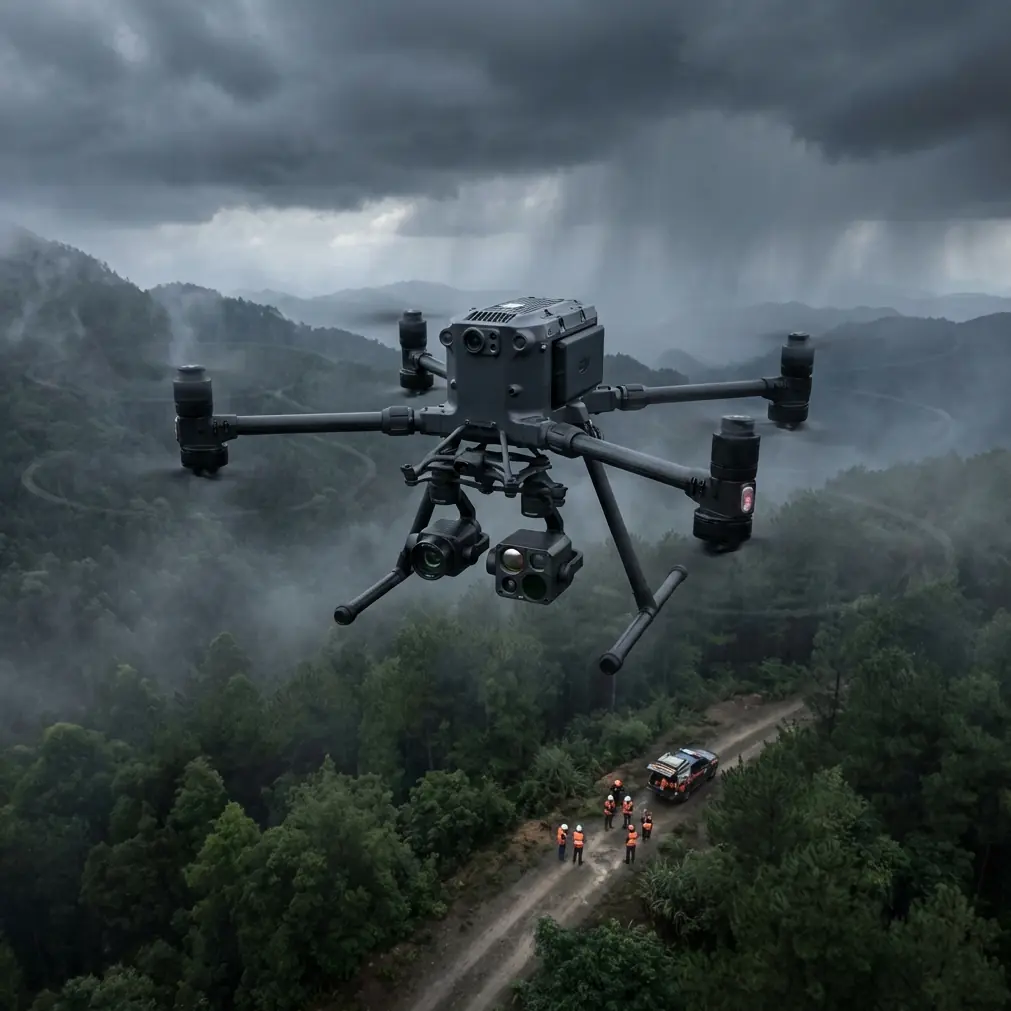
Matrice 400 Field Report: What a 2.5 km² Land Rights Survey Teaches Us About Coastal Solar Farm Spraying
META: A field-based expert analysis of how lessons from a 2.5 km² UAV photogrammetry project translate into smarter Matrice 400 planning for coastal solar farm spraying, mapping accuracy, and mission reliability.
By Dr. Lisa Wang, Specialist
Most articles about the Matrice 400 stay at the feature-sheet level. That misses the point.
A serious aircraft proves itself when the mission is awkward, the site is exposed, and the margin for error is small. Coastal solar farms fit that description perfectly. You are dealing with salt-heavy air, reflective surfaces, wind exposure, long linear infrastructure, and the operational need to move from inspection-grade situational awareness to repeatable treatment passes without wasting time or chemical.
To understand why the Matrice 400 matters here, it helps to look sideways at an older but still very revealing UAV case: a rural land rights photogrammetry project carried out over a 2.5 km² test area on the outskirts of Shuangyashan. In that project, a PPSG UAV using a non-metric camera captured low-altitude remote sensing data, which was then processed with professional aerial triangulation software to generate a DOM and DSM. The result met 1:1,000 mapping accuracy requirements.
That single reference says more about real drone operations than many glossy brochures. It shows that a UAV platform does not need to rely on traditional assumptions to produce useful, defensible outputs. It also shows that workflow design matters as much as hardware. For Matrice 400 operators working around coastal solar assets, those lessons are highly practical.
The hidden link between land rights mapping and solar farm spraying
At first glance, rural land confirmation work and coastal solar maintenance look unrelated. One is a surveying problem. The other is an asset care and vegetation or surface-management problem. In practice, both depend on the same operational chain:
- collect usable low-altitude data,
- process it into decision-ready layers,
- execute field work with positional confidence,
- repeat the task consistently over time.
The Shuangyashan test is valuable because it confirmed that low-altitude UAV imaging with a non-metric camera could still deliver outputs precise enough for formal mapping at 1:1,000 scale. Operationally, that matters because it reinforces a core truth: good mission architecture can compensate for limitations in the sensor category. In coastal solar work, the Matrice 400 benefits from that same principle. The platform is not just a flying camera carrier or payload lifter. It is a systems aircraft for building reliable workflows across inspection, photogrammetry, and treatment planning.
For solar operators, that means you should stop treating spraying as an isolated task. The better model is survey first, spray second.
Why DOM and DSM thinking belongs in a spraying workflow
The reference project specifically produced a digital orthophoto map and a digital surface model. Those are not abstract cartographic products. They are operational layers.
A DOM gives you spatially corrected visual context. On a coastal solar site, that can be used to define panel rows, service roads, drainage cuts, fence lines, inverter pads, and vegetation corridors. A DSM adds elevation intelligence. That becomes useful where land undulates, where drainage channels create uneven spray geometry, or where vegetation growth along perimeter edges introduces collision and coverage complications.
This is where the Matrice 400 starts to separate itself from smaller, less adaptable airframes. Competitor platforms often force a compromise: either map the site well, or carry the equipment and endurance needed for productive field operations. The Matrice 400 is stronger when the job demands a connected workflow. You can conduct photogrammetry-informed planning, evaluate thermal signature anomalies in the same operating program, and structure repeat missions with a level of continuity that lower-tier aircraft struggle to sustain.
That continuity is not glamorous. It is just what saves hours over a season.
The real operational lesson from the non-metric camera
One of the most overlooked details in the Shuangyashan case is the use of a non-metric camera. Traditionally, some teams assume that only dedicated survey cameras can produce dependable mapping outputs. But the paper highlights another reality: flexible camera settings and proper processing can reduce dependence on perfect lighting and still support accurate deliverables.
That matters on coastal solar farms because light is rarely ideal. Reflective panel surfaces can create visual confusion. Sea haze changes contrast. Wind-driven clouds alter exposure from one pass to the next. A system that allows adaptable imaging strategy, then supports professional post-processing, is much more useful than one that sounds powerful on paper but becomes fussy in real conditions.
With the Matrice 400, the win is not simply “better camera, better result.” The win is ecosystem resilience. If you are building orthomosaics for treatment planning, cross-checking thermal signature patterns for hotspot or fouling analysis, and then launching follow-up sorties, you need platform stability, payload flexibility, and dependable data links. That is where O3 transmission becomes more than a spec line. On large coastal sites, stable transmission helps preserve pilot awareness at long working distances and supports cleaner execution when line layouts stretch across broad acreage.
For teams preparing for BVLOS-aligned operational frameworks where permitted, that kind of robust communications architecture becomes even more meaningful. Not because it removes regulatory obligations, but because it supports disciplined mission design on expansive infrastructure sites.
Coastal exposure changes everything
Solar farms near the coast punish weak operational planning. Salt accelerates wear. Wind turns neat grid missions into battery-draining corrections. Open terrain can tempt crews into overextending range. And because many sites are large but repetitive, operators sometimes become casual. That is when small errors start compounding.
The PPSG UAV case emphasized several classic UAV advantages: low cost, maneuverability, fewer site constraints, and no need for a dedicated airfield. Those same structural advantages still define the best commercial workflows today. The Matrice 400 builds on them, but at a much more mature level.
For coastal solar spraying, what matters most is not just getting airborne from difficult terrain. It is doing so repeatedly, with minimal interruption. Hot-swap batteries are a genuine operational asset here. On a long day covering treatment blocks across multiple panel sectors, battery changeovers can either preserve momentum or fracture it. If your aircraft forces awkward shutdown cycles, your treatment rhythm suffers. With hot-swap capability, the Matrice 400 is better suited to maintaining tempo while protecting mission continuity, especially when crews are balancing spray windows against wind shifts and tidal moisture conditions.
That is one of those areas where it quietly outperforms many competing setups. Some aircraft are acceptable for isolated flights. Fewer are truly efficient across a full commercial day.
GCPs still matter, even when automation gets better
There is a temptation in modern drone work to assume the platform can solve everything itself. It cannot.
If you want your spray plan to align tightly with panel rows, exclusion zones, access lanes, and drainage boundaries, GCP discipline still deserves attention in many mapping scenarios. The original land rights project reached formal mapping precision only because the image processing chain was treated seriously. The lesson is not that software is magic. The lesson is that geometry matters.
For a Matrice 400 workflow, that means you should build survey-grade habits into operational planning whenever the site demands repeatability. GCP-supported photogrammetry can help establish treatment polygons with less ambiguity, especially on sites where panel expansions, erosion, or seasonal vegetation changes alter the visual environment. It also gives asset managers something they care about deeply: a record that can be compared over time without relying on memory or rough field notes.
That historical continuity is often more valuable than a one-off “successful” spray mission.
Thermal signature is not just for fault finding
The context around Matrice 400 often brings up thermal payload workflows, and for good reason. But on solar farms, thermal signature analysis should not be boxed into hotspot detection alone.
Before a spraying operation, thermal patterns can reveal where dust accumulation, standing moisture, or localized environmental stress is distorting panel performance or microclimate conditions around installation blocks. That is operationally relevant because it can influence where maintenance intervention is most urgent and where access conditions may affect the safety or quality of a spraying pass.
Again, this connects back to the logic of the reference project. In Shuangyashan, the value of the UAV system was not merely that it captured images. It produced analyzable outputs from which action could follow. DOM and DSM were decision tools. In the same way, thermal layers on a Matrice 400 are valuable when they shape the field plan rather than sit unused in storage.
Security and transmission are not side issues on infrastructure sites
Coastal energy assets are operational infrastructure. That means data handling is part of the mission, not an afterthought.
When teams discuss AES-256 and stable long-range transmission, some people tune out because they associate those features with IT checklists rather than field results. That is a mistake. If you are flying around commercially sensitive generation assets, secure links and controlled data practices matter. AES-256-level link protection supports stronger governance over inspection and mapping data, while O3 transmission supports more stable command and situational feedback across large site footprints.
That does not just satisfy internal policy. It reduces the friction between flight teams and asset owners. And reduced friction is productivity.
If you are currently planning a coastal solar workflow and want to compare deployment options against your site constraints, one practical starting point is to message our field team here.
Why the Matrice 400 is especially strong in this use case
The strongest argument for the Matrice 400 in coastal solar spraying is not a single feature. It is the way the platform supports linked tasks without forcing a hardware reset in your operating model.
A weaker competitor may handle inspection well but become inefficient when the mission expands into terrain-aware planning or long-duration repetitive sorties. Another may carry payloads adequately but lack the transmission confidence, battery workflow, or enterprise integration to support a high-discipline infrastructure program. The Matrice 400 excels because it is more comfortable in the messy middle where real work happens: mapping, validation, thermal review, route refinement, repeat deployment, and documentation.
That is the same kind of systems value hinted at by the 2015 land-rights photogrammetry case. There, a UAV with a non-metric camera, proper aerial triangulation processing, and disciplined output generation produced results that met 1:1,000 mapping standards over 2.5 km². The significance was not technological novelty. The significance was proof that a well-structured UAV workflow could deliver credible, operationally useful geospatial products.
For modern solar operators, the Matrice 400 is compelling for the same reason. It supports credible, operationally useful outputs under field conditions that are rarely tidy.
A practical field workflow for coastal solar teams
If I were structuring a Matrice 400 program for coastal solar spraying, I would not start with the spray tank or the treatment pattern. I would start with the information chain:
1. Baseline site capture
Build a current orthomosaic and, where needed, a surface model of the site. Use GCPs when accuracy requirements justify them. Focus on panel corridors, perimeter growth, drainage features, and access restrictions.
2. Thermal and visual review
Layer thermal signature data over the visual map to identify anomalies, stress clusters, or maintenance priorities. This step helps separate urgent treatment zones from routine ones.
3. Environmental timing
Account for wind, humidity, and salt exposure windows. Coastal sites punish lazy scheduling.
4. Mission segmentation
Break the site into treatment blocks that match battery cycles, refill rhythm, crew visibility, and terrain complexity. This is where hot-swap batteries materially improve continuity.
5. Execution with transmission discipline
Use stable O3-linked operations to maintain strong aircraft awareness across broad rows and infrastructure corridors. Avoid stretching missions simply because the site looks open.
6. Repeatable recordkeeping
Store orthomosaic, DSM, thermal, and mission logs in a way that lets the next sortie build on the previous one. The second season should be smarter than the first.
That workflow is not theoretical. It is the updated commercial expression of the same logic demonstrated in the Shuangyashan project: low-altitude capture, professional processing, accurate outputs, then action.
The bigger takeaway
What made that 2.5 km² rural survey meaningful was not the aircraft name. It was the proof of method. A UAV system using a flexible camera setup, careful aerial triangulation, and output products like DOM and DSM reached the precision threshold needed for formal land-rights work. That is a demanding standard.
For coastal solar farm spraying, the takeaway is straightforward. If your drone platform can support accurate pre-mission mapping, dependable data transmission, secure infrastructure workflows, and efficient field endurance, you are not just flying better. You are making the entire maintenance cycle more defensible.
That is where the Matrice 400 earns attention. Not as a generic flagship. As a platform that fits the reality of large, exposed, commercially sensitive sites where inspection, photogrammetry, and treatment need to function as one coherent system.
Ready for your own Matrice 400? Contact our team for expert consultation.