
Matrice 400 on Windy Solar Farms: What Actually Matters
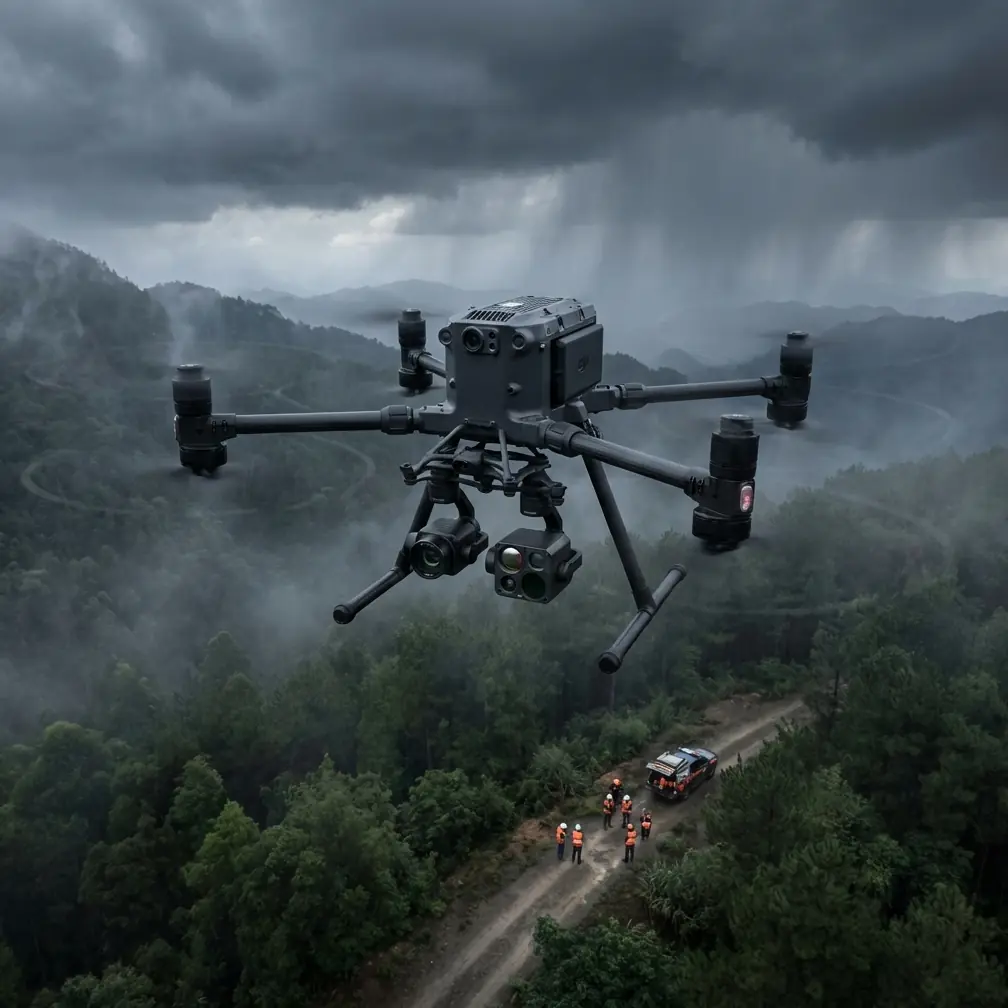
Matrice 400 on Windy Solar Farms: What Actually Matters When Conditions Shift Mid-Flight
META: Expert analysis of how Matrice 400-style stability, damping logic, and flight-control behavior matter for windy solar farm spraying, inspection continuity, and safer commercial operations.
Wind is where glossy drone specs stop being useful.
On a large solar farm, that truth shows up fast. You launch into what looks like a manageable weather window, start working down a row, and ten minutes later the site behaves like a different place. Air starts funneling between panel tables. Heat shimmer builds. Gusts stop arriving from one direction and begin rolling across the array in uneven pulses. If your aircraft can’t stay composed through that change, every downstream task suffers: spray consistency, obstacle clearance, line tracking, battery planning, image quality, and the crew’s willingness to keep pushing the mission.
That is the lens I’d use for the Matrice 400 in this scenario. Not as a brochure subject, but as a work platform judged by one question: how well does it absorb instability when the weather refuses to stay still?
For solar farm operations, that question matters more than many pilots admit. Even when the mission is described as “spraying,” the aircraft is rarely doing just one thing operationally. It is navigating repetitive geometry, maintaining lateral discipline near structures, dealing with shifting microclimates over reflective surfaces, preserving data integrity for mission records, and often handing off between visual, thermal, and mapping workflows. In the field, stability is not a comfort feature. It is the hidden system that protects output quality.
The most useful way to think about the Matrice 400 here is through two engineering ideas buried in traditional aircraft design: damping and control-law feedback.
Those aren’t abstract textbook terms. They explain why one aircraft feels calm in disturbed air while another feels busy, twitchy, and expensive to operate.
In aircraft landing-gear engineering, anti-shimmy dampers are tested specifically because unwanted oscillation can build energy quickly unless it is dissipated. The design goal is simple: convert that mechanical energy into heat and bleed off the motion before it grows into a serious problem. One reference method measures the time required for angular movement under different applied torques, then derives a damping coefficient from the torque-versus-angular-velocity relationship. In that framework, damping behavior changes with factors such as fluid viscosity, working temperature, transmission efficiency, and orifice size. That sounds far removed from drones over solar arrays, but operationally it is the same story: disturbance enters the system, and the platform either dissipates it cleanly or lets it amplify.
Why does that matter for a Matrice 400 on a windy solar farm?
Because a wind event is not just “wind speed.” It is a chain of disturbances entering multiple control loops at once. The aircraft yaws slightly as a crosswind hits the fuselage, then rolls as the controller corrects, then adjusts thrust and heading to stay on line, all while trying to preserve mission geometry. If those corrections are poorly damped, the drone can start hunting around its intended path. You see it in wider lateral deviations, uneven spray placement, and small heading oscillations that contaminate thermal or photogrammetry passes. If the system is well damped, the aircraft still moves in the gusts, but it settles faster and with less wasted correction.
That distinction is especially important on solar sites because their layout creates local wind behavior that catches crews off guard. Long panel corridors can channel airflow. Open service roads can create side gusts. Temperature differences between gravel, panels, and exposed ground can alter the air mass over the site. Midday operations can feel stable at takeoff and far less stable by the second battery cycle.
I’ve seen that pattern play out like this: the mission begins with straightforward row following under manageable conditions. Then cloud cover breaks. The reflective load from the panels changes. Crosswind becomes quartering wind. The aircraft starts receiving irregular yaw disturbances instead of the smoother drift the crew planned around. At that point, a less capable platform makes the pilot work constantly. The mission pace slows, overlap margins widen, and confidence drops. A stronger platform handles the same change with less drama. Not because physics disappeared, but because the control system is doing what good control systems should do: sense, filter, correct, and settle.
That leads to the second engineering concept: yaw-axis control.
One of the flight-control references describes yaw control as an augmentation function using combined feedback from yaw rate and lateral acceleration. That detail matters. On a drone working a solar farm, yaw is not merely about pointing the nose in the right direction. It affects tracking precision, payload orientation, image alignment, and how efficiently the aircraft rejects side disturbances. If the platform can integrate yaw-rate behavior with lateral response, it has a better chance of staying composed when gusts try to twist it off heading while also pushing it sideways.
Operationally, that means smoother corridor flying and less wandering over panel rows. For spraying, that can help maintain more consistent application geometry in imperfect air. For thermal signature collection, it reduces the subtle angular inconsistencies that make later interpretation more difficult. For photogrammetry, it helps preserve cleaner flight lines and more dependable image relationships, especially when you are trying to keep GCP usage efficient rather than using control points to compensate for sloppy acquisition.
The reference text also mentions a stall-margin network that changes behavior once angle of attack exceeds 15 degrees. While fixed-wing logic does not transfer directly to multirotor operations, the significance is clear: advanced aircraft control systems are built to change response as the flight state becomes more demanding. That is the right mindset for evaluating a Matrice 400. In windy solar farm work, the real question is whether the aircraft remains predictable when it moves from routine loading into a more stressed portion of the envelope. You want a platform that does not feel identical in all conditions, but one that remains intelligible to the operator as conditions worsen.
That predictability affects planning far beyond stick feel.
Take BVLOS-oriented workflow design. Even if a specific operation is conducted under visual constraints, many commercial teams now build procedures around extended route reliability, strong link resilience, and secure mission records. That’s where O3 transmission and AES-256 become meaningful, not as checklist jargon but as continuity tools. On a sprawling solar asset, comms quality and data security are both part of operational professionalism. A stable aircraft with robust transmission is less likely to turn a gusty segment at the far edge of the site into a confidence crisis. A secure data chain matters when thermal datasets, fault records, and infrastructure imagery move through multiple stakeholders.
Battery strategy matters too. Wind punishes poor energy planning. On calm days, crews get used to a certain rhythm; in gusty conditions, return margins shrink faster than expected because the aircraft is constantly correcting. Hot-swap batteries become more than a convenience in that environment. They support shorter, cleaner sortie design. Instead of stretching a mission leg because conditions looked acceptable at launch, teams can reset more often, reassess wind trend, and preserve operational discipline. The weather change mid-flight is where loose battery habits become safety problems.
For solar farms specifically, I would structure Matrice 400 operations around a problem-solution mindset rather than a generic mission template.
The problem is not simply “wind.” It is variable aerodynamic disturbance interacting with repetitive infrastructure, time-sensitive battery planning, and quality-sensitive payload work.
The solution is a platform and procedure stack built around damping, control responsiveness, and mission segmentation.
That means:
- shorter route blocks when wind direction is shifting,
- stricter acceptance limits for thermal work than for general visual inspection,
- conservative reserve planning when quartering headwinds are expected on return legs,
- and a pilot workflow that watches for changes in how the aircraft settles after correction, not just changes in groundspeed.
That last point deserves emphasis. Experienced operators know that the first sign of a deteriorating mission is often not a dramatic warning. It is the feel of the aircraft. The drone takes longer to arrest a yaw nudge. It needs more visible correction to hold line. Hover looks fine, but transitional segments get sloppy. Those are damping clues. In classical testing, engineers moved from simple constant-load methods toward dynamic testing because dynamic testing better reflects real working conditions and gives more credible results. The same principle applies in the field: don’t judge a platform by calm hover behavior alone. Judge it by how it behaves while working, because working flight reveals the real control quality.
That is why weather changes mid-flight are so revealing. They expose the difference between nominal stability and operational stability.
On one solar farm mission profile, for example, the aircraft may begin a pass with smooth tracking and acceptable spray placement. Halfway through, a stronger crossflow arrives between table rows. A marginal system starts oscillating around heading, forcing the pilot to widen tolerances or abort. A better-resolved system absorbs the disturbance with a brief correction and returns to line quickly enough that the mission remains usable. The difference is not cosmetic. It affects rework, consistency, and fatigue.
If you are using the Matrice 400 as a multi-role platform, that stability dividend compounds. Spray operations benefit from steadier path control. Thermal inspection benefits from cleaner sensor orientation and fewer blurred decisions caused by abrupt corrections. Mapping workflows benefit from more uniform image capture, especially where photogrammetry quality is expected across long, repetitive panel fields. In other words, the aircraft’s handling discipline is not trapped inside the flight department. It shows up later in maintenance decisions, report quality, and the number of site revisits you need.
A final point that often gets missed: maintenance logic should borrow from aviation thinking too.
The landing-gear reference stresses that damping-characteristic testing is essential not just in development, but in production checks, maintenance, fault isolation, and design improvement. That mentality is valuable for commercial drone teams. If your Matrice 400 starts feeling different in gusts, don’t reduce the issue to pilot preference. Treat it as an operational signal. Review logs. Compare payload combinations. Check battery condition trends. Look for environmental correlations. Build your own version of dynamic assessment rather than relying on static assumptions. Aircraft that work in harsh commercial cycles should be monitored like systems, not treated like appliances.
For teams operating on large solar sites in variable weather, that mindset often separates clean execution from recurring friction.
The Matrice 400’s real value in this setting is not that it flies in wind. Plenty of aircraft fly in wind. What matters is whether it keeps mission quality intact when conditions shift from manageable to untidy. That comes down to how well the aircraft damps disturbance, how intelligently it handles yaw and lateral correction, how reliable its link remains across a large site, and how disciplined the crew is with batteries and route segmentation.
If you are planning a windy solar farm workflow and want to compare payload strategy, transmission planning, or route structure, you can message our field team here: https://wa.me/85255379740
That conversation should start with the mission, not the spec sheet.
Ready for your own Matrice 400? Contact our team for expert consultation.