
Matrice 400 on Mountain Solar Farms: Range
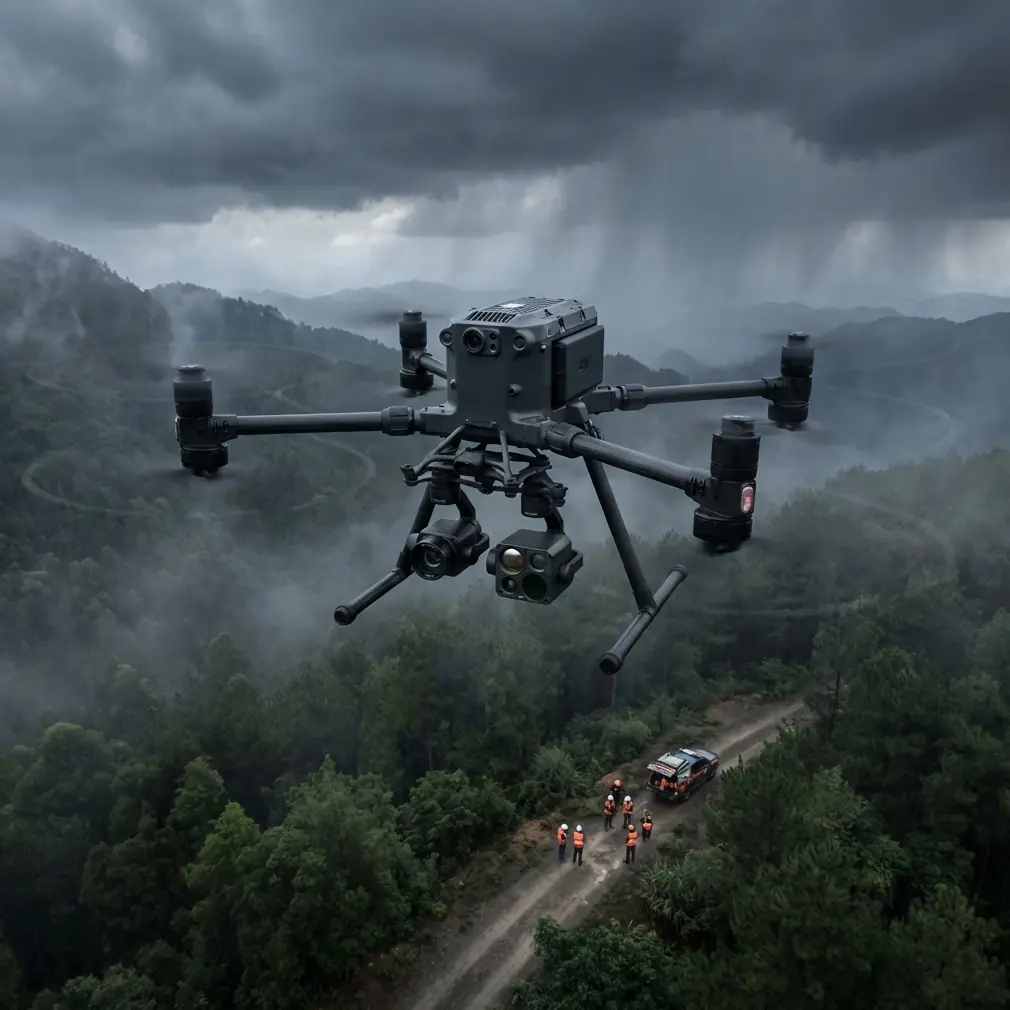
Matrice 400 on Mountain Solar Farms: Range, Antenna Placement, and Signal Discipline That Actually Matter
META: Expert case-study analysis of using Matrice 400 on mountain solar farms, with practical antenna positioning advice, communication reliability insights, and operational planning details grounded in aircraft electrical and antenna design standards.
Mountain solar farms punish weak workflow design.
You see it first in the links. Not the contracts, not the spec sheets, not even the flight logs. The problem shows up when the aircraft drops behind a ridge line, transmission quality starts to fluctuate, and the crew realizes the mission plan assumed “good enough” signal behavior in terrain that never rewards guesswork.
That is why the Matrice 400 conversation for solar spraying in mountainous sites should not start with payload charts or broad claims about intelligence features. It should start with communications discipline, electrical standardization, and the physical placement of antennas and supporting equipment. Those are the quiet variables that determine whether a day’s work flows cleanly or fractures into repeated repositioning, conservative flight boundaries, and lost treatment windows.
I recently worked through a planning framework for a mountain solar farm spraying scenario centered on Matrice 400. The site had three characteristics that made it instructive: long rows of panels stepped across uneven slopes, narrow service roads with intermittent visibility to the operating area, and frequent need to transition between direct visual segments and extended stand-off control positions. In that kind of environment, “maximum range” is the wrong phrase if it encourages people to think only about distance. What matters is usable link integrity across changing geometry.
That distinction sounds academic until you apply it in the field.
Why mountain solar spraying creates a communications problem first
Solar spraying work on elevated terrain is not like broadacre agriculture. The aircraft is often moving along hard-edged man-made geometry built into natural topography. Panels, support structures, drainage cuts, fencing, and ridgelines all shape the radio environment. Add the need to hold steady passes over reflective surfaces and work close to slope transitions, and the command-and-control chain becomes a primary operational concern.
For a Matrice 400 crew, that affects more than live control. It influences thermal signature review, verification passes, photogrammetry support flights for route planning, and the reliability of any downstream documentation tied to treatment coverage. If you are producing before-and-after evidence or aligning treatment zones against a mapped panel layout built with GCP-backed survey control, your data quality is only as good as your ability to fly repeatable paths with stable awareness of aircraft status.
This is where the old aircraft systems logic remains surprisingly relevant. One of the reference documents on aircraft electrical system design stresses that a standard system must be built with clear purpose and overall coherence, not as a loose collection of parts. It also emphasizes interdependence across horizontal subsystems and vertical layers of the system architecture. That may sound abstract, but it maps cleanly onto real Matrice 400 operations in rough solar terrain.
A spraying setup is not just aircraft plus tank plus remote. It is an electrical and operational system: aircraft, payload, batteries, charging flow, controller placement, transmission settings, route planning, visual observer positioning, data capture, and recovery contingencies. If those elements are optimized independently, the mission feels sophisticated but behaves inconsistently. If they are designed as one integrated system, you get fewer surprises.
The antenna lesson most crews learn too late
The most practical takeaway from the reference material is simple: antenna-related placement matters more than people think.
One avionics reference states that the matching antenna tuner should be installed as close to the antenna as possible, with the distance generally not exceeding 500 mm. The same source also notes that the standing wave ratio on the feedline between transmitter and matching device should stay no greater than 2 across the working frequency range.
Now, Matrice 400 crews are not building aircraft HF radio sets. But the principle transfers well: every unnecessary mismatch, extension, and sloppy placement decision between radio components and their effective radiating elements creates loss, instability, or reduced margin. On a mountain solar farm, reduced margin is exactly what you do not have.
Operationally, that means three things.
1. Put the control position where the antennas can “see,” not where the truck looks convenient
A lot of field teams park in the most accessible flat spot and then try to make the link work from there. That often puts the remote station below a berm, behind a maintenance shed, or off-axis to the main treatment corridors. In mountain terrain, the right operating position is the one that preserves line-of-sight through the longest portion of the route network, even if it is less comfortable.
If you have O3 transmission in the stack, treat it as capable infrastructure, not magic. It still benefits from clean geometry. The best range improvement I see in the field usually comes from moving the pilot station 20 to 40 meters, not from changing any menu setting.
2. Keep local obstructions away from the controller antenna path
The 500 mm tuner-distance rule from the reference exists because proximity and unnecessary feed path compromise performance. In practical Matrice 400 terms, don’t crowd the controller setup with metal cases, battery stacks, vehicle pillars, portable shelters, or improvised mounting hardware directly interfering with antenna orientation and near-field space.
On mountain solar sites, crews often build themselves a poor RF environment without noticing. They stand beside the truck bed full of batteries, rest the controller against metal rails, and operate next to temporary fencing. Then they blame terrain alone. Terrain is only part of it.
3. Antenna orientation should follow the route shape, not habit
“Point it at the drone” is incomplete advice. For long stepped solar arrays on sloped ground, the link corridor may arc across terraces rather than extend in a straight line. The antenna setup should be aligned to preserve the strongest practical coverage through the main work segment, especially where the aircraft dips slightly below the operator’s elevation or passes near row transitions.
The same reference warns that the radiation pattern should not have deep nulls in the main directions needed for reliable communication. That is highly relevant here. If your operator stance, controller angle, or support gear placement creates dead sectors where the aircraft repeatedly turns or descends, you are introducing a predictable weak point into every sortie.
Signal quality matters because audio-era principles still apply to modern drone work
Another detail from the reference material deserves more attention than it usually gets. The avionics text explains that for intelligible single-sideband communication, carrier drift beyond roughly 50 to 100 Hz makes speech hard to understand, so each side should limit drift to about 25 to 50 Hz in the worst case. It also stresses high frequency stability and linear amplification to avoid distortion.
Again, a Matrice 400 is not an old airborne radio installation. But the engineering lesson remains current: stable, low-distortion links do not happen by accident. They result from disciplined component behavior, predictable amplification, and controlled installation quality.
In drone operations, that translates to respecting firmware consistency, maintaining clean power architecture, avoiding dubious accessory integrations, and planning for battery transitions in a way that does not destabilize the mission rhythm. Hot-swap batteries are valuable here not because they sound advanced, but because they preserve system continuity during repeated treatment cycles on large terraced sites. If the site demands dozens of short, terrain-aware sorties, fast battery turnover reduces pressure to reposition hurriedly or stretch a flight into less favorable link conditions.
A real case pattern: spraying and inspection in the same mountain block
The strongest Matrice 400 teams on solar sites do not separate spraying from inspection thinking. They connect them.
At the mountain site in this case pattern, the workflow started with a quick photogrammetry pass to confirm route geometry against the current site condition. Existing GCP references helped validate critical edges where runoff channels and access tracks had shifted the safe margins since the previous survey. That mattered because the spray aircraft would later fly close to repetitive panel rows where visual depth cues can become misleading, especially under strong glare.
After mapping, the crew reviewed a thermal signature layer from prior inspection data to prioritize sections where buildup, residue, or environmental fouling had justified treatment. This is where Matrice 400 operations become more than simple coverage flying. Communication stability now supports a layered mission architecture: route confirmation, treatment execution, and post-pass verification.
Any signal weakness in that chain degrades more than aircraft control. It degrades traceability.
For operators working toward scalable BVLOS-style site logic where regulations permit and mission approvals support it, this is even more critical. The moment you extend beyond the easiest visual geometry, you need a more rigorous understanding of antennas, topography, relay expectations, and fallback positions. Not because the aircraft is fragile, but because mountain terrain exaggerates every lazy assumption.
Electrical standardization is not paperwork; it is uptime
The other reference document, focused on aircraft electrical system design, argues that standardization supports research, design, manufacturing, procurement, evaluation, and later improvement. It also notes that where domestic standards do not exist, international or advanced foreign standards can be adopted or used to build model-specific standards.
For Matrice 400 crews managing solar spraying programs across multiple sites, that idea has direct commercial value.
Build your own operating standard around the aircraft.
Not a vague SOP binder. A real field standard:
- fixed controller mounting practices
- defined antenna orientation rules by terrain category
- battery rotation logic
- payload interface inspection steps
- link-quality thresholds that trigger repositioning
- map-control naming conventions
- GCP usage rules for route-validation missions
- post-flight review tags for transmission anomalies
That is how you avoid the slow decay that hits many expanding drone teams. Without standardization, every pilot improvises. One crew works from a ridge shoulder, another from a service road trough, another beside a metal equipment container. Three different link behaviors emerge, and leadership mistakes them for aircraft inconsistency instead of workflow inconsistency.
A coherent standard system, to borrow the language of the reference, gives each subtask a place in the larger objective. On a mountain solar farm, that means your spray mission, battery logistics, radio setup, mapping validation, and data review all reinforce one another.
Practical antenna positioning advice for maximum usable range
If the goal is to get the most out of Matrice 400 on sloped solar terrain, here is the field-tested sequence I recommend:
First, walk the site before first lift and identify the longest contiguous treatment corridor. Then identify where terrain interrupts line-of-sight rather than where roads happen to end.
Second, stand at candidate control points and look for three failure sources: panel reflections obscuring visual cues, local metal clutter around the pilot station, and ridge shoulders that will block the aircraft during turning segments rather than straight passes.
Third, choose the operating point that gives the cleanest total route visibility, even if the first leg of the mission launches slightly farther from the nearest work area.
Fourth, keep the controller and any external accessories physically clear of dense metal objects, stacked batteries, and vehicle bodywork. Small setup improvements can recover meaningful margin.
Fifth, if one position cannot support the entire block, plan staged control points in advance. Do not wait for weak signal alerts to decide where to move.
Sixth, after the first sortie, compare recorded link behavior with route geometry. If instability repeats in the same turn or descent zone, fix the control geometry before assuming environmental interference.
That process sounds simple because it is. It is also rare, because many teams still chase settings before they correct placement.
If your team is building out mountain-site procedures and wants a practical second set of eyes on controller positioning, route layout, or signal planning, you can message our field team directly on WhatsApp.
Why this matters specifically for Matrice 400
The Matrice 400 sits in a class of aircraft where performance potential can easily outpace field discipline. That is not a criticism. It is a risk that comes with capable platforms. Once operators know the aircraft can handle demanding payload and mission profiles, they sometimes stop paying attention to the “boring” system details that make those profiles dependable.
On mountain solar farms, boring details decide output.
Antenna placement decides whether the aircraft maintains solid command through the lower terrace turn. Electrical standardization decides whether one crew can hand over to another without reinventing procedures. Battery handling discipline decides whether the flight tempo stays smooth across a long treatment day. Mapping and GCP verification decide whether the aircraft is flying the route the site actually has, not the one the team assumes. Transmission security layers such as AES-256 matter too, but secure transmission only helps if the link architecture itself is stable and intelligently placed.
That is the operational core. Not hype. Not brochure language. Just the engineering truth that a mountain site will expose every weakness in your planning stack.
The crews that get the best results from Matrice 400 on solar spraying work are usually not the ones talking most about peak specifications. They are the ones who understand that communication reliability begins with physical setup, that standards are productivity tools, and that range is only useful when it remains clean across real terrain.
Ready for your own Matrice 400? Contact our team for expert consultation.