
Matrice 400 in Extreme-Temperature Spraying
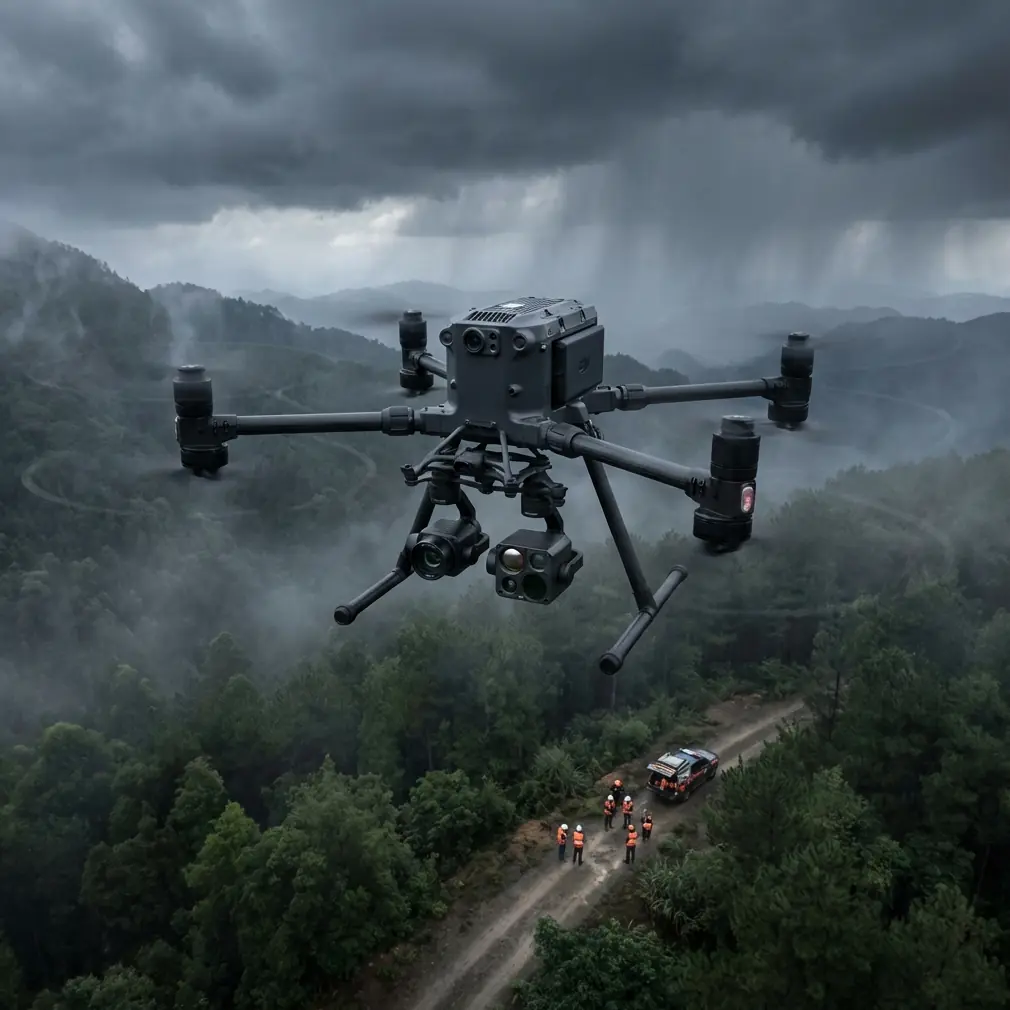
Matrice 400 in Extreme-Temperature Spraying: A Field Report on Structure, Flow, and Signal Discipline
META: Field-tested insights on using the Matrice 400 for spraying work in extreme temperatures, with expert analysis on structural loading, fluid behavior, EMI management, transmission stability, and practical mission planning.
I’ve spent enough time around spraying operations to know that temperature is rarely the only problem. Heat and cold simply expose every weak assumption at once: marginal hose routing, lazy antenna orientation, sloppy battery rotation, unstable links near interference, and payload setups that looked fine on paper but behave differently once pumps, booms, and liquid mass start moving together.
That is the right lens for thinking about the Matrice 400 in extreme-temperature spraying venues. Not as a single aircraft with a headline spec sheet, but as a system that has to manage three things at the same time: structural loading, fluid delivery behavior, and communication reliability. If any one of those drifts out of tolerance, the mission quality drops long before the aircraft itself gives up.
This field report is built around two technical reference threads that matter more than they first appear. One comes from classic aircraft structural vibration data for tubular sections and length-dependent behavior. The other comes from fluid-system loss calculations for expanding pipe sections, with coefficients changing across Reynolds-number ranges and geometry. Neither source mentions the Matrice 400 directly. Both are highly relevant to how a serious operator should think about spraying with it.
Why extreme-temperature spraying is really a systems problem
On a calm test day, almost any platform can look competent. The real separation happens when the venue is hot enough to stress batteries and electronics, or cold enough to change fluid viscosity, nozzle response, and power delivery. Spraying work compounds that pressure because the payload is not static. The tank empties. The center of gravity shifts. The pump system pulses. Tubes, mounts, and booms all experience vibration that changes across the mission.
This is where operators often focus too narrowly on output rate or acreage per hour. Those are useful commercial metrics, but they do not explain why two identical aircraft can produce very different application quality.
With the Matrice 400, the better approach is to treat the airframe and spray package like a coupled machine. That means paying attention to how structural members respond over length, how liquid flow changes through transitions, and how signal integrity survives in electrically noisy environments such as greenhouses, industrial farms, metal-roofed venues, or energy infrastructure corridors.
Structural stiffness is not abstract when the spray system is mounted to the aircraft
One of the reference datasets provides section-size and tube-length relationships for circular tubular members. Even in the rough extracted form, the trend is obvious and operationally useful: as tube length increases, stiffness-related values fall sharply. For example, a 32x28 section is listed around 3150 at a short length condition and drops to roughly 1250 at the longest condition shown. A 25x22 section moves from about 2460 down to 963 across the same progression.
Those numbers matter because spraying payloads add distributed mass and periodic excitation. In simple terms, long unsupported members become more willing to flex and vibrate. On a drone like the Matrice 400, that translates into several practical consequences:
- boom or bracket oscillation can alter nozzle spacing in flight
- resonant behavior can disturb droplet consistency
- camera-based observation of spray pattern becomes less trustworthy if the mounting structure is moving
- repeated vibration can loosen fittings and change the direction of spray output over time
This is especially relevant in extreme temperatures. In cold conditions, some materials become less forgiving and damping characteristics can shift. In high heat, joints, fasteners, and polymers may behave differently under sustained load. You do not need to be running a lab to see the result. You see it in uneven swaths, edge misses, and repeat flights to correct areas that should have been done once.
The lesson for Matrice 400 operators is straightforward: keep unsupported spray-structure lengths conservative, and treat mounting geometry as a flight-quality variable, not just a fabrication convenience. If your custom spraying frame extends farther out for wider coverage, you may gain width but lose precision. The structural reference makes clear that length is not a small variable. It is a dominant one.
Fluid losses become mission losses when temperature changes the liquid
The second reference thread deals with aircraft fuel-system design, specifically loss coefficients in pipe sections with gradual expansion and related flow calculations. Again, this seems distant from spraying until you remember that any liquid delivery system on a drone lives or dies by pressure stability.
The source explicitly ties coefficients to geometry and Reynolds number, including a range of Re = (0.5 ~ 4) × 10^5 in one set of curves and tabulated values that vary with configuration. Some listed coefficients sit around 0.050, 0.083, 0.141, and in another group 0.101, 0.120, 0.176, even up toward 0.395 depending on the case.
Why does that matter in the field? Because extreme temperatures can push the spray liquid into a different flow regime than the one the system was tuned around. Colder fluid can become harder to move cleanly through transitions. Warmer fluid may behave more easily in the line but produce different atomization at the nozzle. If you combine that with poorly designed diameter changes, elbows, or expansion sections near the pump manifold, pressure losses become inconsistent across the boom.
The visible effect is rarely dramatic. It is more annoying than spectacular. One side lays down slightly heavier. Another line responds slower at startup. Turn compensation becomes harder to trust. Edge rows get overdosed while center rows stay acceptable. If you are trying to document application quality for a commercial customer, those small errors become expensive.
For Matrice 400 spraying setups, the operational significance is this: line routing and transition design deserve the same seriousness as flight planning. Sudden changes in tube diameter, unnecessary fittings, or asymmetrical routing can make an aircraft with excellent flight stability produce average application results. The fluid-system reference reminds us that losses are geometry-dependent, not just pump-dependent.
Thermal stress changes how you should stage the mission
The Matrice 400’s value in difficult venues is not only raw lifting and flight intelligence. It is also how cleanly you can build a disciplined operational workflow around it.
In high heat, I prefer shorter, deliberate sortie blocks with battery rotation planned from the start rather than stretching each mission leg for theoretical efficiency. Hot-swap batteries are particularly valuable here because they reduce dead time while keeping the aircraft workflow continuous. But “hot-swap” should not tempt crews into rushing inspections. Extreme-temperature spraying punishes rushed crews. Every swap is also a chance to verify hose security, pump prime consistency, and whether any bracket or nozzle has started walking out of alignment from vibration.
In cold conditions, the issue is different. Fluids, seals, and power systems all ask for a more patient start. The airframe may be ready before the payload delivery behavior is truly stable. The mistake is to judge readiness based only on takeoff status and telemetry health. I want the spray system itself behaving predictably before the mission line begins.
This is where the Matrice 400’s broader sensing ecosystem can help. Thermal signature monitoring is not only for payload imagery jobs. It can also support preflight awareness around equipment temperature balance, identify unusual heat patterns near pumps or power modules, and make troubleshooting faster when the environment is stressing the system unevenly.
Electromagnetic interference is often the hidden reason spraying quality falls apart
The user brief mentioned handling electromagnetic interference with antenna adjustment, and that is exactly the kind of detail real crews care about. EMI does not always announce itself as a total signal loss event. More often it degrades command confidence just enough to make operators slow down, hesitate, or manually overcorrect.
Spraying venues are full of EMI traps: metal structures, buried utilities, nearby relay equipment, greenhouse framing, high-power motors, and reflective surfaces that create ugly multipath behavior. The Matrice 400’s O3 transmission architecture gives crews a strong foundation, but even a strong link can be mishandled.
The practical fix is often embarrassingly simple. Before blaming the aircraft, adjust antenna orientation to match the aircraft’s working geometry, not the pilot’s default stance. If the route includes repeated lateral passes across a reflective corridor, maintain cleaner face-on antenna presentation relative to the aircraft’s active leg instead of leaving the controller position static and suboptimal. In one industrial-agriculture venue I’ve seen link confidence improve materially just from repositioning the pilot station a few meters and changing antenna angle to reduce reflections from sheet-metal surfaces.
That matters operationally because link quality affects spray precision. A pilot who trusts the transmission behaves differently. Line holding improves. Turns get cleaner. Recovery from wind or turbulence is smoother. If you are operating with encrypted workflows and sensitive site data, AES-256 support also matters because industrial customers increasingly expect secure transmission as a baseline, especially where mapping, treatment records, and infrastructure imagery are involved.
Mapping and spraying should not live in separate mental boxes
A lot of teams still separate mapping crews from spraying crews as if those were unrelated tasks. On the Matrice 400, that division leaves performance on the table.
Photogrammetry done before treatment can reveal terrain transitions, canopy density variation, standing water, and access constraints that shape the spray plan. Where accuracy matters, GCP-backed workflows help anchor the dataset and reduce doubt when you are trying to align treatment zones with actual field features or venue boundaries. This is even more useful in extreme conditions, because weather-stressed operations leave less room for improvisation. The more exact the mission geometry is before launch, the less time the aircraft spends making corrections in the air.
That same pre-mission mapping also helps identify EMI-heavy zones. If a roof edge, substation corner, or metallic enclosure repeatedly appears near the route, you can pre-brief antenna strategy and pilot positioning rather than discovering the problem midway through a live application run.
BVLOS conversations should also stay grounded in operational maturity rather than marketing. The Matrice 400 may fit into advanced workflows where BVLOS is relevant, but in spraying operations the real question is whether the crew has the discipline, procedures, and regulatory framework to preserve application quality at that distance. Range without process is just longer exposure to small errors.
What I would standardize on every extreme-temperature Matrice 400 spraying job
If I were writing the SOP for a commercial team, I’d insist on six repeatable checks.
First, inspect every spray-structure support with length in mind. The structural reference values make it clear that a longer member is not just a slightly weaker version of a shorter one. The drop can be severe, as the 32x28 example falling from about 3150 to 1250 shows. Keep extensions tight and bracing purposeful.
Second, review hose transitions and fitting geometry. The fluid-system reference demonstrates that loss coefficients are not fixed. They vary significantly with form and flow regime, and values spanning roughly 0.05 to 0.395 are enough to produce meaningful field differences.
Third, establish a temperature-specific fluid readiness check. Don’t assume the pump behavior you saw yesterday in mild weather will carry into a very cold dawn or a high-heat afternoon.
Fourth, plan battery rotation around consistency, not hero flights. Hot-swap batteries should protect throughput while preserving system checks.
Fifth, pre-brief EMI handling. This includes pilot location, controller orientation, and antenna adjustment matched to the route geometry. That one discipline prevents a surprising number of “mystery” issues.
Sixth, tie mapping and spraying together. If your team needs a second opinion on workflow design, payload integration, or field setup, you can message a Matrice 400 applications specialist here.
The Matrice 400 earns its place when crews operate it like an aircraft system
The most impressive spraying results I’ve seen did not come from crews chasing maximum speed. They came from crews who understood that the airframe, payload frame, liquid system, transmission link, and mission geometry all influence one another.
That is why the old aircraft references behind this discussion are still useful. Structural tables showing stiffness changes with tube length are not academic relics when your spray boom is oscillating in turbulent summer air. Flow-loss coefficients tied to geometry and Reynolds number are not abstract equations when your application uniformity shifts because a cold morning changed how the liquid moves through the system.
For the Matrice 400, those lessons are practical. Shorter and stiffer payload structures help preserve nozzle discipline. Better fluid routing protects pressure consistency. Antenna adjustment in EMI-prone venues protects command confidence. O3 transmission and AES-256 support strengthen site reliability and data handling. Thermal signature awareness, photogrammetry, GCP-backed planning, and careful battery workflow turn a capable platform into a dependable commercial tool.
Extreme-temperature spraying is unforgiving, but it is also revealing. It shows whether a team is merely operating a drone or truly managing an aerial application system.
Ready for your own Matrice 400? Contact our team for expert consultation.