
Matrice 400 in Windy Vineyards: A Field Report on Mapping
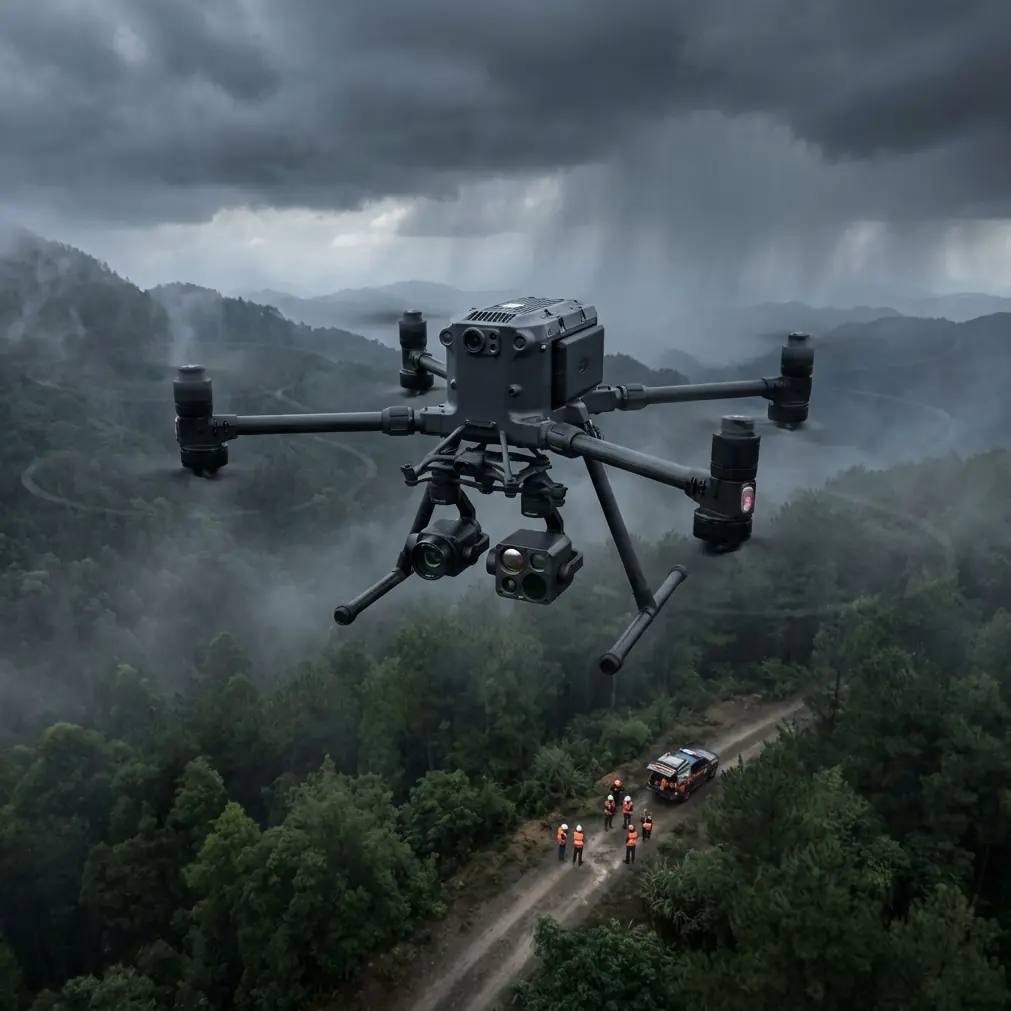
Matrice 400 in Windy Vineyards: A Field Report on Mapping, Thermal Insight, and Safer Low-Altitude Work
META: Field-tested Matrice 400 guidance for windy vineyard operations, covering thermal signature analysis, photogrammetry workflow, O3 transmission reliability, hot-swap batteries, AES-256 security, and BVLOS planning.
By Dr. Lisa Wang, Specialist
Wind changes everything in a vineyard.
Rows that look tidy from the road become turbulent corridors once you put a large drone to work above the canopy. Air curls over trellis lines, slips through gaps, and rebounds off slope breaks. In practical terms, that means your aircraft does not just fight a steady crosswind. It deals with rolling, localized disturbances that can affect spray consistency, image overlap, and pilot confidence in the same flight.
That is why the Matrice 400 deserves a more grounded discussion than the usual spec-sheet summary. For vineyard teams working in wind, the real question is not whether the platform is advanced. It is whether its architecture helps you maintain useful data quality and stable low-altitude performance when conditions are less than ideal.
This field report is built around that question.
Why the Matrice 400 matters in a windy vineyard setting
The Matrice 400 sits in the category of aircraft expected to do serious work, not just fly a clean demo route on a calm morning. In vineyards, that distinction matters because operations often stack multiple objectives into one field day. A team may need to inspect for irrigation stress, identify weak vine blocks, collect photogrammetry for terrain or drainage analysis, and support treatment planning while staying inside narrow timing windows set by weather.
Wind compresses those windows even further.
A platform like the Matrice 400 becomes relevant when it can carry a professional sensing package, hold a stable track over irregular terrain, and preserve command reliability even when vines, slope geometry, and long row alignments create less-than-friendly radio conditions. The inclusion of O3 transmission is especially meaningful here. In open farmland, operators sometimes assume signal behavior will always be simple. Vineyards prove otherwise. Long rows, elevation changes, tree lines, and outbuildings can produce strange dead zones and orientation problems. A more robust transmission link gives the pilot more margin when the aircraft is working farther down a block or making repeated passes across undulating ground.
That margin is operational, not cosmetic. It reduces the temptation to shorten missions, skip edge rows, or fly higher than necessary just to feel comfortable with signal quality.
Windy spray environments demand more than stable hover performance
Even though your scenario centers on spraying vineyards in windy conditions, the operational truth is broader: a spray mission is only as good as the data and planning behind it.
Before a single droplet leaves the tank, the crew needs to know where the stress zones are, which rows are lagging, where water is pooling, and whether any weak sections correlate with drainage, soil compaction, or disease pressure. This is where a Matrice 400-based workflow becomes valuable. It can support thermal signature collection and photogrammetry in a single operational ecosystem, helping the vineyard manager make better treatment decisions rather than simply covering acreage.
Thermal signature analysis is especially useful in vineyards because canopy temperature often exposes problems before they become obvious from the ground. A stressed section of vines may radiate differently than healthy adjacent rows, revealing irrigation irregularities, blocked emitters, or early disease patterns. In wind, however, thermal work gets trickier. Gusts can cool leaf surfaces unevenly and create false-looking variation if you do not plan the mission correctly. The Matrice 400’s stability and mission repeatability help reduce that noise by making it easier to keep altitude, speed, and overlap controlled across a full survey.
That consistency matters when you are comparing one flight against another. Vineyard decisions are often trend-based. One thermal map is interesting. Four thermal maps collected with consistent parameters are useful.
Photogrammetry still matters, even for a spray-focused operator
There is a common mistake in agricultural drone planning: treating photogrammetry as separate from crop treatment. In vineyards, that is too narrow.
Photogrammetry gives you a structural view of the property that directly influences how spraying should be planned. You can use it to build terrain models, identify slope transitions, evaluate runoff pathways, and refine obstacle awareness around poles, wires, access roads, and irregular boundary rows. When wind is part of the equation, those models become even more practical because they help predict where gusts may accelerate or swirl.
Ground control points, or GCPs, still deserve a place in that workflow. In a vineyard spread across broken terrain, GCPs improve positional confidence in your maps and models, especially when the data will be used for repeat measurements or compliance-grade documentation. If a manager is comparing canopy development or drainage change over time, small accuracy gains have real value. Without that discipline, it becomes easier to confuse mapping error with agronomic change.
The Matrice 400 is not interesting here because it magically removes the need for process. It is interesting because it supports a disciplined process without becoming the bottleneck.
The wildlife moment that changed the flight plan
One of the more revealing moments in vineyard operations has nothing to do with software menus or payload specs.
During a late-afternoon thermal pass over a wind-exposed block, the aircraft identified a heat anomaly near the end of a row section that initially looked like a compact equipment signature. The visual feed clarified it: a roe deer had bedded down in the lee side of the canopy where the vines and slight terrain dip cut the wind. Without a good sensor stack and a stable enough platform to inspect the anomaly properly, that patch could easily have been treated as an empty edge zone.
Instead, the team adjusted the route, preserved separation, and flagged the area for the ground crew before any spraying plan was finalized.
That matters for two reasons. First, it shows why thermal signature review should not be treated as a purely agronomic layer. It also supports safer, more environmentally aware operations. Second, it highlights the practical advantage of having a platform that can gather meaningful sensor data in conditions that are not perfectly calm. Wildlife encounters are not rare in vineyards. They are just often missed until the wrong moment.
Hot-swap batteries are not a convenience feature in the field
On paper, battery swapping sounds like a workflow footnote. In a real vineyard operation, hot-swap batteries can be the difference between completing a coherent mission set and having to restart with mismatched light and wind conditions.
This is especially true in wind. Weather windows tend to be narrow, and battery consumption can rise when the aircraft is continuously correcting for gusts. If you are collecting thermal data, interruptions are not just annoying. They can damage comparability between flight segments as sun angle, ambient conditions, and canopy temperature shift. If you are supporting a spray workflow, delays can push the operation into a less favorable wind period.
Hot-swap capability helps maintain tempo. The aircraft stays mission-ready while the crew cycles power efficiently, which is far more useful than rebuilding the whole operation after every battery exchange. It also reduces the rushed behavior that can creep in when teams feel pressure to relaunch quickly. Calm procedures are usually safer procedures.
O3 transmission and AES-256 are more relevant than many growers realize
Vineyard operators tend to focus first on airframe durability and sensor quality. Fair enough. But communication reliability and data security deserve equal attention, especially as larger agricultural businesses centralize drone-derived intelligence.
O3 transmission has practical value because vineyard geography is rarely as simple as it looks on a satellite image. Small ridges, shelterbelts, equipment sheds, and row orientation can all influence command-and-control quality. A stronger link architecture supports safer flight farther down-row and across broken parcels, which is particularly important when planning missions that may eventually sit within a BVLOS framework where regulations and approvals allow.
AES-256 is the less visible piece, but it matters if your drone program handles sensitive agricultural mapping, treatment records, or infrastructure imagery. Vineyards increasingly operate as data businesses as much as farming businesses. Drainage patterns, disease history, block productivity, and operational maps are strategic assets. Encryption is not a luxury feature in that environment. It is part of responsible data stewardship.
For teams building a mature operation, that combination of transmission resilience and protected data flow is a sign that the aircraft belongs in professional use, not just demonstration days.
BVLOS potential changes how large vineyard estates think about coverage
Most vineyard drone work today still happens within conventional visual workflows. Even so, BVLOS should be part of the planning conversation because large estates and fragmented properties create an efficiency problem that line-of-sight operations cannot always solve elegantly.
The Matrice 400 becomes more interesting when you view it as a platform that can grow with that operational future. In a vineyard context, BVLOS is not about flying farther for the sake of it. It is about reducing repositioning downtime, maintaining smoother block-to-block continuity, and allowing one trained team to supervise larger survey areas with appropriate approvals and safety controls.
That future depends on many factors beyond the aircraft, including regulation, detect-and-avoid strategy, site procedures, and risk assessment. Still, platform choice matters. If your aircraft cannot support the communications reliability, mission repeatability, and professional operational framework needed for scalable work, your drone program will plateau early.
A practical workflow for windy vineyard teams
For crews considering how to use the Matrice 400 in this setting, the best results usually come from sequencing the day intelligently.
Start with an early mapping or inspection pass before thermal contrast becomes distorted by full daytime heating and before winds strengthen. Use photogrammetry to confirm terrain and obstacle context, especially if there have been changes to row ends, temporary equipment staging, or erosion channels. If the goal is plant stress evaluation, follow with a thermal mission under repeatable parameters and compare against prior datasets instead of relying on a single isolated map.
Then use that intelligence to refine treatment areas and decide whether conditions support spraying at all. That last point matters. A capable aircraft does not eliminate the agronomic penalties of spraying in the wrong wind. It simply gives you better information and better control when the window is acceptable.
If your team is building that workflow and wants to compare sensor strategies or mission planning logic, this is the kind of discussion that is easiest to have directly in the field context: message our UAV specialists.
What separates a useful platform from an impressive one
The reason professionals keep coming back to aircraft like the Matrice 400 is not that they are flashy. It is that they reduce operational friction in places where friction is expensive.
In vineyards, those friction points are easy to recognize:
- unstable air at low altitude
- the need for repeatable thermal and visual data
- pressure to finish missions inside short weather windows
- difficult radio conditions across long, uneven parcels
- the need to protect sensitive operational data
- the growing importance of scalable workflows that may lead toward BVLOS
A smaller or less integrated setup can still perform parts of the job. But once the operation becomes multi-layered, with mapping, thermal review, treatment planning, and repeated site visits, the value of a more capable system becomes obvious.
That is the right lens for evaluating the Matrice 400 in a windy vineyard. Not as an abstract flagship. As a working aircraft that helps professionals preserve data quality, operational discipline, and situational awareness when field conditions are trying to chip away at all three.
And in agriculture, that is the test that matters.
Ready for your own Matrice 400? Contact our team for expert consultation.