
Matrice 400 for Coastal Vineyard Work: The Battery
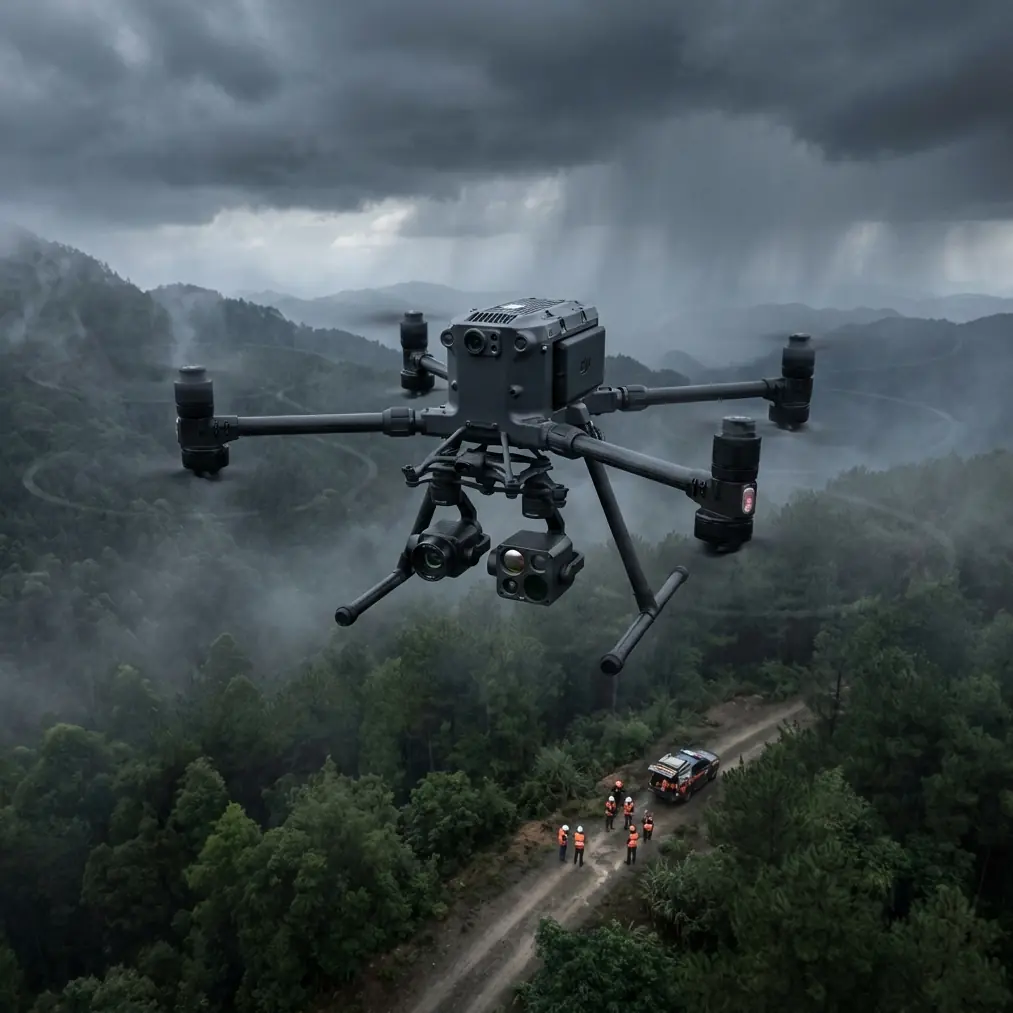
Matrice 400 for Coastal Vineyard Work: The Battery Discipline That Decides Your Day
META: A field-focused tutorial on using Matrice 400 in coastal vineyard operations, with practical battery safety lessons drawn from DJI battery guidance and the evolution of multirotor flight systems.
By Dr. Lisa Wang, Specialist
Coastal vineyards expose a drone operation to two things that rarely forgive laziness: moisture and repetition.
Moisture comes from sea air, fog, spray drift, damp ground cover, and the kind of light rain that crews are tempted to ignore because the mission is “almost done.” Repetition comes from flying row after row with a predictable pattern, which is exactly when shortcuts creep in. For a Matrice 400 operator working around crop treatment, mapping, or thermal assessment in vineyards near the coast, battery management is not housekeeping. It is operational control.
That point becomes clearer when you look backward for a moment. Multirotor aviation did not become practical just because airframes improved. The revival period around 2010–2013 combined simpler user interaction with better stabilization. One widely cited step in that era was the arrival of consumer systems that used optical-flow speed estimation for indoor hovering, paired with one-key takeoff and control through phones, tablets, or laptops. Around the same time, V. Kumar’s 2012 TED presentation became a milestone because it showed the public what quadrotors could do when control theory, sensing, and vehicle agility actually worked together.
Why does that matter to a Matrice 400 flying over vines today? Because modern operators inherit a dangerous illusion from that progress: if the aircraft feels stable and automated, the weak points must also be automated away. They are not. Sophisticated flight control reduces pilot workload. It does not repeal battery chemistry.
The coastal vineyard problem nobody should treat as minor
A vineyard beside the sea creates a messy combination of salt-laden air, changing winds, and frequent surface moisture. Even if your Matrice 400 is assigned to civilian tasks such as thermal signature collection, photogrammetry, treatment verification, stand-count analysis, or route rehearsal for future BVLOS workflows, the battery remains the component most likely to turn a manageable mission into an expensive interruption.
DJI’s battery guidance for the Matrice series makes the water hazard plain. If a battery comes into contact with liquid, or if it falls into water during flight or handling, it should be removed immediately, moved to a safe open area, and left alone until fully dry. After that, it is not to be reused. That is not an overreaction. It is a recognition that water intrusion can trigger internal decomposition and, in the worst case, self-ignition or explosion.
In a coastal vineyard, that instruction has real field significance. Spray tanks, rinse stations, wet tailgates, mud, condensation inside transport cases, and early-morning dew all create routes for moisture exposure long before a battery ever “falls into water.” Operators often think only of rain. The manual’s logic is broader than rain. Any liquid contact can destabilize the battery internally.
The second detail from DJI’s guidance that deserves more attention is the temperature band: use the battery between -10°C and 40°C, with explicit warning that temperatures above 50°C can lead to fire or explosion, while temperatures below -10°C can severely damage battery life. In a vineyard by the coast, many teams focus on cooling because summer fieldwork is obvious. But black battery casings sitting in direct sun on the back of a utility vehicle can heat far faster than ambient air suggests. A 31°C afternoon can still produce battery surface temperatures that push into a bad zone when cases are closed, airflow is poor, and turnaround is rushed.
This is where battery discipline stops being theory.
My field rule: never let “just one more row” decide the swap
When I train crews for agricultural and inspection workflows, I tell them to make the battery swap decision before the final row, not during it.
That sounds trivial until you watch how coastal vineyard missions unfold. A crew completes several clean passes. Wind shifts slightly off the water. One block remains. The aircraft is still flying normally. The operator knows the route. Everyone wants to finish. So they stretch the pack.
That is exactly the wrong moment to trust habit over procedure.
On paper, the Matrice 400 ecosystem may support advanced features operators care about—long-range O3 transmission stability, encrypted links such as AES-256 for sensitive estate data, hot-swap batteries for faster rotations, and payload flexibility for thermal or photogrammetric collection. In practice, those strengths only help if the crew treats energy management as part of mission planning, not as an afterthought handled by the person nearest the case.
My preferred battery tip from real field work is simple: create a “coastal reset” at every landing. The battery comes out, the compartment is visually checked, connectors are checked for moisture or contamination, and the pack is physically staged in a dry zone away from rinsing tools, mixing stations, or open vehicle beds. No battery goes directly from aircraft to charger just because the team is in a hurry. It first passes a dryness and impact check.
That rule exists for good reason. DJI’s battery guidance explicitly says a battery that has suffered a fall from the aircraft or an external impact should not be used again. Vineyard operations create many chances for “minor” impacts that people rationalize away: a battery sliding inside a truck drawer, a bumped corner on a stone wall, a hurried handoff near a trailer, or a pack dropped a short distance onto compacted soil. Batteries do not care whether the crew considers the drop dramatic.
Why this matters even more with spraying-adjacent operations
The prompt here is coastal spraying, but the lesson applies across the whole mission stack. Even if your Matrice 400 is not dispersing material itself and is instead handling support roles—pre-treatment mapping, canopy vigor analysis, thermal signature review, or post-application verification—you are operating in an environment where airborne droplets and wet handling are normal.
That changes how you stage equipment.
I recommend separating the flight table from the chemical workflow by default, even if the drone mission is only supporting the spray team. Charging stations, battery logs, and installed payloads should live upwind and upslope from washdown areas whenever possible. Salt mist and fine droplets travel farther than crews think. Batteries should be stored in a dry transport arrangement, then acclimated before use rather than left open to ambient dampness.
If your crew is also building photogrammetry products from vineyard blocks, battery consistency matters for another reason: data continuity. Image quality, overlap discipline, and timing become harder to manage when a crew is squeezing the last usable minutes from a questionable pack. GCP placement, mission segmentation, and light-window planning all benefit when battery swaps are predictable. The airframe may be smart, but photogrammetry still rewards boring consistency.
The historical lesson hidden inside modern convenience
The early multirotor breakthrough years taught the industry that ease of use expands adoption. Optical-flow hovering, one-key takeoff, and unified consumer systems made drones accessible in ways that older platforms never were. Open API thinking also widened what users expected from flight platforms. That legacy continues in enterprise aircraft today: more automation, more sensing, better control links, cleaner interfaces.
But accessibility has a side effect. It can make crews underestimate the old-fashioned physical constraints that still govern safe operation.
The 2012 academic spotlight on quadrotors, including the IEEE special issue on aerial robotics and the attention drawn by Kumar’s public demonstration, emphasized modeling, estimation, and control. Those areas are why today’s aircraft can hold stable flight in conditions that would once have ended a mission immediately. Yet none of that control sophistication removes the need to respect corrosion, liquid intrusion, connector damage, or thermal abuse.
That is why a Matrice 400 tutorial for coastal vineyard readers should not begin with payload glamour. It should begin with what most teams handle dozens of times per day: the battery.
A practical pre-flight and post-flight battery workflow for coastal vineyards
Here is the sequence I teach when operations involve sea air, vine moisture, and tight turnaround times.
1. Start with a dry-chain mindset
The battery should move from storage to aircraft through a dry handling path only. No wet gloves. No damp vehicle bed. No “clean enough” towel that was just used elsewhere. If a pack touches moisture, it is not a nuisance; it is a decision point.
2. Confirm temperature before installation
DJI’s battery guidance sets the usable range at -10°C to 40°C. That means checking actual pack condition, not just the weather app. In coastal sun, enclosed cases heat quickly. In cold morning starts, don’t assume the battery is ready because the aircraft powers on.
3. Install or remove only with power off
The manual specifically warns against inserting or removing the battery while powered on because that can damage the power interface. In a fast vineyard workflow, this is one of the easiest rules to break. Make it non-negotiable.
4. Treat swelling, leakage, or damaged packaging as a stop sign
The DJI guidance is unambiguous: do not use bulging, leaking, or visibly damaged batteries. Coastal operations accelerate wear because packs are moved often, staged in field vehicles, and exposed to harsh ambient conditions. Quick visual inspection saves time later.
5. Quarantine any dropped battery
A battery that falls from the aircraft or suffers external impact should not go back into rotation. Not after one test hover. Not after “it still looks fine.” Out of service means out of service.
6. If there is water exposure, retire it from use
This is the rule crews most want to soften. Don’t. If the battery enters water or gets significantly wetted, remove it, place it in a safe open area, keep clear until fully dry, and do not reuse it. Build your field plan around having enough battery margin so this decision is easy.
7. Build swap timing into the mission design
Hot-swap capability is valuable only if the crew uses it proactively. Segment vineyard blocks so that swaps happen at clean mission boundaries rather than whenever the operator starts to feel nervous.
Data, security, and why disciplined power handling supports both
Some operators think of battery checks as separate from digital workflow. In reality, they are linked. When a Matrice 400 team is collecting thermal signature data, disease-stress indicators, or photogrammetric imagery anchored with GCPs, an unplanned power event can break dataset consistency, interrupt coverage geometry, and complicate traceability. If the estate also requires protected transmission and storage practices, features such as AES-256 and stable O3 transmission matter. But secure, high-quality data begins with uninterrupted, predictable flight segments.
That is one reason I urge vineyard teams to think of batteries as part of information quality control. A rushed launch with a questionable pack is not just a hardware risk. It can undermine the validity of the entire sortie.
The human factor still decides the mission
Multirotors came a long way from the revival period of 2010 to 2013, when consumer accessibility, open interfaces, and public demonstrations of agile flight reshaped the category. Today’s Matrice-class operators benefit from that legacy every time a complex route feels routine.
Routine is useful. It is also dangerous.
If you are flying vineyard blocks near the coast, the smartest habit you can adopt is not a flashy setting or a clever automation trick. It is a hard-edged battery routine that assumes moisture is present even when you cannot see it, assumes impacts matter even when they look minor, and assumes mission success depends on ending a flight one row early rather than one mistake late.
If your team is setting up a coastal workflow and wants to compare battery handling checklists, payload planning, or photogrammetry procedures, you can message me here.
Ready for your own Matrice 400? Contact our team for expert consultation.