
Matrice 400 in Dusty Field Survey Work: What Actually
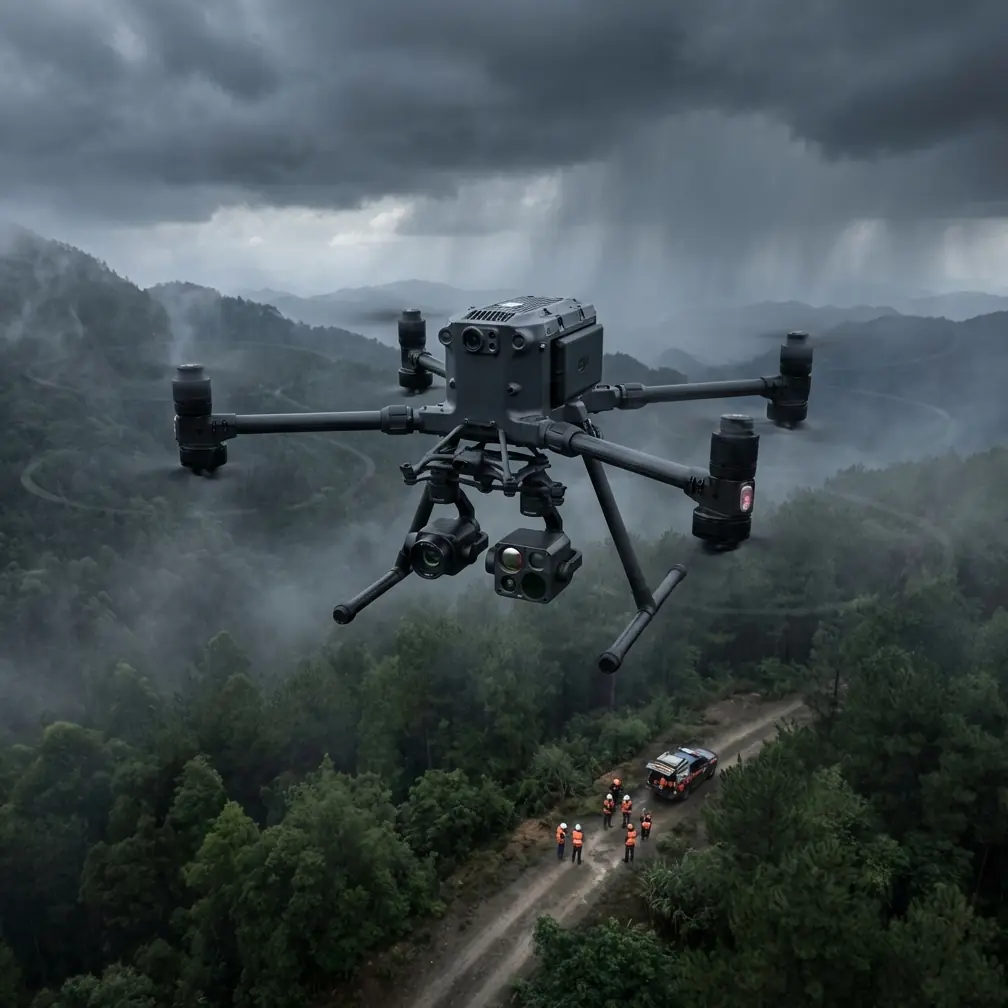
Matrice 400 in Dusty Field Survey Work: What Actually Matters Before You Launch
META: Expert guide to using the Matrice 400 for dusty field surveying, with practical insights on pre-flight cleaning, photogrammetry accuracy, thermal workflows, transmission reliability, and battery strategy.
Dust changes the way a survey mission unfolds long before the aircraft leaves the ground. Anyone mapping dry farmland, irrigation corridors, or construction-grade agricultural plots knows the pattern: a few vehicle passes on a service road, wind pushing loose soil across the launch zone, and fine particles settling everywhere they can. The result is not just a dirtier aircraft. It is a higher-risk workflow.
That is where the Matrice 400 becomes interesting.
Not because it magically removes environmental problems, but because it gives operators enough capability and redundancy to keep survey quality high when the site is less than ideal. In dusty field conditions, the real question is not whether the platform can fly. Most professional aircraft can. The real question is whether the aircraft can preserve data integrity, maintain safe sensing performance, and keep the mission moving without introducing avoidable risk. On that front, the Matrice 400 is worth discussing in practical terms.
For operators surveying fields in dry, dusty conditions, the biggest mistake is treating pre-flight cleaning as a cosmetic task. It is not. On a platform with advanced obstacle sensing, long-range transmission, encrypted communications, payload flexibility, and hot-swap battery capability, cleaning is part of mission assurance. Ignore that, and the aircraft may still take off, but the survey output can quietly degrade.
The pre-flight step I insist on in dusty environments is simple: clean every vision, sensing, and payload interface surface before powering the aircraft for mission confirmation. That means sensor windows, camera glass, thermal optics, gimbal contact areas, landing gear cavities, battery seating surfaces, and the airframe zones where dust can migrate toward connectors. This takes a few minutes. It can save an entire day of fieldwork.
Why is that such a big deal on the Matrice 400? Because this class of aircraft is built for serious work. If you are using it for photogrammetry, your overlap strategy, shutter timing, and GCP layout can be excellent, yet your final model still suffers if the optical path is compromised by a thin film of dust. The problem is subtle. It does not always look like obvious blur. Sometimes it shows up as reduced image contrast, inconsistent edge definition, or troublesome tie-point generation when processing. In broad-acre survey jobs, where repeatability matters more than a single pretty frame, that kind of degradation is expensive.
The same logic applies to thermal signature capture. A dusty lens or contaminated protective window can flatten useful thermal detail, especially in early morning surveys where temperature differentials are narrow and operators are trying to pick up irrigation anomalies, stressed vegetation bands, or equipment heat patterns. Thermal data already demands discipline in timing and interpretation. Adding a dirty optical surface to the equation turns a precise tool into a noisy one.
Dust also affects the safety stack, and this is the part many field teams underestimate. The Matrice 400 belongs in the category of aircraft expected to support advanced operational profiles, including longer corridor work and missions that may be planned with BVLOS frameworks in mind where regulations and approvals allow. That places more weight on dependable sensing and situational awareness. A contaminated sensor face can reduce confidence in obstacle detection behavior, especially around wires, tree lines, poles, and uneven terrain transitions at field edges. Even when the aircraft remains fully controllable, degraded sensing margin is not something a professional crew should accept as normal.
Transmission reliability matters too. The Matrice 400 conversation naturally brings up O3 transmission because stable link performance is central to modern inspection and survey operations. In open farmland, people often assume radio conditions are easy. Sometimes they are. Sometimes they are not. Large metal irrigation systems, undulating terrain, tree belts, utility structures, and long stand-off distances can all complicate the link environment. When an aircraft is already operating in a dusty zone, the professional response is to reduce every other avoidable variable. Clean aircraft, checked antennas, verified firmware state, and a confirmed home point create a stronger baseline before the mission begins. O3 gives operators robust transmission capability, but robust does not mean careless.
Then there is data security. Agricultural surveys increasingly overlap with land management records, infrastructure planning, water-use decisions, and proprietary farm operations. If your workflow includes networked devices, cloud transfer points, or enterprise reporting pipelines, secure transmission standards matter. The Matrice 400 discussion often includes AES-256 because encryption is no longer a niche concern reserved for defense or utility operators. It has practical significance in commercial fieldwork. If you are collecting imagery that informs land valuation, crop strategy, or infrastructure condition, protecting that data is part of professional practice, not an optional technical flourish.
Still, the most immediate operational advantage in dusty field surveying may be battery strategy. Hot-swap batteries sound like a convenience feature until you are halfway through a large mapping block with stable light, predictable wind, and ground crew already positioned around control points. Then they become a continuity tool. In dry environments, every extra landing and restart cycle creates another opportunity for dust intrusion during handling. A hot-swap workflow reduces unnecessary downtime and helps crews maintain mission rhythm. It also lowers the temptation to rush battery changes, which is often when contamination on terminals, latches, or seating surfaces gets overlooked.
That said, hot-swap only pays off if the team treats battery handling like a controlled procedure. In a dusty field, never place packs directly on a vehicle bed coated in fine soil or on bare ground near the launch point. Use a clean case, inspect contacts, check the seating channel, and wipe around the mounting area before insertion. On a platform built for demanding operations, poor battery discipline is a self-inflicted problem.
Photogrammetry brings its own set of field-specific considerations. The Matrice 400 is the kind of aircraft operators choose when they want dependable performance with professional payload flexibility. But dusty conditions punish sloppy mission planning. If you are mapping crop parcels or topographic variation, establish GCPs where they will remain visible and uncontaminated during the mission window. Dust can reduce marker clarity, especially on low-contrast surfaces. That affects checkpoint confidence and can create avoidable uncertainty in the final deliverable. A strong airframe does not replace good survey control.
I also recommend adjusting launch and recovery habits instead of relying on raw aircraft capability. Do not spool up directly beside the dust plume created by your own pickup truck. Move the launch point. Lay down a pad if conditions justify it. Face the aircraft so that prop wash does not immediately recycle loose material into the payload area. After landing, do not rush straight into battery removal and payload swaps while particles are still moving across the platform. Let the scene settle. Then clean, inspect, and continue.
This is where experienced crews separate themselves from casual users. They understand that field success is usually decided by the small decisions around the aircraft, not just the aircraft itself.
A good dusty-environment workflow for the Matrice 400 looks something like this: arrive early enough to evaluate the launch surface, establish a cleaner staging zone, inspect optics before power-on, verify battery interfaces, confirm RTK or survey-control strategy, review wind direction for takeoff dust management, and only then begin mission checks. After each sortie, repeat a shorter version of that cycle. Not because the aircraft is fragile, but because precision work demands process.
If your team is building or refining that process, it helps to compare notes with operators who work these sites regularly. One practical way to do that is to message an experienced UAV specialist and pressure-test your field procedure before your next survey block.
Another point worth stressing is that the Matrice 400’s strengths are cumulative. O3 transmission supports command confidence over larger areas. AES-256 supports secure handling of sensitive operational data. Hot-swap batteries support continuity on long survey days. Thermal signature capture expands the aircraft beyond visible-light mapping into diagnostic work. But those features only deliver their full value when the operator preserves clean inputs. Dust is the classic input contaminant. It interferes quietly, and professionals ignore quiet failures at their own peril.
This matters even more for mixed missions. Many field teams are no longer collecting just one data type. A single visit may include photogrammetry for volume or contour work, thermal review of irrigation infrastructure, and visual inspection of access routes or drainage lines. On the Matrice 400, that kind of multi-role use is part of the appeal. Yet multi-role use means contamination has more chances to affect output in different ways. The same dust that slightly softens RGB imagery may also reduce the reliability of thermal interpretation or compromise confidence in automated safety behavior. A five-minute cleaning step protects all of it.
There is also a human-factor benefit. Crews that begin with a disciplined cleaning and inspection routine tend to fly better missions. The act itself forces everyone to slow down and actually look at the aircraft. That is often when somebody notices a partially fouled lens, a dusty battery bay, a nicked prop, or residue around a payload mount. None of those findings are dramatic. All of them matter.
For surveying fields in dusty conditions, then, the Matrice 400 is not just a powerful aircraft. It is a platform that rewards professional habits. Its capabilities make it suitable for demanding agricultural and land-survey workflows, especially where operators need secure communications, resilient transmission, flexible sensing, and efficient battery turnover. But the hidden lever is discipline at the launch point.
If you want cleaner orthomosaics, more trustworthy thermal results, better sensing confidence, and fewer interruptions over the course of a long survey day, start with the least glamorous step in the operation: clean the aircraft properly before every flight.
That is not housekeeping. It is mission planning.
Ready for your own Matrice 400? Contact our team for expert consultation.