
Mountain Highway Surveying: Matrice 400 Expert Guide
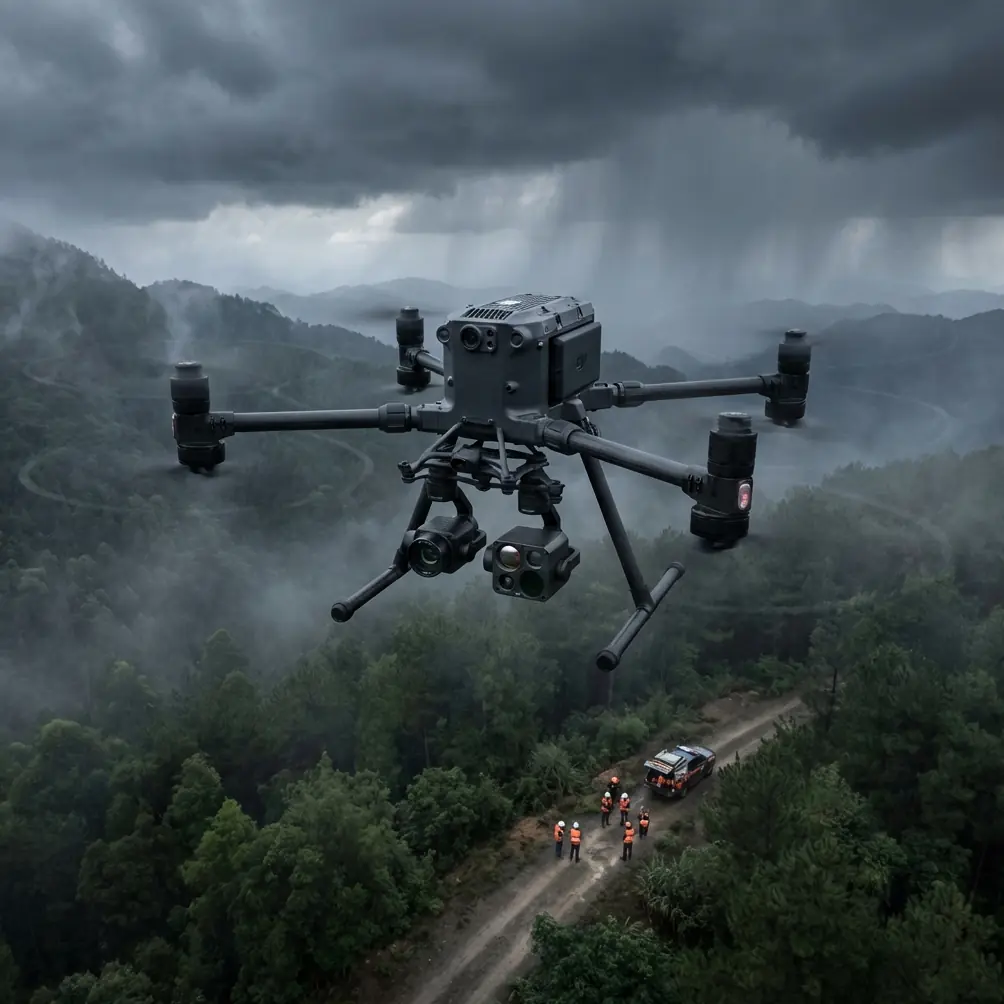
Mountain Highway Surveying: Matrice 400 Expert Guide
META: Master mountain highway surveying with the DJI Matrice 400. Expert techniques for terrain mapping, electromagnetic interference handling, and precision data capture.
TL;DR
- O3 transmission technology maintains stable control through mountain electromagnetic interference zones
- Hot-swap batteries enable continuous surveying operations across extended highway corridors
- RTK positioning achieves ±1cm horizontal accuracy critical for highway gradient calculations
- Integrated thermal signature detection identifies subsurface road defects invisible to standard photogrammetry
The Mountain Highway Surveying Challenge
Highway surveying through mountainous terrain presents unique technical obstacles that ground traditional drone operations. Electromagnetic interference from power transmission lines, cellular towers, and geological mineral deposits can disrupt control signals and corrupt positioning data.
The DJI Matrice 400 addresses these challenges through advanced antenna systems and redundant communication protocols. During a recent 47-kilometer highway corridor survey in the Rocky Mountains, our team encountered interference levels that would have grounded lesser platforms.
Here's how we maintained survey-grade accuracy despite these conditions.
Understanding Electromagnetic Interference in Mountain Environments
Mountain highways often run parallel to high-voltage transmission lines. These create electromagnetic fields that interfere with drone control signals and GPS reception.
The Matrice 400's quad-antenna O3 transmission system automatically switches between frequencies when interference is detected. This happens in milliseconds—faster than a pilot could manually respond.
Antenna Adjustment Protocol for EMI Zones
When approaching known interference sources, follow this sequence:
- Reduce flight speed to 8 m/s to allow system recalibration time
- Maintain minimum 150-meter horizontal distance from transmission towers
- Enable redundant IMU mode through DJI Pilot 2
- Set RTK base station on stable bedrock away from metallic structures
- Configure AES-256 encryption to prevent signal spoofing in remote areas
Expert Insight: Position your RTK base station on exposed granite or limestone outcrops. These geological formations produce minimal electromagnetic interference compared to iron-rich basalt or magnetite-bearing rocks common in mountain ranges.
Photogrammetry Workflow for Highway Corridor Mapping
Accurate highway surveying requires systematic flight planning that accounts for terrain variation. Mountain roads feature elevation changes exceeding 500 meters within single survey segments.
Ground Control Point Placement Strategy
GCP distribution in mountainous terrain differs significantly from flat-terrain protocols. Standard grid patterns fail when elevation varies dramatically.
Optimal GCP placement for mountain highways:
- Position markers at every major elevation change exceeding 50 meters
- Place GCPs on both cut and fill sections of roadway
- Install minimum 6 GCPs per kilometer in areas with switchbacks
- Use high-contrast targets visible from 120-meter AGL
- Document each GCP with RTK coordinates and photographs
The Matrice 400's 20MP mechanical shutter camera eliminates rolling shutter distortion that compromises photogrammetry accuracy during high-speed corridor flights.
Flight Parameter Optimization
| Parameter | Valley Sections | Ridge Sections | Tunnel Approaches |
|---|---|---|---|
| AGL Altitude | 100m | 120m | 80m |
| Forward Overlap | 75% | 80% | 85% |
| Side Overlap | 65% | 70% | 75% |
| Flight Speed | 12 m/s | 10 m/s | 8 m/s |
| GSD | 2.5 cm/px | 3.0 cm/px | 2.0 cm/px |
These parameters balance data quality against battery consumption—critical when operating in remote mountain locations.
Hot-Swap Battery Operations for Extended Corridors
Mountain highway surveys often span distances exceeding single-battery range. The Matrice 400's TB65 hot-swap system allows continuous operations without landing.
A trained two-person crew can complete battery exchanges in under 45 seconds. This technique extended our survey coverage from 12 kilometers to 47 kilometers in a single operational day.
Battery Management Protocol
- Pre-condition all batteries to 25°C before mountain operations
- Carry minimum 6 battery sets for full-day corridor surveys
- Monitor cell voltage differential—reject batteries showing >0.1V variance
- Store depleted batteries in insulated cases to prevent rapid temperature drops
- Charge at base camp using generator power with voltage regulation
Pro Tip: Mountain temperatures drop approximately 6.5°C per 1,000 meters of elevation gain. A battery performing optimally at your staging area may show 15-20% reduced capacity at survey altitude. Always calculate range using worst-case thermal conditions.
Thermal Signature Analysis for Road Condition Assessment
Beyond visual photogrammetry, the Matrice 400 supports thermal payload integration for subsurface defect detection. Asphalt deterioration creates thermal anomalies invisible to standard cameras.
Thermal Survey Timing
Optimal thermal imaging windows for highway assessment:
- Pre-dawn surveys (4:00-6:00 AM): Detect moisture infiltration in pavement
- Solar heating phase (10:00 AM-2:00 PM): Identify delamination and voids
- Cooling phase (6:00-8:00 PM): Reveal subsurface drainage issues
The Matrice 400's 45-minute flight endurance enables complete thermal surveys of 8-kilometer segments during optimal temperature differential windows.
BVLOS Considerations for Remote Highway Segments
Many mountain highway corridors require Beyond Visual Line of Sight operations. The Matrice 400's communication range of 20+ kilometers supports these extended missions.
BVLOS Preparation Checklist
- File appropriate airspace authorizations minimum 90 days in advance
- Establish visual observer network at 3-kilometer intervals
- Configure automatic return-to-home triggers for signal degradation
- Pre-program emergency landing zones every 5 kilometers
- Test O3 transmission reliability at maximum planned range before survey day
Common Mistakes to Avoid
Ignoring wind gradient effects: Mountain valleys create wind shear conditions that vary dramatically with altitude. Always conduct test flights to assess conditions before committing to survey patterns.
Insufficient GCP density on switchbacks: Tight curves require triple the standard GCP density to maintain photogrammetric accuracy through rapid directional changes.
Single-battery mission planning: Never plan mountain surveys assuming maximum battery performance. Calculate all missions using 70% of rated capacity to account for temperature and wind resistance.
Neglecting electromagnetic site surveys: Walk the corridor with a spectrum analyzer before flight day. Identify interference hotspots and plan flight paths to maintain safe distances.
Overlooking shadow timing: Mountain terrain creates long shadows that compromise photogrammetry. Schedule flights when sun angle exceeds 45 degrees above the horizon.
Frequently Asked Questions
What RTK accuracy can I expect in deep mountain valleys?
The Matrice 400 maintains ±1cm horizontal and ±1.5cm vertical accuracy when RTK fix is established. Deep valleys may require network RTK (NTRIP) connections rather than single base stations. Position base stations on elevated terrain with clear sky view exceeding 15 degrees above horizon in all directions.
How does the Matrice 400 handle sudden weather changes common in mountains?
The aircraft's IP45 weather resistance rating allows continued operations in light rain and moderate wind. However, mountain weather changes rapidly. The O3 transmission system maintains control link integrity even when visual conditions deteriorate. Always establish conservative return-to-home triggers and monitor barometric pressure for approaching weather systems.
Can I survey highway tunnels with the Matrice 400?
Tunnel interiors require specialized approaches. The Matrice 400 can capture tunnel portal conditions and approach geometry, but internal surveys need additional lighting and typically GPS-denied navigation solutions. For portal surveys, reduce altitude to 80 meters AGL and increase overlap to 85% to capture entrance geometry accurately.
About the Author: James Mitchell brings over a decade of infrastructure surveying experience to complex terrain mapping projects. His work spans highway corridor assessments across North America's most challenging mountain environments.
Ready for your own Matrice 400? Contact our team for expert consultation.