
M400 for Remote Venue Surveys: Expert How-To Guide
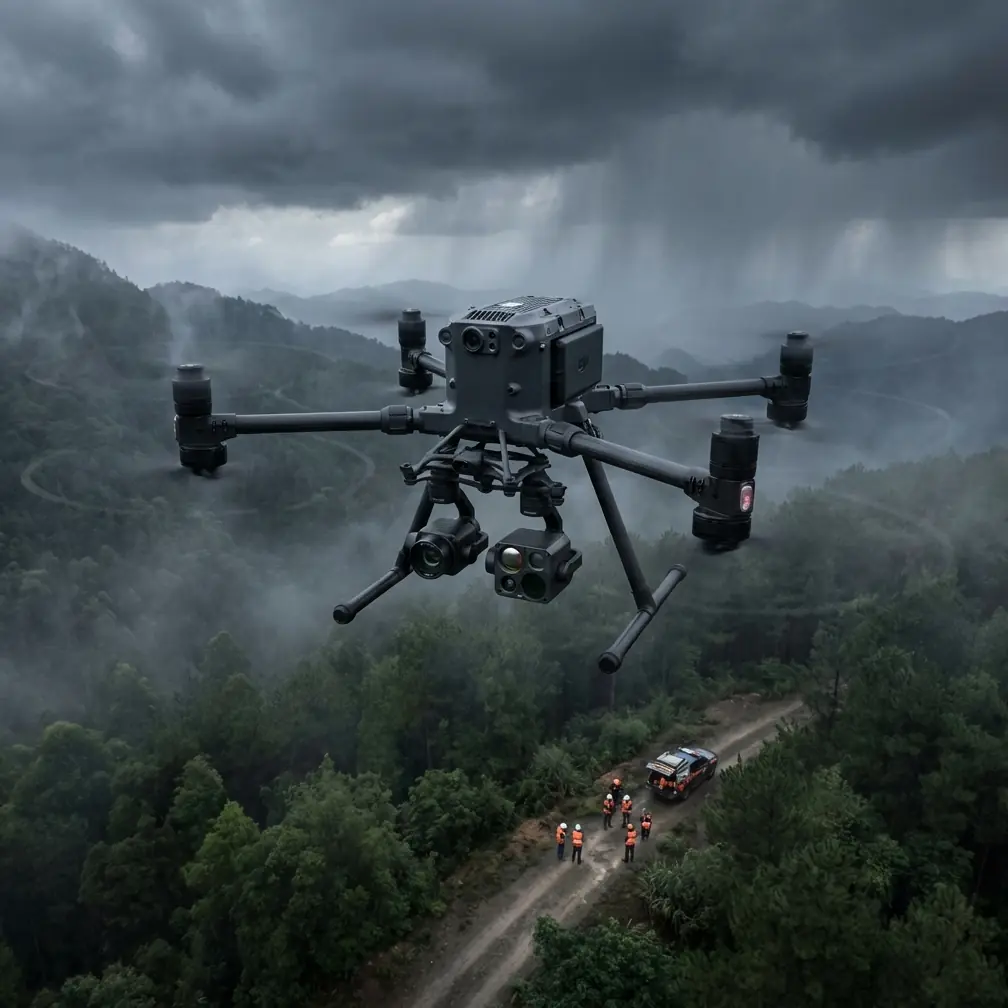
M400 for Remote Venue Surveys: Expert How-To Guide
META: Master remote venue surveying with the Matrice 400. Dr. Lisa Wang reveals optimal flight altitudes, thermal techniques, and BVLOS strategies for professionals.
TL;DR
- Optimal flight altitude of 80-120 meters delivers the best balance between coverage area and ground sampling distance for venue surveys
- O3 transmission system maintains reliable control up to 20km, essential for remote site operations
- Hot-swap batteries enable continuous surveying sessions exceeding 4 hours without returning to base
- AES-256 encryption protects sensitive venue data during transmission and storage
Why Remote Venue Surveying Demands Specialized Equipment
Remote venue surveying presents unique challenges that standard consumer drones simply cannot address. The Matrice 400 solves three critical problems: maintaining signal integrity across vast distances, capturing survey-grade data in variable conditions, and operating efficiently when support infrastructure doesn't exist.
This guide walks you through the complete workflow for surveying venues in remote locations—from pre-flight planning through deliverable generation. You'll learn the exact altitude settings, sensor configurations, and flight patterns that produce professional results.
Understanding Remote Venue Survey Requirements
Venues in remote areas—whether concert grounds, sports facilities, or event spaces—require comprehensive spatial documentation. Traditional ground surveys can take weeks. Drone-based photogrammetry reduces this to hours.
The M400's sensor payload capacity of 2.7kg accommodates multiple simultaneous capture systems:
- RGB cameras for visual documentation and orthomosaic generation
- Thermal imaging for identifying subsurface features and drainage patterns
- LiDAR integration for precise elevation modeling under vegetation
Expert Insight: When surveying remote venues, I always deploy thermal signature analysis during early morning hours (5:30-7:00 AM). Temperature differentials reveal underground utilities, buried structures, and soil composition variations invisible to standard RGB capture. This single technique has saved clients thousands in unexpected excavation costs.
Pre-Flight Planning for Remote Operations
Site Assessment Protocol
Before deploying to any remote venue, complete these essential preparations:
Airspace verification:
- Check for temporary flight restrictions (TFRs)
- Identify controlled airspace boundaries
- Document any BVLOS waiver requirements
Communication planning:
- Map cellular coverage zones
- Establish backup communication protocols
- Configure O3 transmission frequencies for minimal interference
Power logistics:
- Calculate total flight time requirements
- Pack sufficient hot-swap batteries (minimum 6 units for full-day operations)
- Identify emergency charging locations if available
Ground Control Point Strategy
Accurate photogrammetry depends on proper GCP placement. For remote venues, I recommend a modified distribution pattern:
| Venue Size | Minimum GCPs | Placement Pattern | Expected Accuracy |
|---|---|---|---|
| Under 5 hectares | 5 | Corner + center | 2-3cm horizontal |
| 5-20 hectares | 8-10 | Perimeter grid | 3-5cm horizontal |
| Over 20 hectares | 12+ | Distributed matrix | 5-8cm horizontal |
Place GCPs on stable, flat surfaces visible from survey altitude. Avoid areas with heavy vegetation or temporary structures.
Optimal Flight Parameters for Venue Surveys
Altitude Selection
Flight altitude directly impacts three critical factors: ground sampling distance (GSD), coverage efficiency, and image overlap quality.
For venue surveying, maintain 80-120 meters AGL. This range produces:
- GSD of 1.5-2.5cm per pixel with standard payloads
- Single-flight coverage of 15-25 hectares
- Sufficient overlap for reliable photogrammetric processing
Pro Tip: Increase altitude to 100-120 meters when surveying venues with significant elevation changes. The additional height prevents collision risks while maintaining consistent GSD across terrain variations. Drop to 80 meters only for flat venues requiring maximum detail.
Flight Pattern Configuration
The M400's intelligent flight planning supports multiple survey patterns. Select based on venue geometry:
Grid pattern works best for:
- Rectangular venues
- Open areas without obstructions
- Maximum efficiency requirements
Crosshatch pattern delivers superior results for:
- Complex venue layouts
- Areas requiring 3D modeling
- Sites with vertical structures (bleachers, stages, towers)
Configure 75% frontal overlap and 65% side overlap as baseline parameters. Increase to 80/70 for venues requiring detailed 3D reconstruction.
Executing the Survey Mission
Launch and Initial Calibration
The M400's RTK positioning system requires proper initialization before survey flights. Allow 3-5 minutes for full satellite lock and base station synchronization.
Verify these parameters before beginning the survey pattern:
- Satellite count: Minimum 16 for survey-grade accuracy
- HDOP value: Below 1.0 for optimal positioning
- RTK status: Fixed solution confirmed
- Battery temperature: Within 15-45°C operating range
Managing BVLOS Operations
Remote venue surveys frequently require beyond visual line of sight operations. The M400's O3 transmission system supports this through:
- Triple-frequency communication reducing interference susceptibility
- Automatic frequency hopping maintaining connection through obstacles
- Real-time video latency under 200ms enabling responsive control
Maintain a visual observer at the survey perimeter when operating BVLOS. Establish clear communication protocols using predetermined radio calls for:
- Altitude changes
- Pattern modifications
- Emergency procedures
- Battery swap coordination
Thermal Survey Integration
Thermal signature capture adds significant value to venue surveys. The M400 supports simultaneous RGB and thermal recording, eliminating the need for separate flights.
Key thermal applications for venues include:
- Subsurface utility detection through temperature differential analysis
- Drainage pattern mapping visible during temperature transitions
- Structural assessment identifying moisture intrusion or insulation failures
- Crowd capacity planning through heat distribution modeling
Schedule thermal capture during optimal temperature differential periods—typically early morning or late evening.
Data Processing and Deliverable Generation
Field Processing Workflow
Remote operations often lack reliable internet connectivity. Prepare for field processing by:
- Pre-loading photogrammetry software on a capable laptop
- Configuring offline processing workflows
- Establishing quality checkpoints before leaving the site
Process a subset of images on-site to verify data quality. This prevents costly return trips for missed coverage or focus issues.
Standard Deliverable Package
Professional venue surveys typically include:
| Deliverable | Resolution | Format | Primary Use |
|---|---|---|---|
| Orthomosaic | 2-3cm/pixel | GeoTIFF | Site documentation |
| DSM | 5cm/pixel | GeoTIFF | Elevation analysis |
| 3D Point Cloud | 50+ points/m² | LAS/LAZ | Volume calculations |
| Thermal Overlay | 10cm/pixel | GeoTIFF | Infrastructure mapping |
| Contour Lines | 25cm intervals | DXF/SHP | Engineering integration |
Common Mistakes to Avoid
Insufficient battery reserves: Remote operations demand backup capacity. Carry 50% more battery capacity than calculated requirements. Environmental factors and unexpected re-flights consume reserves quickly.
Ignoring wind patterns: Remote venues often experience different wind conditions than nearby populated areas. Check multiple weather sources and plan flights during calm periods, typically early morning.
Skipping GCP verification: Always photograph each GCP with a handheld GPS reading visible. This creates verification documentation and enables post-processing corrections.
Single-pass thermal capture: Thermal signatures change throughout the day. Capture thermal data at multiple times for comprehensive analysis, especially when identifying subsurface features.
Neglecting AES-256 encryption: Venue survey data often contains sensitive information. Enable encryption on all storage media and transmission channels. The M400's built-in encryption protects against unauthorized access during and after operations.
Frequently Asked Questions
What flight altitude produces the best results for venue photogrammetry?
For most venue surveys, 80-120 meters AGL provides optimal results. This range balances ground sampling distance (achieving 1.5-2.5cm per pixel) with efficient coverage area. Lower altitudes increase detail but dramatically extend flight time. Higher altitudes reduce image quality below professional standards.
How many batteries are needed for a full-day remote venue survey?
Plan for 6-8 hot-swap battery sets for comprehensive full-day operations. Each battery provides approximately 45 minutes of flight time under survey conditions. Factor in temperature effects—cold environments reduce capacity by 15-25%. The hot-swap capability eliminates downtime between flights, maximizing productive survey hours.
Can the M400 maintain reliable control for BVLOS venue surveys?
The O3 transmission system maintains control links up to 20km in optimal conditions. For practical BVLOS operations at remote venues, expect reliable performance at 8-12km ranges accounting for terrain interference. The triple-frequency system automatically selects optimal channels, and AES-256 encryption ensures secure command transmission throughout extended-range operations.
Dr. Lisa Wang specializes in drone-based surveying methodologies with over 12 years of experience in remote sensing applications. Her research focuses on optimizing UAV workflows for infrastructure and venue documentation.
Ready for your own Matrice 400? Contact our team for expert consultation.