
Matrice 400 Surveying Tips for Wildlife in Low Light
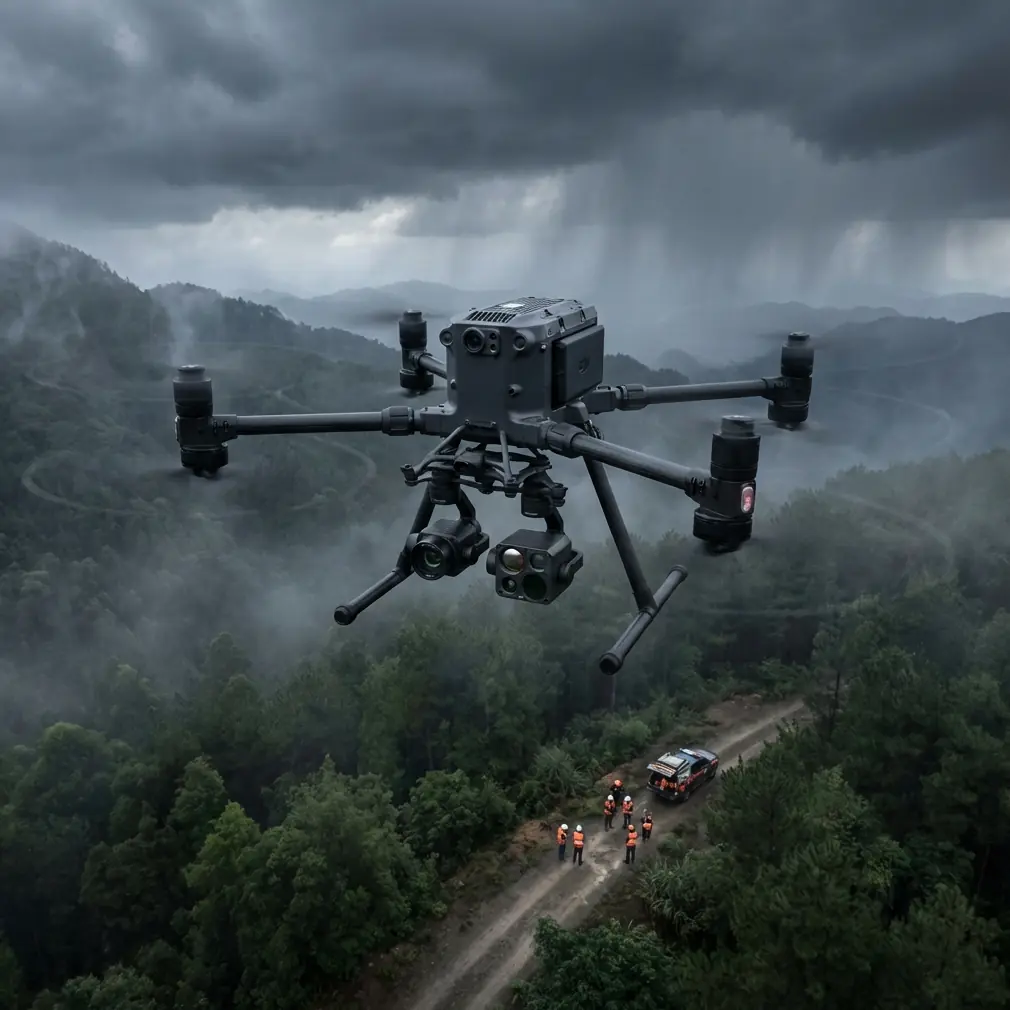
Matrice 400 Surveying Tips for Wildlife in Low Light: A Field Case Study on What Actually Matters
META: A practical Matrice 400 wildlife surveying case study covering low-light operations, thermal signature interpretation, battery strategy, O3 transmission, AES-256 security, and photogrammetry workflow decisions.
When teams ask me whether the Matrice 400 is the right platform for wildlife surveys in low light, I usually answer with another question: what part of the mission is failing today? Detection, endurance, data integrity, or workflow? In most field programs, the bottleneck is not the aircraft alone. It is how the aircraft fits into a broader operational stack.
That is why the most useful way to think about the Matrice 400 is not as “a drone” in isolation, but as a tool inside a larger mission system. That framing lines up with a shift the UAV sector has been talking about for years. At the Geek Park Rebuild2018 technology business summit held on July 21 in Chengdu’s Chenghua District, drone technology kept coming up alongside artificial intelligence and real-world applications. The deeper point from that discussion still holds: the industry matured when attention moved away from the aircraft as a novelty and toward what gets built around it. In other words, the real value is not “drone first,” but application first.
For wildlife work in low light, that distinction is not academic. It changes how you configure the Matrice 400, how you plan your sorties, and even how you decide when not to fly.
The mission profile: low-light wildlife surveying is not just “night flying lite”
I was recently advising on a survey program designed to monitor animal movement at dawn and just after sunset, when thermal contrast is often more useful than visible detail. The team’s previous workflow relied on smaller platforms that performed well for quick visual checks but struggled once the mission required three things at the same time: reliable thermal detection, repeatable geospatial outputs, and enough link confidence to cover broad habitat edges without constantly repositioning the crew.
This is where the Matrice 400 conversation gets serious.
A low-light wildlife mission usually has two parallel objectives. The first is detection: finding animals based on thermal signature, movement patterns, or brief visual opportunities. The second is documentation: converting observations into data that stands up to ecological review, land management decisions, or repeat seasonal comparisons. Many crews are good at one and surprisingly weak at the other.
If you only detect animals but cannot geolocate or compare your findings over time, your survey becomes anecdotal. If you build beautiful photogrammetry outputs but miss animals during peak activity windows, your map is technically neat and biologically thin. The Matrice 400 fits these missions best when the payload and flight profile are chosen with both goals in mind.
Why the Matrice 400 belongs in the “+drone” phase of UAV operations
That Rebuild2018 discussion in Chengdu matters here for a simple reason. It reflected a broader industry realization that UAVs reached a later stage of development once internet-connected workflows, AI interpretation, and vertical applications started driving adoption. For wildlife teams, this translates into a practical rule: stop evaluating the aircraft as a standalone object and start evaluating the entire survey pipeline.
With the Matrice 400, the operational question becomes:
- Can it capture thermal and visible information during poor light?
- Can it maintain stable transmission when terrain, vegetation, or distance complicate line management?
- Can it secure sensitive location data, especially for protected species work?
- Can the crew sustain repeated sorties without introducing battery-related downtime or unsafe habits?
- Can the output feed a mapping and reporting workflow that includes photogrammetry and GCP-based validation where needed?
That is the difference between owning an advanced UAV and running a dependable wildlife survey program.
Thermal signature first, visible confirmation second
In low-light wildlife work, thermal signature often becomes the lead indicator rather than a backup sensor. That changes crew behavior. Instead of searching for textbook visual identification from the start, operators learn to read patterns of heat, spacing, movement, and background contrast.
With the Matrice 400, a strong thermal workflow should be built around environmental timing. In the hour after sunset, some terrain features still release stored heat, which can mask smaller animals. Near dawn, the opposite may happen: the background cools enough to make warm-bodied targets stand out with more consistency. Experienced crews do not simply launch at “night.” They launch when thermal separation is likely to be strongest.
This matters because wildlife surveys are full of false positives. Rocks, rooftops, irrigation hardware, and tree trunks can all look persuasive for a few seconds. The aircraft helps, but the workflow decides the result. My advice is to use thermal for initial cueing and visible or zoom confirmation only when the geometry and light support it. If you chase visible identification too early, you waste battery and drift out of your ideal search grid.
For ecologists who also need habitat context, the same mission block can support follow-up photogrammetry during brighter conditions. That is one reason the Matrice 400 has appeal in conservation operations: one platform can sit at the center of a detection-and-mapping program rather than forcing the team to split workflows across multiple aircraft classes.
O3 transmission is not just a convenience feature in habitat surveys
In brochures, transmission systems often get reduced to range claims. In the field, range is not the headline. Stability is.
Wildlife teams working along forest margins, wetlands, ridgelines, and uneven agricultural boundaries need consistent situational awareness between aircraft and crew. O3 transmission matters because low-light missions already reduce the margin for error. You may be operating in dim conditions, over visually repetitive terrain, while trying to monitor a moving thermal target. The last thing you want is intermittent confidence in your downlink.
Operationally, a stronger transmission architecture affects three things.
First, it reduces the temptation to reposition the crew too often. Constantly moving the ground station during a survey sounds flexible, but it breaks rhythm, introduces logging mistakes, and can fragment observation coverage.
Second, it supports cleaner decision-making in longer transects. When a hotspot appears at the edge of a search lane, the team can decide whether to investigate, mark, or continue with more confidence if the feed remains stable.
Third, it improves coordination during advanced missions that may eventually scale toward BVLOS frameworks, subject to local regulation and approved operating procedures. Even when teams are still flying within line-of-sight rules, using systems built with robust transmission discipline prepares them for more structured mission growth later.
AES-256 matters more than many wildlife teams assume
Conservation groups, environmental consultants, and land managers sometimes underestimate how sensitive wildlife data can be. Nesting areas, migration corridors, and locations of rare species should not be handled casually. That is why AES-256 is not a technical footnote. It is part of responsible field practice.
On the Matrice 400, secure data handling supports missions where geotagged imagery or live feeds could expose sensitive habitats if mishandled. This is especially relevant when survey teams collaborate across universities, NGOs, private landowners, and contractors. The aircraft is flying over ecology, but the data lifecycle extends far beyond the flight.
From an operational standpoint, secure transmission and data governance reduce risk in two ways. They protect the integrity of sensitive field information, and they also make the platform easier to justify internally when organizations are reviewing digital risk, compliance, and chain-of-custody expectations.
If your wildlife program includes protected species or restricted survey zones, security is not optional. It is part of your field methodology.
The battery management tip I learned the hard way
Here is the field lesson that saves more missions than most sensor debates: do not use battery swaps as a pause; use them as a reset point.
With hot-swap batteries, the Matrice 400 allows efficient turnaround. That is valuable, especially in dawn and dusk windows when animal activity can shift quickly and every minute feels expensive. But crews often misuse this advantage. They rush the swap, relaunch fast, and carry forward small problems from the previous sortie: a slightly altered gimbal angle, an unconfirmed home point, a fogging lens, an unlogged observation, or a thermal palette that no longer suits the changing ground temperature.
My rule is simple. Every hot-swap should trigger a 60-second discipline check before takeoff. Confirm battery seating, verify expected cell balance indicators, recheck timestamp and mission segment labeling, inspect the lens face, and ask whether the next flight has the same objective as the last one. At dawn, for example, you may need to shift from broad thermal search to more selective confirmation as ambient conditions change.
The tip sounds minor. It is not. In wildlife programs, missed detections often come from transition mistakes, not dramatic failures. A hot-swap system gives you tempo; only good habits turn that tempo into usable survey quality.
When to combine photogrammetry and GCPs with wildlife observation missions
Not every wildlife sortie should become a mapping mission. That is one of the most common workflow errors I see. Teams collect far more imagery than they can process, then wonder why reporting lags behind fieldwork.
Use photogrammetry when habitat structure, terrain change, waterline movement, or corridor analysis are part of the actual decision you need to make. If your objective is to compare seasonal edge use, identify burrow-adjacent disturbance, or document vegetation gaps around observed movement, structured mapping adds real value.
That is where GCPs still earn their place. A well-designed GCP layout sharpens positional confidence when the final deliverable needs to align with prior site models, ecological baselines, or engineering layers used by land managers. In practical terms, GCP-backed mapping turns observations from “we saw activity here” into “we can compare this exact zone over time with confidence.”
For the Matrice 400, this dual-use capability is part of the platform’s appeal. A morning mission can begin with low-light thermal search and later transition into site documentation once illumination improves. One aircraft, one crew, two datasets, provided the team is disciplined enough to separate mission goals and file structures.
A realistic case workflow for the Matrice 400
In the field, my preferred low-light wildlife workflow looks like this:
The crew arrives before first usable light, not at launch time. They assess surface temperature behavior, moisture, wind, and the likely direction of movement for the target species. The first Matrice 400 sortie is kept narrow in purpose: detect active thermal signatures along known transition zones. No broad cinematic wandering. No unnecessary hovering over empty ground.
Any detections are logged with immediate verbal shorthand and map references. If confidence is low, the crew uses angle changes rather than reflexively pushing deeper into the area. Stable O3 transmission supports these decisions because the operator is not guessing at feed reliability while the target moves.
After landing, the hot-swap routine begins. Batteries are changed, but the mission is also re-centered. Has the thermal background shifted? Are false positives increasing as the ground warms? Is this still a detection flight, or should the second sortie focus on confirmation and corridor tracking?
If the survey requires habitat modeling, later flights gather imagery intended for photogrammetry, with GCPs already laid out and recorded. That separation keeps datasets clean. Thermal search flights stay about wildlife. Mapping flights stay about spatial structure.
This is the kind of mature operation the UAV industry has been moving toward since discussions like the 2018 Chengdu summit made it clear that drones only become truly valuable when integrated with AI, connectivity, and domain-specific applications. The aircraft matters. The surrounding method matters more.
What makes the Matrice 400 a strong fit for this reader scenario
For a team surveying wildlife in low light, the Matrice 400 stands out when the mission demands more than simple spotting. It supports a layered workflow: thermal-led detection, secure data handling, resilient transmission, efficient battery turnover, and optional transition into mapping-grade documentation.
Two details are especially operationally significant.
The first is hot-swap battery support. In low-light windows, survey opportunity is compressed. Hot-swap capability helps crews preserve tempo, but the real advantage appears only when it is paired with a disciplined reset checklist. That combination reduces downtime without sacrificing data quality.
The second is O3 transmission. In habitat surveys where vegetation, distance, and terrain complicate observation, link stability directly affects target confirmation, crew positioning, and mission continuity. This is not a comfort feature. It influences whether the survey produces confident detections or fragmented maybes.
Add AES-256 into the picture, and the Matrice 400 also becomes easier to justify for organizations handling sensitive ecological location data. That will matter more, not less, as conservation programs become increasingly digital and collaborative.
If your team is still deciding how to configure a practical workflow around the platform, I usually recommend talking through the mission profile before talking about accessories. The right setup for wetland mammals at dawn is not automatically the right setup for thermal counts along open grassland edges. If you need a field-oriented second opinion, you can reach out here for a practical mission discussion: https://wa.me/85255379740
The bigger story is that the Matrice 400 fits exactly where the UAV sector has been heading for years. The aircraft is no longer the whole point. The mission is. Wildlife surveying in low light makes that obvious very quickly. You are not buying airborne hardware to admire its specifications. You are building a reliable way to detect, verify, secure, and compare ecological information under difficult conditions.
That is the standard worth designing for.
Ready for your own Matrice 400? Contact our team for expert consultation.