
Surveying Wildlife in Extreme Temperatures With Matrice 400
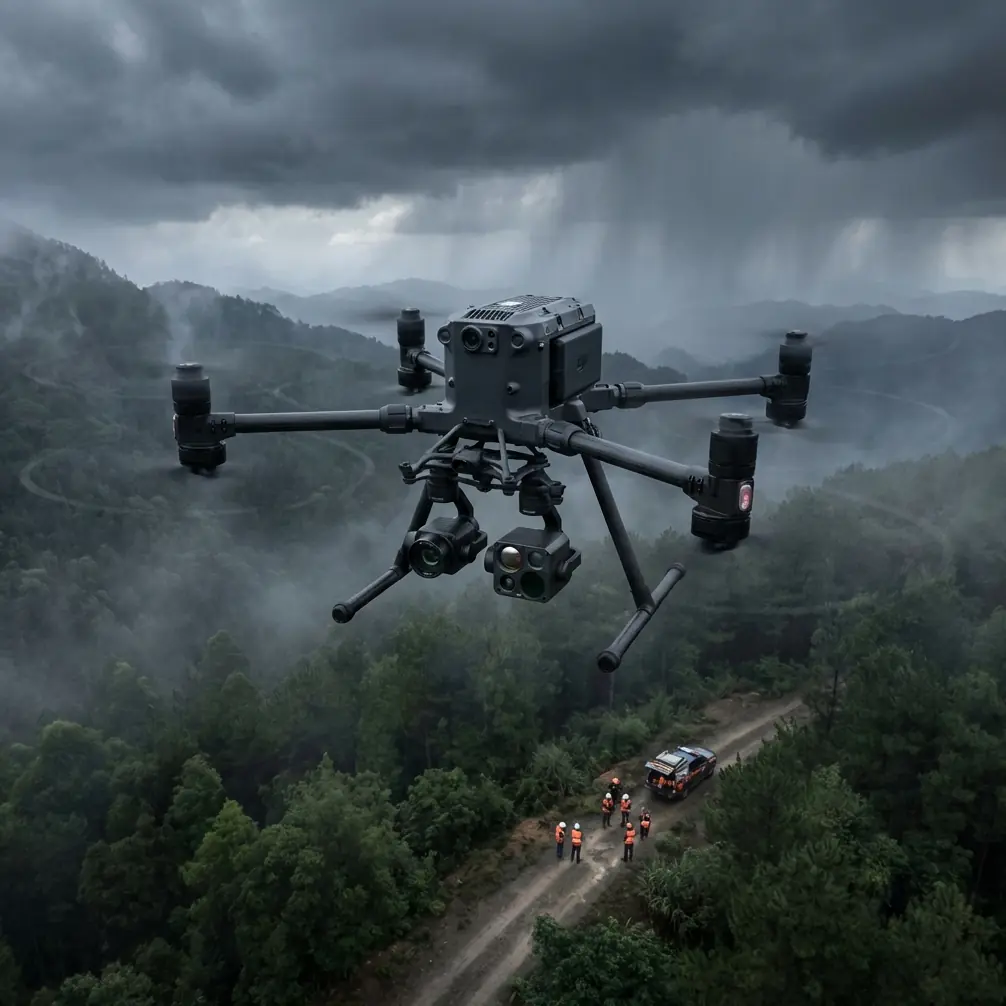
Surveying Wildlife in Extreme Temperatures With Matrice 400: Practical Field Tips From an Industrial UAV Lens
META: Learn how to use Matrice 400 for wildlife surveying in extreme heat and cold, with practical tips on thermal signature capture, photogrammetry, antenna positioning, EMI handling, hot-swap battery workflow, and secure long-range operations.
Wildlife work pushes aircraft harder than many industrial missions. You are often operating far from roads, in punishing heat or bitter cold, over reflective water, rock faces, snowfields, wetlands, or scrubland where the environment itself interferes with sensing, navigation, and radio performance. That is exactly why the Matrice 400 deserves attention from serious survey teams.
I’m writing this from the standpoint of field methodology rather than brochure language. If your job is counting ungulates at dawn, locating nesting zones without disturbing habitat, tracking thermal movement along a ridgeline, or producing habitat maps that stand up to review, the aircraft is only part of the system. The result depends on how you configure the mission, manage signal stability, and interpret the environmental conditions in real time.
There is also a bigger industry backdrop worth noticing. At the 139th Canton Fair, where three core indicators reportedly hit record highs—total exhibition area, number of exhibitors, and frequency of new product launches—the industrial drone sector drew unusual international attention. One UAV company highlighted in the source material stood out as the only drone enterprise to receive a dedicated English-language feature from Xinhua. That matters for operators watching the Matrice 400 category because it signals something broader than trade-show publicity: industrial UAV capability from China is now being framed for a global professional audience, with intelligent manufacturing and export readiness at the center of the story. For wildlife survey teams, that translates into a more mature ecosystem of airframes, payload strategies, support expectations, and mission-specific integration.
Why extreme-temperature wildlife surveys are different
Wildlife surveys are not standard corridor inspections with a fixed target and repeatable geometry. Animal behavior changes with temperature stress. In cold conditions, animals may cluster in sheltered pockets, making thermal signature interpretation more complex because multiple bodies merge into one bright mass. In heat, the opposite happens: land surfaces retain or radiate energy in ways that flatten contrast, so your thermal imagery can become less decisive during the wrong part of the day.
The Matrice 400 becomes useful here not because it magically solves biology, but because it supports a workflow that can adapt. Long-range situational awareness, stable transmission, secure data handling, payload flexibility, and battery continuity all matter more in wildlife work than people first assume.
A missed detection in a wildlife census is not just an image problem. It can be a timing problem, a flight line problem, a sensor-angle problem, or an RF problem.
Start with the mission objective, not the drone
Before launching the Matrice 400, define which of these you are actually doing:
- population count
- nest or den identification
- habitat condition mapping
- migration corridor observation
- heat-stress monitoring
- carcass detection for ecological assessment
Each objective changes how you use thermal signature data and photogrammetry.
If you are counting animals, thermal may be primary and RGB secondary. If you are mapping habitat changes, photogrammetry and GCP placement will drive the mission design. If you are documenting species use of a landscape during a temperature event, you may need synchronized thermal and visual passes, not just one or the other.
That distinction matters because extreme temperatures shrink your margin for error. In cold environments, battery behavior and launch tempo become planning constraints. In hot environments, sensor heating, atmospheric shimmer, and midday thermal washout can degrade data quality before the aircraft itself becomes the issue.
Thermal signature: timing is your real advantage
Thermal sensors are often treated as a universal answer for wildlife surveys. They are not. They are excellent when the temperature delta between animal and background is meaningful. They struggle when the environment radiates similarly to the subject.
For the Matrice 400 workflow, my recommendation is simple:
In cold conditions
Fly shortly after first light, when animals remain warmer than the terrain but before sun exposure creates inconsistent patches across slopes, trees, and rocks. Snow can help with contrast, but exposed stone warmed by early sun can create confusing hotspots.
In hot conditions
Work near dawn, dusk, or at night where regulations and mission approvals allow. Midday flights over open ground can flatten thermal separation so badly that a resting animal becomes hard to distinguish from heated soil or brush.
Operationally, this is where experience beats automation. If your thermal feed shows too many false positives, do not just lower altitude and hope. Reassess angle, background material, and time window. Wildlife thermal interpretation is always contextual.
Pair thermal with photogrammetry for defensible survey outputs
A lot of teams collect thermal detections and stop there. For internal observation, that may be enough. For ecological reporting, land management planning, or stakeholder review, it often is not.
Photogrammetry gives the survey spatial credibility. With a well-planned Matrice 400 mission, you can correlate thermal detections with orthomosaic context, terrain patterns, vegetation cover, and access constraints. This is especially useful when documenting how animals use microhabitats during temperature extremes.
Use GCPs where ground access is possible and ecologically appropriate. In remote conservation areas, GCP deployment may be limited, but even a small number of carefully surveyed points can improve confidence in map alignment. That matters when comparing repeated seasonal missions or validating whether animals consistently return to the same sheltered zones.
A thermal hotspot without map-grade context is an observation. A thermal hotspot anchored to repeatable photogrammetric data is evidence.
O3 transmission in harsh terrain: keep the link clean
Mountain shoulders, ravines, dense vegetation, and even metallic field infrastructure can disrupt signal quality. The Matrice 400 class is built for demanding industrial connectivity, but field crews still need to manage the link actively.
One issue that deserves more attention is electromagnetic interference. In wildlife operations, it can appear unexpectedly near remote telecom structures, solar installations, power corridors bordering habitat, research stations, or even vehicles parked too close to the launch area.
Here is the practical method I teach teams:
- Establish a clean takeoff zone. Move away from vehicles, generators, repeater boxes, and temporary metal tables.
- Check orientation before liftoff. Antenna position matters. Do not point the antenna tips directly at the aircraft; maintain the broadside relationship that best supports the O3 transmission path.
- Watch for terrain masking. A strong link on takeoff can degrade sharply once the drone drops behind a ridgeline or tree band.
- If interference appears, adjust before climbing aggressively. Small controller antenna changes can stabilize a marginal feed better than brute-force repositioning later.
- Change pilot stance if needed. Sometimes a few steps sideways or a slight elevation change restores line quality because the local interference field is highly directional.
That last point sounds minor until you see it in practice. I have seen crews waste a survey window troubleshooting what they thought was a payload issue when the fix was simply rotating the controller position and re-aiming the antennas to reduce EMI impact.
For wildlife work, this is operationally significant because a broken video link does more than interrupt flying. It can break your detection sequence, invalidate your count pattern, and force a second pass that increases disturbance over the survey area.
AES-256 and why data security matters in conservation work
Not every wildlife survey is sensitive, but some absolutely are. Nest locations, endangered species concentrations, and migration stopovers can become vulnerable if location data is poorly handled. Secure transmission protocols such as AES-256 are not just enterprise talking points in this context. They support responsible data stewardship.
If your organization is working with protected-species records, private reserve boundaries, or collaborative research datasets, secure handling of flight media, live downlink data, and exported geospatial files should be part of your SOP. The aircraft can provide a secure technical foundation, but the team still needs disciplined file management and access control.
This is one reason the broader industrial drone manufacturing story matters. The reference material describes a company recognized as the only drone enterprise at the 139th Canton Fair to receive a dedicated English-language Xinhua feature, framed as an example of China’s intelligent manufacturing strength. In practical terms, that kind of recognition reflects growing scrutiny from international markets. Operators should expect not just capable airframes, but stronger attention to professional-grade security, reliability, and documentation.
Hot-swap batteries: not a luxury in cold wildlife missions
In extreme-temperature fieldwork, hot-swap batteries are one of those features you only fully appreciate after a long day in wind and subfreezing air.
For wildlife teams, the value is straightforward:
- less downtime between sorties
- better continuity when following a count plan
- reduced need to power-cycle the aircraft repeatedly in harsh conditions
- smoother handoff between search, confirmation, and mapping passes
Cold weather drains battery performance faster and can change your safety margins quickly. A hot-swap workflow helps preserve mission rhythm. The key is to warm spare batteries properly, rotate them systematically, and record performance trends by sortie. Do not treat all packs as behaving identically in field cold.
In heat, the benefit shifts. You are less worried about cold-induced voltage behavior and more concerned with keeping operations efficient before light quality or thermal conditions deteriorate. Hot-swap support shortens the gap between flights when your ideal survey window is narrow.
BVLOS considerations for large-area habitat surveys
For broad habitat assessments, BVLOS can transform what is realistically surveyable in a single campaign. Large wetlands, grassland migration corridors, estuary systems, and alpine reserves often exceed what a visual-line-only workflow can cover efficiently.
That said, BVLOS should never be discussed casually. It depends on local regulatory approval, airspace constraints, risk assessment, observer strategy, and mission-specific safety controls. The Matrice 400 platform may fit the technical profile for demanding long-range tasks, but the operation itself must be lawful and structured.
Where BVLOS is permitted, its value in wildlife work is substantial. You can maintain more consistent transect spacing, reduce vehicle repositioning near sensitive areas, and cover fragmented terrain with fewer interruptions. Done correctly, that can improve both data quality and habitat protection.
Field checklist for extreme-temperature wildlife surveys with Matrice 400
Here is the condensed workflow I recommend:
Before deployment
- define target species behavior under current temperature conditions
- select thermal and RGB objectives separately
- identify EMI sources near the launch area
- prepare GCP plan if photogrammetric accuracy matters
- confirm data security procedures for sensitive ecological sites
On site
- validate wind and thermal conditions, not just general weather
- choose launch point with best transmission geometry
- set antenna orientation deliberately for O3 stability
- run a short test leg to check video quality and thermal contrast
- record the time, terrain type, and surface temperature conditions
During flight
- avoid chasing every hotspot; maintain survey discipline
- cross-check thermal detections with visual context
- monitor link quality as terrain changes
- adjust antenna position at first sign of EMI-related instability
- log anomalous behavior immediately for post-flight review
Between sorties
- use hot-swap battery workflow carefully
- inspect lens clarity and sensor condition
- compare detections across passes before changing altitude or overlap
- keep metadata organized while field observations are still fresh
If your team is refining an M400 wildlife workflow and wants a field-operations discussion rather than a generic product pitch, this direct chat link is often the fastest route: https://wa.me/85255379740
The bigger signal behind Matrice 400 adoption
The most interesting part of the source material is not a specification sheet. It is the context. The 139th Canton Fair was described as reaching historic highs across three indicators, and within that environment a drone company in the industrial category received singular English-language coverage from Xinhua. That combination says something meaningful to professional users: industrial UAV systems are no longer being presented only as hardware exports. They are being positioned as mature tools within a larger intelligent-manufacturing narrative.
For wildlife survey teams, that matters because endurance, transmission integrity, secure workflows, and payload integration are not isolated features. They are signs of an ecosystem becoming more capable of supporting serious field science and commercial environmental work at scale.
And that is where the Matrice 400 fits. Not as a miracle machine. As a field platform that rewards disciplined operators, thoughtful mission planning, and a strong understanding of how temperature, terrain, radio conditions, and sensor logic interact.
If you approach it that way, extreme-temperature wildlife surveys become less about coping with harsh conditions and more about using them intelligently.
Ready for your own Matrice 400? Contact our team for expert consultation.