
Matrice 400 for Wildlife Survey in Dusty, EMI-Heavy Terrain
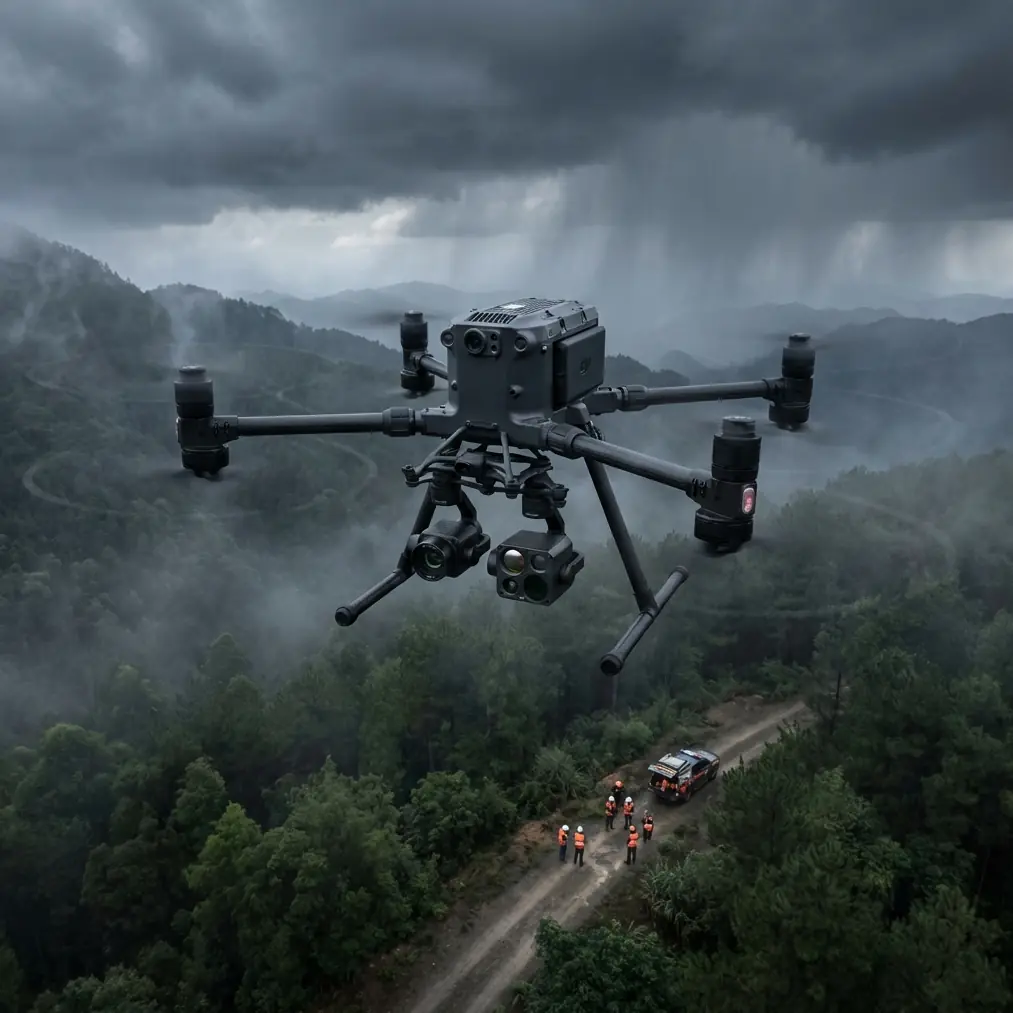
Matrice 400 for Wildlife Survey in Dusty, EMI-Heavy Terrain: What Actually Matters in the Field
META: Expert analysis of Matrice 400 wildlife survey operations in dusty environments, with practical insight on EMI handling, power-system logic, maintenance safety, thermal work, photogrammetry, and BVLOS-ready planning.
Wildlife surveying sounds gentle until you do it for real.
You are often launching before sunrise, working around ridgelines, pumps, fences, repeater towers, solar installations, vehicle convoys, and dry ground that turns every landing zone into a dust event. The aircraft is only one part of the job. The real challenge is keeping image quality, transmission stability, and crew safety intact while the environment keeps trying to degrade all three.
That is the right lens for thinking about the Matrice 400.
Rather than treating the platform as a generic “big drone,” it makes more sense to look at it as a field system operating at the intersection of power stability, signal integrity, maintainability, and payload usefulness. Two technical ideas from classic aircraft system design help frame that reality surprisingly well: stable terminal pressure behavior in hydraulic systems, and safety-driven electrical layout rules that prioritize clear isolation, grounding, shielding, and maintenance access. Those may sound far removed from UAV wildlife work, but they map directly to how a serious Matrice 400 workflow should be planned.
The field problem: dust, EMI, and fragile data quality
A wildlife mission in dusty country usually combines two jobs that pull against each other.
First, you want standoff observation. That means reliable transmission, clean telemetry, and enough confidence in link quality to hold position and collect usable thermal signature data without pushing too close to animals or habitat features.
Second, you want mapping-grade repeatability. If the mission includes photogrammetry, GCP validation, corridor checks, or habitat-change documentation, then every small instability matters: vibration, landing contamination, connector wear, RF interference, battery interruptions, and inconsistent flight lines.
Now add electromagnetic interference. The issue is often underappreciated because the link does not always fail dramatically. Sometimes it just gets “soft.” Video becomes less clean. Antenna alignment gets fussier. Telemetry takes longer to settle. A pilot sees occasional warning behavior near towers, overhead infrastructure, or mobile radio equipment and assumes the problem is random.
Usually it isn’t.
The better way to think about EMI is as a management problem, not just a signal problem. You do not eliminate it. You design around it.
Why aircraft-system thinking applies to the Matrice 400
One of the reference materials describes hydraulic terminal conditions in a very disciplined way. On pages 662–663 of 飞机设计手册 第12册, a constant-pressure terminal is modeled with terminal pressure treated as fixed, and the terminal impedance is effectively zero. A closed end is the opposite boundary case, with terminal flow set to zero. Those details come from hydraulic analysis, not drones, but the operational lesson is useful: boundary conditions define system behavior.
That matters on a Matrice 400 mission because your field setup creates the “terminal conditions” for the aircraft. A dust-choked improvised launch point, poor battery handling, and a compromised RF environment become the boundary conditions the aircraft must live with. If those conditions are unstable, no amount of payload sophistication will fully rescue the result.
The same source also references gas behavior in pressure devices using a polytropic exponent, with n = 1.4 for an adiabatic process. Again, the number itself belongs to aircraft fluid-power analysis. Operationally, it reminds us that energy systems do not behave in a perfectly static way under load and environmental change. That is exactly how drone crews should think about power and thermal margins in harsh field work: not as fixed numbers on a spec sheet, but as dynamic behavior shaped by temperature, dust, mission timing, and repeated takeoff cycles.
The second reference, from 飞机设计手册 第16册, is even more directly relevant. It states that hazardous materials and fluids should be selected for the best safety performance, that high-risk equipment should have automatic fault protection, that the main power switch should be clearly marked, and that exposed equipment surfaces and shields should remain at ground potential during normal operation except for antenna and transmission-line ends. It also stresses maintenance access around high voltage, high temperature, toxic chemicals, electromagnetic radiation, and other hazards.
Those are not abstract textbook niceties. They describe the mindset needed for a Matrice 400 crew working long days in dust with multiple batteries, sensors, chargers, antennas, and support cases spread around a temporary field base.
What this means for wildlife operations specifically
Wildlife teams rarely fly in perfect RF conditions. You may be working near conservation infrastructure, remote pumping stations, utility corridors, or research stations. In open country, signal reflection can be as troublesome as outright obstruction. Dust adds another layer by increasing turnaround pressure: people rush battery swaps, set gear on dirty surfaces, and start troubleshooting antennas with contaminated hands and connectors.
This is where the Matrice 400’s mission value is decided.
If your payload stack includes thermal signature work at dawn and visible-spectrum mapping later in the same sortie window, then stable transmission and disciplined power handling matter as much as optics. Thermal surveys are unforgiving of bad hovering behavior and inconsistent framing. Photogrammetry is unforgiving of line deviations, weak overlap discipline, and sudden changes in speed or altitude caused by poor situational management.
The practical answer is to treat the aircraft as a system that needs clean inputs from the crew.
Handling EMI with antenna adjustment: the field method that actually works
The context here specifically calls for handling electromagnetic interference through antenna adjustment, and this deserves a realistic explanation.
When the Matrice 400 starts showing reduced link confidence in a wildlife survey area, many operators react by climbing, pushing forward, or blaming terrain. That may help, but it misses the first fix: re-evaluate antenna geometry.
Antenna adjustment should be deliberate, not frantic. The objective is to optimize the relationship between the controller antennas and the aircraft’s position while reducing exposure to local interference sources. In practice, that means:
- repositioning the ground operator a few meters away from vehicles, generator trailers, metal fencing, repeater hardware, or high-current charging stations
- adjusting antenna angle to maintain the strongest intended radiation pattern toward the aircraft rather than pointing antenna tips directly at it
- rotating the body position of the pilot station if nearby structures are reflecting or partially shadowing the signal path
- elevating the control position slightly if ground clutter and dust cloud residue are causing a low-angle path problem
This sounds basic, yet it is often the difference between stable O3 transmission behavior and a mission that constantly feels one step from a warning. In dusty terrain, link instability is easy to misread because visual haze and operational fatigue make every problem look similar. Antenna adjustment is one of the fastest non-invasive corrections available.
If your crew is building a repeatable survey SOP around the Matrice 400, document antenna orientation for different mission sectors. Do not leave it to memory. Wildlife projects often revisit the same habitat blocks, and the RF problem spots tend to repeat.
Power discipline is not glamorous, but it protects mission continuity
The electrical design reference emphasizes clear power isolation and fault protection, and that is exactly the discipline a Matrice 400 team needs around battery handling.
Hot-swap batteries are valuable not because they sound advanced, but because they preserve workflow continuity during narrow wildlife activity windows. Dawn thermals, nesting observations, herd movement tracking, and low-wind mapping intervals do not wait for slow resets. But hot-swap capability only pays off if the crew uses a controlled process:
- batteries staged in clean, shaded, clearly identified positions
- unambiguous pack rotation and health logging
- visible confirmation of active power state before handling
- no rushed swapping in active dust plumes
- no placing packs or connectors directly on ground cloths already coated with grit
That “clearly marked main power switch” concept from the reference is more relevant here than it first appears. In mixed teams with pilots, observers, ecologists, and vehicle support personnel, ambiguous power state creates preventable errors. A serious Matrice 400 operation should make power-state verification verbal and procedural, not assumed.
The fault-protection idea is equally significant. If a system is serious enough to carry sensitive payloads over remote habitat, then abnormal electrical behavior should trigger a conservative response from the crew. Do not normalize odd startup behavior, intermittent warnings, or “one battery that’s usually fine.” In wildlife work, the cost of an aborted survey is lower than the cost of compromised airborne reliability over inaccessible ground.
Dust management is not just about cleaning
Most operators think dust control means wiping the aircraft after flight. That is too late.
Dust enters the mission at the launch and recovery stage, where it affects motors, gimbals, connectors, cooling paths, lens surfaces, battery interfaces, and human decision-making. It also amplifies maintenance mistakes. The safety reference’s emphasis on accessibility around hazardous areas is a useful design principle here: if your field layout forces people to reach awkwardly around chargers, cases, hot components, or spinning props, they will eventually contaminate or damage something.
For a Matrice 400 wildlife setup, the better solution is a clean workflow geometry:
- separate landing area from battery prep area
- isolate payload changes from dust-generating foot traffic
- keep RF equipment and high-current charging stations from clustering together
- assign one crew member to inspect connector faces and antenna mounts before relaunch
- pause after landing if needed rather than rushing a hot turnaround through a dust cloud
This is not overcautious. It is how you keep a high-value survey platform delivering consistent data across a multi-day campaign.
Thermal and photogrammetry on the same platform: why system stability decides output quality
The Matrice 400 becomes especially useful when wildlife teams combine mission types instead of treating each sortie as a single-purpose flight.
A dawn thermal signature run can identify animal presence, movement corridors, denning activity, or heat-retaining ground disturbances. Later, a visible-spectrum photogrammetry mission can document terrain, vegetation structure, water access routes, and habitat edges with the precision needed for reporting and comparison over time.
But dual-role operations magnify every weakness in setup.
Thermal work demands timing, stable observation, and trust in your downlink. Photogrammetry demands overlap discipline, consistent altitude, and accurate geospatial control. If you are flying with GCP-supported mapping methods, then the aircraft’s value is tied directly to repeatability. The problem is not whether the Matrice 400 can carry the right sensor package. The problem is whether the whole mission chain remains stable enough to extract professional-grade results from it.
That brings us back to the reference materials. Hydraulic system theory treats boundary conditions as decisive. Electrical safety design treats grounding, shielding, fault protection, and access as non-negotiable. Together, they point to a simple truth: reliable output starts before takeoff.
BVLOS readiness starts with infrastructure, not paperwork
Many wildlife programs are moving toward larger-area operations and future BVLOS alignment. The temptation is to frame BVLOS as mainly a regulatory or transmission feature discussion. That is incomplete.
For a Matrice 400, BVLOS readiness begins with repeatable field discipline: clean power procedures, dependable link management, maintenance-safe layout, and documented response patterns for EMI zones. AES-256-level transmission security and robust O3 communication architecture are valuable, but they do not replace operational rigor. Secure transmission does not compensate for sloppy antenna practice. Extended range does not excuse poor launch-site selection.
If your team is building toward corridor-scale habitat monitoring or broad-area census workflows, start by hardening the basics on visual-line missions first. That foundation scales.
The expert takeaway
The most useful way to understand the Matrice 400 for wildlife survey work is not through isolated feature talk. It is through system behavior under stress.
The source material on aircraft hydraulic design highlights how fixed boundary conditions shape downstream performance. The electrical-system reference adds the non-negotiables: automatic fault protection, clear power identification, grounded external surfaces, and maintenance layouts that reduce exposure to hazards. Those details matter because dusty, EMI-prone wildlife operations punish weak systems thinking.
So when a Matrice 400 crew succeeds in the field, it is usually because they did the unglamorous things well. They staged batteries cleanly. They adjusted antennas intelligently when interference appeared. They protected connectors from grit. They respected fault signals. They built a launch geometry that supported both safety and data quality. And as a result, the aircraft could do what it was supposed to do: collect usable thermal and mapping data without disturbing the landscape it was sent to observe.
If you are planning a wildlife survey workflow around the Matrice 400 and want to compare field setups, payload logic, or EMI mitigation practices, you can message our drone team here and discuss the mission profile directly.
Ready for your own Matrice 400? Contact our team for expert consultation.