
How I Track Construction Sites in Complex Terrain With the M
How I Track Construction Sites in Complex Terrain With the Matrice 400
META: A field-tested Matrice 400 workflow for tracking construction progress in complex terrain using photogrammetry, thermal signature review, O3 transmission, AES-256 security, hot-swap batteries, and weather-aware flight planning.
By Dr. Lisa Wang, Specialist
Construction sites in broken terrain expose every weakness in an aerial workflow. Steep cut slopes distort line of sight. Haul roads throw up dust. Elevation changes push lighting conditions around faster than most teams expect. Add schedule pressure, and “just fly a grid” stops being useful advice.
This is where the Matrice 400 earns attention. Not because it makes site tracking simple, but because it reduces the number of weak links between data capture and actual project decisions. When I use it for construction progress tracking, I am not looking for cinematic footage. I am looking for repeatability, secure data movement, stable transmission across uneven ground, and enough power flexibility to keep a survey sequence intact when conditions shift halfway through the mission.
Below is the workflow I use when the job is a live construction site in complex terrain and the deliverable needs to stand up to engineering review, contractor coordination, and executive reporting.
Start with the terrain, not the aircraft
On rugged sites, the first mistake is planning from the office using a flat map mindset. A site may look compact on paper, yet the real working environment behaves like several different sites stacked vertically. One ridge blocks signal to a staging area. A retaining wall creates shadow at one hour and glare the next. Fresh earthworks can alter takeoff options from one week to the next.
Before I launch the Matrice 400, I define three things:
- What has to be measured
- What only needs visual confirmation
- What could become inaccessible if weather turns
That distinction matters. A cut-and-fill verification pass is different from tracking equipment movement or checking drainage installation. Photogrammetry needs disciplined overlap and consistent geometry. Thermal signature review, by contrast, may be about spotting curing irregularities, water intrusion patterns, overheated temporary power components, or comparing active versus inactive work zones.
On a complex site, bundling every objective into one generic mission usually produces mediocre data for all of them.
Build the mission around control and repeatability
For progress tracking, I usually break the operation into layered missions:
- a high-consistency mapping flight for photogrammetry
- a targeted oblique pass for slopes, walls, and structures
- a thermal review mission where thermal signature matters
- a rapid comparison pass over areas likely to change week to week
The Matrice 400’s value here is not only endurance or payload capability. It is the operational flexibility to execute these as a coordinated sequence rather than as disconnected improvisations.
When I am generating orthomosaics or surface models, I use GCPs where site conditions allow. On construction projects in complex terrain, GCP placement often becomes more strategic than extensive. You do not need to flood the site with them, but you do need them where slope breaks, elevation transitions, and long linear works can otherwise propagate error. If a road bench wraps around a hillside, a poorly placed control scheme can make progress quantities look cleaner than reality.
This is also where aircraft stability and transmission resilience begin to matter directly to survey quality. A dropped feed, interrupted route, or manual correction at the wrong moment introduces inconsistency. Teams often think of transmission as a pilot convenience. On terrain-heavy jobs, it is a data integrity issue.
Why O3 transmission matters more in complex terrain
On an open site, transmission quality feels routine. In ravines, stepped excavation zones, and partially obstructed corridors, it becomes part of your risk control model. O3 transmission helps keep command and video feedback reliable when line-of-sight conditions are less forgiving than they appear from the launch point.
That operational significance is practical, not abstract. If the aircraft is crossing behind a terrain feature while you are validating overlap, checking exposure consistency, or confirming that a haul road edge was captured, stable transmission reduces the chance that you discover gaps only back in the office. On a live construction site, reflying a section is not always easy. A crane may swing into the corridor later. Dust may worsen. Access may close.
For teams considering BVLOS frameworks in approved civilian operations, dependable transmission architecture also becomes foundational to procedure design, especially when terrain is the factor that most often disrupts confidence.
Security is not an afterthought on construction work
Large construction programs involve more than pretty maps. Progress imagery can reveal schedules, material staging, subcontractor sequencing, temporary works, and infrastructure tie-ins. That is why I treat data security as part of flight planning.
AES-256 matters here because site tracking frequently passes through multiple stakeholders: owner reps, project managers, engineers, and geospatial teams. If the workflow includes remote review or file movement beyond the pilot’s device, encrypted handling should be a baseline expectation. People sometimes frame this as an IT checkbox. In reality, it is an operational trust issue. If a contractor is allowing recurring aerial capture over sensitive commercial development or energy infrastructure, they want confidence that transmission and stored data are not being treated casually.
That is one of the reasons I prefer to define the reporting pipeline before the mission. The drone can capture excellent data, but if the chain after the flight is sloppy, the whole operation becomes harder to justify.
What changed when the weather shifted mid-flight
One of the clearest tests of any site-tracking setup comes when the conditions stop matching the plan.
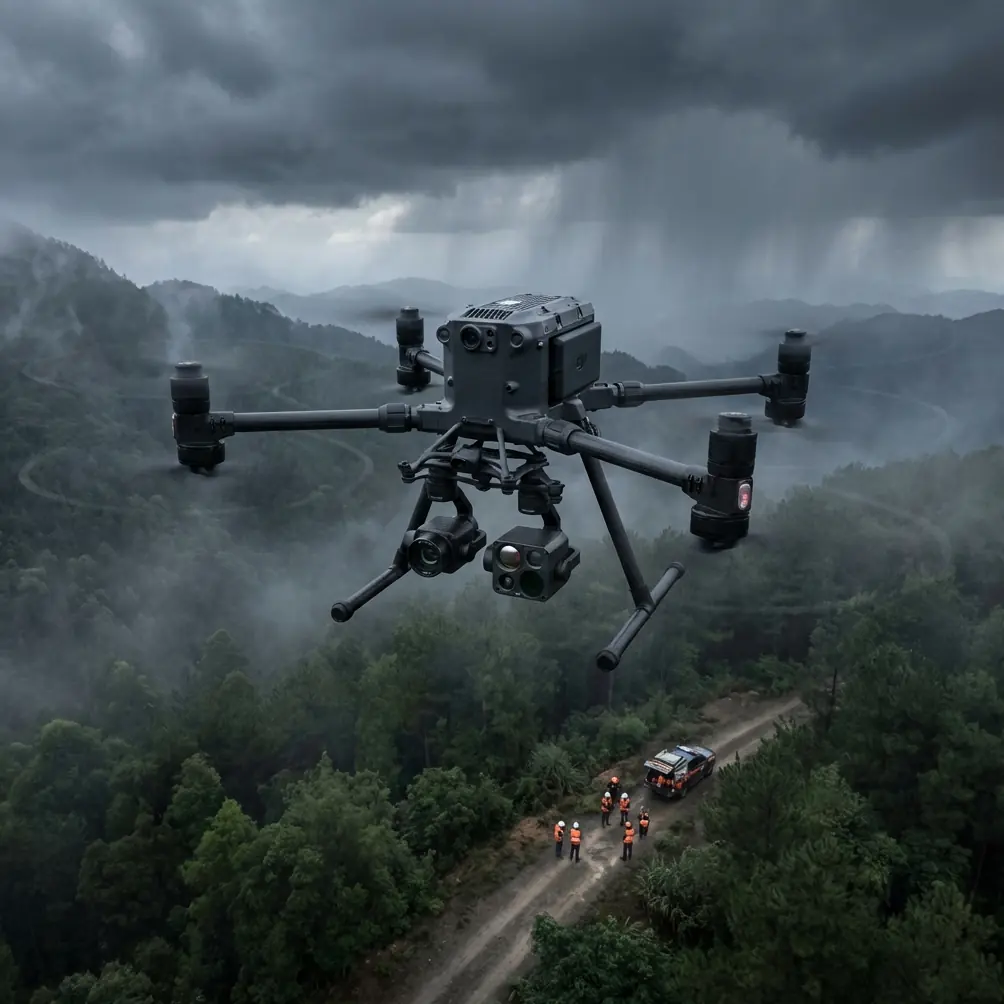
I had a mission over a mountain-adjacent construction corridor where the morning began with stable light and only moderate wind at the launch area. About halfway through the mapping sequence, cloud cover thickened, the wind began to channel across a cut section, and visibility contrast changed over the darker soil lifts. This is the kind of shift that ruins consistency if the aircraft, pilot, and mission logic are not prepared for it.
The Matrice 400 handled the transition well for two reasons. First, link stability remained usable despite the terrain and changing conditions, so I did not have to guess what the aircraft was actually seeing over the far slope section. Second, the battery workflow gave me options instead of forcing a bad compromise.
Hot-swap batteries sound like a convenience feature until weather compresses your available window. Then they become operationally significant. Rather than rushing a compromised continuation or abandoning the entire sequence, I was able to pause, reassess the lighting break, swap power, and resume with a cleaner strategy. On construction sites, that can be the difference between preserving weekly comparability and introducing enough inconsistency to weaken trend analysis.
This is one of the most underrated advantages for long or segmented site monitoring. Progress tracking is not only about total air time. It is about how gracefully you recover when the environment interrupts the script.
A useful lesson from civil aircraft design logic
An odd but relevant lesson comes from civil aircraft interior and systems design references. In one cargo-container specification table, standard unit dimensions such as 3175 × 2235 mm and a maximum gross weight figure of 2449 kg appear alongside other structured constraints for internal loading. In another aircraft systems reference, there is explicit treatment of how fixed system weight can create a fuel compensation penalty.
Those are not drone specifications, but the design logic is highly relevant to construction-site UAV work: every platform lives inside a chain of tradeoffs involving volume, weight, energy, and mission utility.
For Matrice 400 operators, the takeaway is simple. Payload choices, battery strategy, and mission segmentation are not separate decisions. They are coupled. If you load the platform for one type of capture without thinking through the downstream impact on endurance, recovery margin, and reflight risk, you are making the same category of mistake aircraft designers spend entire manuals trying to avoid.
That is why I plan construction tracking as a systems problem. The aircraft, payload, environmental conditions, transmission reliability, and deliverable requirements all affect each other. A drone mission that looks efficient in a checklist can still be inefficient in engineering terms if it creates avoidable rework.
Photogrammetry on steep and irregular sites
Photogrammetry over complex terrain requires discipline. The Matrice 400 helps, but it does not forgive lazy setup.
Here is the field logic I use:
1. Separate horizontal surfaces from vertical complexity
Do not expect one flight altitude and one camera geometry to capture benches, roadways, retaining features, and partially completed structures equally well. Nadir mapping may be enough for stockpile change, but not for wall condition or facade-adjacent earthworks.
2. Use GCPs where terrain change can distort confidence
On flatter projects, sparse control can still produce serviceable outputs. In rugged construction corridors, I want GCPs near elevation transitions and in zones where future comparisons will matter commercially, such as utility alignments, drainage paths, and slope stabilization works.
3. Keep weekly missions as similar as reality allows
Consistency beats perfection. If weather or site access forces a change, record it and isolate the impact in your reporting. The point is not to chase laboratory conditions. It is to preserve comparability.
4. Don’t ignore obliques
Oblique imagery often catches what top-down mapping misses: erosion at the toe of a slope, face irregularities, temporary shoring details, or edge degradation along haul routes.
Thermal signature review for construction monitoring
Thermal payload use on construction sites is often misunderstood. It is not there to make every report look more advanced. It is there to answer specific questions.
A thermal signature can help identify:
- moisture patterns that differ from surrounding material
- uneven curing behavior
- overheating in temporary electrical setups
- drainage anomalies after weather events
- active machinery or systems relative to scheduled work status
The key is timing. A thermal pass should be planned around the material behavior you want to observe, not added casually at the end of a visible-light mission. On a site where weather changed mid-flight, I may delay thermal review if cloud cover or surface cooling would make interpretation less reliable. Good operators know when not to collect data.
Reporting that project teams actually use
The best construction drone reports do not overwhelm the site team with imagery. They answer decisions already on the table.
For weekly or biweekly Matrice 400 tracking, I usually deliver some combination of:
- orthomosaic comparison against the prior capture
- cut/fill or surface change summary
- annotated oblique stills of concern areas
- thermal observations only where they support a concrete finding
- a short variance log explaining any mission changes caused by weather, access, or safety conditions
That final item matters. If a stakeholder sees a slightly different angle or coverage area, they should not have to guess why. Explain it once, clearly, and confidence goes up.
When Matrice 400 is the right fit for this job
I choose the Matrice 400 for complex terrain construction tracking when the site demands more than a quick visual overview. The deciding factors are usually:
- the need for repeatable progress capture across uneven topography
- confidence in O3 transmission where terrain can complicate operations
- secure handling through AES-256 in multi-stakeholder workflows
- hot-swap battery flexibility when weather, terrain, or site access compress the mission window
- support for layered data capture including photogrammetry and thermal review
That combination makes it useful not because it promises perfect flights, but because it gives the operator more control when the site behaves like a real site.
If you are designing a monitoring workflow for a difficult construction environment and want to compare mission setups, this is a practical place to start: message our field team directly.
Final field advice
If your construction site sits on complex terrain, do not judge the Matrice 400 by headline specs alone. Judge it by whether it helps you preserve decision-quality data when terrain blocks visibility, when cloud cover shifts across the cut line, when a thermal pass needs to be separated from mapping logic, and when a battery swap determines whether the day stays useful.
That is the standard that matters in professional site tracking. Not whether the drone flew. Whether the data remained trustworthy after the conditions stopped cooperating.
Ready for your own Matrice 400? Contact our team for expert consultation.