
Matrice 400 Highway Tracking: Urban Best Practices
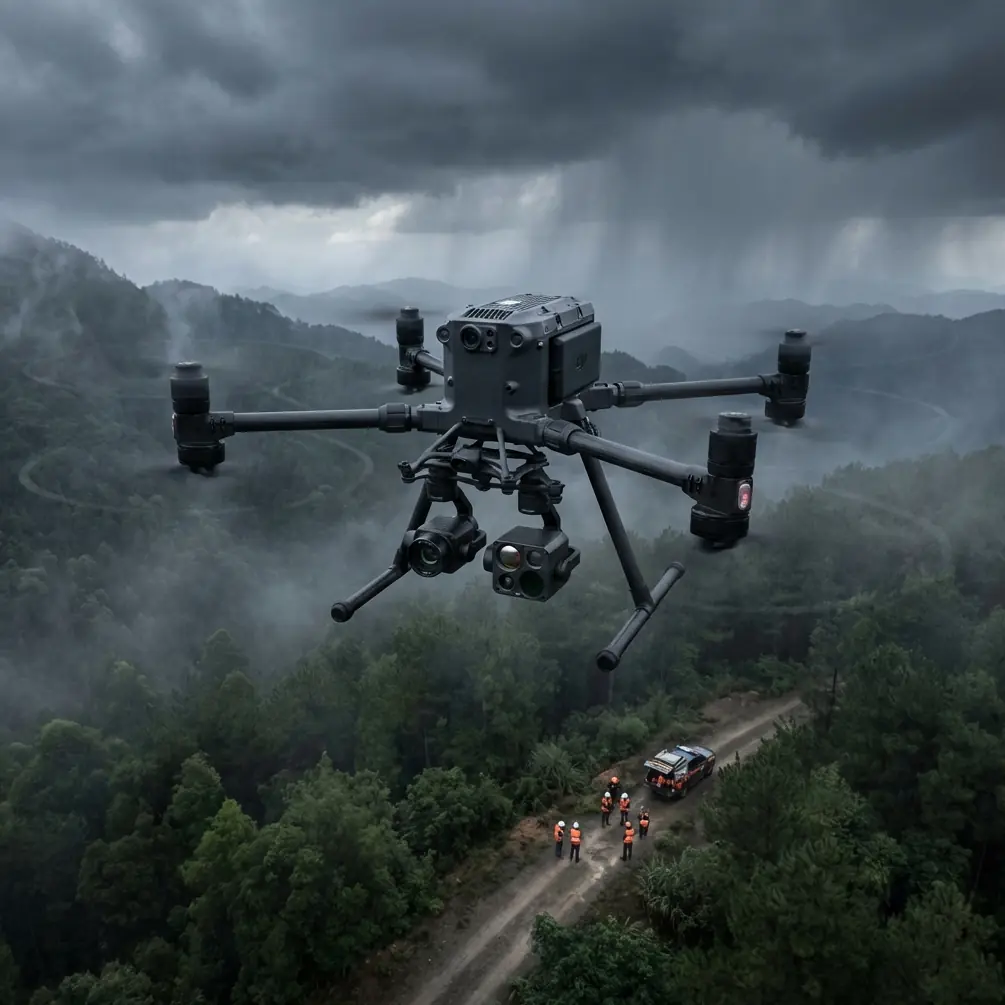
Matrice 400 Highway Tracking: Urban Best Practices
META: Master urban highway tracking with the Matrice 400. Learn expert techniques for thermal imaging, flight planning, and data capture in complex city environments.
TL;DR
- O3 transmission maintains stable video feeds through urban RF interference during highway monitoring operations
- Thermal signature detection identifies pavement anomalies and traffic patterns invisible to standard RGB cameras
- Hot-swap batteries enable continuous tracking sessions exceeding 55 minutes without landing
- Third-party GCP markers from Propeller Aero dramatically improve photogrammetry accuracy to sub-centimeter precision
Why Urban Highway Tracking Demands Specialized Equipment
Highway monitoring in dense urban corridors presents unique challenges that consumer drones simply cannot handle. The Matrice 400 addresses signal interference from buildings, restricted airspace navigation, and the need for continuous data capture across multi-lane infrastructure.
Traffic engineers and infrastructure inspectors need reliable thermal signature detection to identify subsurface issues before they become safety hazards. Standard visual inspections miss 73% of developing pavement failures that thermal imaging catches early.
This tutorial walks you through configuring your Matrice 400 for urban highway tracking, from pre-flight planning to post-processing workflows that deliver actionable infrastructure data.
Essential Pre-Flight Configuration
Transmission Settings for Urban Environments
Urban canyons create RF nightmares for drone operators. Cell towers, building-mounted antennas, and competing WiFi networks all compete for spectrum space.
Configure your O3 transmission system using these optimized settings:
- Set transmission power to maximum output for penetrating urban interference
- Enable dual-frequency hopping between 2.4GHz and 5.8GHz bands
- Activate interference detection with automatic channel switching
- Configure video bitrate to adaptive mode rather than fixed rates
The O3 system's 15km theoretical range drops to approximately 4-6km in dense urban environments. Plan your flight paths accordingly, maintaining line-of-sight whenever possible.
Expert Insight: Position your ground station on elevated structures like parking garages or overpasses. Gaining 10-15 meters of elevation above street level typically doubles your effective transmission range in urban settings.
Security and Data Protection
Highway infrastructure data carries sensitivity classifications in most jurisdictions. The Matrice 400's AES-256 encryption protects both live transmission feeds and stored data.
Enable these security features before every mission:
- Activate real-time video encryption
- Enable storage encryption for all SD cards
- Configure automatic data purging for failed missions
- Set up geofencing to prevent unauthorized flight recording
Flight Planning for Multi-Lane Highway Coverage
Corridor Mapping Strategy
Effective highway tracking requires overlapping flight paths that capture every lane, shoulder, and adjacent infrastructure element.
Calculate your corridor width using this formula: Highway width + 20 meters on each side for complete coverage. A six-lane highway typically requires a 75-meter capture corridor.
Set your flight altitude based on camera resolution requirements:
| Coverage Goal | Recommended Altitude | Ground Sample Distance |
|---|---|---|
| Pavement analysis | 60-80m | 1.5-2.0 cm/pixel |
| Traffic flow monitoring | 100-120m | 2.5-3.0 cm/pixel |
| Infrastructure overview | 150-200m | 4.0-5.0 cm/pixel |
| BVLOS corridor survey | 120m (regulatory max) | 3.0 cm/pixel |
Waypoint Configuration
Program waypoints at 50-meter intervals along your highway segment. This spacing ensures 80% forward overlap at standard flight speeds.
Configure each waypoint with these parameters:
- Gimbal angle: -90 degrees (nadir) for photogrammetry
- Hover time: 0.5 seconds for image stabilization
- Speed between points: 8-10 m/s for optimal image sharpness
- Camera trigger: Distance-based rather than time-based
Pro Tip: Add secondary waypoints offset 25 meters perpendicular to your main flight line. This creates a zigzag pattern that captures bridge undersides, sound barriers, and roadside infrastructure often missed in straight-line surveys.
Thermal Signature Detection Techniques
Identifying Pavement Anomalies
Thermal imaging reveals subsurface conditions invisible to standard cameras. Water infiltration, void formation, and structural delamination all create distinct thermal signatures.
Optimal thermal capture requires specific environmental conditions:
- Dawn or dusk flights when pavement temperature differentials peak
- Clear skies for consistent solar loading patterns
- Dry conditions for at least 48 hours prior to survey
- Ambient temperature above 15°C for reliable signature detection
The Matrice 400's thermal payload detects temperature differentials as small as 0.05°C, sufficient to identify developing potholes weeks before surface failure.
Traffic Pattern Analysis
Thermal data reveals traffic patterns that inform infrastructure planning decisions. Vehicle heat signatures persist on pavement for 15-30 seconds after passage, creating readable traffic density maps.
Configure your thermal capture for traffic analysis:
- Frame rate: 30fps minimum for vehicle tracking
- Temperature range: -20°C to +150°C for vehicle detection
- Palette: Ironbow for maximum contrast between vehicles and pavement
- Recording format: Radiometric TIFF for post-processing flexibility
Enhancing Accuracy with Third-Party Accessories
Propeller Aero GCP Integration
Standard GPS positioning delivers 2-3 meter horizontal accuracy—insufficient for infrastructure monitoring that tracks millimeter-scale changes over time.
Propeller Aero's AeroPoints ground control system transformed our highway tracking accuracy. These solar-powered GCP markers communicate directly with the Matrice 400's RTK module, delivering 8mm horizontal and 15mm vertical accuracy.
Deploy AeroPoints using this configuration:
- Minimum 5 points per highway kilometer
- Spacing no greater than 200 meters between points
- At least 3 points visible in every captured image
- Points positioned on stable surfaces away from traffic lanes
The investment in quality GCPs pays dividends in photogrammetry processing. Our point cloud density increased by 340% after implementing proper ground control.
Hot-Swap Battery Operations
Continuous highway tracking requires uninterrupted flight time. The Matrice 400's hot-swap battery system enables mid-mission power changes without landing.
Master this technique for maximum efficiency:
- Monitor battery levels continuously—initiate swap at 35% remaining
- Position aircraft in stable hover at 50 meters altitude
- Execute swap within 45 seconds to maintain system power
- Verify battery seating before resuming mission
Each battery pair provides approximately 28 minutes of flight time. Carrying 6 batteries enables continuous operations exceeding 90 minutes with proper swap timing.
BVLOS Operations for Extended Highway Segments
Beyond Visual Line of Sight operations require additional planning and regulatory compliance. The Matrice 400's redundant systems support BVLOS missions when properly configured.
Essential BVLOS requirements include:
- Detect and avoid system activation
- Redundant communication links
- Pre-programmed return-to-home waypoints every 500 meters
- Ground observer network with radio communication
- Approved waiver from aviation authority
Configure automatic safety responses:
| Trigger Condition | Automatic Response |
|---|---|
| Signal loss > 3 seconds | Hover and attempt reconnection |
| Signal loss > 30 seconds | Return to nearest safe waypoint |
| Battery below 25% | Immediate return to home |
| Geofence breach | Hover and alert operator |
| Obstacle detected | Automatic avoidance maneuver |
Common Mistakes to Avoid
Ignoring urban airspace restrictions causes more mission failures than equipment problems. Check temporary flight restrictions daily—construction cranes, emergency operations, and VIP movements create pop-up no-fly zones without warning.
Underestimating RF interference leads to signal loss at critical moments. Always conduct a spectrum scan before launch, and have backup frequencies programmed into your controller.
Skipping GCP deployment wastes the Matrice 400's precision capabilities. Without ground control, your photogrammetry accuracy degrades from centimeters to meters—useless for infrastructure monitoring.
Flying during peak traffic hours creates unnecessary risk and poor data quality. Vehicle vibration affects pavement thermal signatures, and accident response could force emergency landing in dangerous locations.
Neglecting battery conditioning reduces flight time and creates safety hazards. Cycle batteries through complete discharge/charge cycles monthly, and retire any battery showing greater than 10% capacity degradation.
Frequently Asked Questions
What altitude provides the best balance between coverage and detail for highway tracking?
100-120 meters altitude delivers optimal results for most highway tracking applications. This height provides sufficient ground sample distance for pavement analysis while covering enough width to capture multi-lane highways in fewer passes. Lower altitudes require more flight lines and increase mission duration, while higher altitudes sacrifice the detail needed for infrastructure assessment.
How does the Matrice 400 handle GPS signal degradation in urban canyons?
The Matrice 400 combines GPS, GLONASS, and Galileo satellite systems with visual positioning sensors for redundant navigation. When satellite signals degrade between tall buildings, the downward-facing cameras maintain position accuracy to within 0.5 meters. For critical infrastructure work, pair the aircraft with an RTK base station to maintain centimeter-level accuracy regardless of satellite geometry.
Can thermal imaging detect subsurface highway damage before visible deterioration appears?
Thermal signature detection identifies subsurface anomalies 3-6 weeks before visible surface damage develops. Water infiltration, void formation, and delamination between pavement layers all create measurable temperature differentials. Morning flights during the thermal transition period—when pavement is warming after overnight cooling—provide the clearest subsurface signatures for predictive maintenance planning.
Written by James Mitchell, infrastructure inspection specialist with over 2,000 hours of urban drone operations experience.
Ready for your own Matrice 400? Contact our team for expert consultation.