
Matrice 400 Highway Tracking Tips for Extreme Temperatures
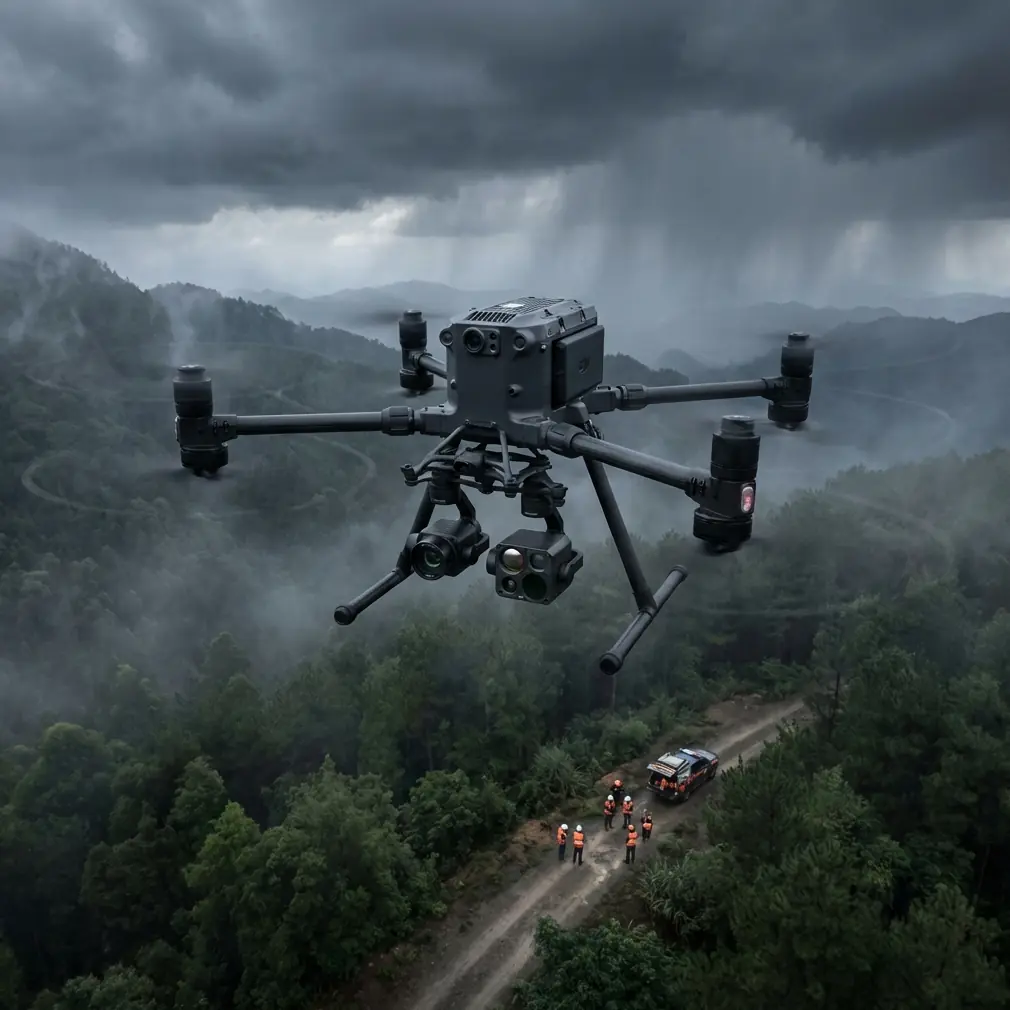
Matrice 400 Highway Tracking Tips for Extreme Temperatures
META: Expert guidance on using the Matrice 400 for highway tracking in extreme heat and cold, with practical advice on thermal payloads, hot-swap batteries, O3 transmission, AES-256 security, and BVLOS-ready workflow planning.
Highway monitoring looks simple from a distance. A long corridor, repetitive assets, predictable traffic flow. In practice, it is one of the harder drone jobs to execute well, especially when temperatures swing to the edge of what crews and batteries can tolerate.
The challenge is not just getting a drone airborne. The challenge is sustaining reliable situational awareness over miles of pavement while heat shimmer, winter air density, crosswinds, signal obstructions, and operational fatigue all start working against the mission. That is where the Matrice 400 enters the conversation.
For teams tracking highways in extreme temperatures, the Matrice 400 stands out because it addresses the mission as a systems problem rather than a simple flight-time contest. Endurance matters, yes. But in roadside operations, endurance only pays off if the aircraft can hold a stable link, protect sensitive infrastructure data, keep payload options open, and stay productive when a battery change would otherwise slow the whole operation.
The real problem with highway tracking in heat and cold
A highway is a harsh operating environment for unmanned aircraft. In peak summer, asphalt radiates heat upward, creating visual distortion and reducing contrast for standard optical inspections. In severe cold, battery efficiency drops, launch procedures slow down, and every minute spent exposing cells to ambient air can eat into useful mission time. Add the operational reality of bridge spans, embankments, overpasses, signs, utility crossings, and vehicle traffic, and it becomes clear why many platforms struggle outside controlled demo conditions.
This is also a corridor mission. That matters. Unlike a compact site inspection, highway tracking often pushes crews to operate farther from takeoff, manage changing line-of-sight conditions, and maintain chain-of-custody for imagery that may support safety documentation or incident review. A drone used here cannot be judged by top speed alone. It has to behave like a field asset that remains dependable for an entire shift.
The Matrice 400 is well-positioned for that kind of work because several of its operational features match the weak points of highway missions. The most practical examples are hot-swap batteries, O3 transmission, and AES-256 data security. Those are not marketing extras in this use case. They solve real bottlenecks.
Why hot-swap batteries matter more on highways than on closed sites
On a highway corridor, battery replacement is not a minor interruption. It breaks mission rhythm. The crew has to pause coverage, reassess traffic conditions, confirm airspace status, and rebuild the operator’s mental map of what has already been checked. In extreme cold, long battery-change intervals also expose personnel and equipment to unnecessary handling time outdoors. In extreme heat, every additional minute on the shoulder or in a staging zone adds stress and risk.
That is why hot-swap batteries are operationally significant. When a platform supports battery replacement without fully shutting down the aircraft workflow, crews reduce dead time between sorties and preserve continuity across long inspection legs. The gain is not merely convenience. It improves corridor coverage consistency.
Compared with lighter competitor platforms that may force a full reset between flights, the Matrice 400 approach better suits highway patrol and infrastructure verification. That difference becomes obvious during multi-segment missions where the same team must document guardrails, thermal anomalies, shoulder erosion, traffic bottlenecks, drainage issues, or accident-related changes over an extended stretch. Less downtime means fewer missed details and less pressure to rush the relaunch.
For cold-weather work, this also helps battery stewardship. Teams can cycle preconditioned packs more efficiently instead of letting the aircraft sit idle while the system restarts and payload checks begin from scratch.
Thermal signature tracking is where extreme-weather highway work gets interesting
Standard RGB imagery can be enough for visible defects, but extreme temperatures change what “visible” means. Heat shimmer can blur fine detail over sun-baked pavement, while snow cover or low-angle winter light can flatten surface definition. This is where thermal signature analysis becomes genuinely useful.
A thermal payload on the Matrice 400 can help crews detect patterns that would otherwise blend into the background. On highways, that can include overheated vehicles stopped on the shoulder, unusual temperature contrast near mechanical assets, water intrusion patterns under changing surface conditions, or post-incident scanning where a scene must be understood quickly and from a safer offset.
Operationally, thermal is not just a second camera. It is a second way of reading the corridor. In summer, thermal can reveal hotspots against cooler surroundings or isolate active objects when visible contrast is poor. In winter, it can help crews spot heat leaks, identify recently active vehicles, or differentiate surfaces that look visually similar but behave differently in temperature maps.
This matters because extreme-temperature missions are often time-sensitive. A thermal-enabled Matrice 400 setup can shorten the interval between detection and response, particularly when a team must determine whether a roadside condition is superficial or operationally urgent.
O3 transmission is not a luxury when the route keeps changing
Highway work rarely gives the pilot a clean, uninterrupted signal environment. Overpasses, elevation changes, roadside structures, and the geometry of the corridor can all affect how a link behaves in the field. A platform built for broad, reliable O3 transmission has a practical advantage here.
The significance is straightforward: if your video and telemetry link remains stable as the aircraft tracks farther along the route, you can make better decisions with less hesitation. Stable transmission improves confidence during inspections of traffic incidents, lane closures, bridge approaches, and remote segments where repositioning the ground team is slow or unsafe.
This is also one of the clearest areas where the Matrice 400 can outclass smaller aircraft marketed for general enterprise work. Some competitors perform adequately on short visual hops near the pilot, then become less comfortable once the mission stretches into a true corridor operation. The Matrice 400’s stronger transmission architecture is more relevant in that moment than small differences on a spec sheet.
For teams considering BVLOS operations where regulations and approvals allow, transmission reliability becomes even more consequential. No aircraft alone makes a mission BVLOS-ready, but a platform with robust link performance provides a more credible foundation for the procedures, observers, communications planning, and risk controls that highway authorities increasingly evaluate.
AES-256 security matters when road data is sensitive
Not every highway mission is routine pavement monitoring. Some flights involve critical infrastructure, incident documentation, construction sequencing, bridge support analysis, or government-operated transportation assets. In those environments, the way data is protected matters almost as much as the imagery itself.
That is where AES-256 enters the picture. On paper, encryption can seem abstract. In real operations, it affects whether stakeholders are comfortable moving aerial data across teams and using the platform for sensitive work. Secure handling of live feeds and stored mission data reduces exposure when the material could reveal traffic patterns, infrastructure conditions, or restricted-site details.
The Matrice 400 earns attention here because it is not only a flight platform. It is part of a secure operational workflow. For public-sector transportation teams, engineering firms, and contractors supporting road authorities, that distinction can influence procurement as much as payload performance.
A drone that captures excellent data but complicates data governance creates friction. A drone that supports stronger security standards helps the mission survive legal, procedural, and stakeholder scrutiny after the flight ends.
Photogrammetry on highways demands discipline, not just overlap
Highway tracking often shifts from live observation to mapping. That is where photogrammetry becomes central. But corridor mapping in extreme temperatures is harder than many crews expect. Heat shimmer distorts surface detail. Wind affects image consistency across long linear runs. Lighting changes rapidly along a route. If the mission needs survey-grade confidence, weak field habits will show up later as alignment errors and soft models.
The Matrice 400 gives crews a better platform for these larger mapping blocks, but results still depend on method. If your deliverable includes measurements, drainage analysis, shoulder deformation, or lane-edge change detection, you need disciplined GCP placement and a realistic understanding of where thermal conditions can degrade image quality.
Ground control points matter because highways are linear, repetitive environments. Without solid reference, reconstruction software can struggle with long, uniform surfaces. Properly distributed GCPs help lock the model to real-world coordinates and reduce drift across extended segments. In practical terms, that means better consistency when comparing one survey period to another.
A useful field approach in extreme heat is to schedule photogrammetry runs when pavement temperatures are less punishing and atmospheric shimmer is reduced. In extreme cold, crews should protect battery temperature, keep launch procedures tight, and verify that image capture timing remains consistent throughout the route. The aircraft can support the mission, but the mission still has to be designed intelligently.
A problem-solution workflow for Matrice 400 highway teams
If your problem is fragmented coverage during extreme-weather patrols, the first solution is continuity. Build your operation around hot-swap battery cycles, pre-staged packs, and segmented route planning so that the aircraft stays productive while the crew stays organized.
If your problem is poor visibility, the solution is payload strategy. Use thermal to identify what standard optical sensors miss, especially when road temperature, glare, snow, or low-angle light starts hiding operationally important detail.
If your problem is signal uncertainty along a long corridor, the solution is not to fly timidly and hope for the best. It is to use a platform with proven transmission strength, then support it with a route design that respects terrain, structures, and observer placement. This is where O3 transmission becomes an enabler rather than a checkbox.
If your problem is whether the imagery will stand up in engineering or public-sector review, the solution is to treat mapping and security as part of one workflow. Use GCP-backed photogrammetry when accuracy matters. Maintain secure data handling with AES-256-capable systems when the mission touches critical infrastructure or sensitive transport operations.
And if your problem is deciding whether the Matrice 400 is worth choosing over a smaller enterprise competitor, the answer comes down to mission stress. On short, fair-weather flights, many drones look similar. On highways in severe heat or cold, differences in battery workflow, transmission resilience, payload flexibility, and security architecture become visible very quickly.
Where the Matrice 400 makes the strongest case
The Matrice 400 is not compelling because it can do a little of everything. It is compelling because highway tracking in extreme temperatures is unforgiving, and this aircraft is built for unforgiving work.
That shows up when crews need to maintain corridor awareness over long distances. It shows up when thermal signatures tell a more useful story than visible imagery. It shows up when an encrypted workflow matters to the client. It shows up when the mission cannot afford a clumsy battery turnaround. And it shows up when teams are building toward more advanced operational models, including structured BVLOS programs where permitted.
For organizations trying to standardize highway inspection and tracking, the smarter question is not “Can the drone fly the route?” Most serious enterprise platforms can fly. The better question is “What happens when the route gets long, the weather gets ugly, the data gets sensitive, and the crew still needs to deliver?” That is the moment where the Matrice 400 starts separating itself.
If your team is evaluating a deployment plan, payload stack, or corridor workflow, you can message a UAV specialist here to discuss how to configure the aircraft around heat, cold, thermal use, and mapping accuracy rather than relying on a generic template.
Highway tracking is a discipline of small margins. A slightly weaker link, a slower battery cycle, a less secure data path, a softer thermal readout, a poorly controlled photogrammetry block—each one is manageable on its own. Together, they can unravel a mission. The Matrice 400 earns its place by reducing those weak points in the exact environments where they hurt most.
Ready for your own Matrice 400? Contact our team for expert consultation.