
Tracking Highways in Windy Conditions With the Matrice 400
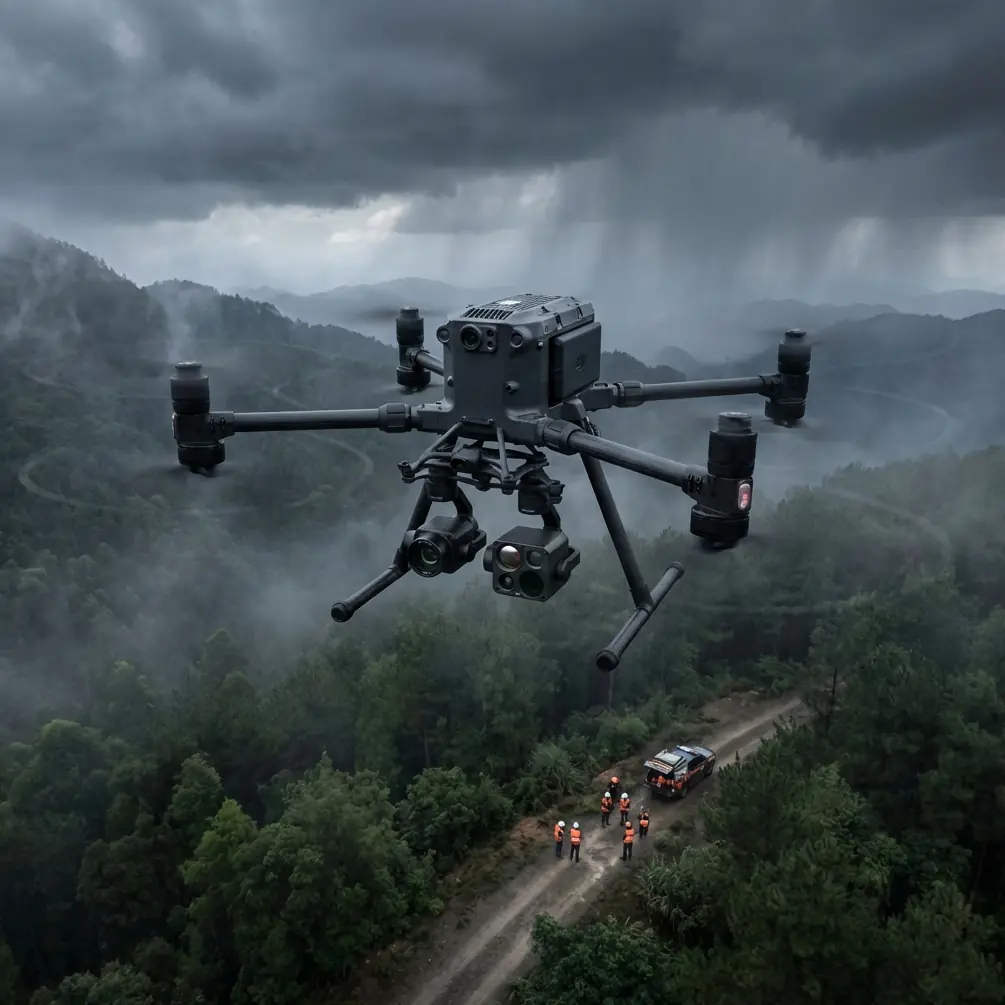
Tracking Highways in Windy Conditions With the Matrice 400: A Field Report From the Edge of the Corridor
META: Expert field report on using the Matrice 400 for highway inspection in windy conditions, with practical advice on antenna positioning, thermal workflows, BVLOS planning, and data capture discipline.
Highway work exposes every weakness in a drone program. Wind rolls off embankments, traffic creates visual clutter, and long linear corridors punish weak link discipline faster than almost any other mission type. If you are flying the Matrice 400 to track highways in gusty conditions, the airframe is only part of the story. The real difference between a clean mission and a frustrating one usually comes down to how well the operator manages transmission geometry, sensor priorities, and battery transitions while the aircraft is moving down a narrow, signal-hostile path.
I have spent enough time around road surveys and infrastructure patrols to say this plainly: corridor missions are never just about keeping the drone in the air. They are about maintaining a stable stream of usable information while the aircraft is constantly changing angle, distance, and relationship to the controller. That is why the Matrice 400 deserves attention here. It is not simply a large enterprise platform suited to inspection. In highway tracking, especially when crosswinds are active, it becomes a systems tool. The platform, the payload logic, the transmission behavior, and the operator’s body position all matter.
This field report focuses on that operational reality rather than brochure claims. The scenario is straightforward: tracking highways in windy weather, often along long stretches where visibility and link reliability fluctuate. The goal is not cinematic footage. The goal is repeatable intelligence.
The first thing I tell crews is to stop thinking about wind as a single number. A forecast might look manageable, but highways create local turbulence that is harder on tracking missions than on static structure work. Overpasses, sound barriers, tree lines, cut slopes, and moving truck wakes all disturb the air differently. The Matrice 400 is built for demanding professional use, but windy corridor work still amplifies pilot error. If your aircraft needs repeated yaw corrections because the nose is hunting in gusts, your imagery quality drops, your thermal alignment can become less useful, and your pilot attention shifts away from the route itself.
That matters because highway operations often require multiple data layers in one sortie. A visible feed may be tracking pavement condition, lane edge degradation, or roadside encroachment. At the same time, a thermal signature can reveal overheating equipment, drainage anomalies after temperature shifts, or vehicle incidents obscured by lighting conditions. Thermal is especially useful when the mission objective includes spotting abnormal heat patterns near roadside electrical assets, tunnel approaches, bridge joints, or maintenance equipment staging areas. In windy conditions, however, thermal interpretation gets sloppy if the aircraft is not holding a stable line and speed. You are not just fighting air. You are protecting the integrity of the dataset.
The Matrice 400 is particularly strong when you build the mission around transmission confidence. In long highway corridors, O3 transmission is not a line item on a specification sheet. It is the operational backbone. On paper, operators tend to focus on range. In the field, the more practical question is whether the feed remains reliable enough to support confident route decisions as the aircraft moves past changing terrain and roadside interference sources. Highway environments are notorious for mixed signal conditions: steel structures, passing vehicles, utility infrastructure, reflective surfaces, and elevation changes all work against you.
That brings me to antenna positioning, which is still one of the most neglected skills in enterprise UAV teams. Most pilots know to “point the antennas correctly,” but few do it with discipline once the aircraft is moving several hundred meters down a corridor. For maximum range and stability, do not aim the tips of the antennas at the aircraft. The strongest radiation pattern usually projects broadside from the antenna faces, so your job is to keep those faces oriented toward the drone’s flight path. On a highway mission, that often means rotating your body gradually as the Matrice 400 advances, rather than standing rigidly in one direction while the aircraft drifts into a weaker part of the pattern.
In practice, I advise crews to imagine a flat panel of energy extending from each antenna side rather than a laser beam from the end. If the drone is running parallel to a highway and you are positioned at the shoulder or a service area, keep the controller centered at chest height, avoid shielding it with your torso, and pivot with the aircraft. Do not let a vehicle roof, guardrail geometry, or even your own body block the cleanest path. I have seen operators lose link quality not because the corridor was too long, but because they crouched near a truck, turned sideways into the wind, and unknowingly put metal and muscle between the controller and the aircraft.
There is also a corridor-specific reason to think carefully about where you stand. Highways tempt teams to set up wherever parking is easiest. That is often the wrong choice. If you launch from the low side of a cut section or next to large roadside signage, your O3 transmission performance can degrade earlier than expected. A modest rise in elevation and a clear lateral view of the flight path usually do more for effective range than obsessing over minor controller settings. Good antenna technique starts before takeoff with ground selection.
Security and data governance deserve equal attention. Roadway inspections often touch sensitive infrastructure, accident scenes, or government-managed corridors. That is where AES-256 matters operationally, not academically. Encrypted transmission reduces the risk associated with capturing and relaying mission data across long routes where information sensitivity may be high. If your team is documenting thermal anomalies near utilities, traffic-control systems, or restricted maintenance zones, link security is part of mission design. For enterprise highway work, encryption is not a “nice to have.” It is basic professional hygiene.
Another strength in this kind of operation is the role of hot-swap batteries. Corridor missions lose efficiency fast when every battery event forces a full shutdown, reboot, and mission reconfiguration cycle. With the Matrice 400, hot-swap workflow can preserve tempo during extended field days. That does not mean crews should treat battery changes casually. In windy environments, you want a disciplined replacement sequence, a sheltered staging point, and a clear callout protocol between pilot and visual observer. But the operational advantage is real: less downtime, cleaner continuity, and fewer rushed restarts when weather windows are tight.
For highway tracking, that continuity affects more than convenience. If you are building a photogrammetry deliverable across a linear route, consistency is everything. A corridor map stitched from multiple interrupted flights can still be excellent, but only if capture discipline stays intact. That is where GCP planning enters the picture. Even with a capable enterprise platform, ground control points remain the difference between a visually plausible map and a survey-grade result. On windy days, crews sometimes rush the air segment and assume the software will absorb inconsistencies later. It rarely does. Stable overlap, repeatable altitude, and well-distributed GCPs are what make long-road datasets trustworthy.
Photogrammetry over highways also creates a tension between speed and detail. Fly too fast in gusty conditions and you increase blur risk, especially when the aircraft is making constant micro-corrections. Fly too slowly and you expose the mission to more battery cycles and changing light conditions. The Matrice 400 gives operators room to manage that tradeoff, but it does not eliminate the need for judgment. I usually recommend designing the mission around the most valuable decision output. If the end user needs crack progression context or shoulder deformation cues, prioritize image stability and overlap. If the goal is broader situational awareness over a long segment, you can bias toward coverage efficiency while still protecting core data quality.
BVLOS discussions often come up in these corridor environments, and for good reason. Highway monitoring is one of the clearest use cases for beyond visual line of sight operations because the asset itself extends far beyond practical VLOS coverage. But windy corridor BVLOS should never be treated as merely a legal threshold to clear. It is an operational discipline. You need a route plan that accounts for emergency landing options, vehicle movement below, terrain masking, and communication handoffs within the team. Even with strong transmission performance, BVLOS on a highway is only as safe as the procedures behind it.
One overlooked habit is segmenting the corridor mentally even when the software treats it as one continuous route. I encourage crews to break a highway mission into operational blocks defined by terrain, traffic complexity, and likely wind behavior. For example, an elevated bridge approach behaves differently from a tree-lined median section. A wide open straightaway with crosswind exposure deserves different speed and camera handling than a recessed segment with frequent roadside structures. The Matrice 400 can handle varied mission demands, but the operator should not fly every kilometer as though it presents the same aerodynamic and signal profile.
Thermal work deserves a second mention because it is often misunderstood in road operations. Operators sometimes expect thermal imagery to solve every detection problem at once. It will not. What it does well is isolate anomalies that would be slow or unreliable to identify in standard visible imagery, especially during low-angle light or in cluttered roadside scenes. On a windy highway mission, use thermal strategically. Confirm the purpose before launch. Are you searching for overheated components, assessing drainage behavior through temperature variation, or identifying a vehicle or person against a cooler background? Your flight profile should reflect that answer. Thermal is most valuable when it is tied to a clear operational question, not when it is simply recorded because the payload allows it.
If you are building a highway workflow around the Matrice 400, the best crews are the ones that stay boring in the right ways. They check antenna orientation repeatedly. They do not improvise GCP logic mid-mission. They rehearse battery transitions. They protect line quality instead of assuming the transmission system will save them from poor ground posture. And when conditions deteriorate, they shorten the segment rather than forcing a full route out of a marginal weather window.
That level of discipline sounds unglamorous, but it is exactly what turns a capable aircraft into a dependable highway tool. The Matrice 400 fits this work because it supports layered sensing, secure transmission, long-route thinking, and efficient field rhythm. Yet the platform only reveals its value when the operator respects the corridor. Wind is not just a weather note. It is a mission variable that touches image quality, thermal usability, transmission stability, and battery timing all at once.
If your team is refining a corridor workflow and wants to compare field setups, I am happy to swap notes through this direct ops channel: message me here.
For most highway teams, the biggest gains will not come from flying farther. They will come from flying cleaner. Better antenna geometry. Smarter launch points. Tighter battery choreography. More honest decisions about when BVLOS adds value and when it adds unnecessary complexity. That is where the Matrice 400 becomes more than a platform name on a fleet list. It becomes a reliable instrument for infrastructure intelligence in conditions that expose weak habits very quickly.
Ready for your own Matrice 400? Contact our team for expert consultation.