
Matrice 400 in Windy Highway Corridors: A Practical Setup
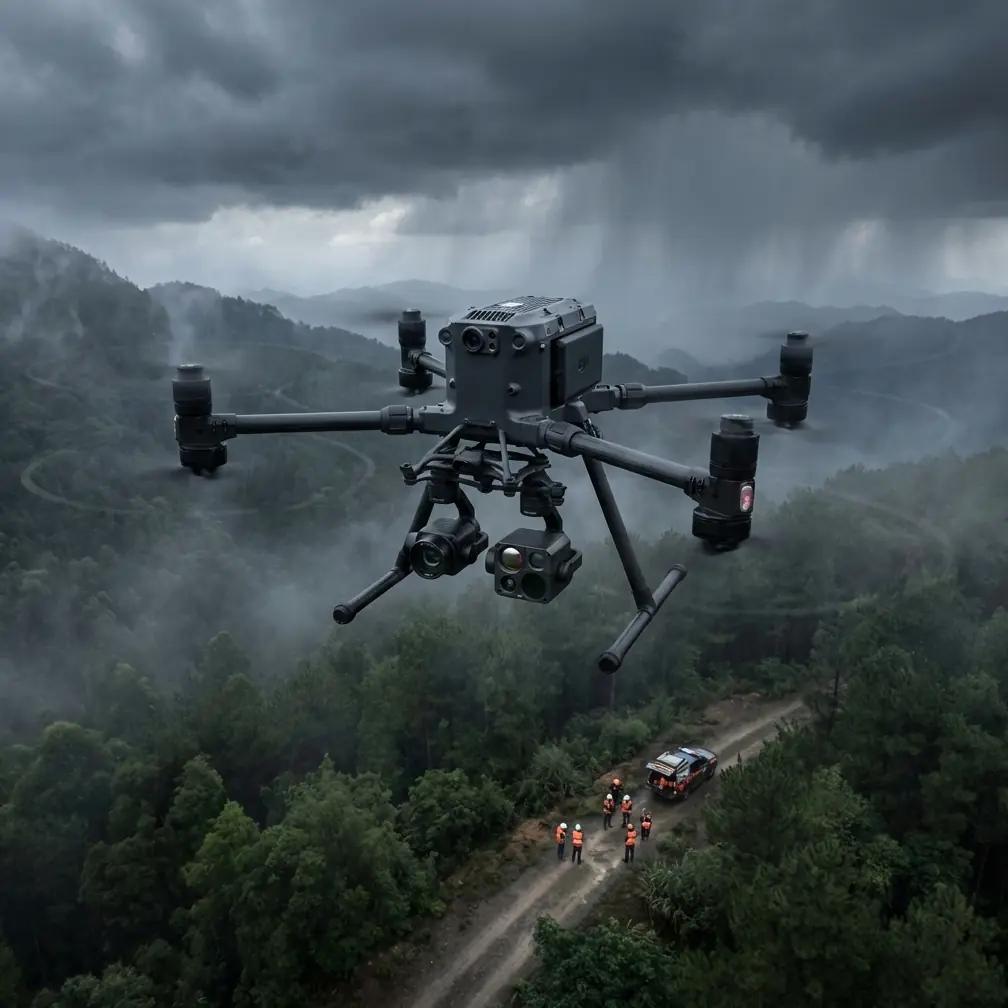
Matrice 400 in Windy Highway Corridors: A Practical Setup Guide for Stable Tracking and Clean Data
META: Learn how to configure a Matrice 400 for windy highway tracking, with expert guidance on EMI-aware antenna positioning, altitude accuracy, throttle response stability, and reliable inspection data capture.
Highway tracking looks straightforward until the wind starts pushing the aircraft sideways, trucks turn the corridor into a moving electromagnetic environment, and your data stack has to stay usable from the first waypoint to the last. That is where the Matrice 400 earns its keep. Not because it can simply stay airborne, but because the platform can be set up to keep image geometry, thermal consistency, and control response stable when conditions are less forgiving.
For teams inspecting road assets, traffic flow, drainage lines, barriers, bridges, or right-of-way encroachment, windy highway work punishes weak setup discipline. A drone drifting a little in open farmland is one thing. A drone drifting beside fast-moving vehicles, metal sign gantries, power infrastructure, and long reflective surfaces is another. The difference between a smooth mission and a frustrating one often comes down to details that operators skip: antenna orientation, throttle behavior, altitude estimation strategy, and how the aircraft’s sensors are interpreted during motion.
This guide focuses on those details for the Matrice 400, especially in the context of tracking highways in windy conditions.
Start with the real constraint: the environment is not neutral
Highways create a layered operating environment. Wind tends to be channeled by embankments, overpasses, and sound barriers. Heat shimmer can interfere with visual interpretation in the afternoon. Large vehicles introduce motion clutter. Metal structures and utility lines increase the chance of local electromagnetic interference. If you are trying to collect thermal signature data, photogrammetry outputs, or repeatable visual inspection imagery, the corridor itself is working against consistency.
The Matrice 400’s value in this setting is not just payload capacity or transmission range. It is the platform’s ability to support disciplined, repeatable operations when the mission needs a mix of situational awareness, stable flight, and trusted data links. Features such as O3 transmission and AES-256 matter here not as brochure items, but because highway tracking often stretches along long, exposed routes where link integrity and data security both become operational issues. For infrastructure contractors, utility survey teams, and transport agencies, that combination matters during extended corridor work and especially during BVLOS programs where every weak link gets amplified.
Still, even a strong platform can be undermined by poor preparation.
Antenna adjustment is not a minor preflight task
When operators talk about electromagnetic interference, they often jump straight to the obvious sources: towers, substations, heavy power lines. On highway work, the interference profile is often more subtle. Overhead sign frames, traffic monitoring equipment, nearby communications hardware, and even the geometry of the road corridor can affect signal behavior. Wind adds another complication because the aircraft may spend more time crabbed into the airflow, changing how its body and antennas present relative to the ground station.
That is why antenna adjustment deserves deliberate attention before takeoff and during route progression. The goal is not simply “point the antennas at the drone.” On a highway mission, especially one with long linear tracking, you want to preserve clean geometry between the controller antennas and the aircraft as the route bends, descends, or passes beneath roadside structures. If you notice intermittent signal quality drops near specific sections, do not assume range is the issue. Often it is angle, obstruction, or reflected interference.
A practical workflow is to pause before the aircraft enters known clutter zones, reassess the line-of-sight path, and fine-tune antenna orientation based on the aircraft’s projected heading rather than its current position alone. This matters even more if you are collecting high-value visual and thermal outputs simultaneously, because transmission instability can slow decision-making at exactly the wrong moment. O3 transmission helps, but it does not remove the need for disciplined antenna management.
If your team is building a standard operating procedure for corridor work, add an antenna check at every major route transition: before overpasses, before bridge structures, near traffic control equipment, and wherever the road alignment changes direction significantly.
Windy tracking demands smooth power delivery, not just power
One of the most overlooked factors in stable highway flight is throttle behavior during quick corrections. In crosswinds, operators and flight controllers constantly make small power adjustments to maintain path fidelity. If the propulsion system responds harshly or inconsistently at lower rpm ranges, the aircraft may not simply feel rough; it can show stutter, temporary instability, or degraded precision just when you need a clean tracking line.
A useful technical reference from ESC behavior explains why. In BLHeli-based control systems, demag compensation exists to reduce the risk of motor stalls caused by long winding demagnetization time after commutation. The classic symptom is very specific: motor stop or stutter during a quick throttle increase, particularly at low rpm. That detail matters operationally, because windy highway tracking often creates exactly that condition. The aircraft is not always climbing aggressively; more often it is making fast, repeated corrections from a relatively modest power state.
Even if the Matrice 400 uses an integrated propulsion architecture beyond hobby-style tuning practices, the underlying lesson still applies: smooth transient response is a flight safety and data quality issue. If your aircraft or payload behavior suggests jerky lateral corrections in gusts, the answer is not always “fly slower.” Sometimes the right response is to review propulsion health, firmware status, motor balance, and controller tuning assumptions rather than pushing the pilot to compensate manually.
The same BLHeli material points out that raising commutation timing can help with demag-related issues, but at the cost of efficiency, while reducing throttle change rate can soften the problem at the cost of slower response. For highway work, that tradeoff is highly relevant. In wind, slower response can degrade corridor tracking. Lower efficiency can shorten productive mission time. The operational takeaway is simple: do not treat propulsion smoothness as a background technical matter. It directly affects track hold, image overlap, and confidence near roadside obstacles.
Altitude discipline is harder than it looks over highways
Many corridor teams focus heavily on horizontal path accuracy and forget that altitude errors quietly ruin deliverables. On a windy highway mission, inconsistent height above ground can distort photogrammetry overlap, alter thermal interpretation, and create uneven perspective on assets like guardrails, pavement edges, lighting poles, and drainage structures.
One especially useful insight from multirotor estimation research is that orientation estimation and height estimation are often treated separately for easier error analysis, but better performance can come from a more tightly coupled approach. That matters because aircraft motion in wind complicates sensor interpretation. If your aircraft is pitching and rolling repeatedly to fight crosswinds, the sensor stack is experiencing movement patterns that can inject error into the estimated state.
The same research highlights two details that deserve direct operational attention:
- Inclination error depends heavily on the type of movement the sensors experience, and under certain motion profiles it can cause significant orientation error.
- MEMS accelerometer bias changes over time due to bias instability, temperature, and related effects, so estimating that bias as part of a Kalman state is highly desirable.
That may sound academic, but for a Matrice 400 crew tracking a windy highway, it is practical. If the aircraft has been operating in the sun, then transitions into cooler airflow over an elevated roadway or water crossing, sensor behavior can drift. If the aircraft spends long segments leaning into a crosswind, small orientation and accelerometer bias errors can feed into height estimation quality and, by extension, the consistency of your data products.
The reference also notes that an altimeter can help eliminate height drift caused by changing atmospheric pressure. This is especially valuable in long linear missions where barometric drift can accumulate gradually enough that crews do not notice it until the dataset is already compromised. In road inspection, that drift may show up as inconsistent scale in imagery or variable apparent thermal behavior because the standoff distance keeps changing.
For Matrice 400 operations, the takeaway is to build your flight plan and QA process around altitude validation, not just route completion. If your workflow supports terrain awareness, onboard ranging, or externally validated checkpoints, use them. If you are producing photogrammetry, do not rely on a single altitude assumption for the full corridor.
Use GCPs selectively, not ritualistically
Ground control points still matter, but highway environments are rarely ideal for dense GCP deployment. Traffic exposure, access limitations, and long route lengths make full-coverage placement unrealistic. The better approach is selective validation. Use GCPs at transition areas, elevation changes, bridge approaches, and representative sections where your final output is most sensitive to vertical and horizontal consistency.
In a windy mission, this helps separate true aircraft performance issues from downstream processing artifacts. If the Matrice 400 has held a clean path but your model bends or scales poorly in one segment, targeted GCPs can reveal whether the problem came from altitude drift, orientation error, or insufficient image geometry.
For thermal signature work, the same logic applies. You may not need a dense control network, but you do need reference discipline. Highways present many repeating surfaces. Without validation, thermal anomalies can be misread when the actual problem is changing altitude, changing angle, or inconsistent pass timing.
Payload strategy should match the wind, not just the task list
A common mistake in corridor operations is overloading the mission objective. Teams try to collect visual inspection, thermal, and mapping-grade imagery in one pass without considering how wind degrades each dataset differently. The Matrice 400 can support sophisticated payload workflows, but the operator still has to decide what quality standard matters most on that flight.
If crosswinds are strong and gusty, prioritize the dataset that is least tolerant of geometric inconsistency. For some projects, that is photogrammetry. For others, it is thermal inspection at a controlled angle and distance. If you try to satisfy all objectives equally in poor conditions, you often end up with no dataset strong enough to defend.
This is where hot-swap batteries become more than a convenience. They allow the crew to divide the corridor into cleaner mission blocks and preserve aircraft readiness between shorter, better-timed sorties. Instead of forcing one long run through changing wind and thermal conditions, you can pause, reassess, and relaunch with tighter control over the data standard.
Build a corridor-specific preflight, not a generic one
For windy highway tracking with the Matrice 400, your preflight should include items many teams still treat as optional:
- Review wind direction relative to road alignment, not just headline wind speed.
- Identify likely EMI zones, especially bridge steel, overhead gantries, roadside electronics, and utility crossings.
- Confirm antenna orientation strategy for each route segment.
- Validate altitude reference logic for long runs.
- Check expected sensor temperature transitions if the mission spans major environmental changes.
- Confirm payload priority if conditions worsen.
- Assess whether the mission will remain VLOS or transition into approved BVLOS procedures.
- Verify encryption and transmission settings appropriate to client and corridor sensitivity.
The point is not to make the checklist longer. It is to make it relevant.
During flight, watch for subtle clues
A Matrice 400 mission rarely fails all at once. It usually degrades gradually. Watch for these early signs:
- Small but repeated deviations off the road centerline in crosswinds
- Brief transmission quality drops at the same route features
- Inconsistent gimbal behavior during gust response
- Unexpected variation in apparent altitude over similar terrain
- Thermal imagery that looks “different” between adjacent passes without an obvious environmental cause
These are usually not isolated symptoms. They often point back to the same root issues: signal geometry, sensor estimation under motion, or propulsion response during rapid corrections.
If your team needs a second set of eyes on a corridor workflow, antenna setup, or payload planning for a Matrice 400 deployment, you can message a UAV specialist directly.
What separates a clean highway mission from a mediocre one
The best Matrice 400 operators do not win by flying more aggressively. They win by reducing avoidable error. They understand that a motor stutter risk during quick low-rpm throttle changes is not just an engineering footnote. They understand that accelerometer bias drift and movement-dependent inclination error can ripple into altitude inconsistency and weaker deliverables. They understand that antenna adjustment in electromagnetic clutter is a live operational task, not a static preflight gesture.
That is what windy highway tracking really demands: not heroics, but technical discipline.
The Matrice 400 is well suited to this kind of work because it supports serious corridor operations. But the aircraft alone does not guarantee clean results. Reliable inspections come from pairing the platform with thoughtful route design, careful antenna management, stable control response, and altitude awareness that holds up over the full length of the road.
Get those pieces right, and the aircraft becomes more than a camera in the sky. It becomes a dependable survey and inspection tool for one of the most demanding civilian flight environments crews face on a regular basis.
Ready for your own Matrice 400? Contact our team for expert consultation.